Your Guide to the Glorified Extension Lead We Call a Portable EV Car Charger
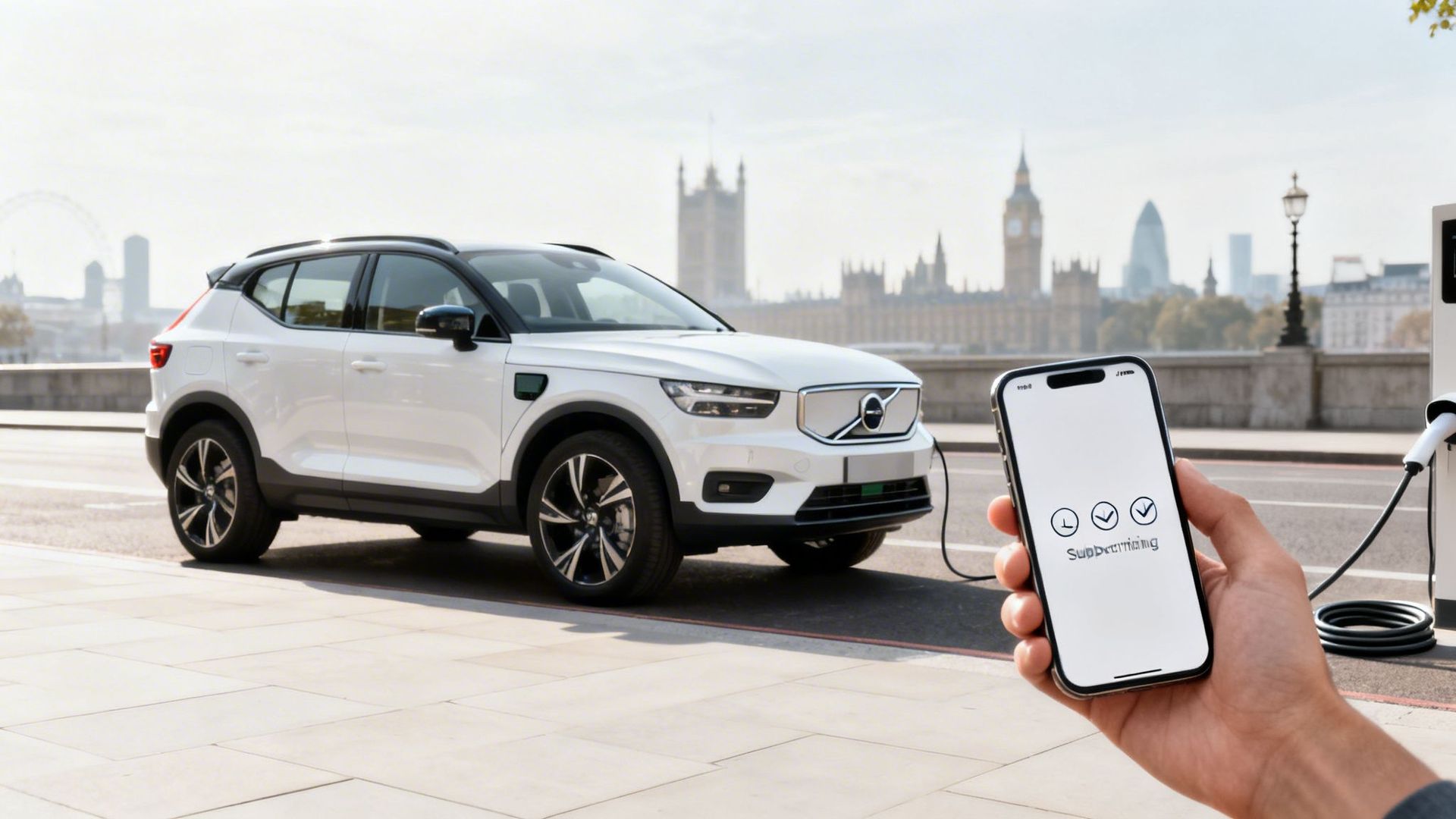
Think of a portable EV car charger as your very own 'get out of jail free' card, but for electricity. It’s a wonderfully flexible way to top up your car's battery from pretty much any standard plug socket, saving you from the indignity of pushing. It's much more than just a cable; it's a clever, compact unit that gives you a smidgen of charging independence, freeing you from the grim hunt for a working public charging point.
Your Cure for Charging Cold Sweats
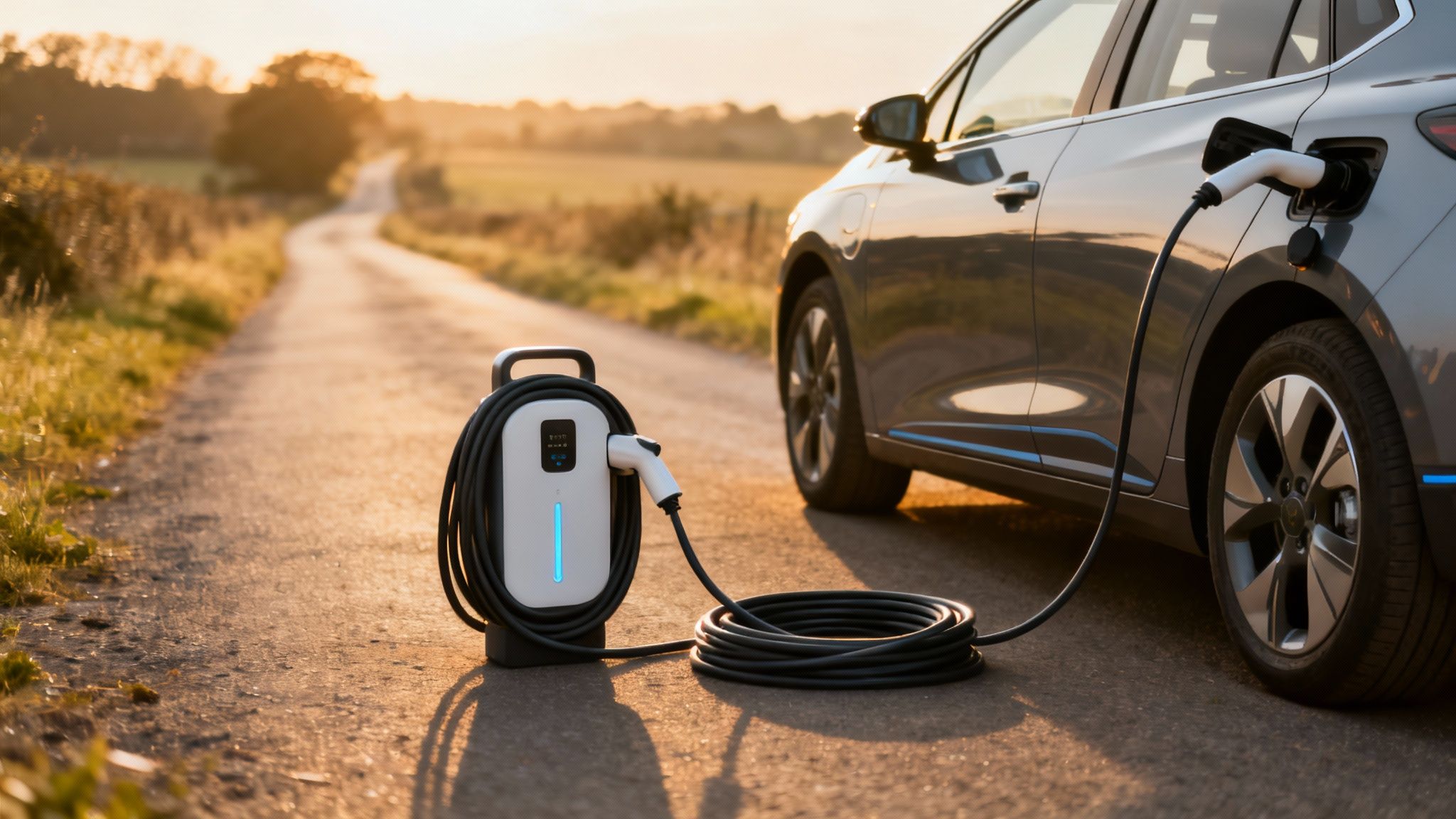
Let's be honest. You've made the leap to an electric car. You love the quiet power and the smug feeling as you glide past petrol stations. But there's a little voice, a nagging worry that pops up whenever the battery level drops below 30% : range anxiety.
It’s that all-too-common fear of being stranded, miles from anywhere, with a battery that’s about as useful as a chocolate teapot. It's the EV driver's nightmare—the silent, powerless drift onto the hard shoulder, followed by that slightly sheepish call to a recovery service. This is exactly where the portable EV car charger swans in, looking terribly pleased with itself.
The Ultimate Backup Plan
It’s tempting to call it a 'jerry can for electricity', but that doesn't do it justice. A portable charger is a sophisticated piece of kit that lets you plug your car into a regular wall socket. Visiting a mate's house? Staying at a remote holiday cottage? Popping in to see your nan? No problem. It turns a potential disaster into a minor, tea-drinking inconvenience.
These chargers are quickly becoming an essential bit of kit for any serious EV driver. They offer:
- Freedom from the network: You're no longer completely at the mercy of finding a public charge point that's both available and working (a rare combination).
- Peace of mind on long trips: It’s a safety net that sits quietly in your boot, just in case.
- Convenient top-ups: Perfect for adding a few extra miles while you're at a friend's house for dinner, pinching their electricity.
The demand for these handy gadgets is through the roof. The UK market for portable EV chargers hit around USD 58.22 million in 2024 and is set to grow at a staggering rate as more drivers see the benefits.
It’s clear that as EV ownership becomes more common, the need for flexible, reliable charging is growing too. For many, choosing between a portable charger and a fixed wallbox is a big decision. Our guide on whether to invest in a home charger or stick with public networks can help you figure out what's best for you.
Decoding Charger Plugs and Power Ratings
Right, let’s get to grips with the alphabet soup of EV charging. If you’re new to this, the world of Type 2, CCS, and kilowatts can feel like a language designed by engineers, for engineers. But understanding the basics is what stands between a seamless top-up and standing in a drizzly car park with a plug that just won't fit.
Think of it like the early days of mobile phone chargers. There were a few different standards floating about, but thankfully, for day-to-day charging here in the UK, one connector has become the undisputed king.
The King of Connectors: Type 2
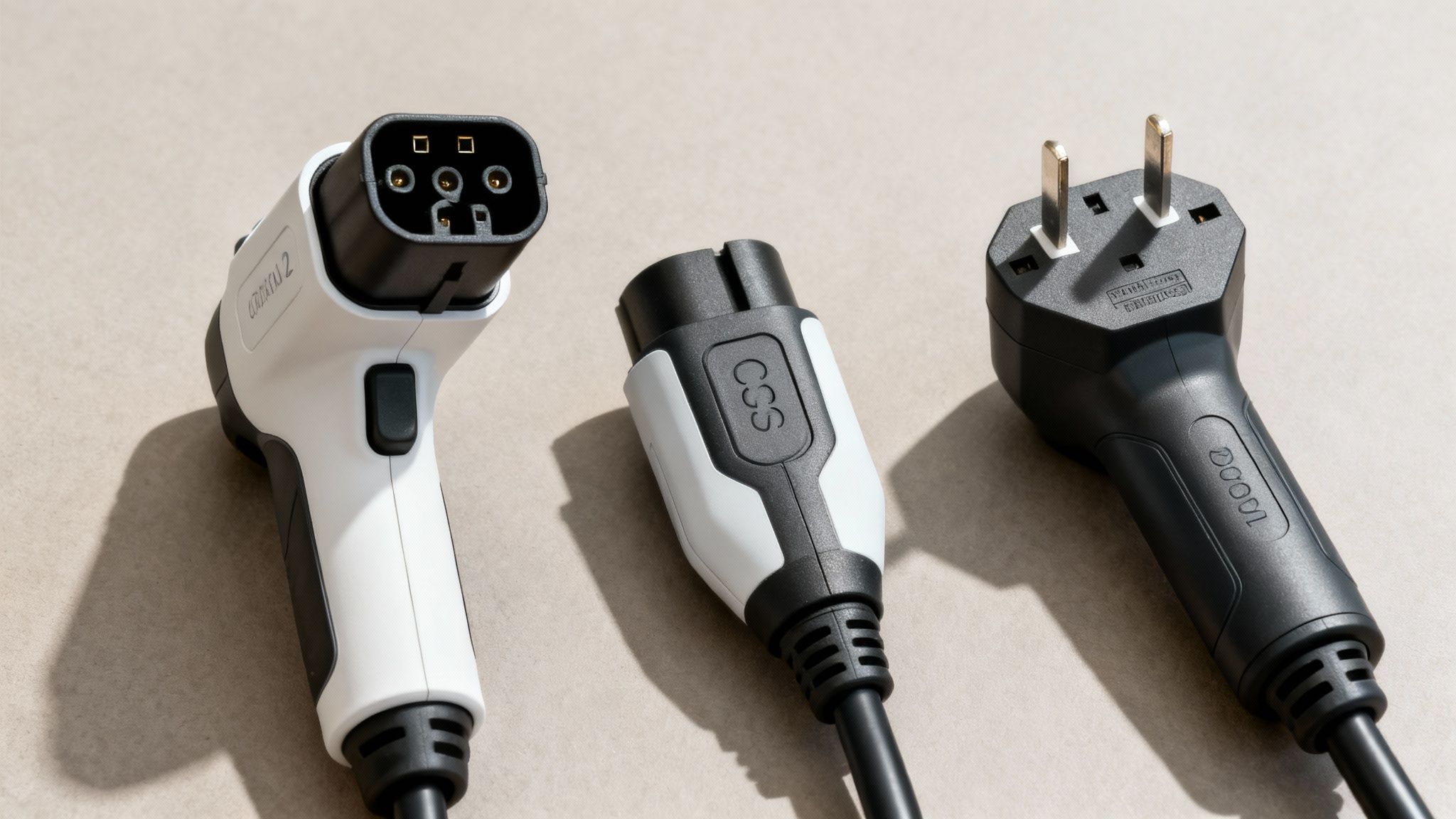
For almost every electric car you’ll find in the UK and Europe, the Type 2 connector is the one you need for AC charging. It’s the standard plug you'll see on portable chargers, home wallboxes, and the public chargers at supermarkets and hotels. It’s a simple, effective seven-pin plug that has brought some much-needed order to the charging world.
The portable charger you buy will have a Type 2 plug on the end that connects to your car. This is non-negotiable. If you're driving a modern EV in the UK, it must be Type 2.
What About the Others?
Of course, it’s not quite that simple. You'll hear other acronyms being thrown around, but these are mostly for the big, powerful rapid chargers you find at motorway service stations.
- CCS (Combined Charging System): This is essentially a Type 2 plug with two large DC pins underneath. Your car’s charging port will have a flap covering these extra holes. When you need a super-fast charge on a long journey, you’ll use a CCS charger, but for a portable charger, these bottom pins aren't used.
- CHAdeMO: This was the go-to rapid-charging standard for early Japanese models, most famously the Nissan Leaf. It’s a much larger, rounder connector that is gradually being phased out in Europe in favour of CCS. While this won't affect your choice of portable AC charger, it's handy to know the difference. For anyone still navigating this older standard, our guide on CCS to CHAdeMO adapters can help bridge the gap.
The key takeaway is this: portable chargers deliver AC power from a domestic socket. That means they will always connect to your car using the standard Type 2 part of the port, not the larger DC pins designed for rapid charging.
The Humble 3-Pin Plug: A Last Resort
And then we have the familiar, trusty 3-pin plug – the same one you use for your toaster. Your portable EV charger will plug into the mains using one of these (or a chunkier Commando socket). Be warned, though: charging your car from a standard 3-pin socket is an exercise in extreme patience. It’s painfully slow, delivering a trickle of power at around 2.3kW .
This is your emergency option. It’s for when you’re visiting family in the middle of nowhere and it’s either this or pushing the car home. It will work, eventually, but you'll be measuring the charge time in days rather than hours.
Power Ratings: What Kilowatts Really Mean
Now for the numbers. Portable chargers are rated in kilowatts (kW), which is simply a measure of how quickly they can feed electricity into your car’s battery. The higher the kW, the faster you’ll charge.
For portable units, the most common ratings are 3.6kW and 7kW . A charger running from a 3-pin plug will always be limited to about 2.3kW for safety. To get speeds up to 7kW , you’ll need to plug into a dedicated, professionally installed Commando socket, like the blue ones you often see at campsites.
Here’s a quick, no-nonsense table to show what that means in the real world.
Charger Power Ratings vs Estimated Charging Times
| Charger Power (kW) | Plug Type | Approx. Time to Add 100 Miles | Best Use Case |
|---|---|---|---|
| 2.3kW | Standard 3-Pin | 11 - 14 hours | Emergency or desperate overnight top-up |
| 3.6kW | 3-Pin or Commando | 7 - 9 hours | A more practical overnight charge |
| 7kW | Blue Commando Socket | 3.5 - 5 hours | A proper home-style charge speed on the go |
As you can see, the difference is stark. A 7kW charger can add a very useful 25-30 miles of range per hour , while a 2.3kW charger plugged into a 3-pin socket will only manage about 8-10 miles per hour . One gets you a decent top-up during a long visit to a friend's house; the other barely covers your trip to the local shops and back.
Smart vs. Dumb Chargers: Which One's for You?
Right then, let's get into one of the biggest debates in the portable EV charging world: smart versus dumb. It's a proper head-to-head, a bit like choosing between a smartphone and an old-school Nokia. One is packed with features and connectivity, while the other just does its one job brilliantly, without any fuss.
Figuring out which camp you're in isn't about chasing the latest gadget. It’s about what you genuinely need from your charger. Do you want a clever bit of kit that helps you save money and track everything, or a straightforward, reliable tool that just gets the power flowing?
The Case for Smart Chargers: The Brainy Option
Think of a smart portable EV charger as a small computer with a charging cable attached. Its defining feature is connectivity – usually Wi-Fi or Bluetooth – which lets it communicate with an app on your phone. This simple connection unlocks a whole host of features that can genuinely save you a decent chunk of change.
The star of the show is scheduled charging . Why does this matter so much? Because electricity prices fluctuate, sometimes dramatically. Many energy suppliers, like Octopus Energy, offer special EV tariffs with incredibly cheap rates overnight. A smart charger lets you plug in your car when you get home from work, but you can set it to only start charging at, say, midnight, when the price plummets.
It's a bit like setting your dishwasher to run overnight. You load it up, tell it when to start, and wake up to a full battery and an energy bill that won't give you a nasty shock.
On top of that, smart chargers typically offer:
- Energy Monitoring: The app gives you a detailed breakdown of exactly how much electricity your car has used, so you can track your spending down to the last penny.
- Remote Control: Need to start or stop a charge while you're still at the pub? There's an app for that. It's a handy feature to have in your back pocket.
- Software Updates: These chargers can get updates over the air, meaning they can gain new features or have bugs fixed long after you've bought them.
In Defence of Dumb Chargers: The Simple Workhorse
Now, let's talk about the other side. A ‘dumb’ charger is refreshingly simple. It has no app, no Wi-Fi password to remember, and it couldn't care less about your electricity tariff. You plug it in, a light turns on, and it gets to work. End of story.
There's a real, honest appeal to that simplicity. There are no apps to crash, no frustrating connectivity dropouts because your car is parked in a Wi-Fi dead spot, and zero complex setup. It’s a pure tool, plain and simple.
This no-frills approach is ideal if you’re looking for a portable charger mainly as an emergency backup or for the odd trip to visit family. If you're not on a special off-peak energy tariff, the main money-saving benefit of a smart charger disappears anyway, so why pay for features you'll never use?
A dumb charger is often more robust, too, simply because there are fewer complex electronics inside to go wrong. It’s a dependable piece of kit built to do one thing: move electricity from a socket to your battery. For a lot of people, that’s exactly what they need. So, what'll it be?
How to Pick the Perfect Portable Charger
Right, let’s get down to brass tacks. You’ve decided a portable EV charger is for you, but now you’re staring at a screen full of options, and they all look vaguely the same. Choosing the right one isn’t just about picking the slickest design; it's about matching the tech to your car, your lifestyle, and your specific needs. Get this wrong, and you’ll just end up with a very expensive ornament rattling around in your boot.
Think of this as a practical guide to asking the right questions. You're the detective, and the perfect charger is your prime suspect. First, we need to build a profile, starting with the most important clue: your car.
Match the Charger to Your Car and Lifestyle
The first question is always: what are you driving? A dinky city runabout like a Fiat 500e with a modest battery has very different charging needs from a long-range beast like a Polestar 2. A smaller battery doesn’t need a super-fast portable charger; even a slow overnight top-up from a 3-pin plug will add a decent chunk of range. For a much larger EV, that same charger might barely make a dent.
Next, you need to be brutally honest about how you'll actually use it. Is this a ‘break-glass-in-case-of-emergency’ device for those rare, nail-biting moments? Or will you be using it regularly when visiting relatives who still think an EV is a glorified milk float?
Consider these scenarios:
- The Emergency Backup: If it’s purely for peace of mind, a basic, reliable ‘dumb’ charger will do the job perfectly. You don't need fancy apps or scheduling for something you hope never to use.
- The Regular Visitor: Frequently staying somewhere without a dedicated charge point? A slightly faster charger, maybe one that can use a Commando socket, could be a godsend. Adding smart features for scheduled overnight charging would be even better.
- The Holidaymaker: If you're heading to remote cottages or campsites, a robust, weatherproof model is non-negotiable.
This handy infographic breaks down one of the key choices you'll face.
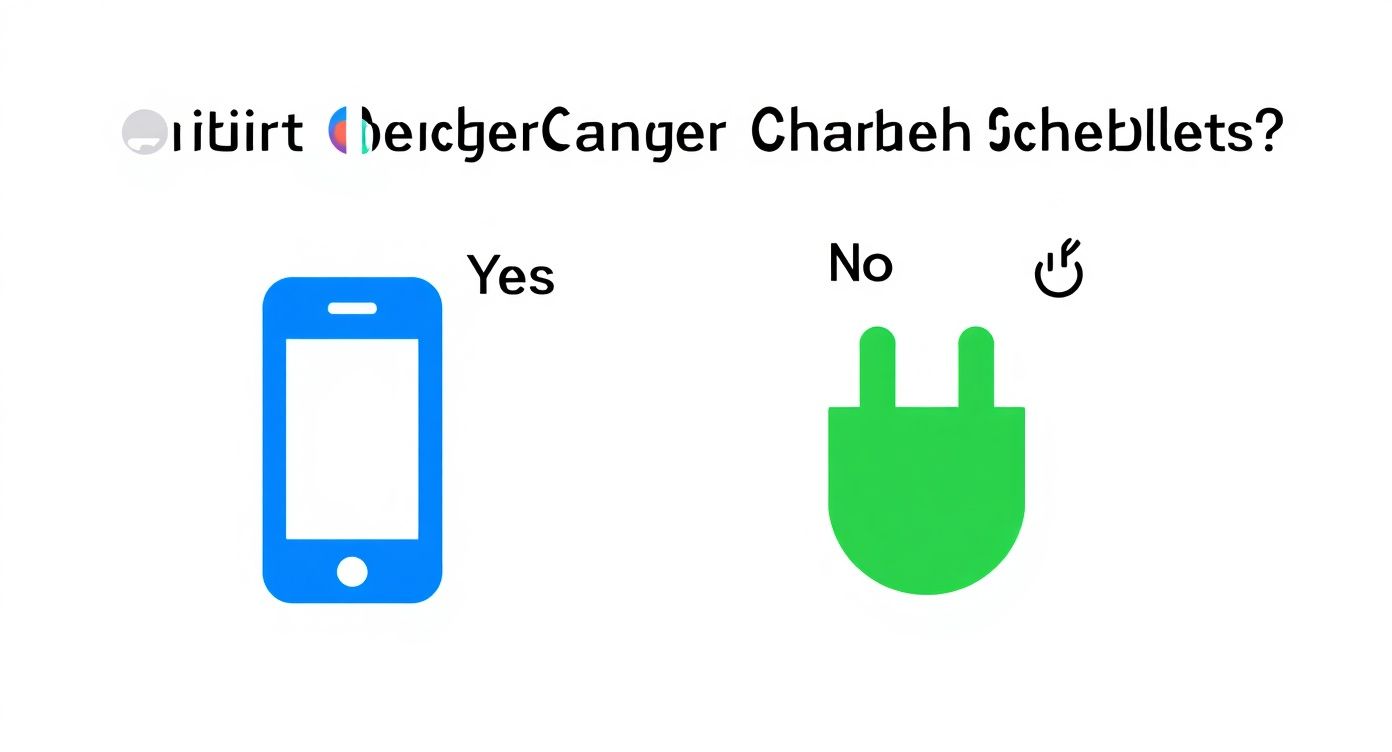
Ultimately, the choice often boils down to whether you can take advantage of cheaper overnight electricity tariffs. That's the main draw of a smart charger.
Get the Measure of Your Cable
Cable length is one of those surprisingly crucial details you only appreciate when you get it wrong. It’s easy to think longer is always better, but that’s not really the case. For most people, a 5-metre cable hits the sweet spot—it’s long enough for most situations without becoming an unruly python in your boot.
A cable that's too short is obviously a nightmare, forcing you into some creative parking gymnastics. But one that's too long is just a pain. It's a trip hazard, a faff to coil up, and more prone to damage. Trust me, wrestling with ten metres of thick, cold cable in the pouring rain is an experience that will test the patience of a saint. If you’re often fighting with tangled wires, our guide on UK retractable car chargers might be just what you need to escape that particular cable hell.
Your ideal cable length depends entirely on where you'll most often be charging. Measure the distance from a likely socket to where your car’s charge port will be. Then add a little extra for good measure.
Weatherproofing Is Not a Suggestion
Finally, let’s talk about the Great British weather. It’s inevitable your portable charger will be used outdoors, often in less-than-ideal conditions. This is where the IP (Ingress Protection) rating becomes your best friend. It’s a simple two-digit code that tells you how well the device is sealed against solids (like dust) and liquids (like our beloved rain).
You should be looking for a charger with at least an IP55 rating. Here’s what that means:
- The first ‘5’ means it’s well-protected against dust getting inside.
- The second ‘5’ means it can withstand low-pressure water jets from any direction—perfect for shrugging off a typical downpour.
An IP67 rating is even better. This means it’s completely dust-tight and can even be temporarily submerged in water. While you shouldn’t plan on charging your car underwater, it’s a brilliant indicator of a robust, well-made piece of kit that won’t give up the ghost at the first sign of drizzle. Don’t compromise on this; electricity and water are not friends.
Safety First: Don’t Burn Your House Down
Right, let's talk about the bit that might make you a little nervous: plugging a high-voltage device into your very expensive car, usually right next to your house. It's completely safe, but only if you approach it with a bit of common sense. This is where we cover the essentials to make sure your charging experience is smooth and uneventful.
The urge to just grab any old extension lead from the garage can be powerful, but please, resist it. That dusty, paint-splattered reel was made for a lawnmower, not for continuously drawing the power of several kettles for hours at a time. Using one is a shortcut to a melted plug, and trust me, that's not something you want to deal with.
Sockets and Sparks: Get a Professional In
Your standard three-pin household sockets aren't designed for the long, heavy power draw that an EV needs. While using one for a slow, 2.3kW trickle charge in a pinch is okay, it's not a long-term solution. The wiring inside your walls can get dangerously hot, plugs can begin to melt, and at worst, you risk causing a fire.
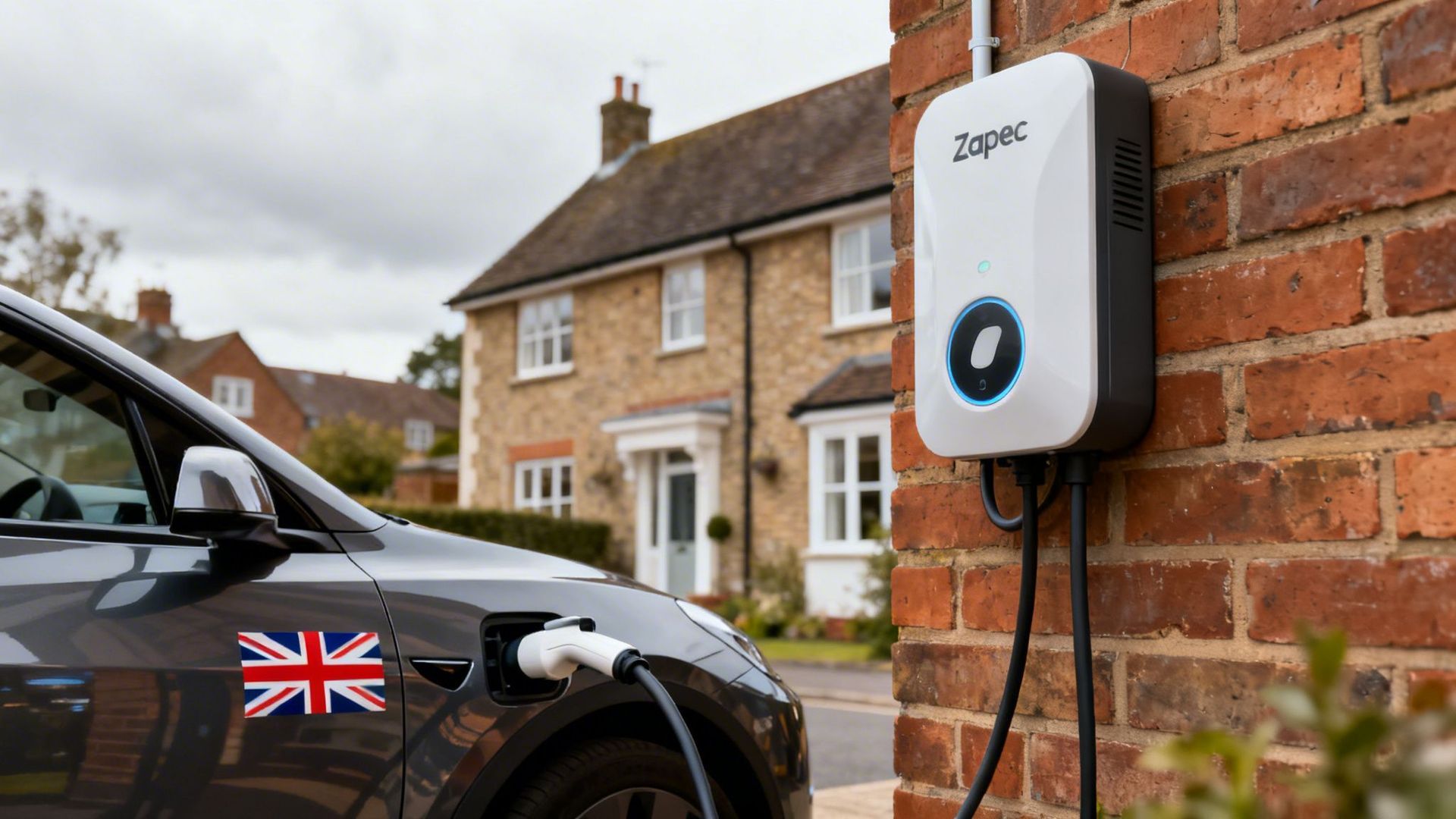
This is exactly why getting a proper outdoor socket fitted by a qualified electrician is non-negotiable for regular charging. They'll run a dedicated circuit from your fuse box with the right kind of wiring and socket—often a heavy-duty blue Commando socket for 7kW charging—that's built to take the strain. Don't cut corners here; a few hundred quid for a professional job is a tiny price to pay for peace of mind.
Think of it this way: you wouldn't try to run your entire kitchen on a single, flimsy extension cord. Your car is a huge electrical appliance, so it needs its own robust, dedicated power supply. It’s the difference between a safe, reliable setup and a potential disaster.
Your Charger’s Built-in Safety Net
Time for a quick but crucial acronym. Every single portable EV charger you consider must have a built-in RCD (Residual Current Device) . An RCD is like a hyper-vigilant bodyguard for your electrical circuit.
It constantly monitors the flow of electricity, and the moment it senses a tiny imbalance—like the current trying to escape through a puddle or, in the worst case, a person—it shuts off the power in a fraction of a second. This little device is what prevents a simple fault from turning into a serious electric shock. If a charger's description doesn't mention a Type A or Type B RCD, just move on. It's a non-negotiable safety feature.
Look for the Official Stamp of Approval
Finally, as you’re comparing chargers online, train your eyes to spot two key symbols: UKCA and/or CE . These aren’t just decorative logos; they are your guarantee that the product has been properly tested and meets UK and European standards for safety, health, and environmental protection.
- UKCA (UK Conformity Assessed): This is the post-Brexit quality mark for products sold in Great Britain. It’s the new gold standard to look for.
- CE Marking: The familiar European equivalent, which you'll still see on plenty of products sold in the UK.
A charger that's missing both of these marks is a complete gamble. It might be fine, but it could just as easily be a poorly made fire risk. It's a risk that's simply not worth taking. Think of these certifications as the official "this probably won't burn your house down" seal of approval—the absolute bare minimum for any device handling this much power.
How to Spot a Good Deal and Avoid the Duds
The internet is awash with suspiciously cheap deals on portable EV chargers, often from brands with names that sound like they were picked out of a hat. They promise the world for fifty quid, but how do you separate a genuine bargain from a dangerous dud that could fry your car’s expensive electronics?
It’s actually less complicated than you might think. All you need is a healthy dose of scepticism and a simple checklist to work through. A great deal isn’t just about the lowest price; it’s about getting real value and, most importantly, keeping you and your car safe.
Your Dodgy Deal Detector Kit
Before you even think about clicking ‘buy’, run the offer through this simple framework. If it fails on any of these points, it’s best to just walk away.
-
The Warranty: Anything less than a solid two-year warranty should set alarm bells ringing. Reputable manufacturers stand by their products because they're built to last. A flimsy one-year warranty often hints that even the company doesn't expect it to survive much longer.
-
UK-Based Support: Is there a UK phone number or a proper business address? If the only way to get in touch is a generic email address based on the other side of the world, good luck getting any real help when something inevitably goes wrong.
-
Genuine Reviews: Ignore the perfect five-star reviews on the product page itself – they can be easily faked. Instead, hunt down independent reviews on EV owner forums or dedicated UK car websites. You're looking for honest feedback from real British drivers, highlighting both the good and the bad.
-
Safety Marks: We’ve mentioned this before, but it’s so important it’s worth repeating. No UKCA/CE mark? No deal. It's the absolute bare minimum, confirming the charger meets UK safety standards and won't turn your charging session into a fire hazard.
Think of it this way: you’re not just buying a cable, you’re buying an insurance policy for your car. A cheap, uncertified portable EV charger is a gamble that simply isn't worth the few quid you might save.
Your Questions, Answered
You’ve stuck with us this far, so chances are you've got a few final questions buzzing around. Let's tackle some of the most common queries we hear about portable EV chargers.
Can I Use a Portable EV Charger in the Rain?
This all comes down to its IP (Ingress Protection) rating . Any decent portable charger worth its salt will be at least IP55 rated, which is more than enough to handle the classic British drizzle. Some of the top-tier models boast an IP67 rating, meaning they’re essentially waterproof.
But here’s the crucial bit: the plug that goes into your car and, more importantly, the three-pin plug at the wall socket, must be kept dry. Never, ever leave the plug sitting in a puddle. Just a little bit of common sense goes a long way to keeping things safe.
Will a Portable Charger Damage My Car's Battery?
Not a chance—as long as you’re using a properly certified charger from a reputable brand. Your EV has a very clever piece of kit called a Battery Management System (BMS) , which is the real boss of the charging process. It carefully controls the flow of electricity to protect your battery’s health and longevity. The charger simply supplies the power; the car decides what to do with it.
The only real risk comes from using an uncertified, bargain-basement charger you might find on a sketchy website. Always look for the UKCA/CE markings to ensure it meets UK safety standards. Stick to trusted brands, and your battery will be perfectly safe.
Think of it this way: your car’s BMS is like a strict nightclub bouncer. It decides who gets in and how fast. A good charger plays by the rules, while a cheap knock-off tries to sneak past security, causing all sorts of problems.
Is It Cheaper to Use a Portable Charger Than a Public One?
Yes, almost always. The difference is huge. Public rapid chargers can be eye-wateringly expensive, sometimes costing you more per mile than running an old petrol car. When you charge at home with your portable unit, you're paying your standard domestic electricity rate.
It gets even better if you're on a smart tariff with cheap overnight rates. The savings can be massive. The trade-off, of course, is speed. Public chargers are the hares, while your portable charger is the slow-and-steady tortoise. But when it comes to your bank balance, the tortoise wins this race by a country mile.
Ready to take control of your charging and leave range anxiety behind? Dive into the latest reviews, guides, and expert insights at VoltsMonster . Find your perfect EV solution today at https://www.voltsmonster.com.
VoltsMonster Electric Vehicle Blog