How much do electric cars cost to charge? Let’s talk brass tacks
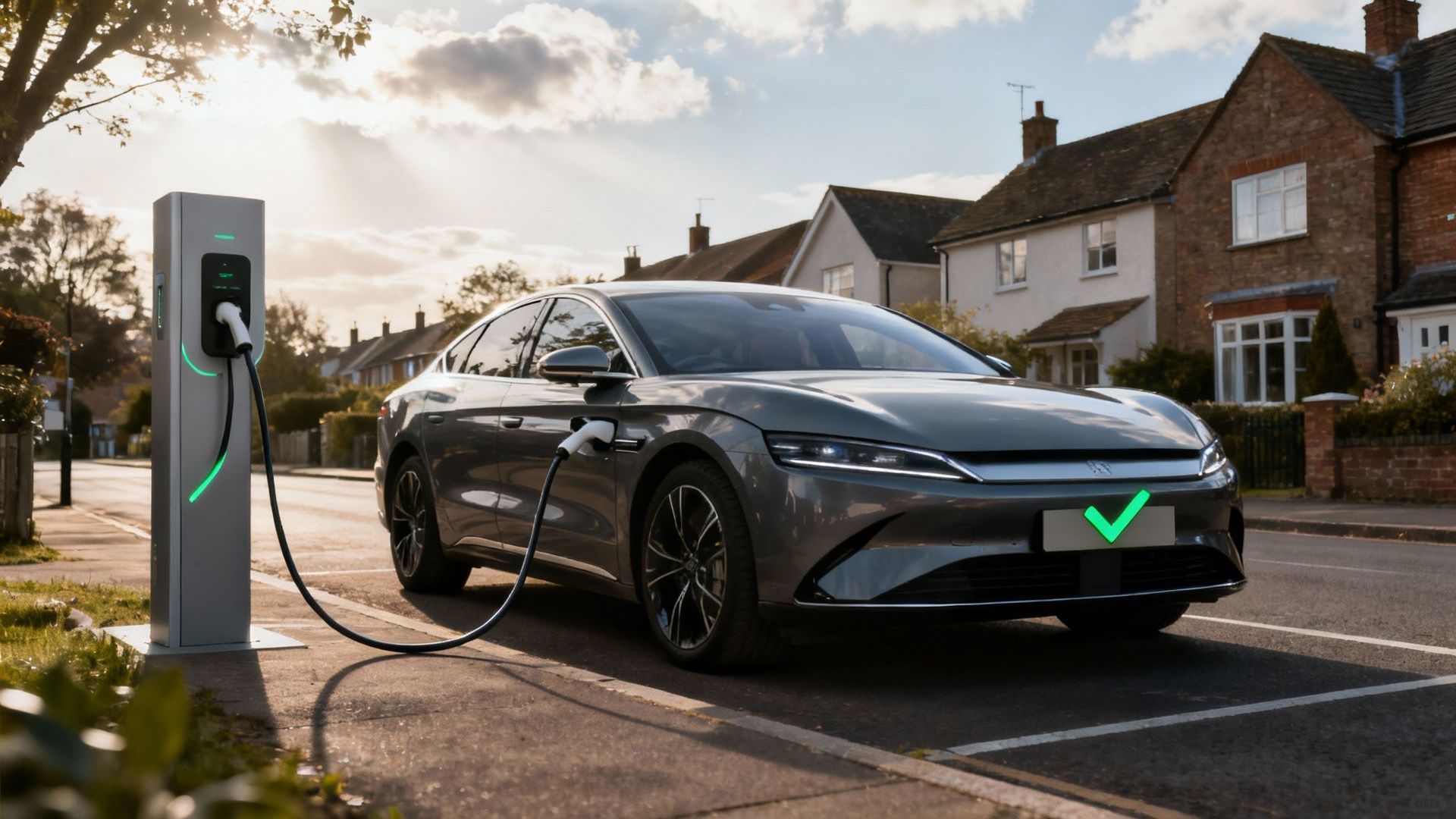
Right then, let's cut the waffle. You want to know how much it costs to charge an electric car, and the brutally honest answer is: it depends. But here's the good news – it's almost always drastically cheaper than pumping your car full of ludicrously expensive petrol. A full 'tank' of electricity could set you back anything from less than a fiver to over thirty quid .
Think of it like buying a coffee. Make it at home, and it costs pennies (that’s your home charger on a sneaky overnight tariff). Buy it at a motorway service station when you're desperate, and you'll need to remortgage your house (that'll be the public rapid charger, then). It's the same principle, just with more volts and fewer baristas judging your life choices.
The Real Cost to Charge an Electric Car in the UK (Brace Yourselves)
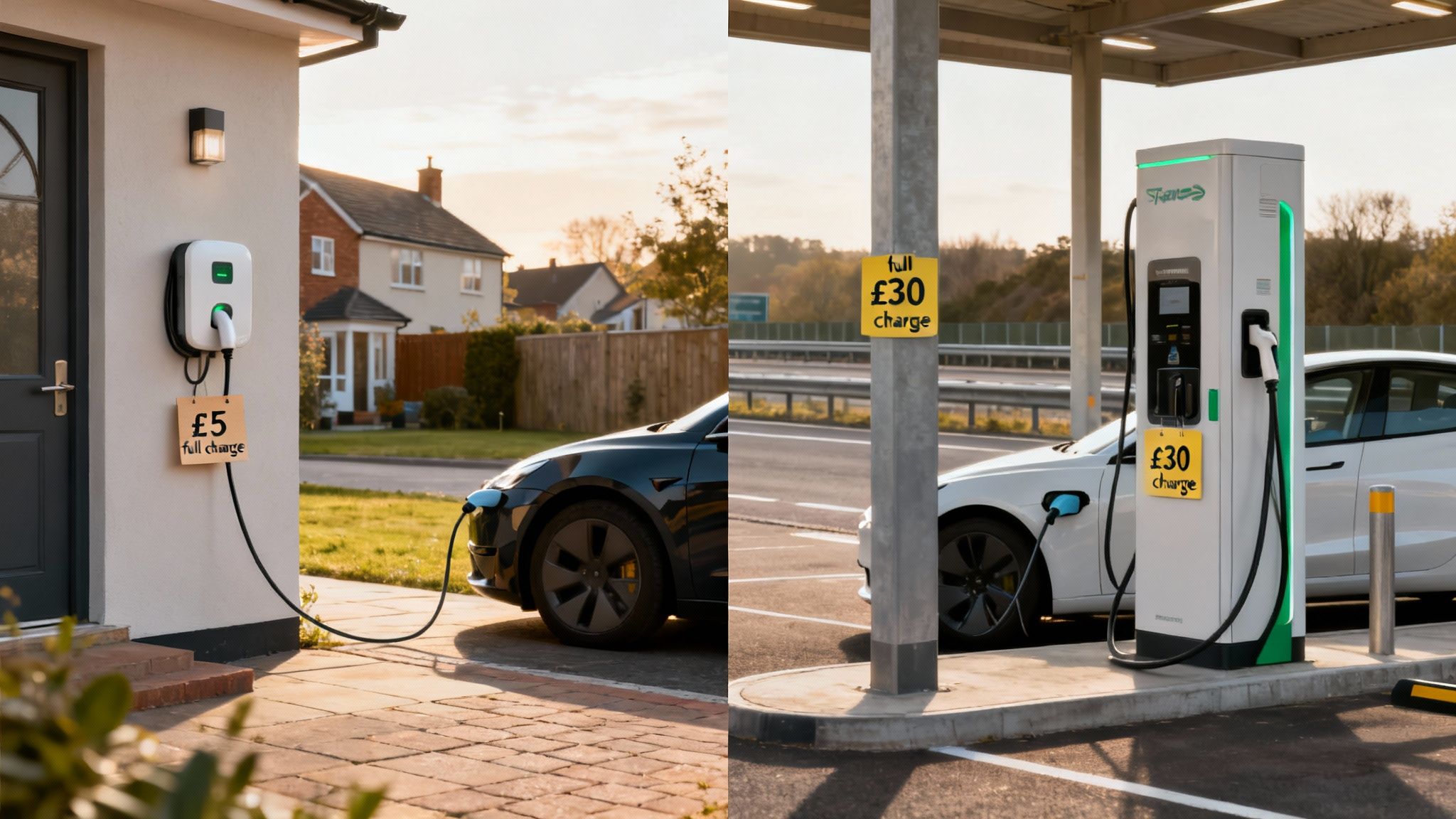
Let's break down the numbers. The single biggest factor that dictates your running costs isn't the car itself, but where you jam the plug in. Get your head around this, and you've basically unlocked a cheat code for incredibly cheap driving.
It really is the difference between brewing a flask of tea at home for tuppence versus paying a king's ransom for a lukewarm cuppa on the M6. One is smart and saves you a fortune; the other is a painful necessity when you're caught short. The exact same logic applies to charging your EV. One is smugly sensible; the other is an act of sheer desperation.
At a Glance: EV Charging Cost Scenarios (The Good, The Bad, and The Ugly)
To put it all into perspective, here’s a quick look at what a full 60kWh charge—typical for a family-sized EV—might cost in different situations.
| Charging Location | Average Cost per kWh | Cost for a Full 60kWh Charge | Cost per Mile (Approx.) |
|---|---|---|---|
| Home (Off-Peak EV Tariff) | 9p | £5.40 | ~2.6p |
| Home (Standard Tariff) | 24.5p | £14.70 | ~7p |
| Public 'Fast' Charger | 55p | £33.00 | ~16p |
| Public 'Rapid' Charger | 79p | £47.40 | ~23p |
As you can see, the gap between charging at home on a good tariff and relying on the fastest public chargers is the size of the Grand Canyon.
Home Charging: The Promised Land of Cheap Motoring
For any EV owner, charging at home is the holy grail. It’s not just the sheer convenience of waking up to a fully charged car every single morning; it’s the massive savings that come with it. By switching to the right energy tariff, you're paying bargain-basement prices for your electricity. You're practically stealing it.
With a dedicated off-peak EV tariff, you could be paying as little as 9p per kilowatt-hour . For a typical 60kWh EV, a full charge would cost around £5.40 . That works out to a running cost of just 2.6p per mile . Compare that to a petrol car chugging along at 14p per mile, and you can see the EV is about five times cheaper to run. It's a no-brainer.
The key takeaway is simple: if you can charge at home, you win. The public charging network then becomes a useful tool for long journeys, not a daily expense that drains your bank account like a vampire with a direct debit.
Public Charging: Welcome to the Wild West
Once you venture out into the world of public charging, the prices get a bit more... dramatic. Out here, you’re paying a premium for the convenience of speed. It’s a perfectly good option for a top-up on a long drive, but relying on it every day is a recipe for financial ruin and a lifetime of regret.
Costs can vary wildly between networks, but here’s a rough guide to what you’re up against:
- Slow 'destination' chargers (supermarkets, car parks): Often cheaper, sometimes even free, but you'll be parked for hours to get a meaningful charge. Your beard will have grown by the time it's done.
- Fast chargers (retail parks, gyms): A good middle ground. They can add a decent chunk of range while you pretend to work out or buy things you don't need.
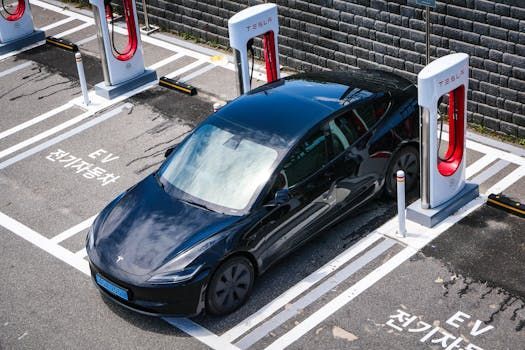
- Rapid/Ultra-Rapid chargers (motorways): These are the most expensive by a country mile. They’re designed to get you back on the road in the time it takes to grab a stale sandwich and a coffee that tastes of disappointment.
Understanding this fundamental split is crucial to managing your costs. For a more detailed breakdown of how this all stacks up against fossil fuels, have a look at our guide on the real cost of owning an EV compared to petrol cars.
Decoding the Maths Behind Your Electric Bill (Don't Panic)
Right, don’t scarper just because we’ve mentioned maths. This isn't A-level calculus; it’s more like working out if a multipack of crisps is better value than buying singles. It's dead simple, and getting your head around it is the key to figuring out how much an electric car really costs to run.
First, let's bust some jargon. The most important term you'll see is the kilowatt-hour (kWh) . Think of it as the electric equivalent of a litre of petrol. It’s a unit of energy, and it's what you buy from your electricity supplier and what you pour, silently and invisibly, into your car's battery.
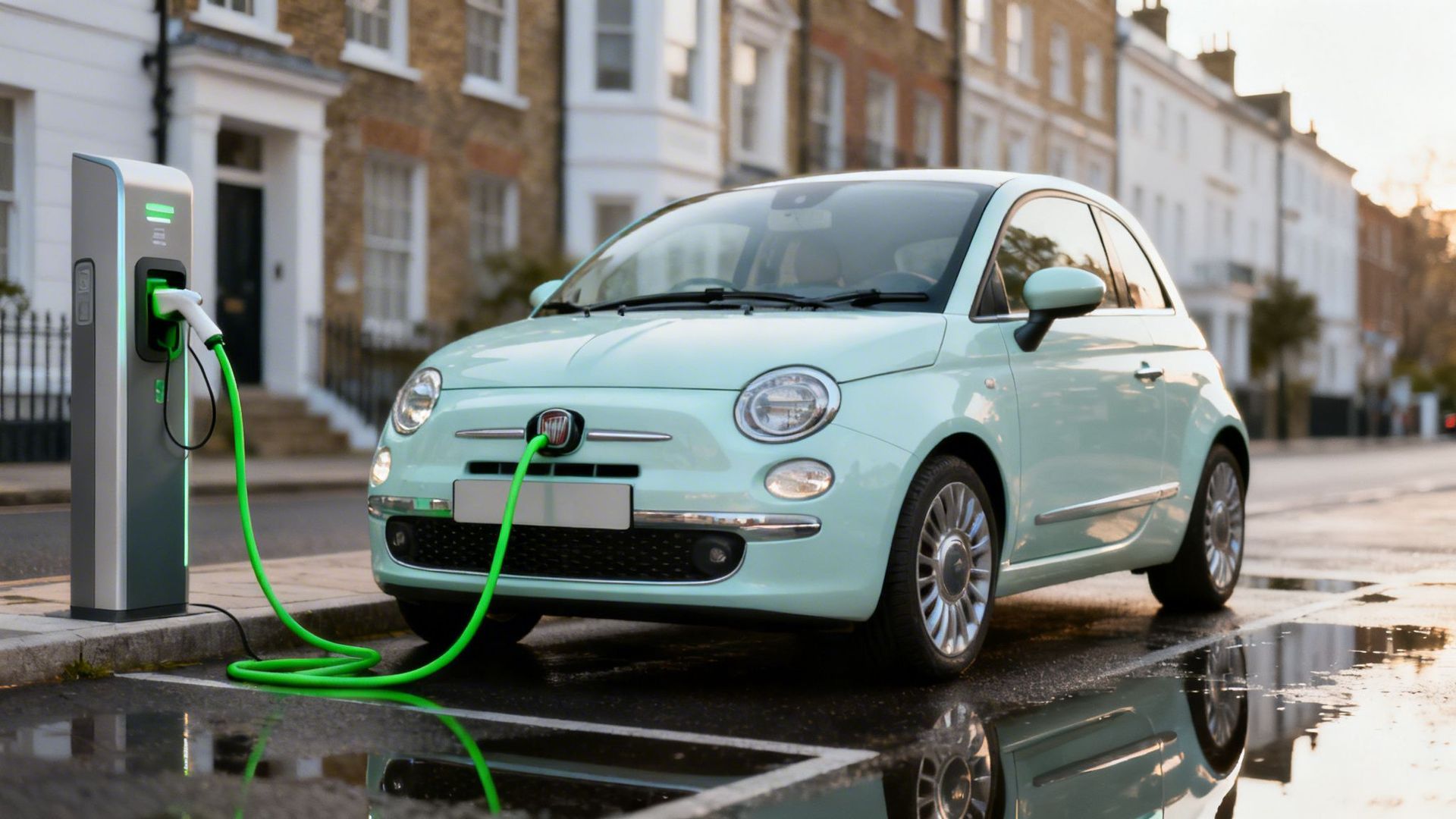
Your car’s battery size is measured in kWh. A small city car like a Fiat 500e might have a 42kWh battery, while a long-range beast like a Kia EV6 has a 77.4kWh battery. This is simply the size of your 'fuel tank'.
The Basic Sums for a Full Charge (Even a Chimp Could Do It)
Calculating the cost of a full charge is almost laughably easy once you know two key numbers. All you need to do is multiply your battery’s size by the price you pay for electricity.
The Golden Formula: Battery Size (kWh) x Electricity Price (pence per kWh) = Total Cost to Charge from Empty
Let’s use a real-world example. Imagine you have a Tesla Model Y with a 75kWh battery and you're charging at home on a standard electricity tariff of 25p per kWh .
- 75 kWh (your battery size) x £0.25 (your electricity price) = £18.75 for a full charge.
See? Simple. You can now glance at any charger's price, know your car's battery size, and do a quick mental calculation to avoid getting ripped off. This basic formula is your superpower in the world of EV charging.
Introducing Miles Per kWh (The Bit That Matters)
Just as petrol cars have miles per gallon (MPG), electric cars have an efficiency rating: miles per kWh (mi/kWh) . It's a straightforward measure of how far your car can travel on a single unit of electrical energy.
- An efficient EV might achieve a brilliant 4-5 mi/kWh on a gentle town run.
- A larger, less aerodynamic electric SUV might only manage 2.5-3.5 mi/kWh , especially when battling a headwind on the motorway.
The higher the mi/kWh figure, the cheaper your journeys will be. You're simply squeezing more miles out of every penny's worth of electricity you put in.
The Angel's Share of Charging (Where Your Money Vanishes)
Now for a little curveball: charging losses . When you charge your car, not all the energy pulled from the grid makes it into the battery. A little bit is always lost as heat, warming up the cables and the car’s own charging electronics.
Think of it like the "angel's share" in whisky making, where a small amount of spirit evaporates from the barrel during ageing. You always have to put slightly more energy in than you get out. It's annoying, but it's physics.
These losses are typically around 5-10% , meaning for every 10kWh you pay for, only about 9-9.5kWh actually ends up in your battery. It's a minor factor, but it’s worth remembering that the true cost will always be a smidgen higher than the simple calculation suggests. It's an unavoidable bit of science, but thankfully not one that will break the bank.
Unlocking Cheap EV Running Costs with Home Charging (This is the Secret)
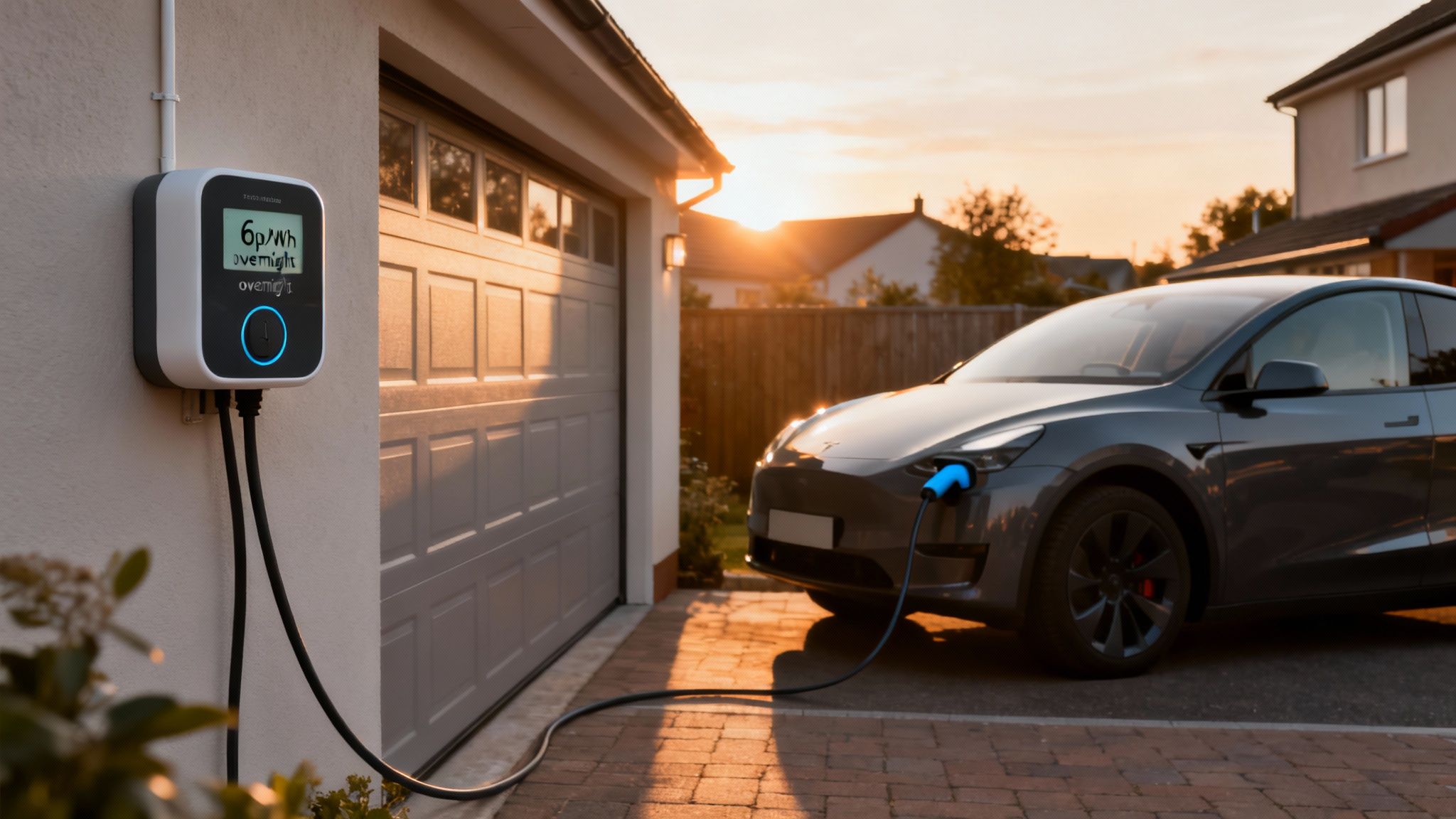
This is it. The big one. The single biggest trick to making electric car ownership so cheap it feels like you're getting away with something. Forget hunting for free supermarket chargers or juggling a dozen public network apps; the real savings happen right on your driveway while you’re fast asleep and dreaming of electric sheep.
Charging at home is the foundation of affordable EV motoring. It’s what separates paying premium prices for every journey from fuelling up for pennies. It means waking up every single morning with a 'full tank', ready for the day, without ever having to visit a grubby petrol station again. The convenience alone is a total game-changer, but the financial perks are where it gets really juicy.
To properly unlock these savings, you need to go beyond just plugging into a standard wall socket. It’s time to get savvy and dive into the world of specialist EV energy tariffs.
The Power of the Off-Peak Tariff (Happy Hour for Your Car)
Your standard electricity tariff charges you the same flat rate whether you’re boiling the kettle at 8 am or charging your car at 2 am. An EV tariff, on the other hand, is much smarter. These plans offer a window of incredibly cheap electricity overnight, usually between midnight and 5 am, when national energy demand is at its lowest and everyone else is asleep.
Rates can plummet to as little as 7.5p per kWh , a massive drop from the typical 25p per kWh you’d pay during the day. This is your golden ticket. By scheduling your car to charge only during these cheap off-peak hours, you slash your running costs to a fraction of the norm. Suddenly, a full charge that might cost £18 on a standard tariff costs you less than a fiver.
Think of it like this: your energy company is basically holding a happy hour for electricity, and your EV gets an exclusive invitation. All you need to do is tell your car or charger to fill up when the prices are low. Simple.
Getting Kitted Out with a Home Charger (Spend a Little, Save a Lot)
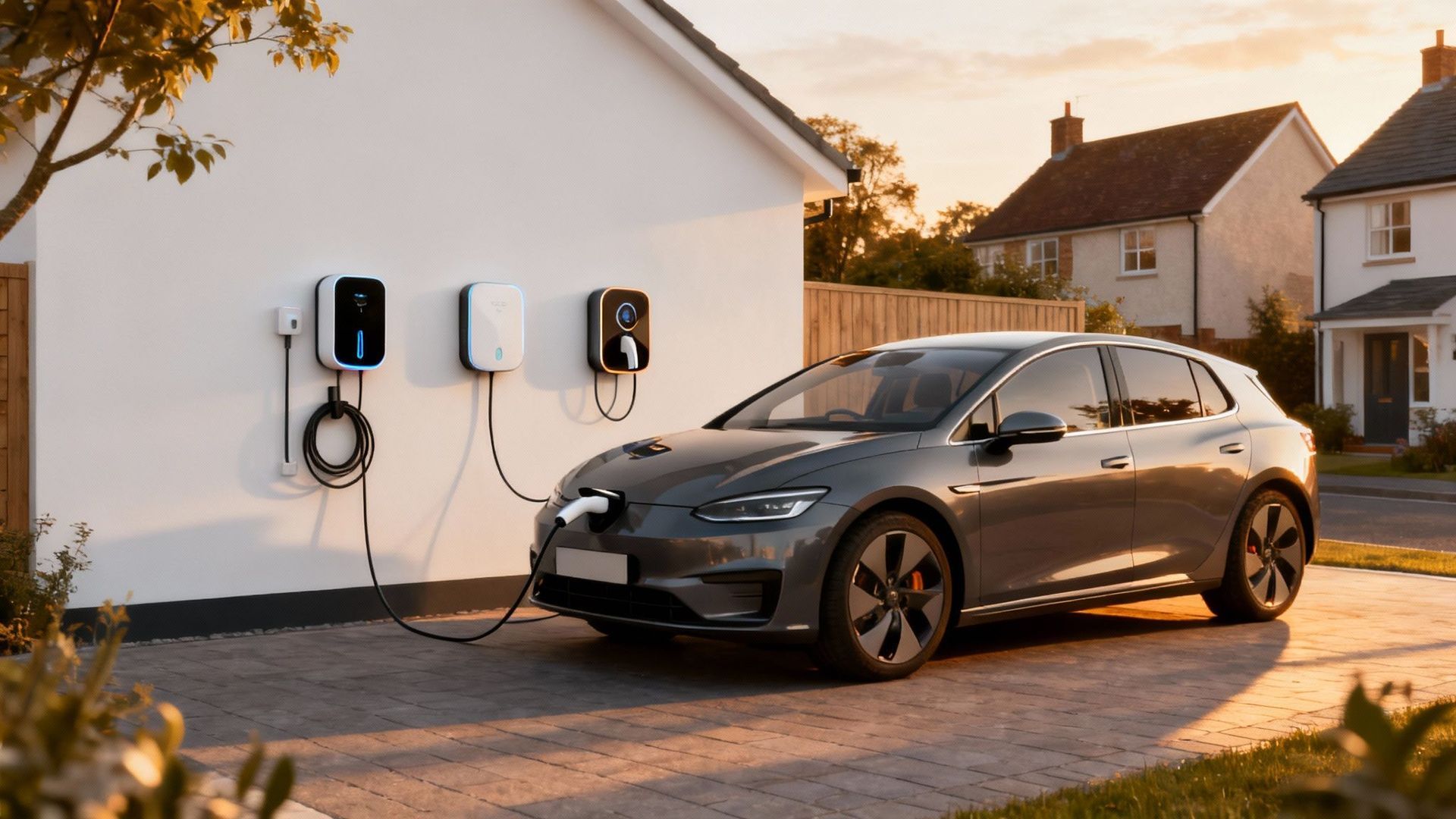
To safely and efficiently take advantage of these overnight discounts, you'll need a proper home charge point, often called a wallbox. While you can use a standard three-pin plug in a pinch, it's painfully slow and not something you should rely on every day. A dedicated wallbox is faster, much safer, and comes packed with smart features that do the thinking for you.
The cost of having one installed typically ranges from £800 to £1,200 . While the main government grants for homeowners have been phased out in England, there are still some financial incentives, particularly if you live in a flat or rented property. To see what you might be eligible for, have a look at our guide which shows financial incentives to using home charging.
Yes, it’s an upfront investment, but the long-term savings are enormous. Most drivers find they recoup the installation cost within the first year or two, just from the money saved by avoiding expensive public chargers and peak electricity rates.
How to Choose Your Home Charging Setup (Don't Buy a Dud)
Not all chargers are created equal, so it pays to know what you’re looking for. When you're shopping around, a few key things will make all the difference.
- Charging Speed: Most home chargers are 7kW , which is ideal for overnight top-ups, adding about 30 miles of range per hour. Some properties can support faster 22kW chargers, but this requires a three-phase electricity supply—a rarity in UK homes unless you live in a castle or a factory.
- Tethered vs Untethered: A tethered charger comes with a permanently attached cable. It's super convenient, but can look a bit messy. An untethered unit is just a socket, meaning you use the portable cable that came with your car (and will inevitably leave it at home when you need it most).
- Smart Features: This is the crucial part. A 'smart' charger connects to your home Wi-Fi, allowing you to schedule charging sessions through an app. This lets you perfectly align your charging with your cheap off-peak electricity tariff, which is absolutely essential if you want to maximise your savings.
Ultimately, installing a home charger and switching to an EV-friendly tariff transforms your car from a running cost into a simple appliance you can run for pocket money. It’s the smartest, cheapest, and by far the most convenient way to live with an electric car.
Navigating the Price Safari of Public Charging Networks
So, you've mastered the art of cheap overnight charging at home. Fantastic. But what about when you’re out on the open road, far from the comfort of your own driveway? Welcome to the wild west of public charging, a landscape where prices can swing from perfectly sensible to eye-wateringly, offensively expensive.
Charging on the go is a completely different ball game. You're dealing with a mishmash of speeds, a confusing array of providers, and a pricing structure that often feels like it was designed by a committee of sadists. Consider this your survival guide to plugging in without getting fleeced.
Think of it like buying a train ticket. Charging at home is like booking an Advance Single weeks ahead – cheap and predictable. Public charging, on the other hand, is like turning up at the station five minutes before departure. You'll pay for the convenience, and the price depends entirely on how fast you need to get to your destination.
The Great Charger Divide: Slow, Fast, and Ludicrous Speed
Not all public chargers are created equal. They generally fall into three categories, each with its own cost and ideal use case. Getting your head around the differences is key to managing your budget and your sanity.
-
Slow Chargers (AC, 3-7kW): These are the tortoises of the charging world. You'll often find them on lampposts or in council car parks, trickling about 10-25 miles of range into your car per hour. They can be incredibly cheap, sometimes even free, but you’ll need to be parked for a good few hours. Possibly days.
-
Fast Chargers (AC, 22kW): This is the happy medium. Dotted around supermarkets and retail parks, they’re perfect for a meaningful top-up while you do the weekly shop and argue about cereal.
-
Rapid & Ultra-Rapid Chargers (DC, 50kW+): These are the motorway workhorses. Designed to get you from 20% to 80% in the time it takes to grab a coffee and question all your life choices, they offer incredible speed. But that speed comes at a premium, with prices often soaring to 80p per kWh or more.
Let's break that down with a quick look at what you can expect to pay and how long you'll be waiting.
Public Charging Speeds vs Costs: A UK Snapshot
The price you pay at a public charger isn't just for the electricity; it's for the speed, convenience, and the massive cost of installing and maintaining these high-powered units. Here’s a rough guide to the UK's public network.
| Charger Type | Power (kW) | Average Cost (p/kWh) | Time to Add 100 Miles (Approx.) | Best For |
|---|---|---|---|---|
| Slow (AC) | 3-7kW | 25p - 45p | 4 - 8 hours | Overnight stays, workplace charging, long-stay car parks. |
| Fast (AC) | 22kW | 40p - 60p | 1.5 - 2 hours | Topping up while shopping or at the cinema. |
| Rapid (DC) | 50-100kW | 65p - 80p | 30 - 45 minutes | Quick boosts on long journeys, motorway services. |
| Ultra-Rapid (DC) | 150kW+ | 75p - 85p | 15 - 25 minutes | The fastest option for getting back on the road ASAP. |
As you can see, the faster you want to charge, the more you'll pay per unit of energy. A little bit of planning can save you a serious amount of money.
The price you pay is for the convenience and speed. If you need to be back on the motorway in under 30 minutes, you’re going to pay a hefty price for it. It can be a minefield out there, so for a deeper dive, check out our sceptic's guide to UK EV charging points to make sure you don't get caught short.
The Hidden Costs and App-Based Faff
Just when you think you’ve got the kWh prices figured out, some networks like to add a few extra wrinkles just to keep you on your toes. The most common culprit is the connection fee – a flat charge of around 50p or £1 just for plugging in. It’s the charging equivalent of a cover charge to get into a terrible nightclub.
Then there’s the app fatigue. A few years ago, you needed a different app for every network, turning your phone into a cluttered mess of forgotten passwords. Things are improving with the rollout of contactless payment, but you’ll still find that many networks offer cheaper rates if you use their app or sign up for a subscription. For high-mileage drivers who stick to one network, a monthly plan can be a godsend, but for the average driver, it's often just another layer of needless complication.
The staggering difference between home and public charging costs is no myth. Recent fleet data shows the average cost for public charging is a hefty 81p per kilowatt-hour , while home charging averages just 25p per kWh . This means drivers who rely solely on public networks are paying more than three times the price for the exact same energy. For more detail on these findings, you can explore the real cost of EV ownership research.
Ultimately, the public charging network is an essential tool for long journeys, but it's a financially punishing way to handle your daily driving. Treat it as a lifeline for road trips, not a substitute for that cheap, convenient overnight top-up at home.
Crunching the Numbers: Real-World Costs for Popular UK Electric Cars
Alright, let's move away from theory and talk pounds and pence. How much does it actually cost to charge an electric car on real British roads? The answer is a classic "it depends" – mostly on the car itself. Its battery size is one thing, but how efficiently it uses that energy is the real game-changer.
Think of it this way: a car with the aerodynamics of a garden shed is going to chew through its battery charge far quicker than a sleek, slippery saloon. That means more frequent, and more expensive, stops at the plug. To show you what this looks like in practice, we’ve taken three of the UK's most popular EVs and run the numbers.
This chart gives you a quick snapshot of the public charging network, breaking down the different speeds you'll find when you're out and about.
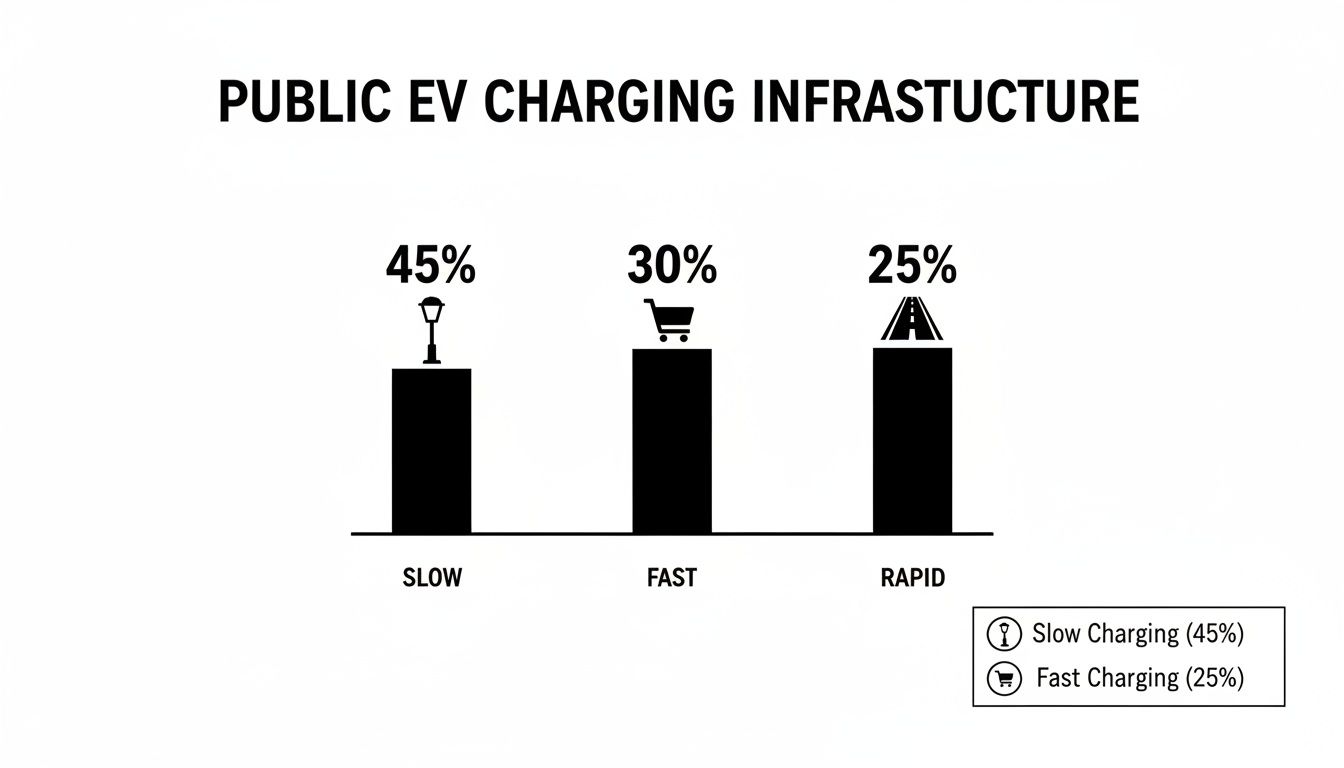
The crucial takeaway here is the trade-off between convenience and cost. The fastest rapid chargers at motorway services command the highest prices, while slower destination chargers are often much easier on the wallet.
Tesla Model Y Long Range
The undisputed king of UK EV sales, the Model Y is the car everyone else is measured against. It combines a decent-sized 75kWh battery with fantastic efficiency, which is its secret weapon for keeping running costs low.
- Home Charging (EV Tariff at 9p/kWh): A full charge from empty will set you back a mere £6.75 . That’s less than a fancy pint in London.
- Home Charging (Standard Tariff at 25p/kWh): On a standard flat rate, the same charge climbs to a more noticeable £18.75 .
- Public Rapid Top-Up (20-80% at 79p/kWh): A typical motorway splash-and-dash adds 60% charge (45kWh) and costs a hefty £35.55 .
A quick word on its efficiency: The Model Y is impressively slippery through the air for a family SUV. Its real-world efficiency means you squeeze more miles out of every kilowatt-hour, making those expensive rapid charges a less frequent, and less painful, experience.
Kia EV6 Long Range
The EV6 is a stylish, capable family car with a slightly larger 77.4kWh battery. It's a brilliant all-rounder, but its head-turning design isn't quite as aerodynamic as the Tesla’s. This has a small but noticeable impact on its running costs.
- Home Charging (EV Tariff at 9p/kWh): A full charge comes in at a very reasonable £6.97 .
- Home Charging (Standard Tariff at 25p/kWh): The cost for a full battery rises to £19.35 .
- Public Rapid Top-Up (20-80% at 79p/kWh): That 60% top-up (46.4kWh) will lighten your wallet by £36.66 .
A quick word on its efficiency: The EV6 is still very efficient, but on a long motorway slog, you might find yourself visiting chargers a fraction more often than in a Model Y. The difference is minor on a single trip, but it all adds up over a year of paying through the nose at service stations.
Nissan Leaf (40kWh)
The humble Nissan Leaf was one of the original EV pioneers and remains a hugely popular choice for city drivers or as a second car. Its smaller 40kWh battery costs less to fill, but its shorter range and older tech mean you’ll be stopping more often on longer journeys, probably weeping quietly to yourself.
- Home Charging (EV Tariff at 9p/kWh): A full charge is an absolute bargain at just £3.60 .
- Home Charging (Standard Tariff at 25p/kWh): Even on a standard rate, it’s only £10.00 to fill from empty.
- Public Rapid Top-Up (20-80% at 79p/kWh): A quick 60% boost (24kWh) costs a more substantial £18.96 .
A quick word on its efficiency: The Leaf is perfectly happy zipping around town. On the motorway, however, its efficiency drops off a cliff. Combine that with the small battery, and long journeys can become a pricey and stressful exercise in charger-hopping.
As you can see, two factors are constantly battling it out: the car's inherent efficiency and the price of the electricity you're feeding it. An efficient car helps to blunt the impact of expensive public charging, but nothing beats the ridiculously low cost of filling up at home on a cheap off-peak tariff.
VoltsMonster Deal of the Week
Every EV driver loves a bargain. Let’s be honest, saving a few quid on charging feels like a proper win. So, welcome to our weekly rummage through the internet’s bargain bin, where we hunt down the best UK deals to lower the cost of juicing up your motor. We cut through the marketing guff to find you genuine savings.
This week, a cracking offer from a big name in home charging, Pod Point, caught our eye. They’re currently knocking a decent chunk off the price of their hugely popular 7kW Solo 3 smart charger . This is one of the most common and reliable home chargers you'll see on driveways up and down the country.
The Pod Point Solo 3 Charger Offer
For a limited time, Pod Point is offering their fully installed 7kW tethered Solo 3 charger for a promotional price, which is a tidy saving on the usual rate. That price includes the charger itself and a standard installation, which covers the vast majority of UK homes. A tethered unit is the convenient option – the cable is permanently attached, so you just pull up, plug in, and you're done. No faffing about in the rain.
Here’s why we reckon it’s a solid deal:
- Smart Scheduling: The charger's app lets you schedule charging to kick in during those cheap overnight electricity tariffs. This is the absolute key to unlocking ridiculously low running costs.
- Proven Reliability: These units are absolute workhorses. They’re built to withstand the glorious British weather and come with a solid warranty for peace of mind.
- No-Faff Installation: Pod Point handles the whole process, from the initial survey right through to the final sign-off, making it a pretty painless experience.
This deal is squarely aimed at new EV owners or anyone still making do with a three-pin plug. Getting a proper 7kW smart charger installed is the single best investment you can make to slash your long-term charging costs.
Just be sure to check the small print before you jump in. The "standard installation" has its limits – if your fuse box is ancient or on the wrong side of the house, you might face some extra charges. For most homeowners, though, this is a significant saving on a top-tier piece of kit. You can check out the full details and claim the offer directly on the Pod Point website.
Your EV Charging Questions Answered
We've thrown a lot of numbers around and dug into how EV charging costs work. But there are always a few common questions that crop up. Let's tackle them head-on to clear up any final bits of confusion.
Is it Cheaper to Charge an EV or Fill a Petrol Car?
Yes. In almost every single case, yes. Even if you were a complete lunatic and only ever used the most expensive motorway rapid chargers, you'd likely find your cost per mile is only about the same as a thirsty petrol car. The real game-changer, though, is charging at home.
A full 'tank' of electricity on a cheap overnight tariff can cost you as little as a fiver. When you compare that to the £70-£80 it takes to brim the tank of a similar family hatchback with petrol, the savings aren't just noticeable—they're enormous.
Do I Have to Get a Special Energy Tariff for My EV?
You don't have to, but honestly, you'd be mad not to. If you stick with your standard electricity rate, you'll be paying the same to charge your car as you do to boil the kettle—somewhere around 25p per kWh .
An EV-friendly tariff is your secret weapon for slashing running costs. It opens up a window of super-cheap electricity overnight, often as low as 7.5p per kWh . This single change has the biggest impact on your motoring budget, so don't skip it unless you actively enjoy wasting money.
How Much Will an EV Add to My Electricity Bill?
This is the big one, isn't it? The question that keeps prospective EV owners up at night. The answer really depends on two things: how many miles you drive and where you do most of your charging.
Let's look at a couple of scenarios for someone driving 10,000 miles a year:
- Charging Smart: If you do all your charging at home on an off-peak EV tariff (let's say 9p/kWh), you're looking at adding roughly £250-£300 to your annual electricity bill.
- Charging on a Standard Rate: That same mileage on a standard tariff (around 25p/kWh) would see your bill jump by closer to £800 .
While that might sound like a hike, just remember you're no longer forking out over £1,400 a year for petrol. You'll be laughing all the way to the bank.
Are Public Chargers at Supermarkets Still Free?
Ah, the good old days. Sadly, the golden age of free public charging has pretty much come to an end. You might still find the odd Tesco offering a bit of free 7kW charging while you do your shop, but the vast majority have now moved to a pay-as-you-go system. The freeloading party is over.
It was a brilliant perk while it lasted, but you can't really rely on free top-ups to run your car anymore. It’s always best to check an app like Zapmap before you head out to see the latest prices and avoid any nasty surprises at the plug.
At VoltsMonster , we're committed to giving you the straight-talking, no-nonsense advice you need to make sense of the electric car world. For more honest reviews and guides, check out our other articles at https://www.voltsmonster.com.
VoltsMonster Electric Vehicle Blog