Solid State Battery Cars: The Future of EVs, or Just More Hot Air?
Solid-state battery cars are the holy grail of electric vehicle tech, whispered about in hushed tones and promising to finally silence the range-anxiety sceptics. We're talking a potential 900+ miles on a single charge and top-ups that take less time than brewing a proper cup of tea — under 10 minutes.
How? By swapping the flammable liquid gunk inside current EV batteries for a slice of stable, solid material. It's a simple change on paper, but one that supposedly makes them safer, lighter, and a whole lot more potent. Let's see if the reality lives up to the hype, shall we?
So What On Earth Is A Solid-State Battery?
Right then, let's cut through the marketing waffle. You’ve probably heard the term "solid-state battery" thrown around, usually attached to some unbelievable claim about a car that can drive from Land's End to John o' Groats without a pit stop. But what does it actually mean for you, me, and our crippling monthly finance payments?
First, let's think about the battery in almost every EV on the road today: the lithium-ion. At its most basic, it's a bit like a chemical sandwich. You have a negative side (the anode), a positive side (the cathode), and wedged between them is a sloppy, wet substance called a liquid electrolyte.
Think of that liquid electrolyte as a tiny swimming pool for charged particles called ions. When you're zipping down the motorway, ions swim from the negative side to the positive, creating the electricity that turns the wheels. When you plug in to charge, they swim back the other way. Simple enough, but that liquid is the battery's biggest weakness. It’s flammable, heavy, and gets grumpier than a badger in a bin during a cold British winter.
Ditching The Liquid For A Solid Upgrade
A solid-state battery does exactly what it says on the tin. It takes that volatile, sloshing liquid electrolyte and replaces it with a wafer-thin, solid material. This could be a ceramic, a polymer, or even a type of glass. It still lets the ions do their back-and-forth swim, but this one change completely rewrites the rulebook.
This single swap is the key to unlocking a whole host of benefits that make today’s EV technology look, well, a bit last-generation. Like comparing a smartphone to a carrier pigeon.
"By eliminating the flammable liquid electrolyte, solid-state batteries offer increased energy density, faster charging, and enhanced safety—all of which are essential for advancing EV technology."
This isn't just a minor tweak; it’s a fundamental redesign of the battery from the ground up. It’s less like improving a petrol engine and more like swapping it for a miniature black hole. This is precisely why car manufacturers are pouring billions into developing solid-state battery cars .
Why This Matters To You, The Driver
Okay, swapping a liquid for a solid sounds interesting, but what does it actually mean when you’re stuck in traffic on the M25? It all boils down to a few key improvements that tackle the biggest headaches people have with electric cars right now.
- Immense Range: The solid structure is far more compact and energy-dense. This means manufacturers can either cram more power into the same size battery for a massive range boost, or they can use a smaller, lighter battery for the same range, which makes the car more efficient and handle better. Thank God.
- Ludicrous Charging Speeds: That soggy liquid electrolyte is a major bottleneck for charging speeds. Shove too much power in too quickly, and it can overheat and, in very rare cases, go 'bang'. The stable solid electrolyte can handle much more current, making a genuine 10-minute charge a real possibility.
- Proper Safety: Take away the flammable liquid, and you dramatically reduce the risk of a battery fire. This makes solid-state battery cars inherently safer and gives designers more freedom with the car's layout, hopefully leading to cars that don't all look like angry kitchen appliances.
- Longer Lifespan: The chemical reactions in a liquid electrolyte cause the battery to degrade over time, slowly losing its ability to hold a full charge. Solid-state chemistry is far more durable, promising a battery that could easily outlast the car itself.
In short, this technology promises to make owning an electric car just as convenient—if not more so—than a petrol or diesel one. Before we get too carried away, it helps to understand the evolution of EV battery technology to appreciate just how far we've already come. This isn't another small step; it's a giant leap.
Lithium-Ion vs Solid-State: The Title Fight
Right then, let's get ready for a proper head-to-head. In one corner, the reigning, undisputed champion of the EV world: the Lithium-Ion battery . It’s the powerhouse behind almost every electric car you see, from a city-hopping Renault Zoe to a neck-snapping Porsche Taycan. It’s a proven technology, it’s everywhere, and frankly, it’s starting to show its age. A bit like a rock star still trying to squeeze into leather trousers from the 80s.
And in the other corner, the challenger: the Solid-State battery . This is the lean, mean, hyped-up contender that promises to fix everything we grumble about with current EVs. But is it all hype, or is it about to deliver a knockout blow? Let's see what this new tech really means for us drivers.
Range and Charging: A Tale of Two Speeds
Let’s be honest, the biggest gripes with EVs today are still range anxiety and the faff of charging. Lithium-ion batteries have come a long way, but that pesky liquid electrolyte is their weak spot. If you push them too hard while charging, they get hot and bothered, so charging speeds have to be carefully capped. A 30-minute stop for a decent top-up is still considered pretty good, which is just about enough time to question all your life choices.
Solid-state batteries, on the other hand, just shrug at these limitations. Their sturdy, solid structure can take a much bigger electrical punch without getting stressed. This translates into two game-changing wins for anyone behind the wheel:
- Go-anywhere Driving Range: Because they cram more energy into the same space, cars with solid-state batteries could comfortably sail past the 600-mile mark. Some forecasts even whisper about a mind-boggling 900 miles . That's London to the Scottish Highlands without stopping.
- Petrol Station-Style Pit Stops: Forget nursing a lukewarm coffee for half an hour. The target here is a 10-minute charge to get you from 10% to 80% . You'll be back on the M6 faster than you can queue for a pasty.
The infographic below really nails down the core advantages solid-state tech is bringing to the fight.
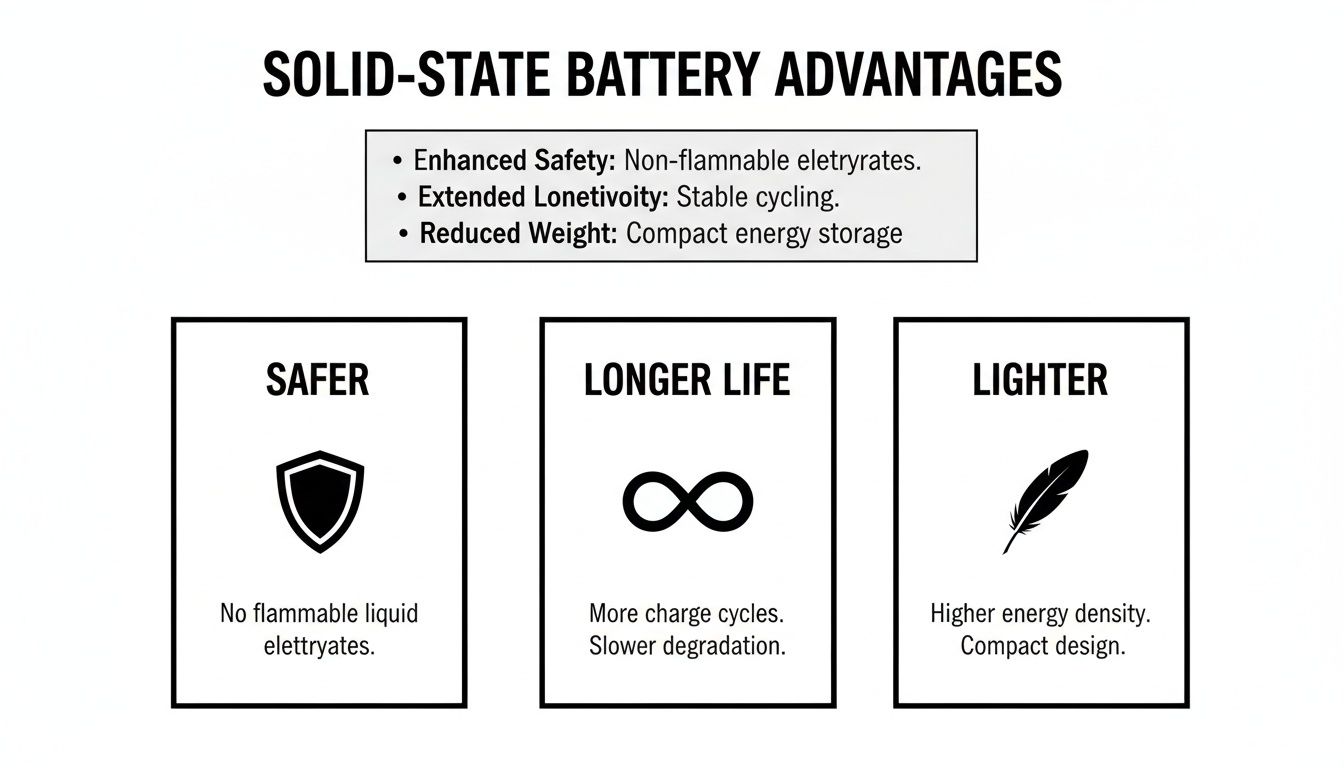
These three pillars—safety, lifespan, and lower weight—are a direct answer to the biggest worries that both current and would-be EV owners share.
Safety and Lifespan: Built to Last
Another little worry with lithium-ion is safety. It's incredibly rare, but the flammable liquid inside can, in extreme cases, cause "thermal runaway"—a technical way of saying the battery gets very hot, very fast. Solid-state batteries completely sidestep this risk. No flammable liquid means no fire. It’s as simple as that.
This natural stability also means they have a much longer life. A solid-state battery is expected to handle far more charge cycles than its liquid-filled cousin, meaning it could easily outlive the car itself. That’s great news for resale values and peace of mind about expensive battery replacements. To see how this fits into the bigger picture, have a look at our deep dive on the latest innovations in electric vehicle battery technology.
The Real-World Impact: Better Cars, Not Just Better Batteries
So, we've got more range, faster charging, and a safer battery. But how does that actually change the car? A lighter, smaller battery pack has a massive ripple effect on a vehicle's design and feel. It lowers the centre of gravity, which makes the car handle better and feel more glued to the road on a winding B-road.
A smaller battery also means more space for you and your stuff. Imagine a family SUV with a genuinely huge boot, or a sports car with a stunning design that isn't compromised by a massive, flat battery taking up the entire floor.
Let's pit these two technologies against each other to see how they stack up for UK drivers.
Battery Brawl: Lithium-Ion vs Solid-State
| Feature | Lithium-Ion (The Old Guard) | Solid-State (The Challenger) |
|---|---|---|
| Max Range | Typically 250-400 miles. Very good, but still requires planning for long trips. | A potential 600-900 miles . This makes range anxiety a thing of the past for almost everyone. |
| Charging Time (10-80%) | A solid 20-30 minutes at a top-tier rapid charger is the current benchmark. | The target is just 10 minutes . As quick as filling up with petrol and grabbing a snack. |
| Safety | Generally very safe, but the liquid electrolyte carries a tiny, theoretical risk of fire. | Inherently safer. The solid electrolyte is non-flammable, virtually eliminating fire risk. |
| Lifespan (Charge Cycles) | Around 1,000-2,000 cycles before significant degradation. Built to last 8-10 years. | Expected to handle many more cycles, potentially lasting the entire lifetime of the vehicle and beyond. |
| Weight & Size | Heavy and bulky, which impacts vehicle efficiency, handling, and interior space. | Far more energy-dense, meaning a lighter and smaller pack for the same range, improving every aspect of the car. |
Of course, the reigning champ isn't going down without a fight. Lithium-ion tech is mature, relatively cheap, and being produced at a colossal scale. For the next few years, it will absolutely remain the dominant power source. But the bell has rung, and solid-state is coming out swinging with a set of promises that could completely redefine what we expect from an electric car.
Which Manufacturers Are All In On Solid State?
Talk is cheap. Any car company can issue a press release with bold claims about a "game-changing" battery. What’s not so easy is sinking billions of quid into the research, development, and mind-bogglingly complex manufacturing needed to actually build the things. So, in the high-stakes poker game that is the future of electric cars, who’s genuinely all in on solid-state, and who’s just bluffing?
The race to bring solid-state battery cars to the showroom is an international grudge match. Automakers know that the first to crack this code will have a monumental advantage, potentially leaving rivals looking like they’ve brought a horse and cart to a Formula 1 race. This isn't just about bragging rights; it's about survival.
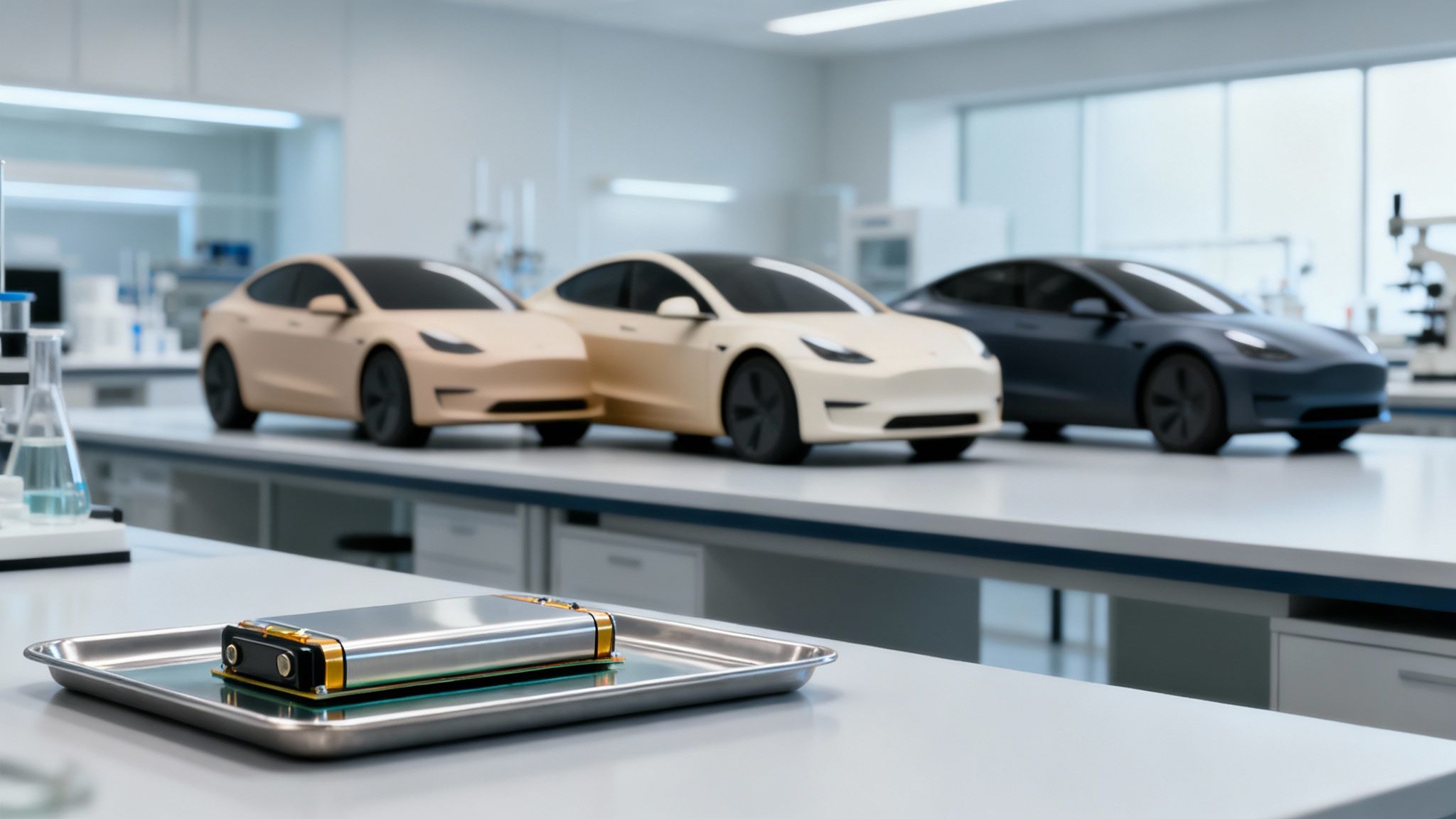
Toyota: The Cautious Giant Wakes Up
For years, Toyota was seen as the class swot who arrived late to the EV party, stubbornly clinging to its hybrid homework. The critics chortled. But it turns out that in the back rooms of their labs, they weren't napping; they were quietly plotting a hostile takeover of the entire battery industry. Now, they’re not just in the race—they’re setting the pace.
Toyota’s confidence is frankly terrifying for its rivals. The company has laid out a definitive timeline, aiming for limited production of its solid-state battery EVs between 2027-2028 . This isn't some vague promise for "the future"; it's a date circled in red on the calendar.
Their claims are equally audacious. We're talking about a potential 900-mile range and a charging time of just 10 minutes . To put that into perspective, that’s enough to drive from Dover to Aberdeen on a single charge and top up in the time it takes to regret buying a service station Ginsters pasty.
By leveraging their decades of experience from hybrid batteries, Toyota is adapting principles like their bipolar cell design to create more compact, efficient, and stable solid-state packs. This isn't a fresh start; it's the culmination of a very, very long game.
As you might expect, their first solid-state models are likely to be premium or high-performance vehicles, where early adopters are more willing to stomach the initial high cost. Don’t expect to see a solid-state Yaris just yet, but a flagship Lexus or a halo sports car seems a dead cert.
Nissan: The Quiet Contender
While Toyota grabs the headlines, don't count out Nissan. They were pioneers with the Leaf, after all, and they have no intention of being left behind. Nissan is also making serious moves, with plans to launch a vehicle powered by their own in-house solid-state batteries by 2028 .
They’re even planning a pilot plant in Yokohama to start producing prototype cells. This is a crucial step that takes the tech from a lab-based theory to real-world manufacturing, and it shows they mean business.
Their approach is slightly different, focusing on all-solid-state batteries (ASSBs) that they believe will be a true leap forward in terms of cost and energy density. Ultimately, Nissan’s ambition is to drive the cost down to a level comparable with petrol cars, making high-performance EVs accessible to everyone. A noble goal, but we'll believe it when we see it.
The German Powerhouses: BMW and VW Group
You can never write off the Germans. The Volkswagen Group (that’s VW, Audi, Porsche, and the rest) has invested heavily in a US-based company called QuantumScape. This partnership is their big bet on solid-state tech, aiming to get these advanced batteries into production cars in the latter half of this decade.
QuantumScape’s work is promising, but they are a battery developer, not a car maker. This means VW’s success is tied to another company's timeline, adding a layer of uncertainty. Still, with the financial might of the VW Group behind them, they are a formidable force.
BMW, in true Bavarian style, is taking a more methodical approach. They are also investing in solid-state development, both internally and with partners, but have been a bit more reserved with their public timelines. They plan to have a demonstrator vehicle running by 2025 but are cautious about promising mass production dates. They're playing their cards close to their chest, but you can be sure they are working furiously behind the scenes.
This corporate chess game is fascinating to watch. Toyota’s early lead seems commanding, but the sheer industrial power of the German giants means they could close the gap frighteningly quickly once the technology matures. One thing is certain—the race is well and truly on, and the winner will redefine the future of driving.
When Can I Buy One in the UK, and Should I Wait?
Right, the million-pound question. After all this talk of 900-mile ranges and ten-minute top-ups, your current EV is probably starting to feel a bit last-generation. The question on every driver's lips is simple: when can I actually get my hands on one of these fabled solid-state battery cars here in the UK?
The short answer? Not tomorrow. But the slightly longer, more helpful answer is that the first wave is much closer than you might think. We're not talking about some far-flung 2040s science fiction anymore.
Toyota, which seems to be leading the pack, is targeting a limited production run between 2027 and 2028 . Let's be clear though, these first models will almost certainly be high-end, eye-wateringly expensive halo cars—think a flagship Lexus or a slinky new sports car. These are for the well-heeled early adopters, the ones who want the ultimate bragging rights at the golf club, not for the weekly shop.
The Mass Market Rollout
For the rest of us, the real action kicks off around 2030 . This is the point where manufacturing should start to scale, costs will hopefully begin their descent from the stratosphere, and other big players like Nissan and the VW Group will be throwing their hats into the ring. By the early 2030s, we should finally see solid-state batteries trickling down into more mainstream family cars.
This timeline isn't just wishful thinking from car bosses; it's getting a serious shove from government regulation. The UK's rapidly evolving EV infrastructure and rules are creating the perfect conditions for this new battery tech. As of 2025, the UK already had over 1.5 million electric vehicles on its roads, with about 20% of all new car registrations being electric.
The government's Zero Emission Vehicle (ZEV) mandate is forcing manufacturers' hands. It sets escalating targets, demanding 80% of all new car sales be electric by 2030 and 100% by 2035 . Car makers who miss these quotas face staggering fines—potentially a cumulative £4.3 billion by 2027 alone. That’s one heck of an incentive to get superior battery tech to market, and fast. For more on the UK's EV policies, the data from sources like Gridserve.com offers some great insights.
So, Should You Hit Pause on Your Next Car Purchase?
Herein lies the dilemma. Knowing this game-changing tech is just over the horizon, should you wait? Is buying a brand-new lithium-ion EV today the motoring equivalent of snapping up a top-of-the-range Betamax player in 1985?
It’s tempting to hold off, but there are a few cold, hard truths to consider before you put your car-buying plans on ice.
Waiting for the perfect tech is a fool's game. There will always be something better just around the corner. The real question is whether today's cars are good enough for your needs right now.
Let's break down the pros and cons of playing the waiting game.
Reasons to Wait (The Pros):
- Future-Proof Performance: You’d be getting a car with next-generation range, charging speed, and safety. It will be a fundamentally better piece of engineering.
- Potentially Better Resale Value: An early solid-state model will likely hold its value far better than the last of the pure lithium-ion cars.
Reasons to Buy Now (The Cons of Waiting):
- Inevitable Delays: Let's be honest, car makers are notorious for missing deadlines. A "2028 launch" can easily slip into 2030.
- The Early-Adopter Tax: The first solid-state cars will be fantastically expensive and will almost certainly have a few teething problems. You'll be paying a hefty premium to be a beta tester on wheels.
- Today’s EVs Are Genuinely Brilliant: Cars like the Hyundai Ioniq 5, Kia EV6, and Polestar 2 are superb vehicles. You'd miss out on years of excellent, zero-emission motoring while you wait for 'the next big thing'.
- Battery Lifespan Isn't an Issue: Modern lithium-ion batteries are built to last. Worries about massive degradation are often overblown, and understanding the real electric car battery replacement cost shows it's not the financial apocalypse many fear.
Our advice? Don’t put your life on hold. If you need a new car in the next couple of years, buy the best EV you can afford today. The current crop of electric cars is more than capable of handling the needs of most UK drivers. By the time your finance deal is up or you're ready to trade in, the solid-state market will be maturing, more affordable, and properly road-tested by those brave early adopters.
The Best Current EV Deal In The UK
Right then, you're sold on the future, but you can't exactly walk into a showroom and drive off in one of these mythical solid-state battery cars . And let's be honest, waiting until 2028 feels like a lifetime away. So, what’s a keen driver to do?
Don't worry, we've done the legwork. We've scoured the UK market to find the best deal right now that gives you a genuine taste of tomorrow's tech, today.
Our top pick is the Hyundai Ioniq 5 on a personal lease. Why this slice of 80s-inspired sci-fi? It all comes down to its 800V electrical architecture . This is the clever bit of kit that lets it charge at frankly ludicrous speeds, getting you as close as possible to that 10-minute solid-state promise without needing a DeLorean.
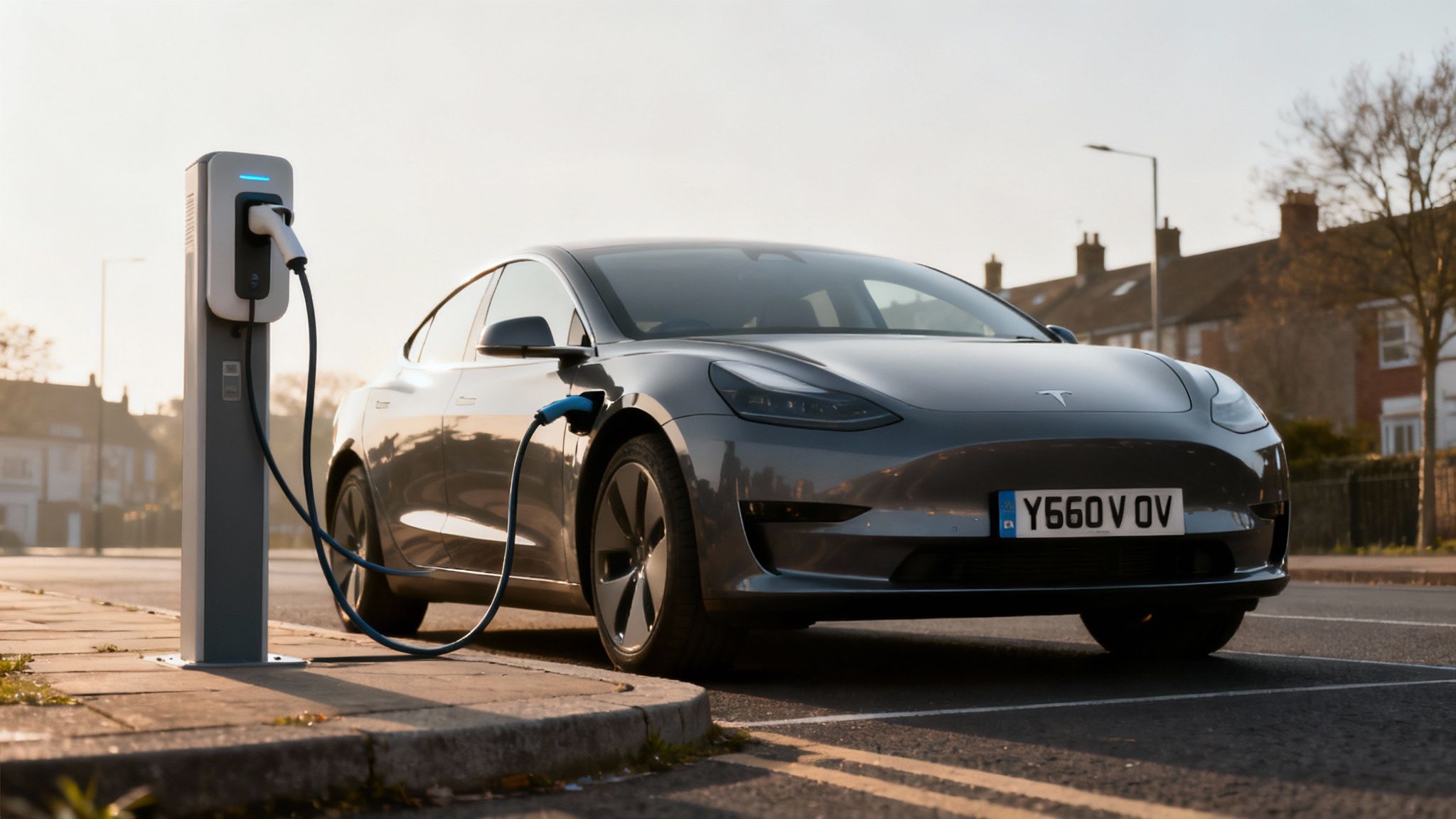
Our Hand-Picked Ioniq 5 Deal
We’ve sniffed out a particularly sharp offer that puts you in the driver’s seat of the 77kWh rear-wheel-drive model. Here are the numbers:
- Initial Payment: £2,500
- Monthly Cost: Around £350
- Mileage: 8,000 miles per year
- Term: 48 months
A deal like this makes the Ioniq 5 a properly compelling option, especially when it leaves many rivals in the dust when it comes to charging. It’s a smart way to get your hands on top-tier tech without the Porsche Taycan-sized hole in your wallet.
This kind of advanced engineering is becoming a big deal across the continent. Europe's solid-state battery market is ballooning, with the UK set to be a major player. The market was valued at about USD 111 million in 2025 and is tipped to reach USD 623 million by 2032. That growth is no surprise; in 2023, Europe churned out enough batteries for roughly 2.5 million EVs . You can read more about European battery market trends to see where things are headed.
The VoltsMonster Road Test
So, what's it actually like on the road? Forget the official figures for a moment. On a typical British A-road, you’ll comfortably see 260-280 miles from the big battery. More than enough for most people's weekly grind.
But the real magic happens when you plug it in. Find a proper 350kW rapid charger, and you can watch the battery go from 10% to 80% in about 18 minutes . That’s genuinely quick enough for a coffee and a comfort break before you’re on your way again.
As for the drive itself, it’s surprisingly comfortable, gliding over our less-than-perfect road surfaces with an elegance you wouldn’t expect from a car with such big wheels. Inside, it’s like a minimalist lounge – spacious, airy, and very clever. The only real grumble is the infotainment system, which has a habit of hiding important settings deep within its menus. It's a small frustration in what is, overall, a brilliantly practical and forward-thinking EV.
Our Verdict On Solid State Battery Cars
So, where does that leave us? After digging through the science, the boardroom promises, and some frankly astonishing numbers, what's the bottom line? Are solid state battery cars the silver bullet that finally wins over the last of the petrolheads, or is this just another case of engineers writing cheques the factory can't cash?
Let's be completely honest. The technology itself is, without a doubt, the future. A potential 900-mile range and a ten-minute pit stop to recharge isn't just an upgrade; it obliterates every major argument left standing against electric cars. It's the promise of EVs that are safer, lighter, and last longer. In theory, it’s the perfect battery.
But – and it's a very big 'but' – it isn't here yet. Not really. While Toyota is confidently pointing to 2028 , the first solid-state cars to hit the road will be prohibitively expensive. Think exclusive playthings for the super-rich, not a practical family car for the weekly shop. Mass-market models you and I can actually afford? They're likely the best part of a decade away.
So What Should UK Buyers Do?
My advice is pretty straightforward: don’t wait. Don't let the promise of tomorrow stop you from enjoying what's available today, because the current crop of electric cars is already fantastic. Buying a top-tier EV now gets you years of silent, cheap, and brilliantly responsive driving. You can let the early adopters pay a fortune to iron out the kinks for everyone else.
The road to the solid-state future is paved with inevitable delays and eye-watering price tags. Don't put your driving life on hold waiting for a perfection that's years away when today’s EVs are already more than good enough for the job.
Think about it. By the time your finance or lease agreement on a new EV ends in three or four years, the solid-state picture will be much clearer. The technology will be proven, the first real-world reviews will be in, and prices will have started their inevitable journey downwards. You'll be in a perfect position to make a smart choice without taking a huge financial gamble.
Ultimately, solid state battery cars are going to completely change the game. They will arrive, and they will be magnificent. For now, though, the smart money is on enjoying the excellent EVs we already have. The revolution is coming, but there's no need to camp out at the barricades just yet.
Right, you’ve made it this far, which probably means you’re either genuinely intrigued or just a glutton for punishment. Either way, you likely have a few nagging questions buzzing around. Let's get them answered, shall we?
Are Solid-State Batteries Actually Safer?
In a word, yes. It's one of their biggest selling points. The key difference is the flammable liquid electrolyte found in current lithium-ion batteries. Solid-state technology gets rid of that completely, swapping it for a stable, solid material that doesn't really want to catch fire.
Think of it like this: a normal EV battery is a bit like carrying petrol in a sturdy plastic container – it’s generally safe, but there's always a risk if it gets punctured. A solid-state battery is more like carrying that same fuel in a solid, inert block. The fire risk just plummets.
This inherent stability doesn't just give drivers more peace of mind; it also gives car designers a lot more freedom in how they package the battery packs.
Will They Make Electric Cars Cheaper?
Eventually, yes, but not straight out of the gate. Let's be realistic: the first cars to feature solid-state batteries will be premium, top-of-the-range models. Manufacturers have sunk billions into R&D and new production lines, and they’ll be looking to recoup that investment from early adopters.
The long-term outlook is much more promising, though. Solid-state designs could reduce the need for expensive and ethically questionable materials like cobalt. Once the manufacturing process matures and scales up, costs should fall significantly. We're likely talking well into the 2030s before they make EVs cheaper than their petrol equivalents, but the potential is definitely there.
How Will They Cope With a Cold, Wet British Winter?
This is where they could be a game-changer for UK drivers. Every EV owner knows the pain of watching their range estimate nosedive on a frosty morning. The liquid electrolyte in today's batteries gets sluggish and inefficient when the temperature drops, which is why your range suffers so much.
Solid-state batteries, with their solid internal structure, are expected to be far less bothered by the cold. Their performance should be much more stable, meaning you won't lose a huge chunk of your range just because you dared to drive in January. That kind of consistent, reliable performance is exactly what UK drivers need.
At VoltsMonster , we cut through the hype to give you the real story on electric cars. For more brutally honest reviews and insights, check out our latest articles on the VoltsMonster website.
VoltsMonster Electric Vehicle Blog