UK's Cheapest New Electric Cars That Don't Cost an Arm and a Leg
For years, the phrase 'affordable EV' felt like an inside joke told by car execs in expensive suits. The idea of an electric car that didn't require a second mortgage was pure fantasy. But thankfully, that era is finally grinding to a halt. The cheapest new electric cars aren't mythical beasts anymore; they're here, and some are surprisingly not terrible.
Welcome To The Age Of Actually Affordable EVs
Let's be honest, the promise of cheap electric motoring has felt like a long, drawn-out practical joke. We were sold the dream of a green future, but the price tags suggested that future was reserved for people who summer in Monaco. A perfect storm of new brands shaking things up, cheaper battery tech, and a mad dash for market share has completely changed the game. The result? A wave of budget-friendly EVs that don't require you to sell a kidney.
This isn't just about feeling smug about saving the planet. It's about cold, hard pragmatism. It’s about saving a fortune on petrol, sidestepping road tax, and driving a brand-new car that doesn't sound like a tractor in its final death throes. We're cutting through the marketing flannel to give you the unvarnished truth.
What We're Actually Comparing
To sort the champions from the chancers, we're focusing on what really matters to your daily life, not the nonsense you’ll find in a glossy brochure. Our criteria are simple and brutally honest:
- Price: The actual on-the-road cost. We’re not getting tangled up in confusing finance deals, just the final number that will make your wallet weep.
- Real-World Range: How far you can actually get on a single charge on a wet, windy Tuesday in Stoke, not in a climate-controlled lab.
- Charging Faff: How long you'll be stood at a service station, nursing a lukewarm coffee and wishing you’d brought a flask.
- Usability: Is the boot big enough for more than a handbag? Does the interior feel like it was assembled with glue and wishful thinking?
Leading the charge is the Dacia Spring, a car so cheap it almost seems like a typo. The Dacia Spring is the undisputed king of affordable EVs in the UK right now, with an eye-watering price starting from just £12,240 after applying the manufacturer's own discount. You can find more details on this budget champion over on Auto Express. This single car has thrown a grenade into the market, forcing every other brand to get serious about value.
For those wanting to dig deeper into what represents genuine bang for your buck, you might be interested in our guide to the best value electric cars in the UK. Below, we'll introduce the main contenders and give a brutally honest first impression of what your hard-earned cash gets you.
| Contender Preview | Starting Price (Approx.) | Key Selling Point | Main Compromise |
|---|---|---|---|
| Dacia Spring | Under £13,000 | Unbeatably low price | Basic... everything |
| Citroën ë-C3 | Under £22,000 | Proper car comfort | Not quite as cheap |
| Leapmotor T03 | TBC (Est. £17,000) | Packed with tech for the price | Unproven brand in the UK |
A Head-To-Head Grudge Match Of Budget EVs
Right, let’s get down to brass tacks. It's one thing to know cheap electric cars exist, but which one is the least likely to give you a serious case of buyer's remorse? It’s time to chuck the main contenders into the ring. We're not just comparing numbers on a spreadsheet; we're thinking about the grim reality of a British winter, a boot full of shopping, and a desperate search for a working charger.
Forget the brochure waffle. We're pitting the Dacia Spring, the Citroën ë-C3, and the mysterious newcomer, the Leapmotor T03, against each other. This is a no-holds-barred contest of practicality, performance (or lack thereof), and pure, unadulterated value.
The Contenders Up Close
First up, the Dacia Spring . Think of it as the Aldi of the EV world: no frills, shockingly cheap, and it does the job surprisingly well. It’s a car that wears its budget credentials like a badge of honour. You can find out more about its spartan charm in our full Dacia Spring review.
Then there's the Citroën ë-C3 . This is the one that wants to feel like a ‘proper’ car. It’s got those famously squishy seats and a ride so soft you could probably drive over a city-centre pothole without spilling your tea. It’s a more comfortable, slightly more grown-up option, but that extra maturity comes with a higher price tag.
Finally, the Leapmotor T03 . This Chinese upstart is trying to muscle in on the scene by offering a boatload of tech for the money. It’s the wildcard, promising gadgets you’d normally find on a much pricier motor, but its long-term reliability and support in the UK are still big question marks.
The real battle isn't just about the lowest price. It’s about which car offers the most liveable compromise. Every single one of these cars cuts corners somewhere; your job is to figure out which corners you can live without.
The chart below shows what most buyers are weighing up when looking at the cheapest new electric cars. It's a tricky balancing act.
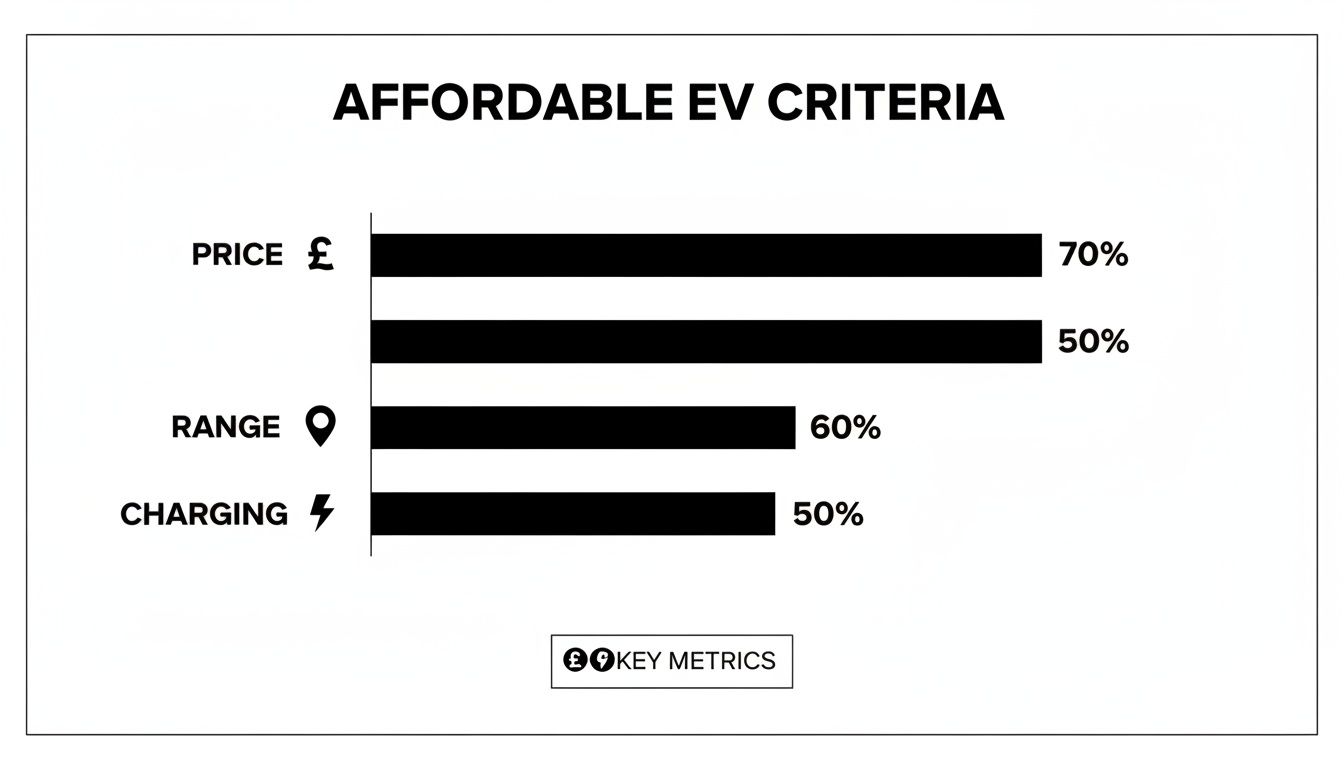
As you can see, the sticker price is still king, but real-world range and charging convenience are massive factors you simply can't ignore.
Price and Positioning
Let's not beat around the bush: the Dacia Spring is the undisputed champion of cheap. After a massive price cut of £3,750 , it’s now firmly the cheapest new electric car you can buy on British roads. That move was a direct shot across the bows of incoming rivals like the Leapmotor.
The Leapmotor T03 is expected to land somewhere around the £17,000 mark, hoping to tempt buyers with extra features for not a whole lot more cash. The Citroën ë-C3, however, starts at just under £22,000 . It's positioning itself as a more premium (ahem) budget option.
Range and Charging Realities
Here’s where the compromises really start to bite. The Dacia Spring offers an official range of 137 miles from its tiny 26.8kWh battery. In the real world, especially in winter, expect closer to 100 miles. That’s fine for city hops but a bit nerve-wracking for anything else. It also has a rather sluggish max charging speed of 30kW , so you’ll have plenty of time to finish your service station coffee. And write a novel.
The Citroën ë-C3 steps things up considerably. Its larger 44kWh battery promises a much more useful 199 miles of official range, and it can slurp electricity at up to 100kW . This makes it a far more viable option if your life extends beyond the M25.
The Leapmotor T03 aims for a middle ground. Its 41.3kWh battery should deliver a respectable range of around 174 miles . Its charging speed for the UK is still to be confirmed, but it's expected to be competitive with the Dacia, if not better.
Budget EV Battle Royale At A Glance
A no-nonsense breakdown of the key stats for our cheapest new electric cars. Forget the brochure waffle, this is what you actually need to know.
| Car Model | On-The-Road Price (£) | Real-World Range (Miles) | Battery Size (kWh) | Max Charging Speed (kW) | Boot Space (Litres) |
|---|---|---|---|---|---|
| Dacia Spring | < £13,000 | ~100 | 26.8 | 30 | 290 |
| Citroën ë-C3 | < £22,000 | ~160 | 44 | 100 | 310 |
| Leapmotor T03 | ~£17,000 (Est.) | ~140 | 41.3 | TBC | 210 |
As the numbers show, the Dacia is the undeniable price king, but the Citroën offers a significant leap in range and charging speed for the extra money, making it a more versatile car. The Leapmotor sits intriguingly in the middle.
So, who wins this grudge match? If your bank account is the only thing guiding you, the Dacia Spring delivers a knockout blow on price. However, if you value comfort and the ability to occasionally leave your postcode without a full-blown panic attack, the extra cash for the Citroën ë-C3 is money well spent. The Leapmotor T03? It remains a fascinating but unproven contender—one for the brave.
The True Cost Of Owning A Budget Electric Car
So, you’ve pulled the trigger and bagged one of the cheapest new electric cars on the market. Congratulations. While your bank balance is breathing a sigh of relief, the purchase price is just the beginning. The real story unfolds in what it costs to live with the thing day in, day out.
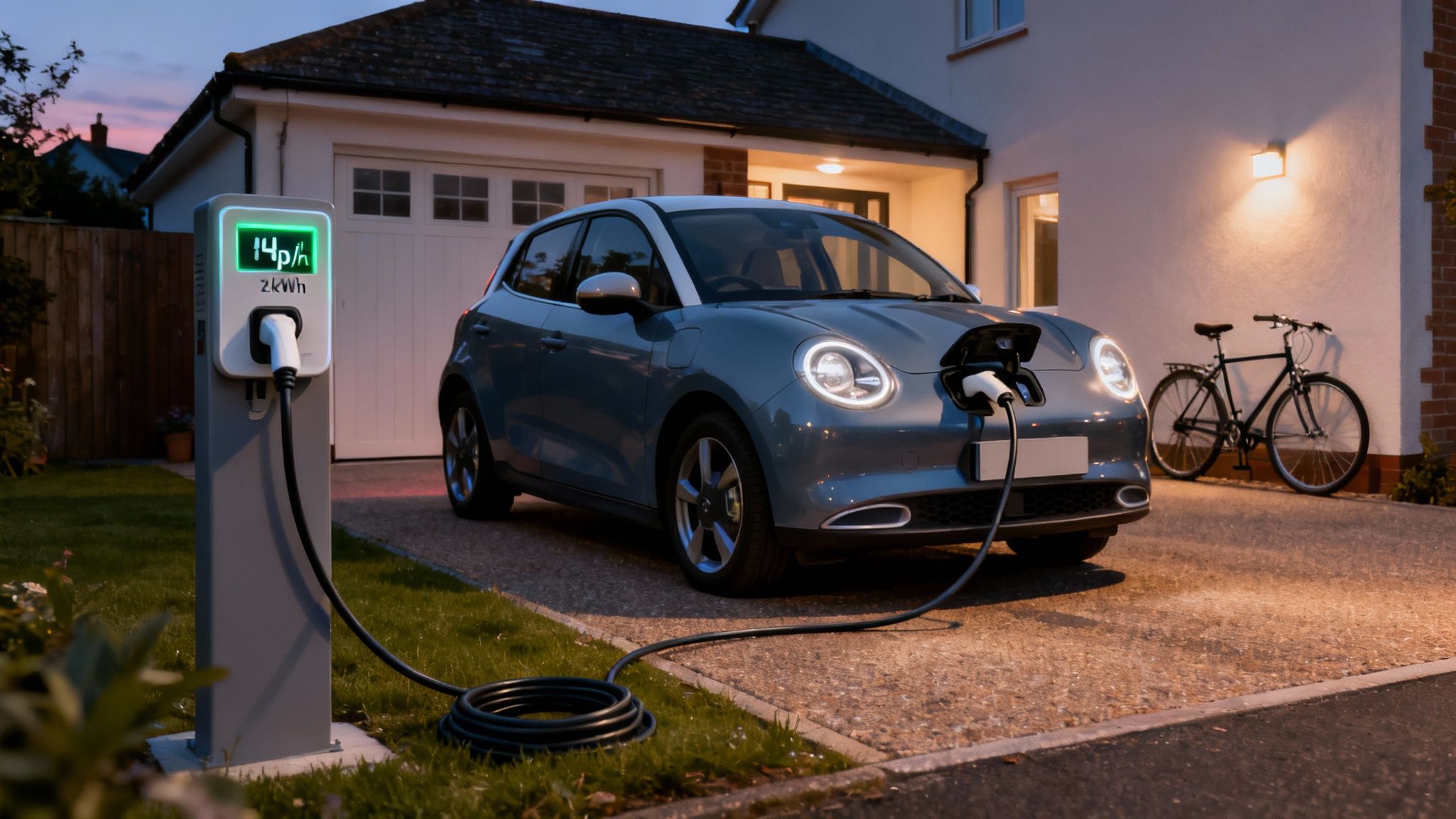
The biggest change, of course, is swapping the grimy petrol station forecourt for the quiet satisfaction of plugging in at home. This is where the dream of affordable EV ownership really comes to life. Forget the dizzying highs and lows of fuel prices; your running costs are now tethered to your home electricity tariff.
Plug in overnight on a cheap off-peak rate, and you're suddenly talking about pennies per mile. With a bit of savvy tariff-shopping, those costs can plummet, making every local trip feel like you’re getting away with something.
Crunching The Numbers: Pence Per Mile
Let's get down to brass tacks. The cost of ‘fuelling’ your budget EV depends entirely on where and when you plug in. It’s a tale of two scenarios: your own driveway versus the wild west of the public charging network.
- Home Charging: This is your secret weapon for savings. If you can secure an off-peak electricity rate of around 7-10p per kilowatt-hour (kWh) , a car with a small battery like the Dacia Spring becomes almost comically cheap to run. A full 'tank' could genuinely cost you less than a fancy coffee.
- Public Charging: This is where things get a lot pricier. Rapid chargers at motorway services are a godsend on a long journey, but they can sting your wallet at 45p to 75p per kWh . Relying on these for your daily charging would wipe out your savings in no time flat.
The trick is to aim for 80-90% of your charging to be done at home. This simple habit transforms your running costs from a volatile lottery into a predictable, low monthly expense. We’re talking costs as low as 3-8p per mile , a figure that’s hard to argue with.
Owning a cheap EV isn't about grand gestures; it's a game of small, consistent wins. The real savings are made overnight while you're sleeping, sipping on cheap electricity. Think of public chargers as a backup for emergencies, not your weekly 'fill-up'.
The Insurance Shock And Servicing Surprises
Now for a potential pitfall many new EV buyers don't see coming: insurance. Insurers are still getting their heads around electric cars, especially the potential cost of repairing or replacing batteries after a prang. This means premiums can sometimes be startlingly high, even for a modest, budget model. It is absolutely essential to get a few insurance quotes before you commit to buying the car.
On the flip side, keeping it on the road is a much happier story. EVs have far fewer moving parts than a petrol or diesel car. There's no engine oil to change, no exhaust system to rust through, and no clutch to wear out.
Servicing is generally cheaper and less frequent, often involving little more than a check-up on the brakes, tyres, and battery health. A cheap EV might feel less substantial than its pricier counterparts, but its mechanical simplicity means there's simply less to go wrong—a massive long-term win. For a deeper dive, check out our article on the real cost of owning an EV compared to petrol cars.
Living With A Smaller Battery And Budget Tech
So, what about the day-to-day reality? Does driving a car with a real-world range of just over 100 miles bring on a constant, crippling anxiety? For most people, the answer is a resounding no. If your car is for the daily commute, school runs, and local errands, a smaller battery is perfectly fine. You just plug it in a couple of times a week, exactly like you do with your phone.
The real compromise with the cheapest new electric cars is usually found inside the cabin. Don’t go in expecting a concert-hall-quality sound system or an infotainment screen that responds with the slick speed of a new smartphone.
Let’s be honest, the user experience can be a bit... basic. App connectivity might be clunky, the plastics will feel hard and scratchy, and you'll forgo the creature comforts found in more expensive models. But that’s the deal you’re making. You're trading a bit of luxury for ludicrously low running costs, and for many drivers, that's a bargain worth striking every single day.
Choosing The Right Cheap EV For Your Life
Let's be brutally honest for a moment. Buying one of the cheapest new electric cars on the market isn't as simple as just picking the one with the lowest price tag. That's a surefire recipe for a miserable ownership experience. The perfect match for you depends entirely on the reality of your day-to-day life.
This isn't a one-size-fits-all game. A car that's a godsend for a city dweller could be a personal hell for someone who has to visit their in-laws three counties away. It’s all about picking the right set of compromises you can happily live with.
Before you get seduced by a tantalisingly low price, you need to have a stern word with yourself about what you actually do with your car. Be realistic, not aspirational.
The City Dweller And Suburban Survivor
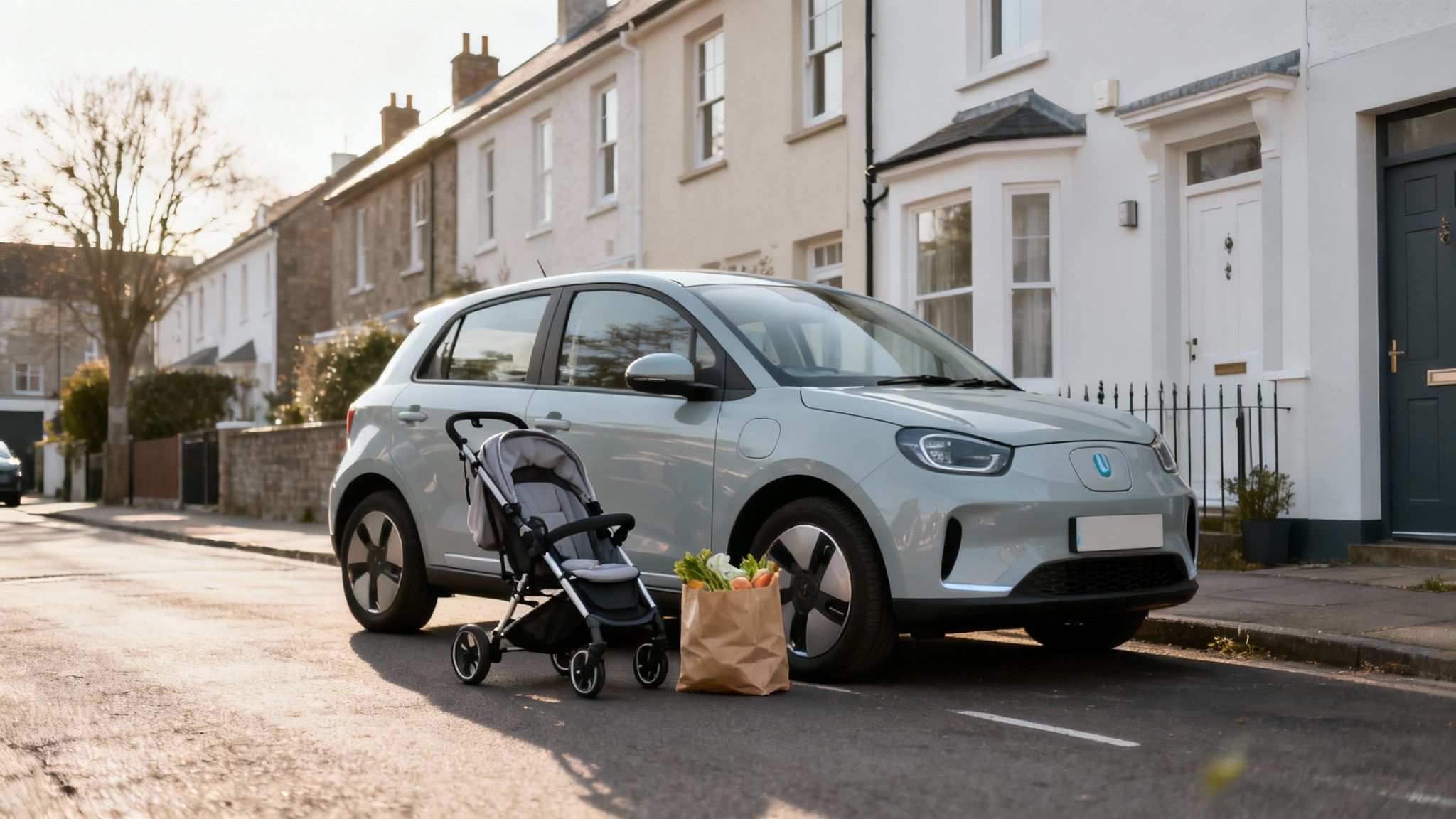
Are your driving ambitions mostly limited to the school run, a weekly pilgrimage to a cathedral-sized Tesco, and the occasional trip into town? If your longest journey is measured in postcodes rather than motorways, you’re in the sweet spot for a true budget EV champion.
For you, a massive battery is just dead weight you’re dragging around for no reason. Range anxiety isn’t really a factor when the furthest you stray from a plug socket is the far end of the supermarket car park. This is where models like the Dacia Spring or the Leapmotor T03 come into their own.
- Your Priorities: Ultra-low running costs, a tiny footprint for nightmare parking situations, and a price that makes you feel smug.
- What You Can Live Without: Blistering performance, a luxurious interior, and the ability to drive from London to Edinburgh without stopping for what feels like three days.
The Dacia Spring, in particular, is purpose-built for this life. It’s a tool for getting from A to B with minimal financial fuss. It’s not exciting, but neither is buying toilet roll in bulk—and both are essential parts of modern life.
The Occasional Motorway Voyager
Perhaps your life is a little more varied. You mostly potter around town, but every few weeks you find yourself on the M1 to visit relatives who had the audacity to move away. For you, the 100-mile real-world range of a basic city EV will induce a cold sweat every time you see a sign for the next services.
This is where spending a few extra thousand quid starts to make a lot of sense. Stepping up to something like the Citroën ë-C3 completely transforms the ownership experience. Its larger battery and significantly faster charging speed turn a potential white-knuckle ordeal into a perfectly manageable journey.
The extra £5,000 for a car like the ë-C3 isn’t just buying you a nicer interior; it’s buying you freedom. It’s the difference between being tethered to your local area and having the flexibility to actually go somewhere.
This is the key decision for many buyers. Do you save the cash and accept the limitations, or do you spend a bit more for a car that imposes fewer restrictions on your life?
The Second Car Commuter
If you're looking for a second car purely to handle the daily grind to work and back, a cheap EV is a masterstroke of financial genius. You already have a bigger family car for weekends and holidays; this new purchase is a specialist tool designed to slash your commuting costs.
In this scenario, you can afford to be ruthless. You don't need a huge boot, acres of rear legroom, or a 200-mile range. You just need a simple, reliable electric appliance that can handle your 20-40 mile round trip five days a week, charging cheaply at home overnight. Again, the Dacia Spring becomes an almost unbeatable proposition here.
This strategy is catching on, with UK EV registrations forecast to explode to 580,000 units as the government's ZEV mandate pushes manufacturers to sell more electric models. Dacia's rock-bottom pricing is perfectly timed to attract budget-conscious buyers who want EV savings without the range anxiety of a single-car household. You can read more about these market trends and Dacia's strategy. Choosing the right cheap EV is all about a frank assessment of your needs, not your wants.
Finding the Best Electric Car Deals Right Now
Right, you’ve seen the contenders and weighed up the running costs. Now for the really interesting bit: finding an actual, tangible bargain that makes one of these cheap EVs an absolute steal. Hunting for the best deals often feels like wading through a swamp of confusing finance offers and small print designed to trip you up. We do the dirty work for you.
Each week, we’ll shine a light on one specific deal that stands out from the crowd. This isn't just about the lowest list price; we're on the lookout for manufacturer incentives, special finance rates, or dealer contributions that turn a good price into a great one. We’ll break it down in plain English, pointing out exactly what makes it a blinder of a deal and which pitfalls to watch out for.
This week, the spotlight falls squarely on the undisputed king of cheap, the Dacia Spring. It’s already the most affordable EV on the market by a country mile, but a current offer makes it even more ridiculously tempting.
Deal Of The Week: Dacia Spring Expression
Dacia, in its infinite wisdom, has decided that even its rock-bottom price wasn't quite low enough. They are currently offering a significant "customer deposit contribution" on their Personal Contract Purchase (PCP) finance deals, which is basically a hefty discount to get you through the door.
Here’s the breakdown of a representative deal available right now, which makes the already outrageously cheap Dacia Spring even more accessible:
- Model: Dacia Spring Expression 65
- On-The-Road Price: £15,995
- Dacia Deposit Contribution: £750
- Customer Deposit: £2,588
- Monthly Payments: £169 over 48 months
- Optional Final Payment: £7,392
What makes this a cracking deal is that £169 a month is less than what many people spend on petrol alone. You're getting a brand-new electric car, with a full warranty, for less than a mid-range phone contract. It’s a genuine gateway into EV ownership without needing to remortgage the house. This tiny city runabout, updated with new motor options, pairs its 24.3kWh battery with chassis tweaks for better handling and faster charging speeds. For more on the latest budget EV specs, you can discover the latest insights on Auto Express.
This isn't just a car; it's a financial calculation. At this price point, the Dacia Spring becomes almost a disposable appliance for modern life. The monthly cost is so low that the fuel and tax savings alone practically cover the payment.
Of course, there are a few things to keep in mind. The 6,000-mile annual limit is tight, so this deal is strictly for local drivers. Go over it, and you’ll be stung with excess mileage charges. You also need to remember the optional final payment—if you want to own the car outright after four years, you’ll need to find over £7,000 . Most people, however, will simply hand it back and jump into a new deal.
For a city dweller or as a second car, this specific Dacia offer is, without a doubt, the sharpest deal on one of the cheapest new electric cars in the UK right now.
Your Burning Questions Answered, No Waffle
Right, you’ve waded through the specs, done the running cost sums, and probably have a favourite in mind. But I’ll bet there are a few lingering questions bouncing around your head. Let's get them sorted, with the straight-talking, no-nonsense answers you need.
Are The Warranties On These Cheap Electric Cars Any Good?
You’d be forgiven for thinking the warranty on a budget EV would be scribbled on a fag packet, but that’s not quite the case. Manufacturers know the battery is the biggest worry for buyers, so they haven't scrimped here. Most offer a separate, much longer warranty just for the battery pack.
Typically, you're looking at cover for eight years or 100,000 miles . This isn't a guarantee against any degradation, but it protects you if the battery's health drops below a certain threshold, usually around 70% of its as-new capacity. For the rest of the car – the tin, plastic, and electrics – you’ll usually get a more standard three-year warranty.
As always, the devil is in the detail. Read the small print. A cheap electric car with a poor warranty isn't a bargain; it’s a potential paperweight waiting to happen.
Will A Cheap EV's Battery Die In A Few Years?
This is the big one, isn't it? The fear that keeps people clinging to their petrol cars. The short answer is a resounding no. That nightmare scenario of the battery packing up the day after the warranty expires is pretty much a myth. Modern EV batteries are engineered to last the life of the vehicle.
Of course, all batteries lose capacity over time – just like your phone. But the rate of decay in a car is far slower than most people imagine. For an average driver doing about 8,000 miles a year , the loss of range after five or six years will likely be so minimal you won’t even notice it day-to-day.
The secret to a long and happy battery life is simply not to abuse it. Don't constantly thrash it on rapid chargers right up to 100%, and try not to leave it sitting fully charged or completely empty for long periods. A bit of care goes a very long way.
Is It Worth Waiting For Even Cheaper Electric Cars?
Ah, the classic tech conundrum. Wait for the next best thing, and you could be waiting forever. It’s true that more budget-friendly EVs are on their way, with new brands eager to get a slice of the UK market. Prices will almost certainly continue to creep down.
But the real question you should be asking is: how much cash are you burning on petrol in your current car while you wait?
If you’re chucking £150 a month on fuel , that's a whopping £1,800 a year that could be going towards a new car payment instead. Do your own sums. If a car like the Dacia Spring works for your life right now, waiting for a hypothetical, slightly cheaper model next year could be a perfect example of false economy.
At VoltsMonster , we cut through the noise to bring you honest, entertaining, and genuinely useful insights into the world of electric vehicles. From reviews to guides, we’ve got everything you need to navigate your EV journey. Explore more at VoltsMonster.com.
VoltsMonster Electric Vehicle Blog