Tesla Battery Life: A Sceptic's Guide for UK Drivers
Right, let's cut the crap. You’re eyeing up a shiny Tesla, but there's a nagging voice in your head wondering if the battery will cark it before you've paid off the finance. The short answer? Not a bloody chance. A modern Tesla battery is engineered to outlast the warranty, the car itself, and probably your fleeting interest in whatever box set you're binge-watching.
Busting the Big Myths About Tesla Battery Life
Forget the horror stories you've heard down the pub. The idea that a Tesla battery just gives up the ghost after a few years is about as believable as a politician's promise. The reality is far less dramatic and a whole lot better for your wallet. These battery packs are seriously tough pieces of kit, engineered for the long haul.
The word you need to get familiar with isn't 'death', but degradation . It’s a bit like your favourite pair of jeans. They don’t just fall apart one morning; they slowly fade and soften after hundreds of washes. A Tesla battery does the same thing, losing a tiny, almost unnoticeable fraction of its total capacity over thousands of miles and countless charges.
What the Real-World Data Says
This isn't just marketing guff; the numbers are in, and they're genuinely impressive. Even in the UK, with our wonderfully unpredictable weather and crumbling roads, Tesla batteries are holding up remarkably well. One study focusing on UK cars found that after seven years on the road, the average Tesla battery still retains an incredible 93% of its original capacity .
That figure lines up perfectly with Tesla's own global data, which shows its Model S and X batteries lose, on average, just 12% of their capacity after 200,000 miles . For anyone who's ever worried about getting stranded on a cold morning in Glasgow, those are reassuring numbers. You can find a deeper dive into these real-world examples on wecovr.com.
So, what does this actually mean for you, the person stuck in yet another traffic jam on the M25? It means your biggest worry should be finding a service station that does a decent coffee, not whether your battery is about to conk out.
The fear of sudden, catastrophic battery failure is one of the biggest myths in the electric car world. In reality, Tesla battery life is a slow, predictable process of gradual capacity loss, not a cliff-edge drop-off. You'll have years of warning before performance is noticeably affected.
Built to Outlast Your Car
Tesla doesn't just bolt its batteries into the car; they are a core, structural part of the vehicle, engineered to outlive almost every other component.
To put that into perspective, your Tesla's battery will likely outlast:
- Your tyres. You’ll get through several sets of these, no question.
- The brakes. Regenerative braking gives them an easy life, but they’ll still wear out first.
- The interior. Especially if you have kids with sticky fingers and a love for melted chocolate.
- The current Prime Minister. Almost certainly.
The bottom line is that the anxiety around Tesla battery life is massively overblown. The technology has proven itself to be incredibly durable. Your car is far more likely to fall victim to a kerbed alloy wheel or a rogue supermarket trolley than a dead battery.
What's Actually Inside the Battery Pack?
Ever wondered what’s going on under the floor of your Tesla? It’s not powered by magic, but by a massive, flat battery pack that’s far more sophisticated than the AAAs in your telly remote. Think of it as thousands of smaller battery cells, a bit like oversized versions of what you’d find in a laptop, all bundled together and managed by some seriously clever electronics.
This whole assembly is called a lithium-ion battery pack , and it's the heart of the car. Its job is to store a huge amount of energy and release it in a controlled, powerful way to drive the motors. But here’s the crucial bit: not all Tesla batteries are created equal. Depending on your car's model and year, you’ll find one of two main chemical recipes inside.
The Great Chemistry Divide: NCA vs LFP
Tesla mainly uses two types of battery chemistry. Knowing which one you have is probably more important than you think, as it directly affects how you should charge your car to get the best long-term Tesla battery life .
First, we have NCA (Nickel-Cobalt-Aluminium) . For a long time, this was Tesla's go-to chemistry, especially for its Long Range and Performance models.
- High Energy Density: NCA packs more punch for its size and weight, which translates directly to more range. It’s the reason these models can go so far on a single charge.
- Charging Rule: These batteries are happiest when they aren't kept at a full charge. The golden rule is to charge to 80-90% for daily driving . This simple habit reduces stress on the cells and helps them last longer.
Then there’s the newer kid on the block, LFP (Lithium-Iron-Phosphate) . You’ll find these in the standard range (or RWD) Model 3 and Model Y vehicles.
- Longer Lifespan: LFP batteries are incredibly durable and can handle more charge and discharge cycles. They tend to degrade even slower than their NCA counterparts over the long run.
- Charging Rule: These batteries love being charged to 100% . In fact, Tesla recommends you do it at least once a week. This helps the Battery Management System (BMS) get an accurate reading of its state of charge, so your range estimate stays reliable.
Understanding your battery type is the single most important thing you can do to preserve its health. Charging an NCA battery to 100% every day is like constantly redlining a petrol engine – you can do it, but you're just wearing it out faster for no good reason.
Why It Matters for UK Drivers
So, which one is better? It’s less a case of better or worse, and more about what’s right for the job. The high-density NCA batteries are brilliant for those long slogs up the M1, giving you that extra bit of range to push on to the next service station. You can learn more about the latest innovations in electric vehicle battery technology to see how these chemistries are evolving.
On the other hand, the robust LFP chemistry is perfect for the daily grind—the school run, the commute, a trip to Tesco. Its willingness to be charged to 100% without a fuss makes it incredibly practical for drivers who just want to start each day with a "full tank," no questions asked.
Ultimately, both are engineered to last for hundreds of thousands of miles, making the battery pack one of the most dependable parts of the car.
How Tesla Batteries Handle Real UK Driving
Forget the glossy brochure figures for a moment. The number you see on paper is one thing, but how a Tesla’s battery copes with a wet Tuesday in Stoke, a glacial crawl around the M25, or a frosty February morning in Aberdeen is what really matters. This is where lab-tested theory meets the grim reality of British roads.
The truth is, your real-world range and the long-term health of your battery are influenced by a unique cocktail of UK-specific factors. Our notoriously unpredictable weather plays a huge part. Cold, damp conditions are the natural enemy of battery efficiency, and you’ll notice your available range dip on winter mornings as the car uses precious energy to heat both the cabin and the battery pack itself.
Then there’s our traffic. The constant stop-start of city driving, say, navigating London’s school run, is actually quite kind to the battery thanks to regenerative braking feeding power back into the system. On the flip side, sitting stationary in a two-hour motorway jam with the heating on full blast will certainly eat into your charge. It's all part of the glorious tapestry of UK motoring.
High-Mileage Heroes and Real-World Data
Despite these challenges, data from actual UK drivers is overwhelmingly positive. These batteries aren't just surviving; they're thriving. And we’re not just talking about cars that pop to the shops. The highest mileage Tesla in the UK, a Model S, has clocked an astonishing 377,989 miles , according to DVSA records. That’s the equivalent of driving around the world 15 times, proving these batteries are built for endurance far beyond the average UK driver's annual 7,400 miles.
Elon Musk himself backs this up, stating that Tesla’s current battery modules are designed to last for 300,000 to 500,000 miles .
This simple breakdown shows the two main battery chemistries Tesla uses—NCA and LFP—and why they behave differently.
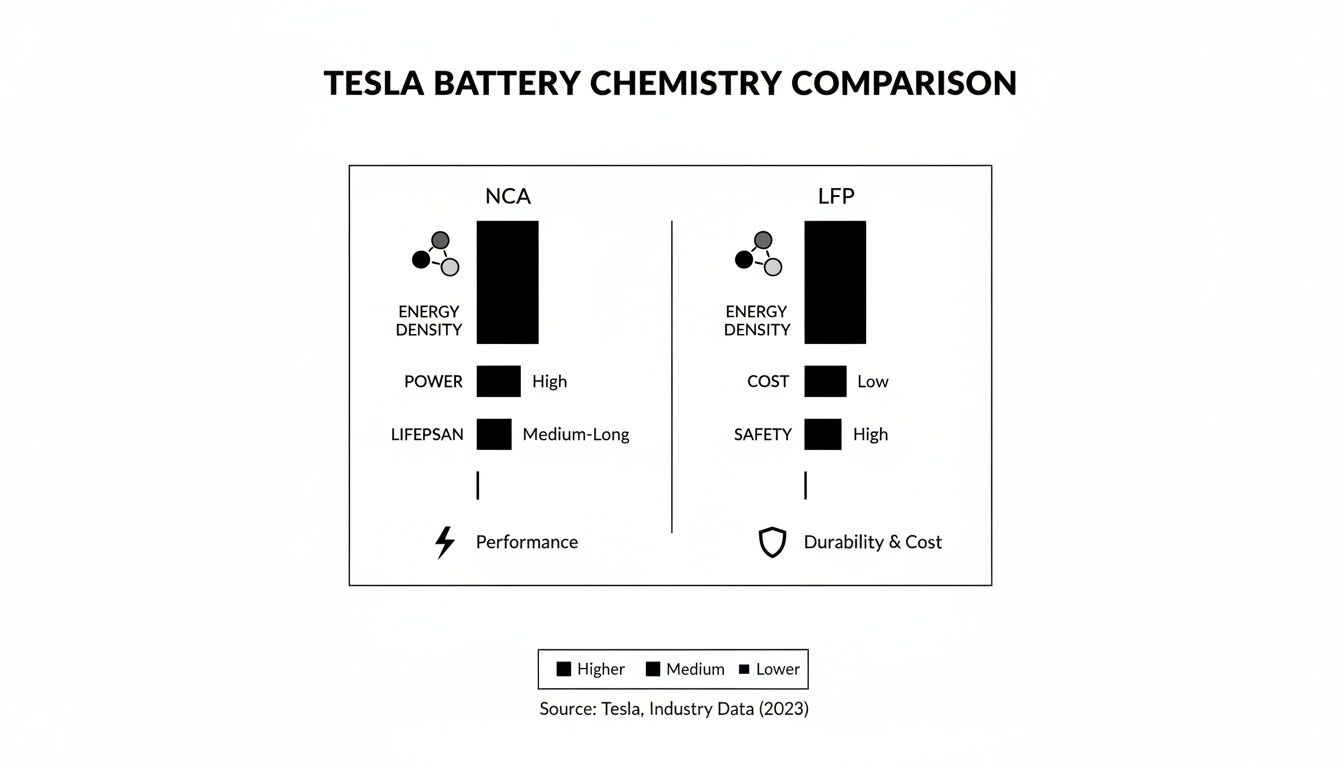
The key difference? NCA batteries pack in more energy for longer range, while LFP batteries offer exceptional longevity and don't mind being charged to 100% regularly.
From Cornwall to the Cairngorms
Let's think about some proper British use cases. A Model X towing a caravan down to Cornwall for the summer holidays will see its range drop significantly because of the extra weight and drag. Conversely, a Model 3 RWD with an LFP battery, used for a daily 50-mile commute across the Midlands, will likely experience almost no noticeable degradation for years, especially if it’s plugged in and charged to 100% at home each night.
The most significant factor in real-world battery performance isn't a single event, but the accumulation of daily habits. Consistent, gentle charging and avoiding leaving the battery at very high or very low states of charge (for NCA types) have a far greater impact than the occasional spirited drive.
The key is to treat official range figures as a starting point. Your driving style, the terrain, tyre pressures, and even how much junk you keep in the boot all play a part. To get a better handle on what to expect from any EV on UK roads, you should check out our guide on electric car real-world range . It’s an essential read for anyone considering the switch.
Ultimately, the evidence from thousands of UK drivers points to one conclusion: a Tesla battery is more than capable of handling everything our unique driving conditions can throw at it. While you might lose some range on a cold day, the long-term health and durability of the pack are exceptionally strong, making total battery failure one of the least likely problems you'll ever encounter.
Understanding Battery Warranty and Replacement Costs
So, what happens if the heart of your Tesla—that multi-thousand-pound battery—decides to pack it in? It’s a valid concern, but the good news is you’re not left completely high and dry. Tesla’s warranty is a pretty solid safety net designed to protect the single most expensive part of your car.
In the UK, a new Tesla's battery and drive unit are covered for eight years . The mileage cap depends on the model, but it’s generous across the board. The Model 3 and Y Long Range/Performance models get 120,000 miles , while the Standard Range Model 3 is covered for 100,000 miles . Older Model S and X vehicles often had even higher mileage limits.
This warranty isn’t just for total failures; it crucially covers significant degradation. Tesla guarantees it will step in if your battery’s capacity drops below 70% within that warranty period. It's their promise that your car won't suddenly have the range of a milk float after just a few years.
What’s the Real Likelihood of Needing a Replacement?
Let's be clear: the chances of your battery actually needing a warranty replacement are incredibly slim. Most owners will see their warranty expire long before their battery health gets anywhere near that 70% threshold.
The data backs this up. Figures from Recurrent show that fewer than 4% of Teslas have needed a battery replacement, and that includes cars that are over a decade old. For EVs made from 2022 onwards, that number plummets to a tiny 0.3% . Even high-mileage heroes, tracked by the DVSA here in the UK, rarely need a new battery. You can dive into the numbers yourself by reading the full research on how long EV batteries last.
The 70% capacity retention clause is Tesla's worst-case-scenario promise. In reality, most batteries will retain well over 80-90% of their health long after the warranty has expired, making a catastrophic failure extremely rare.
Facing the Bill Out of Warranty
But what if you draw the short straw, or you're looking at buying an older Tesla that’s already out of warranty? If the worst does happen, the bill can be eye-watering, but it might not be the financial catastrophe you're picturing. A complete battery pack replacement from a Tesla service centre typically ranges from £10,000 to £15,000 .
Thankfully, a growing network of independent EV specialists across the UK provides a much-needed alternative. These experts can often diagnose and repair individual faulty modules within the pack, rather than swapping out the entire unit. This surgical approach can turn a five-figure invoice into something far more palatable, saving you thousands.
A full replacement is the nuclear option, and it's rarely the only one. For a deeper look at the numbers, our guide on UK EV battery replacement costs is essential reading.
Ultimately, while the potential cost is high, the actual risk is remarkably low. The warranty offers solid peace of mind for the first eight years, and by the time it runs out, your battery will have long since proven its resilience.
Practical Tips for a Long and Healthy Battery Life
Right, let's get practical. You've got one of the most sophisticated battery packs on the planet sitting under your backside, and looking after it is simpler than you might think. It really just comes down to unlearning a few bad habits we've all picked up from our smartphones.
Think of it like this: you wouldn't redline a cold engine, so why treat your battery with the same lack of mechanical sympathy? A little bit of care goes a very long way in keeping your Tesla's battery in peak condition for years to come.
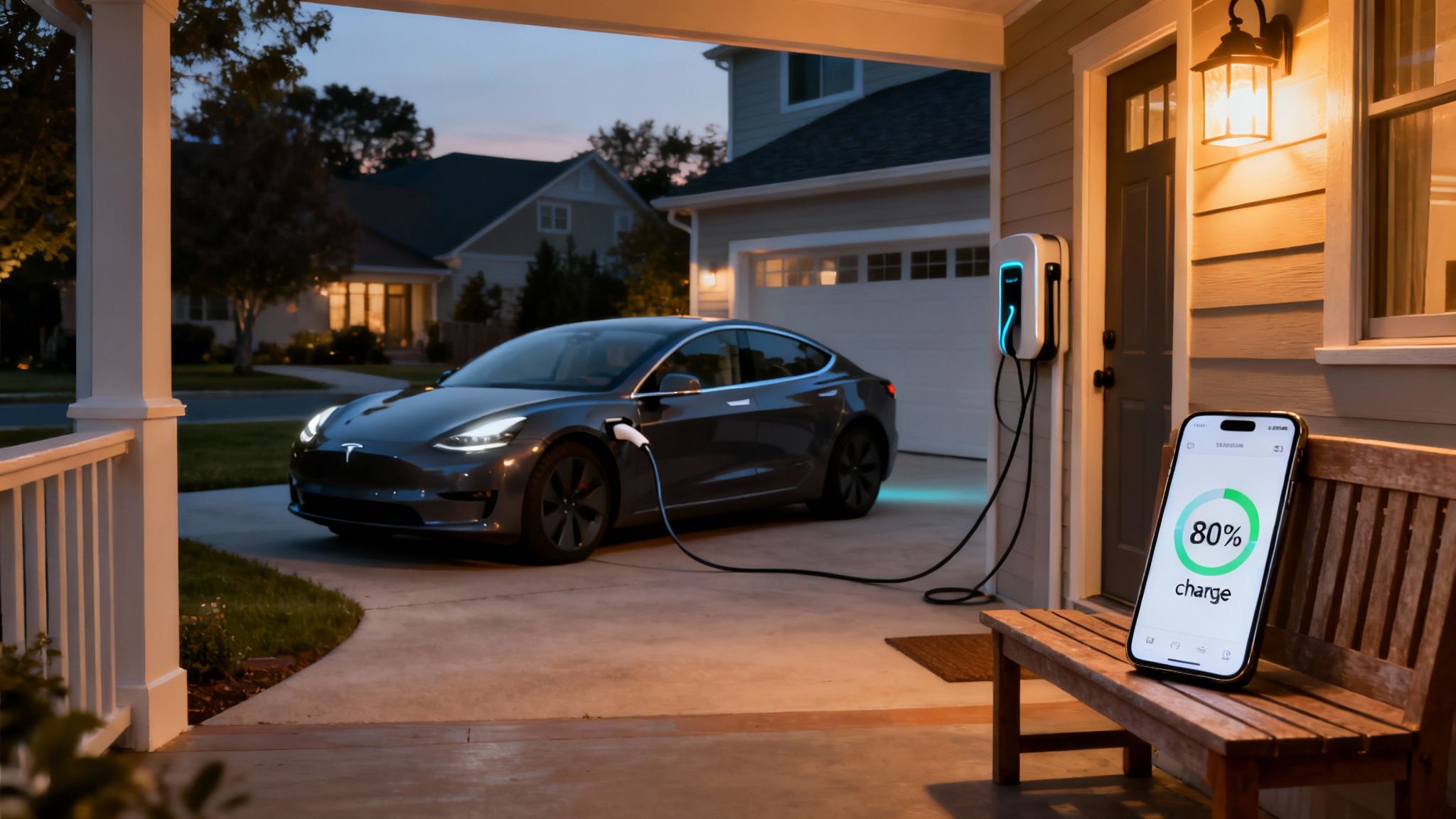
Here's the no-nonsense guide to battery care that will see you right.
Master Your Charging Routine
How you charge is the single biggest factor you can control. Nail this, and you've won 90% of the battle. The first step is knowing which type of battery your car has, as the rules are slightly different.
-
NCA Batteries (Long Range & Performance Models): Embrace the 80% rule . These batteries are happiest when they aren't sitting at extreme states of charge. For day-to-day driving, set your charge limit to 80% in the app. Only push it to 100% when you know you're setting off on a long motorway journey straight away.
-
LFP Batteries (Standard Range / RWD Models): These are the exception to the rule. LFP chemistry is much more resilient and actually benefits from regular full charges. Tesla recommends charging to 100% at least once a week . This helps the Battery Management System (BMS) get an accurate reading, meaning your range estimate stays reliable.
It's not just how much you charge, but how you charge. Supercharging is fantastic when you're crossing the country, but it puts the battery under more strain than a gentle overnight charge at home.
Treat Superchargers like a shot of espresso – great for a quick boost when you’re flagging on a long drive, but not something you want to rely on every single morning. Your home charger is the equivalent of a well-balanced breakfast.
Drive Like You Have a Passenger
Your driving style directly affects battery health. Stamping on the accelerator at every green light is a thrill, but it yanks a massive amount of current from the battery, causing unnecessary stress. A smoother approach is far kinder.
Get to grips with regenerative braking. When you lift your foot off the accelerator, the electric motor works in reverse, slowing the car down and feeding energy back into the battery. It not only boosts your range but also saves a fortune on brake pads. It’s a win-win.
Finally, if you’re parking the car up for a week or two while you jet off on holiday, aim to leave it with a charge of around 50-60% . The car is smart enough to look after itself, but this is the sweet spot for long-term storage.
To make it even clearer, here’s a quick-reference table that pits the good habits against the bad ones.
Do This Not That: A Simple Guide to Tesla Battery Care
| Action | The Smart Way (Do This) | The Daft Way (Don't Do This) |
|---|---|---|
| Daily Charging | Set a limit of 80% (NCA) or 100% (LFP) for everyday use. | Charging to 100% every night and leaving it (NCA batteries). |
| Fast Charging | Use Superchargers for long trips and when you genuinely need a rapid top-up. | Relying on Superchargers for all your daily charging needs. |
| Driving Style | Drive smoothly and use regenerative braking to your advantage. | Aggressive acceleration and sudden braking. |
| Low Battery | Plug in when you get home, even if you have 50% left. Avoid deep discharging. | Regularly running the battery down below 10% . |
| Long-Term Parking | Leave the car with around 50-60% charge if leaving it for over a week. | Leaving it plugged in at 100% or nearly empty for weeks on end. |
Sticking to the "Smart Way" column won't just help you eke out a few extra miles per charge; it will actively preserve the capacity and health of your battery, protecting your car's performance and resale value for the long haul.
Finding the Best Used Tesla in the UK
Right then, let's talk about navigating the used Tesla market here in the UK. It can feel a bit like the Wild West, but if you know what you’re looking for, you can find a cracking deal and avoid any nasty surprises. It's time to get savvy and learn how to spot a gem.
Your first job, before you even think about kicking the tyres, is to investigate the battery. With any electric car, the battery's history and health are everything. We're looking for a metric called the State of Health (SoH) , which is basically a report card on how much of its original juice the battery can still hold.
So, how do you check it? It's not like listening for a rattle in an old petrol engine. The simplest method is to ask the seller to charge the car to 100% and see what range the car's display shows. Then, you just need to compare that number to what it was when it rolled out of the factory.
For instance, a 2020 Model 3 Long Range started life with an official range of around 348 miles. If the one you're looking at now shows 315 miles on a full charge, it's lost about 9.5% of its capacity. For a car of that age, that’s pretty much bang on what you’d expect.
What to Look for in a Listing
As you're scrolling through Autotrader or specialist EV sites, you need to develop an eye for detail. A seller who is upfront about their charging routine is usually a good sign. If they mention that they've mostly used a slow home charger and only hit the Superchargers for the odd long journey, that’s a massive green flag.
Here's a quick cheat sheet for reading between the lines:
- Good Sign: "Mainly charged at home to 80% for daily use. Full service history available. Battery health is excellent."
- Red Flag: "Very fast car. Always charged at the Supercharger for convenience. Range is fine." That second one screams of a life spent hammering the battery with rapid charges, which isn't great for its long-term health.
Another pro tip is to ask the seller if you can access the car's 'service menu'. It’s a bit of a hidden feature, but it gives you a much more detailed breakdown of the battery's condition. You can find guides on how to access it on owner forums – a quick search will show you the way.
Don't be seduced by shiny paintwork and a low price alone. The true value of a used Tesla lies in its battery's condition. A well-cared-for, high-mileage car is often a much better bet than a low-mileage example that's been abused at fast chargers.
Picking the Sweet Spot Model Year
Not all used Teslas are created equal. Over the years, Tesla has constantly tweaked and improved its cars, meaning certain model years offer the best combination of features, battery tech, and value.
A late 2020 or early 2021 Model 3, for instance, is a brilliant buy. These are the 'refresh' models that got the all-important heat pump, which makes a huge difference to your range during a cold British winter. They also benefit from better build quality and a few styling updates compared to the earlier versions.
If a Model S is more your style, look for the post-2016 "Raven" models. These cars got major upgrades to the motors and suspension, making them far more efficient and comfortable to drive. Finding one of these with a solid battery history is the golden ticket.
At the end of the day, buying a used Tesla is all about doing your homework. Check the data, grill the owner on their charging habits, and zero in on the model years known for their solid performance. Get that right, and you’ll drive away in a fantastic bit of kit that will serve you well for years, all while keeping a healthy sum of money in your pocket.
Your Top Tesla Battery Questions Answered
Alright, let's tackle those lingering questions you probably have. Instead of you having to search through owner forums at midnight, we've pulled together the most common queries about Tesla battery life and given them some straight answers.
Think of this as the quick-fire round. Let's dive in.
Will a Cold Snap Kill My Battery?
No, but it's not a fan of the cold. A proper British winter won't cause permanent damage, but it will definitely reduce your battery's efficiency and slash your available range for a while. It’s a bit like us trying to get out of a warm bed on a frosty morning – the battery has to use a chunk of its own energy just to warm up before it can work properly.
The best way around this is to precondition the car while it's still plugged in. This uses power from the mains to warm the battery, meaning you set off with a full "tank" and a warm cabin.
Is It Safe to Let the Battery Run to Zero?
Doing it once by accident isn't a catastrophe, but making a habit of it is asking for trouble. Draining any lithium-ion battery completely flat puts a lot of stress on the cells, and that can speed up degradation over the long haul. Your Tesla has clever software buffers to stop it from becoming truly, chemically bricked, but you should treat 0% range as a genuine emergency.
Think of the bottom 10% of your battery like that emergency tin of beans tucked away in the cupboard. It's there if you're absolutely desperate, but it’s not something you should be planning for dinner every night.
A good rule of thumb is to plug in before you drop below 20% . Simply keeping the battery out of the low single digits is one of the easiest ways to keep it healthy for years to come.
Does the Battery Degrade If I Don't Drive the Car?
Yes, but it's incredibly slow. A parked Tesla will still sip a tiny bit of power to run its onboard computers, often called vampire drain . However, the battery degradation from just sitting there is tiny compared to the wear from regular driving and charging.
If you know you're leaving the car for a few weeks, the best thing to do is park it with a 50-60% charge and leave it unplugged. The car's battery management system is smart enough to look after itself from there, preserving your Tesla battery life .
What’s the Most Overlooked Factor in Battery Health?
Tyres. Honestly. It sounds almost too simple, but your tyres play a huge role in the car's efficiency. Better efficiency means less charging, which means less work for the battery. Under-inflated tyres create more rolling resistance, making the motors work harder and drain more power just to keep you moving.
Check your pressures once a month and keep them at the recommended PSI. It’s a two-minute job that genuinely helps preserve your battery's health by lightening its load. Sometimes the most boring advice is the advice that works.
At VoltsMonster , we cut through the noise to give you the real story on EV ownership. For more brutally honest reviews, guides, and news, check out our latest articles at https://www.voltsmonster.com.
VoltsMonster Electric Vehicle Blog