A Guide to the Battery in a Smart Car
Let's get straight to the point: the battery in a smart car is the most critical, most expensive, and, frankly, most intimidating part of the whole contraption. It's the one component that separates you from gliding silently past petrol stations with a smug grin, or being stuck with a very heavy, very expensive driveway ornament.
So, What Exactly Is This Thing?
First, forget the AA batteries you bung in your TV remote. An EV battery pack isn't one giant Duracell. It’s an incredibly sophisticated piece of kit—a miniature power station, a meticulous thermal regulator, and a hyper-vigilant safety officer, all packaged into one heavy unit under the floor.
This isn't just a tank for fuel; it's the heart and brain of your electric vehicle. The battery dictates everything that matters: how far you can actually drive, how quickly you can dart away from the traffic lights, and—crucially—how much of a dent you'll see in your bank account if something goes pear-shaped.
More Than Just a Box of Sparks
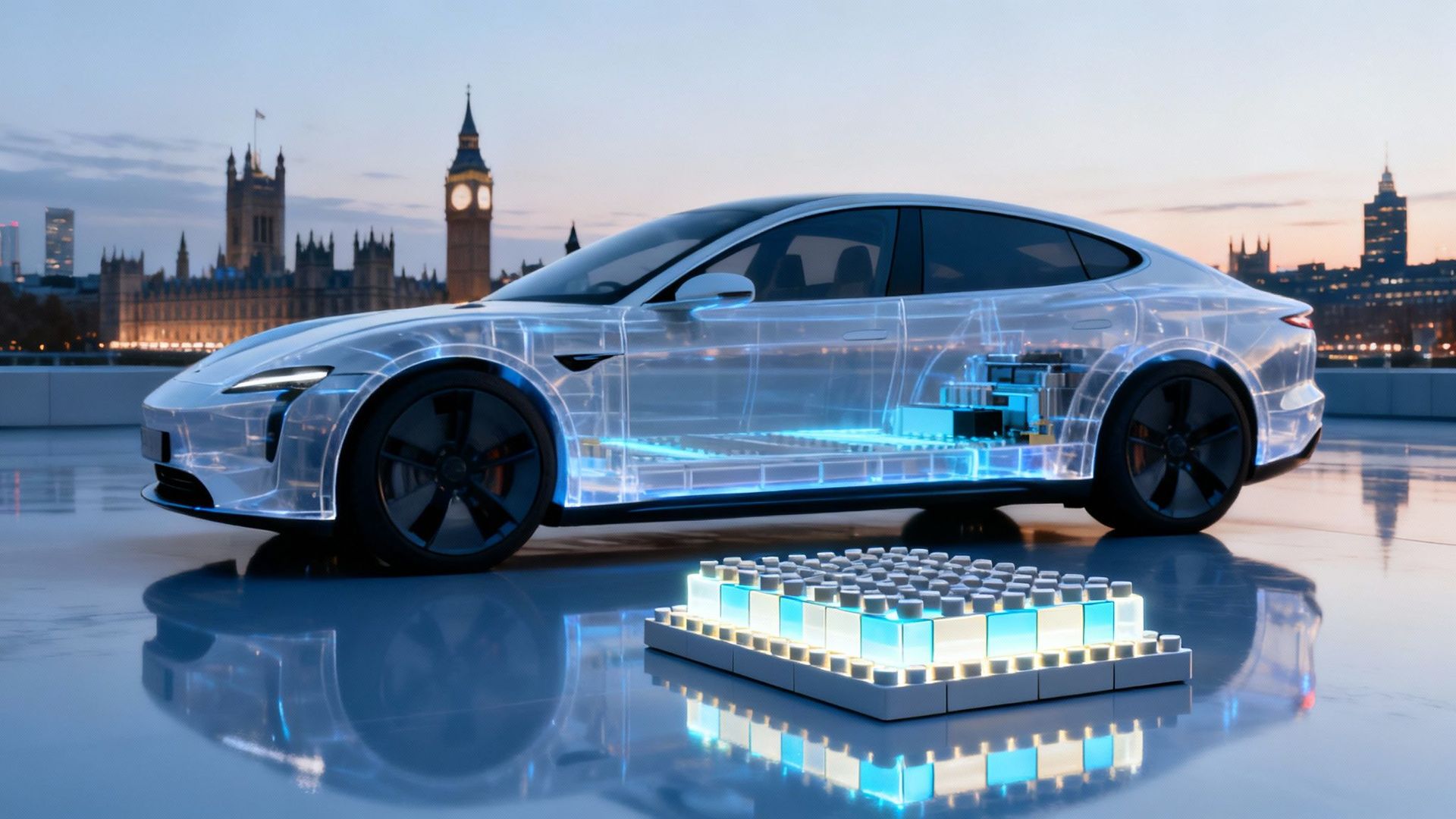
It helps to think of the battery in a smart car like a highly organised library. The entire library is the battery pack . Each bookshelf is a module , and on those shelves are hundreds of individual books, which are the cells . These cells, almost always a lithium-ion chemistry, are where the electrical energy is actually stored and released.
But it’s not just a dumb box of power. The whole system is run by a built-in computer called the Battery Management System (BMS) . This digital mastermind watches over every single cell, making sure they all charge and discharge at the same rate. It keeps them from getting too hot, too cold, or overworked—essentially preventing the whole thing from having a very costly meltdown.
The average degradation rate for an EV battery is around 2.3% per year . This means after eight years on the road, a typical battery should still hold about 81.6% of its original capacity—a much better performance than your average smartphone.
Why You Need to Care
Getting your head around this basic tech is vital for anyone looking to buy an EV in the UK. Why? Because the battery's health, chemistry, and management system directly impact:
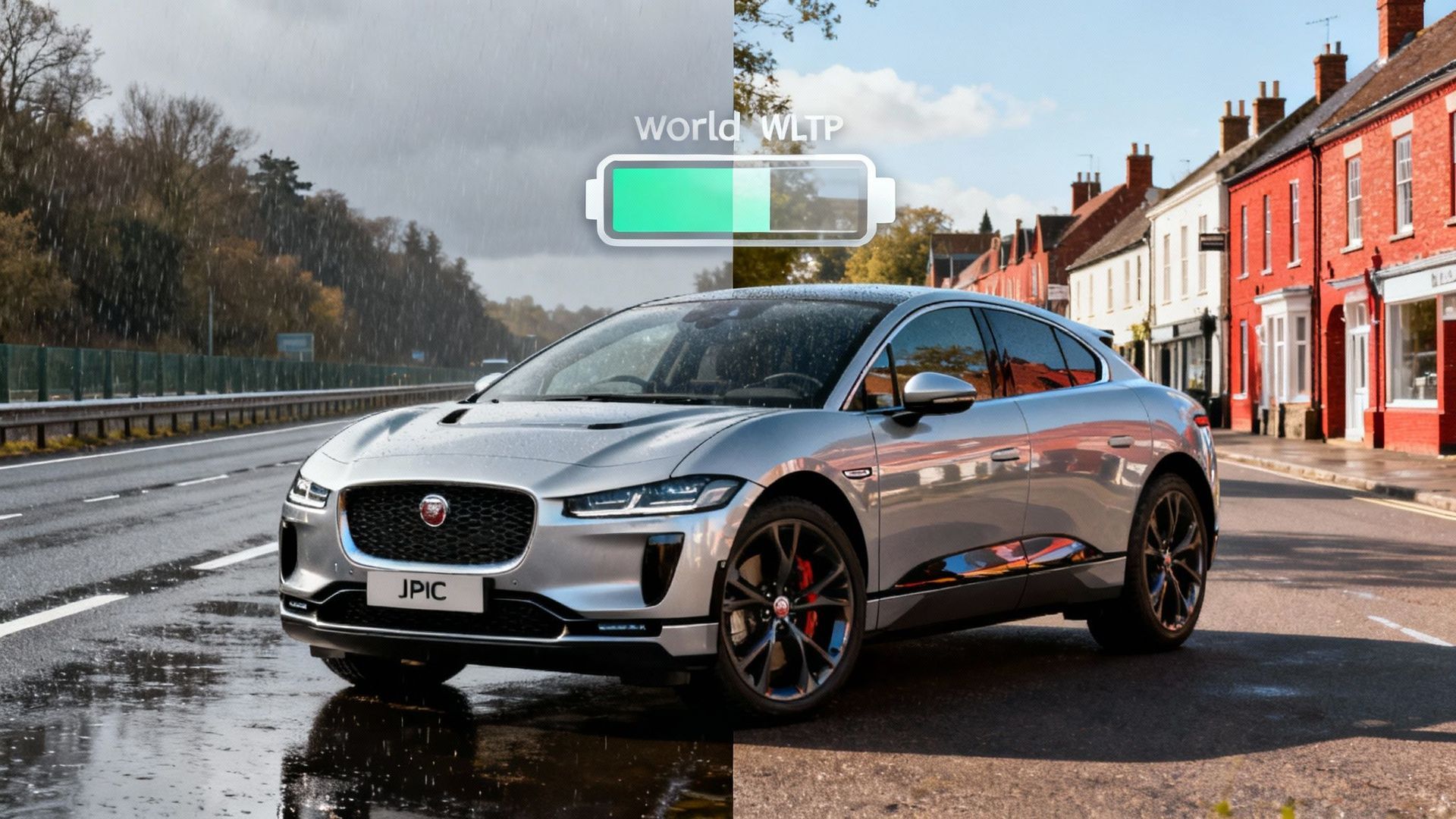
- Real-World Range: The manufacturer's claimed mileage is one thing; how the battery actually performs on a cold, wet Tuesday in November is another entirely.
- Charging Speed: The battery’s design and the BMS dictate how quickly it can safely take on power from a rapid charger without damaging itself.
- Vehicle Lifespan: A well-looked-after battery will often outlast many other parts of the car. A neglected one is a ticking financial time bomb.
- Resale Value: When you come to sell, the first thing any clued-up buyer will ask about is the battery's state of health. It's the single biggest factor in the car's used value.
In the next sections, we’re going to peel back the cover on this technology to look at the good, the bad, and the eye-wateringly expensive. Think of this as your essential pre-flight briefing before you join the electric revolution. Trust me, paying attention now could save you thousands down the line.
Exploring the Inner Workings of an EV Battery
Right, let’s pop the bonnet and see what’s really going on inside that big sealed box under the floor. It’s not some kind of black magic; it’s a brilliant symphony of clever chemistry and even cleverer electronics, all working together to get you to the shops and back without a single puff of smoke.
Think of the battery in a smart car as less of a single brick and more of a highly organised team. This team is made up of hundreds, sometimes thousands, of individual cells, each with a specific job, all contributing to the final result—which, for you, is your driving range and how long that battery will last.
The Chemical Cocktail: What's Your Flavour of Power?
At the very heart of it all is chemistry. Most EV batteries today are part of the Lithium-ion family, but just like any family, it’s full of different personalities. The specific blend of metals used inside the battery’s cathode dramatically changes its performance, cost, and lifespan.
Here are the main types you'll come across in modern EVs:
- NMC (Nickel Manganese Cobalt): This is the popular choice, especially for premium cars. NMC batteries offer a fantastic balance of energy density (that means more miles per charge) and decent power output for zippy acceleration. The downside? The cobalt makes them pricier and brings ethical sourcing into question.
- LFP (Lithium Iron Phosphate): Think of LFP as the rugged, reliable workhorse. These batteries are cheaper to make, don't use any cobalt, and you can regularly charge them to 100% without worrying too much. The trade-off is they're heavier and less energy-dense, so you might get a slightly shorter range from a pack of the same size.
This choice of chemistry isn't just a footnote on a spec sheet; it genuinely dictates the character of the car. The recent surge in UK electric vehicle adoption, which saw pure electrics hit a 23.4% market share, was partly fuelled by big steps forward in these battery technologies. NMC, for instance, is now pushing energy densities towards 300Wh/kg , allowing premium smart cars to boast 400-mile ranges and feel like a proper alternative to their petrol-guzzling cousins.
The Unsung Hero: The Battery Management System
If the battery cells are the musicians in an orchestra, then the Battery Management System (BMS) is the conductor. This onboard computer is arguably the single most important part of the whole setup, responsible for keeping the battery healthy and safe. It’s a hyper-vigilant bouncer, a meticulous accountant, and a worrier of a parent all rolled into one.
The BMS is constantly watching every single cell, checking its voltage, temperature, and the current flowing in and out. Its main jobs are to stop the battery from overcharging, being drained too far, and getting too hot or too cold. It also performs ‘cell balancing’, making sure all the cells are at a similar charge level. This is absolutely critical for maximising both performance and lifespan. Without a good BMS, an EV battery would have the life expectancy of a chocolate teapot.
A sophisticated BMS is the real brains of the operation. It's what allows a manufacturer to confidently offer an 8-year warranty, because it actively protects the expensive battery pack from the most common forms of abuse and premature wear.
Keeping Its Cool: Thermal Management
Finally, we need to talk about temperature. EV batteries are divas; they hate extremes. If it’s too cold, their performance drops off a cliff. Too hot, and you risk damaging them, speeding up degradation, and in a worst-case scenario, triggering 'thermal runaway'—which is every bit as bad as it sounds.
To stop this from happening, manufacturers use clever cooling and heating systems. They generally fall into two camps:
- Air-cooled: A simpler and cheaper method, using fans to blow air over the battery modules. It works, but it’s less effective in really hot or cold weather.
- Liquid-cooled: This is the most common and effective solution. A network of pipes circulates a special coolant through the battery pack, much like a car's radiator system, to keep it in its happy place—usually between 20-40°C .
This kind of system is a must-have for any EV that supports rapid charging, which generates a massive amount of heat. Ultimately, proper thermal management is the key to reliability and making sure the battery in a smart car delivers consistent performance for years to come. For more on this, check out our guide on the latest innovations in electric vehicle battery technology.
Understanding Inevitable Battery Degradation
Let's get one thing straight right away: every battery will lose some of its original gusto over time. It doesn't matter if it's in your phone, your laptop, or your shiny new EV. This process is called degradation , and it’s as natural and unavoidable as death, taxes, and a Friday afternoon traffic jam on the M25.
So, when you see the range on your dashboard drop by a few miles after a year, don’t panic. It doesn’t mean you’ve bought a dud; it just means physics is doing its thing. What you can control, though, is how quickly this happens. The key is understanding which habits are kind to your battery and which are downright destructive.
The Chief Culprits of Battery Ageing
Think of your EV's battery health like a finite resource. Every action you take either chips away at it slowly or takes a big chunk out of its lifespan. The two biggest villains in this story are excessive heat and high voltage.
Repeatedly hammering your car with DC rapid charging is easily the biggest offender. While it’s incredibly convenient for a quick top-up on a long journey, relying on a 100kW+ charger every single day puts immense thermal and chemical strain on the battery cells. In fact, data shows that vehicles frequently using high-power DC chargers can degrade at twice the rate of those that stick to gentler, home-based AC charging.
Another classic mistake is leaving the car parked up for long periods either full to the brim at 100% or completely empty. Lithium-ion batteries are happiest when they’re pottering about in the middle of their charge range, ideally between 20% and 80% . Leaving one at the airport for a fortnight with a full battery is like forcing a sprinter to hold a painful stretch for hours on end—it just causes unnecessary stress.
A Realistic View on Lifespan
Most car manufacturers are confident enough in their tech to offer warranties of around eight years or 100,000 miles . But it's crucial to read the small print. This warranty doesn't promise your battery will feel brand new forever; it typically just covers a total failure or degradation below a certain point, usually around 70% of its original capacity.
The good news is that the average battery degradation rate is a surprisingly slow 2.3% per year . This means that after a typical eight-year ownership period, the battery should still hold over 80% of its initial capacity—more than enough for most people's daily driving needs.
This gradual decline is completely manageable. The trick is to adopt habits that keep you on the gentler side of that average.
- Charging Habits: Prioritise slower overnight AC charging at home. Save the rapid DC chargers for long trips, not your daily routine.
- Parking Smarts: If you're leaving the car for more than a few days, aim for a charge level of around 50-60% , not 100%.
- Driving Style: Constant hard acceleration and braking force the battery to discharge and recapture energy rapidly. This generates more heat and wear over time. Smooth driving is happy driving.
Ultimately, looking after the battery in a smart car isn't about wrapping it in cotton wool. It’s about understanding the basics and avoiding bad habits. For a deeper dive into what you can expect over the long term, you can learn more about how long EV batteries really last in our detailed guide. A little bit of mechanical sympathy goes a very long way in preserving your car's range and, just as importantly, its future resale value.
How to Inspect a Used EV Battery
Right, let's talk brass tacks. Buying a second-hand electric car can feel a bit like a gamble. Get it right, and you've cleverly sidestepped the steepest depreciation, landing yourself a fantastic car for a fraction of the new price. Get it wrong, and you could be facing a repair bill that makes your eyes water.
The decider, almost every single time, is the health of the battery in a smart car . This is your definitive guide to kicking the tyres on a used EV battery. I’m going to arm you with the knowledge to spot a bargain and, just as importantly, to run a mile from a dud. Forget what the seller tells you for a moment; we're hunting for cold, hard data.
The Dashboard Is a Filthy Liar
First things first: the range estimator on the dashboard is almost meaningless when you’re assessing long-term health. It’s a guess, an algorithm’s prediction based on very recent driving. A seller can easily drive like a saint for a week—a practice known as 'hypermiling'—to artificially inflate that number. A full charge showing 200 miles means absolutely nothing about the battery's actual condition.
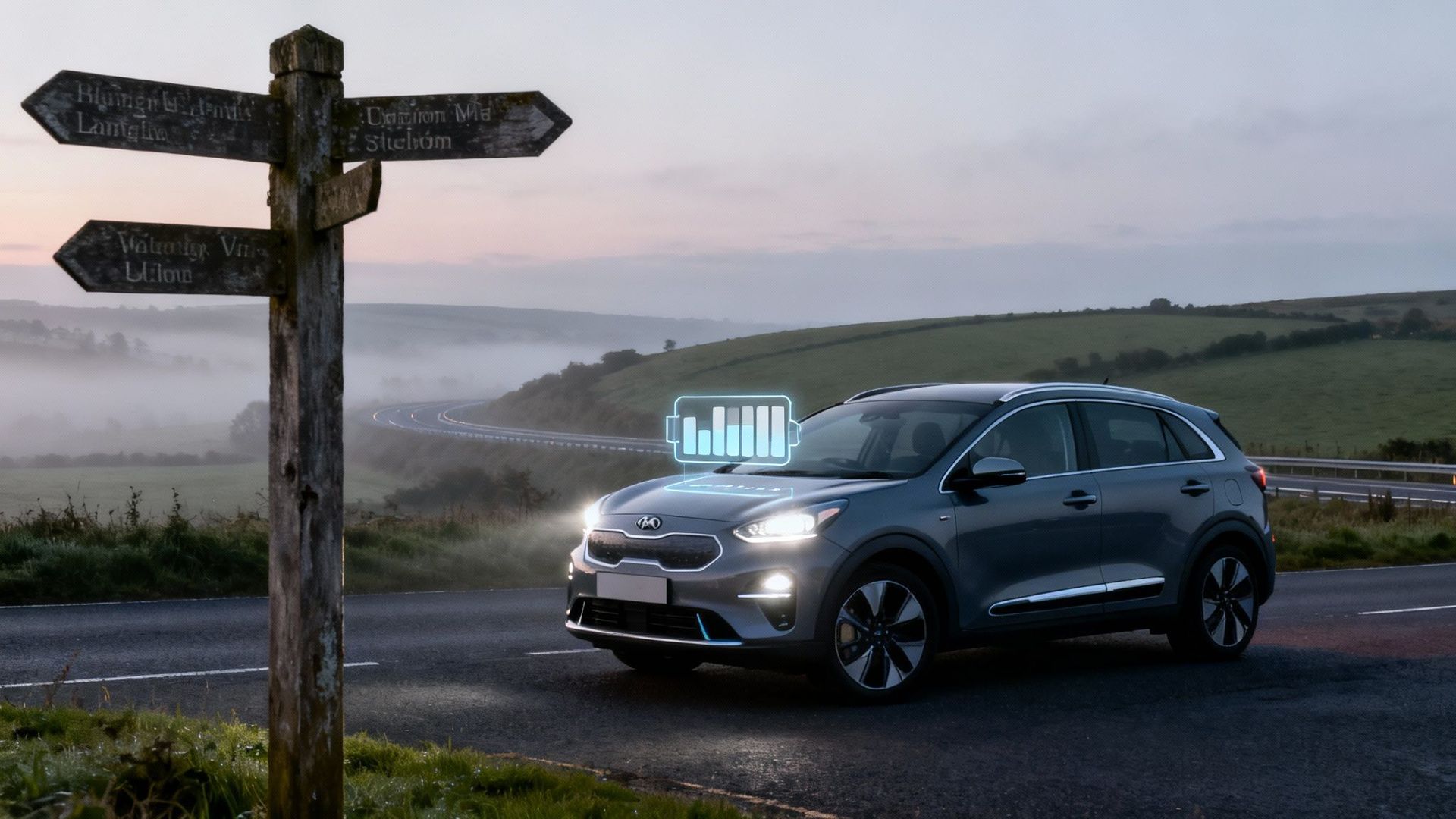
What you really need to know is the battery’s State of Health (SoH) . This is the golden number. It’s a percentage that tells you how much of its original, factory-fresh capacity the battery can still hold. A brand new battery is at 100% SoH ; one that’s been through the wringer might be down to 85% . That 15% difference is thousands of pounds in real-world value.
Getting the Real Story
So, how do you find this magic number? Some cars, like the Nissan Leaf, will actually display a version of it somewhere in the dashboard menus if you know where to dig. Most, however, keep it hidden away. To get the truth, you have two main options.
The first is to get a professional inspection from a dedicated EV specialist garage. They'll plug in their diagnostic tools and give you a proper, printed report. This is the gold standard, but it costs a bit and obviously needs the seller’s cooperation.
The second, and much cheaper, option is a bit of DIY detective work. For less than £30 , you can buy a compatible OBD2 dongle online and download an app like 'Car Scanner' or a model-specific one like 'LeafSpy' for Nissan Leafs. You just plug the dongle into the car's diagnostic port (usually under the steering wheel), connect your phone via Bluetooth, and the app pulls the raw data straight from the car’s brain—including that all-important SoH figure.
Seeing the State of Health with your own eyes is non-negotiable. If a seller is cagey about letting you plug in a dongle or getting a professional report, that’s a massive red flag. Walk away. They're likely hiding something expensive.
Pre-Purchase Checklist and Killer Questions
Once you have the SoH, you can start building a clearer picture. A well-cared-for EV should only lose around 2.3% of its capacity per year on average. If a three-year-old car is showing an SoH of 80% , something is seriously wrong. It’s a sign that the previous owner has probably been hammering it on rapid chargers day in, day out.
Before you even get to the diagnostics, asking the right questions can reveal a lot and show the seller you know your stuff.
Thinking about buying a used EV? It pays to be prepared. Here’s a quick checklist of the crucial points to cover before you commit. Going through these steps can save you a world of trouble down the line.
Used EV Battery Health Checklist
| Check or Question | What to Look For | Why It Matters |
|---|---|---|
| Get the SoH Percentage | An independent reading via an OBD2 dongle or a professional report. Aim for over 90% on a 3-year-old car. | This is the most reliable indicator of the battery's remaining capacity and lifespan. The dashboard range is not trustworthy. |
| Ask About Charging Habits | The ideal answer is "mostly slow AC charging at home overnight." | Constant reliance on high-power DC rapid chargers (over 50kW ) accelerates battery degradation significantly. |
| Check Warranty History | Ask if any battery-related warranty work has been done. | It’s not always a bad sign (a faulty module could have been replaced), but it's crucial information to have. |
| Test Drive From Low Charge | Request to see and drive the car with a low state of charge (e.g., 20% ). | This reveals if the range drops off a cliff at the lower end, which can indicate unbalanced cells or other issues. |
| Discuss Winter Performance | Ask how the range is affected in cold weather. | An honest seller will admit it drops significantly. You're looking for a realistic answer, not a sales pitch. |
By working through this checklist, you arm yourself with the essential data to make an informed decision.
Combining these questions with a genuine SoH reading transforms you from a hopeful punter into an informed buyer. For a more detailed breakdown of what these reports mean, you can read about the truth behind battery health reports on used EVs in our full guide. Doing this groundwork is the single best way to avoid a financial catastrophe and drive away in a genuinely smart deal.
VoltsMonster's Smart Deal of the Week
All this theory about battery health and charging habits is well and good, but it's a bit like describing a great pint of beer instead of actually drinking one. So, let’s put our expertise to the test.
Every week, we dive into the murky waters of the UK's used car market to fish out a real gem—a car that proves you don’t need deep pockets to get behind the wheel of a great EV with a healthy battery.
This week’s find is a 2022 Hyundai Kona Electric 64kWh . We spotted a cracking example with just 40,000 miles on the clock, a complete service history, and a verified State of Health (SoH) of 96% . Now that is what a well-cared-for EV battery looks like.
Why This Kona Is a Cracking Deal
That 96% SoH is the real headline here. For a car that's a couple of years old and has been properly used, losing only 4% of its original capacity is fantastic. It’s a dead giveaway that the previous owner knew what they were doing, likely sticking to a sensible charging routine and not just blasting it on rapid chargers day in, day out.
What does this mean for you? Well, its real-world range is still incredibly close to what it was brand new. Out of the showroom, this Kona would do about 280 miles in fair weather. With its current battery health, you can still bank on seeing around 268 miles . That’s enough to get you from London to Manchester with plenty of range to spare for a detour. It also helps that the car has a liquid-cooled battery pack, which is brilliant for protecting the cells during those essential rapid charges on long trips.
Then there’s the warranty. Hyundai’s battery cover is a solid eight years or 100,000 miles . For this 2022 model, that means you've still got roughly six years or 60,000 miles of manufacturer-backed peace of mind. It’s a huge safety net.
The flowchart below shows the simple, crucial checks we ran to pick this car out from the crowd.
As you can see, it's not rocket science. It's about being methodical: check the battery's health, understand its past, and make sure it drives exactly as it should.
Crunching the Numbers
So, what about the cost? We found this specific Kona up for £17,500 . Let’s stack that up against a petrol equivalent, say a 2022 Ford Puma, which goes for similar money.
- Fuel Savings: A petrol Puma gets around 45 MPG . With petrol at £1.50/litre , driving 10,000 miles a year will set you back about £1,515 . Charging the Kona on a cheap overnight tariff ( 7p/kWh ) costs a paltry £175 to cover the same distance. That's an instant saving of £1,340 a year.
- Tax and Maintenance: The Kona owner pays £0 in road tax; the Puma driver forks out £190 every year. Plus, with way fewer moving parts to go wrong, servicing the Kona is a lot friendlier on the wallet.
Over three years, the Kona owner is looking at potential savings of well over £4,500 compared to sticking with petrol. That’s the real-world power of finding a used EV with a battery in great nick.
And this isn't a one-off. While the Tesla Model Y often grabs the headlines as the UK's top seller, offering up to 331 miles of range, savvy buyers know that incredible value lies elsewhere. The Kona is the perfect example of a brilliant battery in a smart car without the flashy price tag. You can see more about the UK's EV sales trends on best-selling-cars.com.
Our Final Verdict on Smart Car Batteries
So, where does that leave us? After digging into the chemistry, the tech, and the real-world practicalities, it’s clear the battery in a smart car is a magnificent bit of kit. It's a marvel of engineering that silently powers our journeys. But let's be honest, it isn't forged from mythical unobtanium, and it won’t last forever.
The main takeaway from all this is refreshingly simple: you need to cut through the noise. Ignore the breathless hype from manufacturers promising eternal battery life, and equally, ignore the scaremongering from die-hard petrolheads convinced your car will turn into a useless brick after three years. The truth, as it so often does, lives somewhere in the sensible middle.
Show your battery a bit of respect, and it will serve you faithfully for a very, very long time.
The Essential Recap
Your car's battery doesn't ask for much, but a little mechanical sympathy goes a long way. To keep it in fine fettle and protect your investment, just remember these golden rules:
- Charge Smart: For day-to-day top-ups, stick to slower AC charging at home. Save the high-power DC rapid chargers for those long hauls up the M1 when you really need them.
- The 20-80% Guideline: It's not a strict commandment, but trying to keep your battery within this range for daily use really does reduce the stress on the cells.
- Do Your Homework: When you're buying a used EV, the State of Health (SoH) is your bible. A cheap OBD2 dongle is the best thirty quid you’ll ever spend, believe me.
The battery in a smart car is not something to be feared, but it absolutely must be understood. Being battery-savvy is no longer a niche interest for nerds; it's an essential skill for every modern driver.
As the UK’s roads continue to fill with electric vehicles, this kind of knowledge becomes ever more crucial. The market is absolutely booming, with a recent year seeing a record 473,348 new battery electric vehicles registered—a staggering 23.9% increase from the year before.
This surge means nearly one in four new cars sold was fully electric, creating a vibrant used market with over 1.75 million EVs now navigating British roads. For savvy buyers, this is a golden opportunity. You can find out more about these growing EV sales trends on YouTube.
You’re now officially armed with the knowledge to make a properly informed choice. Go forth and drive silently.
Got a Few Lingering Questions?
It's natural to have a few questions still rattling around. Let's tackle some of the most common ones we hear about the batteries in smart cars, with straight-to-the-point answers.
What's the Real Cost of a New Battery?
Let's get straight to it – it’s a hefty bill. If you find yourself out of warranty, replacing the entire battery pack is easily the biggest potential expense of owning an EV. For a standard family car, you could be looking at a cost between £5,000 and £15,000 , and even more for the premium, high-performance models.
But here’s the crucial bit: needing a full replacement is incredibly rare. It’s far more likely that a single faulty module might need swapping out, which is a much, much cheaper job. In reality, most EV batteries are built to last longer than the car they're in.
Can You Jump-Start an Electric Car?
Ah, the classic question. The simple answer is yes, but it’s probably not what you're thinking. Your electric car actually has two batteries. There's the massive high-voltage pack that powers the motors, and then there's a tiny 12-volt battery —just like the one in a petrol car—that runs all the onboard electronics like the lights, infotainment, and computers.
If that little 12V battery dies, the car won't "turn on" because the main systems can't wake up. You can absolutely jump-start this 12V battery with a booster pack or another car, just as you would any conventional vehicle. This gets the electronics humming again, allowing the main high-voltage battery to do its thing. What you can't do is use jump leads to put charge into the main drive battery.
Is it Safe to Charge an EV in the Rain?
Completely. Car makers know it rains a fair bit in the UK, so they've engineered EVs and chargers to handle it. The whole system is packed with safety features, from heavy-duty waterproofing to automatic cut-outs that trip instantly if they sense any moisture getting somewhere it shouldn't.
Charging your EV in a downpour is perfectly safe. The connectors are fully weatherproofed, and there are multiple layers of safety protocols to eliminate any risk of electric shock. So, you have absolutely nothing to worry about.
Does the Battery Warranty Actually Cover Degradation?
It does, but you need to read the small print. In the UK, most manufacturers provide a battery warranty for around eight years or 100,000 miles. This warranty isn't a promise that your battery will perform like new for that whole time. It's a safety net.
The warranty usually only applies if the battery's capacity falls below a specific level—typically 70% —within that timeframe. So, if your battery health drops to 75% after seven years, that's considered normal wear and tear and isn't covered. If it unexpectedly dives to 65%, that’s when you’d make a warranty claim.
At VoltsMonster , our mission is to cut through the noise and give you the real story on EVs. For more honest guides and reviews, explore all our content.
VoltsMonster Electric Vehicle Blog