Kia Niro EV Range: A Brutally Honest Guide for UK Drivers
On paper, the official Kia Niro EV range is a perfectly respectable 285 miles (WLTP). But let's be honest, that figure was cooked up in a lab, probably by someone who's never had to navigate the M25 on a wet Friday with three screaming kids in the back. In the real world of surprise traffic jams and a desperate need for the heater, you’ll be looking at a rather different number.
Think of it more like 260 miles on a balmy summer's day and a rather more bracing 220 miles when Jack Frost is nipping at your knackers .
The Great British Range Robbery: What Really Happens
Welcome to the age-old tug-of-war between an electric car's brochure stats and the gritty reality of UK driving. The official test, the snappily-titled Worldwide Harmonised Light Vehicle Test Procedure (WLTP), is a standardised affair. The trouble is, it conveniently forgets about the Peak District's relentless hills or a car packed to the rafters for a bank holiday trip to Cornwall.
It's the automotive equivalent of a dating profile picture – technically accurate, but missing some very important context. This is where range anxiety, that modern-day malady, is born.
The Kia Niro EV, with its 64.8kWh battery pack , certainly makes a strong case for itself, waving that impressive 285-mile official range about. This figure is based on achieving around 4.4 miles per kWh . However, as many owners and reviewers like the chaps over at Carwow's detailed review have found, a more realistic figure is closer to 260 miles once you factor in typical UK driving.
Official Claims vs VoltsMonster Reality
Right, let's cut through the marketing guff and talk about the numbers that actually matter. Forget the pristine test tracks and imagine a drizzly Tuesday commute instead. The official range is a useful starting point, but it's not the finish line.
The chart below shows the stark difference between Kia's lab-tested figures and what you can genuinely expect during a rare British heatwave versus a miserable, frost-bitten winter morning.
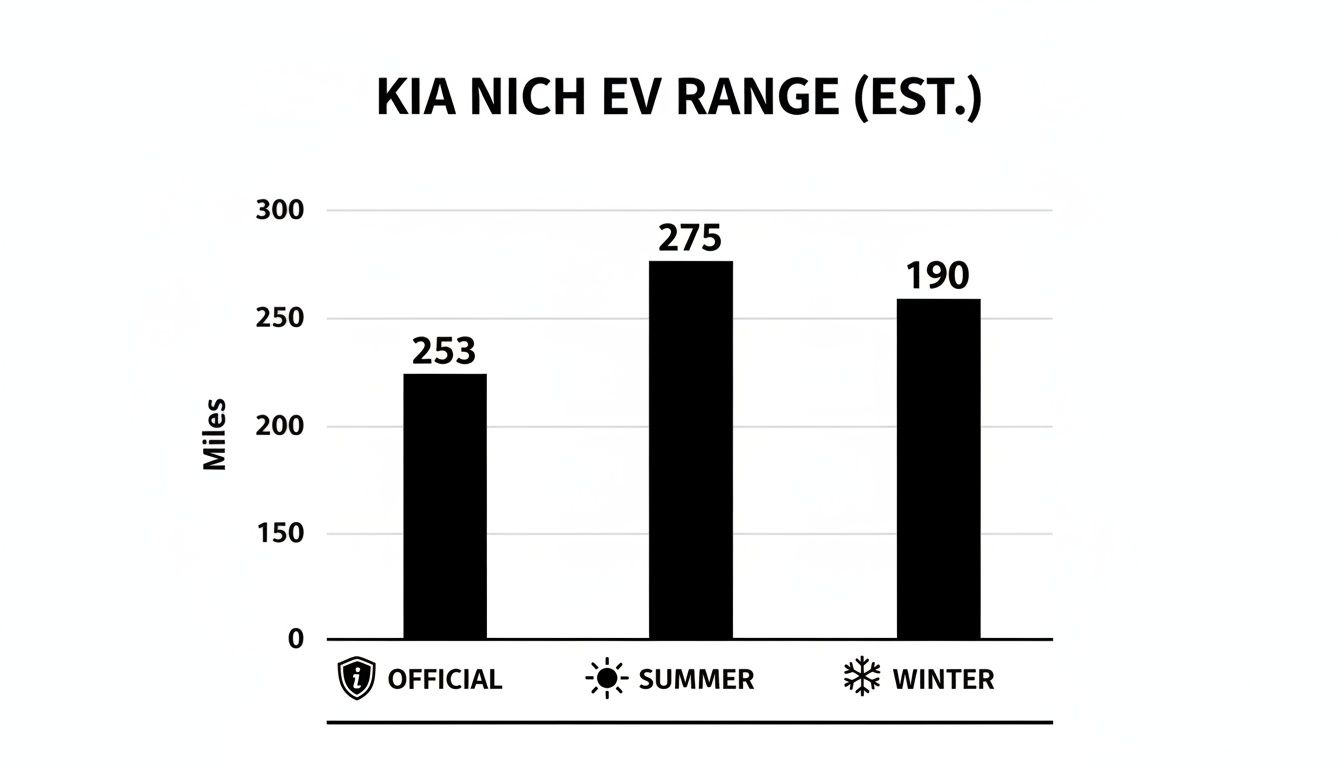
As you can see, that winter drop-off is no joke. It's a sharp reminder that your EV's battery hates the cold just as much as we do.
Kia Niro EV Range At A Glance: Official vs Reality
To put it simply, is the Kia Niro EV range enough for you? For the average UK driver, whose daily mileage barely scratches 30 miles, it's more than ample. But for those longer hauls, knowing the variables is everything.
The table below gives you a quick, no-nonsense summary, comparing Kia's shiny brochure numbers against what we at VoltsMonster have found to be true out on the road.
| Driving Condition | Official WLTP Range (Miles) | VoltsMonster's Real-World Estimate (Miles) |
|---|---|---|
| Urban Commute (Summer) | 285 | ~265 |
| Motorway Run (Summer) | 285 | ~240 |
| Mixed Driving (Winter) | 285 | ~220 |
| Motorway Run (Winter) | 285 | ~190 |
This isn't here to scare you off. It’s here to arm you with the facts. An EV, even a brilliant one like the Niro, is a machine governed by the laws of physics, not the rules of marketing. A heavy right foot, blasting the heating, and cruising at a steady 70mph are the chief culprits in this range heist.
Consider this your primer for deciding if the Kia Niro EV really has the legs for your lifestyle.
Why Drivers Are Ditching Petrol for the Kia Niro EV
Ever spotted a convoy of silent Kia Niro EVs gliding past a petrol station and wondered what they’re running on? It’s not witchcraft; it’s a calculated escape from the tyranny of the pump. The move from internal combustion to electric isn’t just some fleeting trend anymore—for thousands of savvy UK drivers, it's become the default, common-sense choice.
The reasons are stacking up faster than rush-hour traffic on the M6. It's the perfect storm of smart financial incentives, the sheer convenience of waking up to a full battery, and the quiet satisfaction of knowing you’ll never again handle a greasy pump on a freezing Tuesday morning.
And this isn't a niche movement. The numbers show a huge swing towards pure electric, with the Kia Niro EV range making a compelling case. In fact, Kia reckons that by 2026, a whopping 60% of all Niro family buyers will go for the zero-emissions EV. That absolutely dwarfs the 35% expected to choose the self-charging hybrid and the tiny 5% for the plug-in hybrid, a trend highlighted in this in-depth Auto Express analysis.
The Tax Man Becomes Your Best Mate
For company car drivers, the financial argument for the Niro EV is nothing short of a slam dunk. Thanks to the way the UK's tax system is set up, choosing an electric car is like getting a pay rise you didn't even have to ask for.
It all comes down to Benefit-in-Kind (BiK) tax. While a petrol or diesel car might see you handing over a hefty chunk of your salary to HMRC each month, the Niro EV sits in the lowest possible tax band. For the 2024/25 tax year, the BiK rate for zero-emission vehicles is a mere 2% .
To put that into perspective, a similar petrol-powered SUV could easily attract a BiK rate of over 30% . Over a few years, that difference translates into thousands of pounds saved—money that stays firmly in your pocket, not the tax man’s.
Dodging the Urban Tolls
The savings don't stop there. For anyone who drives in or around the capital, the Niro EV is a golden ticket, letting you bypass some of the city's most eye-watering charges.
Owning a Niro EV in London is like having a VIP pass. You get to waltz past the Congestion Charge and ULEZ barriers without paying a penny, saving drivers up to £27.50 every single day they enter the zones.
Here's how the Niro EV helps you beat the city's charges:
- London Congestion Charge: As a zero-emission vehicle, the Niro EV is 100% exempt until December 2025. That’s a potential saving of £15 per day .
- Ultra Low Emission Zone (ULEZ): The Niro EV sails through the ULEZ standards, meaning you avoid the £12.50 daily charge .
- Vehicle Excise Duty (VED): Commonly known as road tax, VED is currently £0 per year for new electric cars, saving you hundreds compared to higher-emission models over the first few years.
The Feel-Good Factor of Going Electric
Beyond the cold, hard cash, there's a powerful psychological shift that comes with owning a Niro EV. Waking up every morning to a "full tank" after charging overnight for a pittance is a genuinely liberating feeling. The quiet, smooth acceleration offers a more refined, relaxing drive, turning the daily commute from a noisy chore into a serene glide.
This cocktail of real-world savings and day-to-day convenience makes the switch feel less like an eco-conscious sacrifice and more like a seriously smart upgrade. It’s a clever power move that's quickly turning the Kia Niro EV into the go-to choice for UK families.
How Weather and Speed Mangle the Kia Niro EV Range
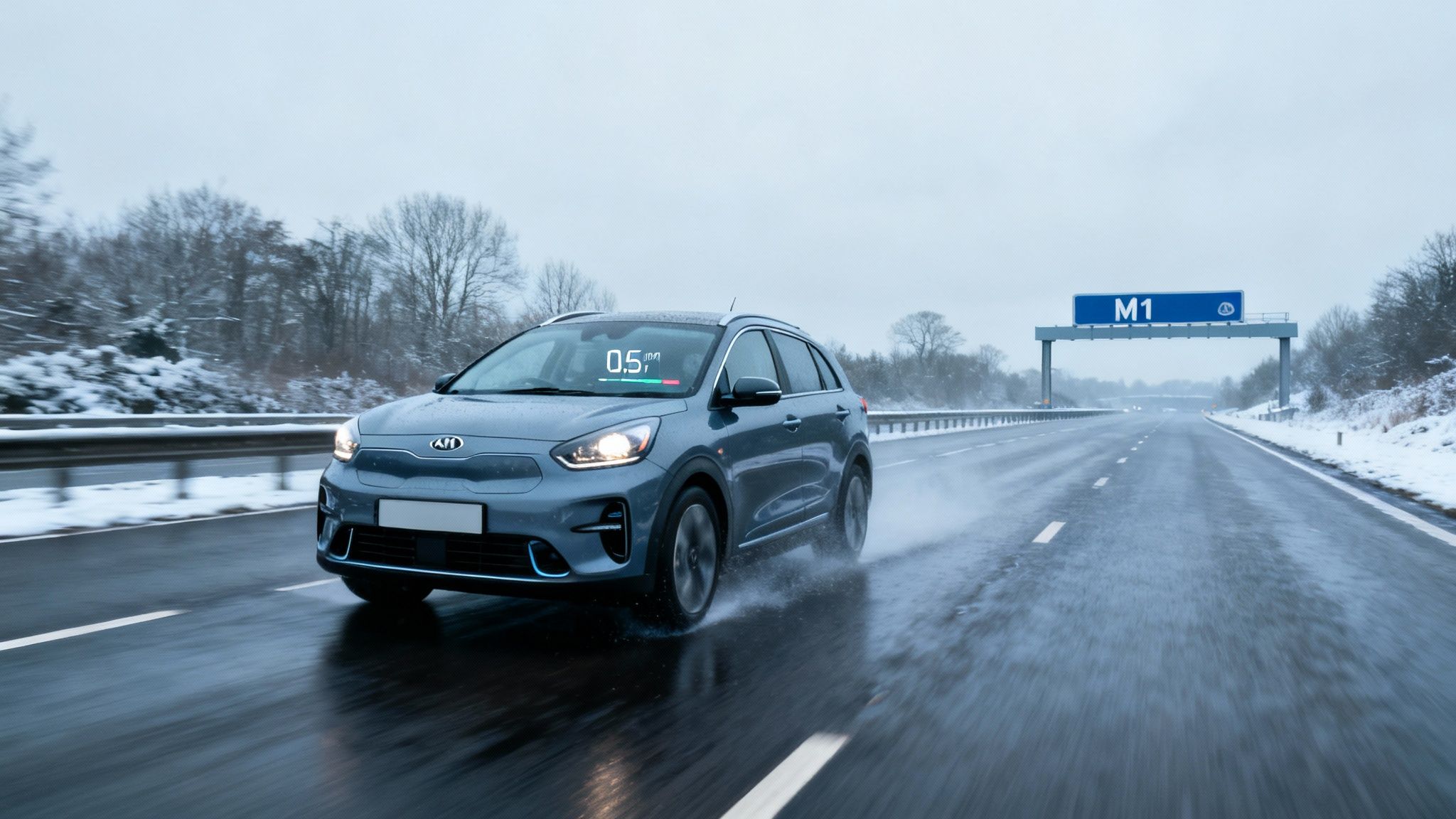
So, you’ve seen the official WLTP figure for the Kia Niro EV. A lovely, reassuring number. Now, let’s talk about the two biggest villains hell-bent on making that number a work of fiction: the great British weather and your right foot.
If you’ve ever watched your phone battery die in seconds on a frosty morning, you already get the basic principle. An EV’s battery is really just a much bigger, more complex version of that.
Batteries are chemical divas; they absolutely despise the cold. When temperatures plummet, the chemical reactions inside slow right down, making it much harder to release energy. This sluggishness means you get fewer miles for your charge, often a drop of 20-30% in the depths of a proper UK winter.
That official 285-mile range can quickly shrink to a far less comforting 220 miles or even lower. It's not a fault with the car; it's just physics giving you a frosty slap in the face. Understanding this is the key to avoiding that heart-in-mouth moment when your destination is 50 miles away but the car reckons it can only manage 40.
The Motorway Speed Trap
The second great range assassin is speed. While petrol cars can be surprisingly efficient cruising at a steady 70mph, electric vehicles are the polar opposite. They are at their happiest pottering around town at 30mph, where regenerative braking can claw back precious energy every time you slow down.
But venture onto the M1 and pin it at 70mph, and you’re forcing the car to fight a constant hurricane of air. The energy required to maintain that speed increases exponentially, not in a straight line. Think of it like this: cycling into a gentle breeze is fine, but cycling into a gale-force wind is utterly exhausting. Same principle.
For the Niro EV, this means motorway driving will drain the battery significantly faster. The difference can be stark, with high-speed cruising easily shaving 40-50 miles off your total potential range compared to sticking to A-roads.
The Silent Energy Thieves
It’s not just the big, obvious things like cold and speed that nibble away at your range. A host of smaller culprits are constantly dipping into your battery, each taking a small but cumulative toll.
Here are a few of the usual suspects you need to keep an eye on:
- Climate Control: Blasting the heater on a cold day is one of the single biggest energy drains outside of the motor itself. The Niro EV’s optional heat pump is a big help here, but it still needs a fair bit of juice to keep the cabin toasty.
- Heated Seats and Steering Wheel: Pure luxury on a frosty morning, but they are direct electrical loads. They use less power than the main cabin heater, for sure, but they still add up.
- Tyre Pressure: Under-inflated tyres create more rolling resistance, forcing the motor to work harder just to maintain speed. It’s a subtle effect, but it adds up over hundreds of miles. Checking your pressures is a free and easy way to protect your range.
"Managing your EV's range is less about hypermiling and more about understanding the compromises. Every press of the accelerator and every degree on the thermostat is a trade-off. Learn the rules of the game, and you’ll never get caught short."
Ultimately, it all comes down to awareness. By understanding how these factors impact your battery, you can make smarter decisions. Pre-heating the car while it’s still plugged in, easing off the accelerator on the motorway, and even just dressing a bit warmer can make a huge difference.
If you want more practical advice, it's worth reading up on the unvarnished truth of electric car real-world range. It helps you stop watching the range meter like a hawk and start driving like you know exactly where the energy is going.
Charging the Kia Niro EV at Home and on the Road
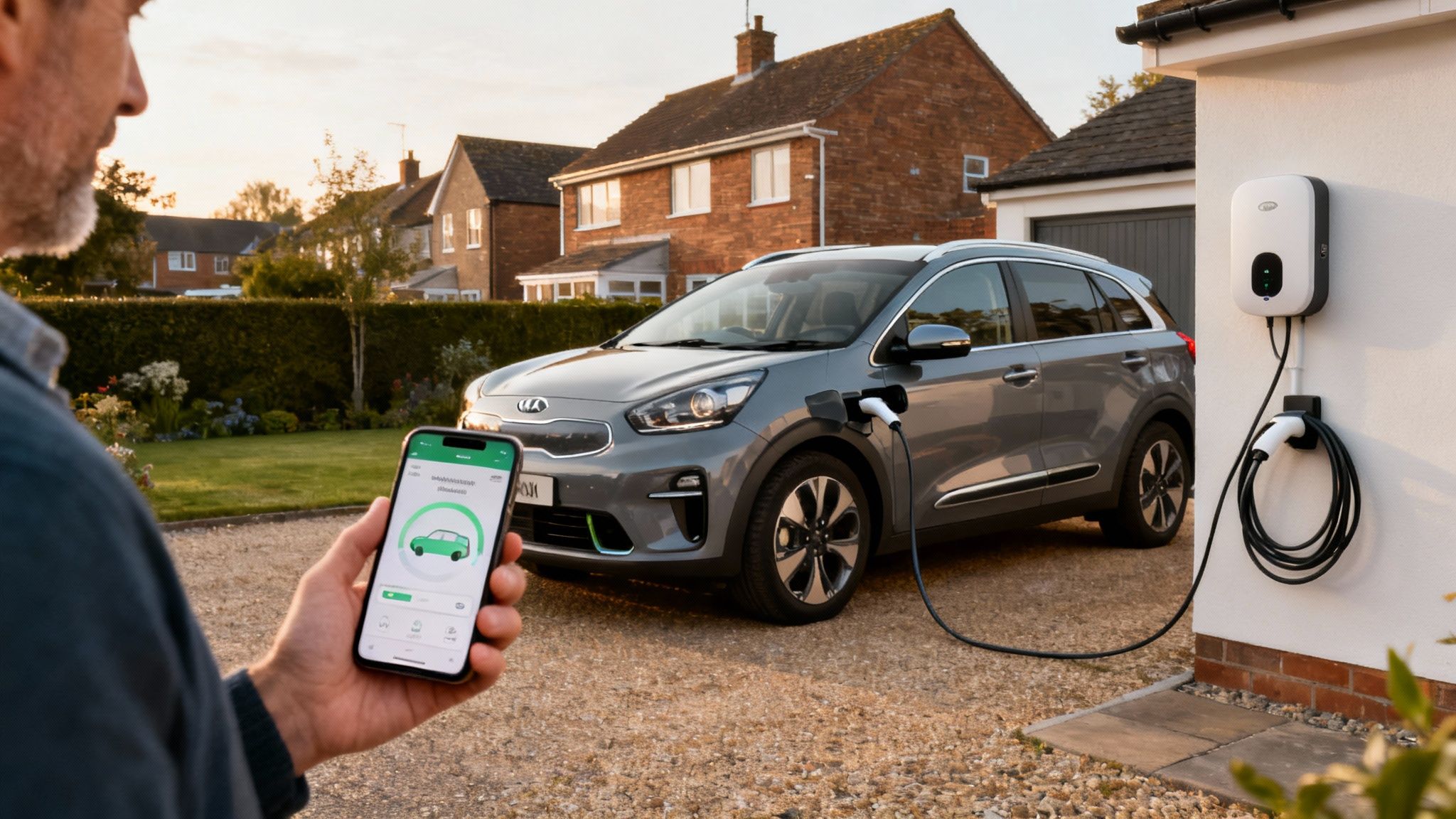
When you get a Kia Niro EV, your relationship with smelly petrol stations is officially over. Instead, you become a bit of a connoisseur of plugs, overnight electricity tariffs, and the quiet satisfaction of waking up to a full "tank" every morning. This is the real magic of electric driving – your home is now your own personal filling station.
The absolute game-changer is getting a dedicated home charger, often called a ‘wallbox’, installed. Forget the faff of trailing a three-pin plug through a window; a proper 7kW wallbox will sort your Niro’s battery from nearly empty to full in under 10 hours . Just plug in when you get home, and you’ll wake up with the maximum Kia Niro EV range ready to go, all for a fraction of the cost of petrol.
While the main government grants for homeowners have mostly fizzled out, there might still be some help available for renters or people living in flats. It's always worth a quick search for the latest government schemes. Even without a grant, the investment quickly pays for itself in sheer convenience and access to cheap overnight electricity. For a proper deep dive, check out our no-nonsense guide to EV home charging stations in the UK.
The Wild West of Public Charging
Once you venture out onto the public charging network, things can feel a bit like the Wild West. You’ll find everything from gleaming, ultra-rapid chargers at motorway services to a lonely, dodgy-looking post in a supermarket car park that hasn't worked since 2019. This is where knowing your chargers really counts.
Public chargers are basically split into two camps: AC (alternating current) and DC (direct current).
- AC Chargers: These are the most common ones you'll spot in places like shopping centres and town car parks. They typically offer speeds of 7kW or 22kW , making them perfect for a decent top-up while you’re doing something else. They’re not really designed for a quick splash-and-dash, though.
- DC Rapid Chargers: These are the big boys. You’ll find them at motorway services and dedicated charging hubs. They pump high-power DC electricity directly into the battery, offering speeds of 50kW and way, way beyond.
The Kia Niro EV’s charging setup is a bit of a mixed bag. Its maximum DC charging speed of 72kW isn't going to win any awards, but it’s practical enough. It will take the battery from 10% to 80% in a perfectly respectable 45 minutes . That’s just about the right amount of time to grab a coffee and use the loo before getting back on the motorway.
Decoding the Speeds and Costs
The speed you get isn’t just down to the charger – it’s also limited by what your car can accept. The Niro EV’s maximum AC charging speed is 11kW , so even if you find a 22kW public post, that's all you'll get. It's on the DC rapid network where you see the real speed.
Getting a handle on the real-world time and cost is key. A rapid charger costs more per unit of electricity, but it gets you back on your journey much, much faster.
Here’s a simple breakdown of what to expect when you plug in your Niro EV.
Niro EV Charging Times And Costs
| Charger Type | Power Output | Time (10-80%) | Typical Cost (per kWh) |
|---|---|---|---|
| Home Wallbox | 7kW AC | ~6.5 Hours | 7-15p (Overnight tariff) |
| Public 'Fast' | 7-22kW AC | ~6.5 Hours | 40-60p |
| Public 'Rapid' | 50kW DC | ~1 Hour 15 Mins | 65-80p |
| Public 'Ultra-Rapid' | 100kW+ DC | ~45 Mins | 70-85p |
To navigate this landscape without pulling your hair out, apps like Zap-Map and PlugShare are absolutely essential. They show you where chargers are, if they’re available, and what other drivers think of them, helping you avoid that dreaded "out of order" sign. With a bit of planning, charging on the go just becomes a simple, predictable part of any long drive.
Living with the Kia Niro EV
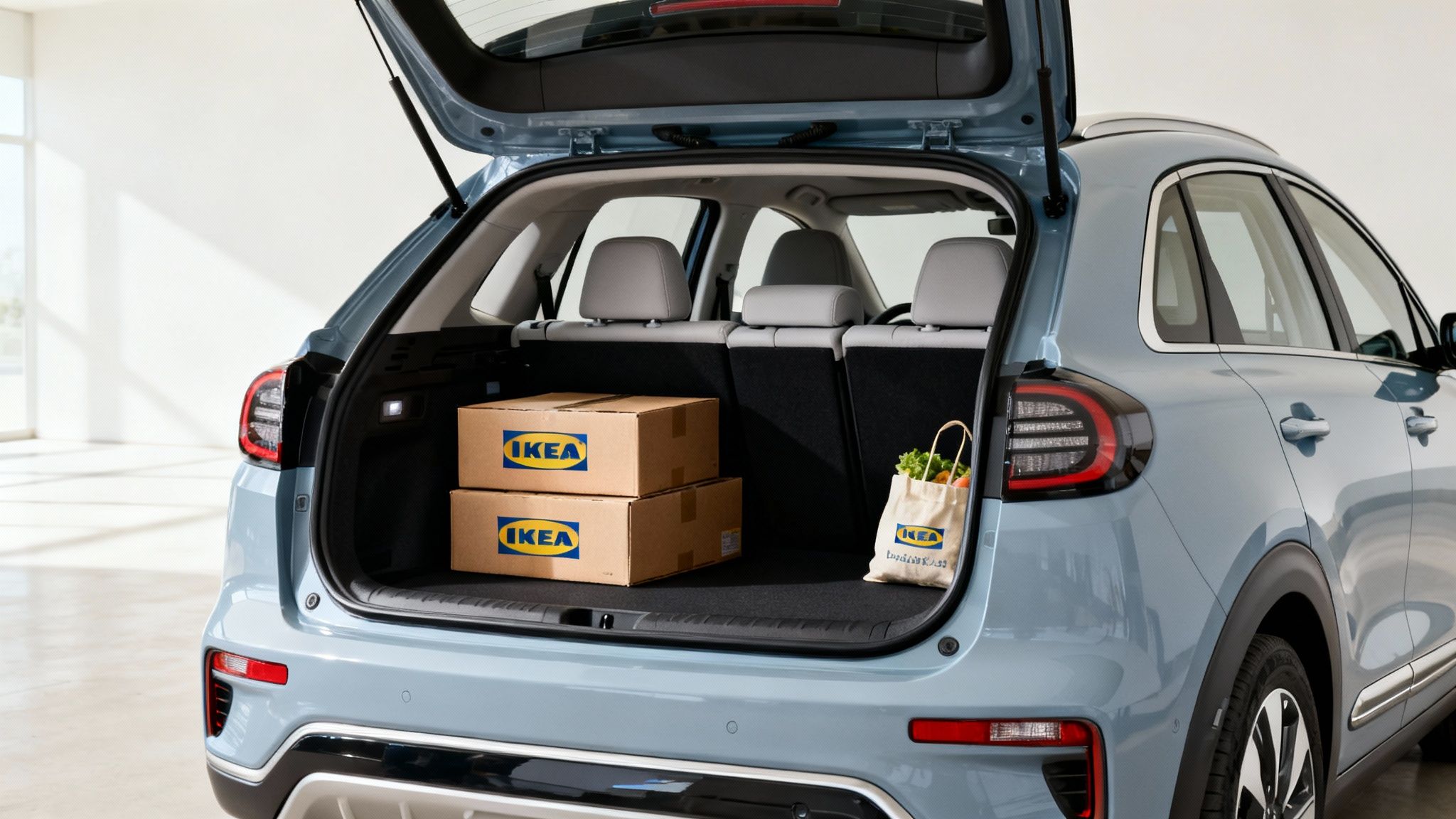
Numbers on a spreadsheet are one thing, but what’s it actually like to live with the Kia Niro EV day in, day out? Does it effortlessly slot into the chaos of British family life, or does it have annoying little quirks that will slowly drive you mad? Let's get past the official Kia Niro EV range figures and into the reality of owning one.
First off, practicality. The boot is a genuinely pleasant surprise. At 475 litres , it’s a fair bit bigger than what you’ll find in many of its rivals, which means it’ll swallow the spoils of a flat-pack furniture mission or a massive weekly shop without breaking a sweat. It’s a proper, usable space that makes the Niro EV feel more like a family workhorse than just an eco-statement.
Inside the Command Centre
Hop inside, and you’re met with an interior that’s refreshingly sensible. Kia hasn’t tried to reinvent the wheel here with some minimalist, button-free nightmare. Instead, you get a clever dual-function touch bar that switches between media and climate controls – a neat compromise that keeps things tidy without burying everything in a distracting touchscreen.
The dashboard itself is dominated by a pair of 10.25-inch screens , and the whole layout is clear and functional. It’s all very logical, feels solidly screwed together, and seems like it was designed by someone who actually drives cars. It’s not flashy, but it just works. In a family car, that’s exactly what you want.
The Niro EV's cabin is a masterclass in 'just enough'. It sidesteps the self-consciously futuristic vibe of some EVs, delivering instead a robust, intuitive layout that you’ll be thankful for every single day. It’s a tool, not a tech demo.
It’s not perfect, though. The vast expanses of piano black plastic trim are a magnet for fingerprints and dust, and the chorus of beeps from the various safety systems can be a bit over the top. While you can thankfully turn most of them off, you have to do it every single time you start the car. It’s a minor grumble, but a grumble nonetheless.
On the Road: Fun or Functional?
So, what's it like to drive? In short, it’s competent, comfortable, and completely unremarkable—and I mean that as a compliment. The ride is composed, soaking up Britain’s pockmarked B-roads with a calmness that eludes some of its stiffer-riding competitors.
Its character really comes into focus when you stack it up against key rivals:
- MG4: The MG is undoubtedly more fun to throw around, with its rear-wheel-drive setup giving it a much more agile feel. The Niro EV, by contrast, is the more comfortable and refined cruiser.
- Renault Megane E-Tech: The Megane definitely feels more stylish and premium inside, but the Niro EV clobbers it on practicality with a much larger boot and significantly more space for rear passengers.
The Niro EV makes no attempt to be a sports car. Its acceleration is brisk enough for confident overtakes on the motorway, but it’s far more of a dependable workhorse than an adrenaline machine. For a closer look at its predecessor, which shares much of this sensible DNA, our in-depth Kia e-Niro review offers more perspective.
Ultimately, living with the Niro EV is an exercise in supreme competence. It’s a car that just quietly gets on with the job, delivering exactly what you need in terms of practicality, comfort, and ease of use. It might not set your pulse racing, but it certainly won’t give you a headache either.
Finding the Best Kia Niro EV Deals
Right, let’s talk brass tacks. It's one thing to chat about the Kia Niro EV's range, but another thing entirely to actually afford one. So, we've donned our deal-hunting hats, trawled through the internet's murky depths, and surfaced with a genuinely decent offer you can look at today.
We're skipping the marketing fluff and baffling jargon. This is about the cold, hard numbers, so you can figure out if it's a real bargain or just some clever financial trickery. Because let's face it, a great car on a terrible deal is just a very expensive paperweight.
VoltsMonster's Deal of the Week: A Kia Niro EV Lease
We’ve spotted a particularly sharp Personal Contract Hire (PCH) deal that makes getting into a brand-new Niro EV a bit less painful on the wallet. The offer is for the Niro EV '3' 64.8kWh model , which, in our opinion, is the sweet spot in the line-up.
Here’s the breakdown, which we sourced from Leasing.com, a well-known and reputable leasing aggregator here in the UK.
The Offer: A brand-new Kia Niro EV '3' in your choice of standard paint. This isn't some bare-bones model; you get the twin 10.25-inch screens, heated seats, and that crucial heat pump for better winter range.
The Cold, Hard Numbers (as of late 2024):
- Initial Payment: £2,100 (often shown as a '6-month' deposit)
- Monthly Payment: £350 per month
- Contract Length: 48 months (4 years)
- Annual Mileage: 8,000 miles per year
- Total Cost over 4 Years: £18,900
So, What's the Catch?
There's always a catch, isn't there? With any lease deal, the devil is in the detail. For this one, the main thing to be mindful of is the mileage limit. 8,000 miles per year works perfectly for a lot of people, but if you're constantly pounding up and down the motorway, you’ll get stung with excess mileage charges (usually around 10-15p per mile), which add up fast.
Also, remember this is PCH, meaning you simply hand the keys back at the end of the term. Think of it as a long-term rental. There's no option to buy the car, and it needs to be returned in good condition, allowing for fair wear and tear.
For the right person, though, this is a fantastic, low-hassle way into a new EV. You get a factory-fresh car under full warranty, predictable monthly outgoings, and you sidestep any worries about depreciation. This specific deal gets you a very capable car for a monthly payment that won't require selling a kidney.
Got a Question? We've Got Answers
Still have a few things buzzing around your head about the Kia Niro EV? You're not alone. We've gathered some of the most common questions we hear from drivers to give you straight, fluff-free answers.
Does the Kia Niro EV Come with Different Battery Sizes in the UK?
Nope. Kia has made this part mercifully simple. Every new Niro EV sold here in the UK gets the exact same 64.8kWh battery pack . This is the one that gives you that official 285-mile WLTP range figure.
You won’t find any confusing entry-level or long-range options to complicate things. It's just one solid battery, designed to offer a great balance of real-world range, affordability, and performance. It makes choosing your car a whole lot easier – what you see is what you get.
How Much Does Range Drop in a Typical British Winter?
Right, let's be honest about this – the drop is noticeable. You should realistically budget for a 20-30% hit to your range once the temperature plummets and you're cranking up the heating. That lovely summer figure of around 260 miles can easily dip to a more modest 180-210 miles in the depths of winter.
It’s not a fault with the car; it’s just physics. Cold weather slows down the chemical reactions inside the battery, and the cabin heater is a huge power draw. Even with the Niro EV's efficient heat pump, a proper British cold snap will always take its toll.
Is Kia's 7-Year Warranty Worth Having on an EV?
Absolutely. In fact, it's one of the biggest reasons to consider a Kia. The famous 7-year/100,000-mile warranty covers everything, including the two most expensive components: the battery and the electric motor.
Crucially, it guarantees the battery will retain at least 70% of its original capacity for the entire period. When you think about the cost of replacing an EV battery, that warranty provides incredible peace of mind. It’s a proper safety net against the nightmare scenario of early battery failure, making it a huge plus for long-term ownership.
At VoltsMonster , we cut through the noise to give you the real-world, no-nonsense advice you need on all things electric. For more honest reviews and guides, check us out at https://www.voltsmonster.com.
VoltsMonster Electric Vehicle Blog