Jaguar I-Pace Range: A Brutally Honest UK Guide
Right then, let's cut the flannel and get straight to the point on the Jaguar I-Pace's range. Officially, Jaguar – in its infinite, brochure-printing wisdom – claims it can manage up to 292 miles on a full battery. But, and this is a but of truly epic proportions, that number comes with more caveats than a politician's apology. In the real world, especially a cold, wet, relentlessly miserable British one, that figure can shrink faster than your bank balance after a trip to the pub.
The Showroom Fantasy And The M6 Reality
You know the scene. A pristine I-Pace, gleaming under showroom lights powerful enough to simulate the surface of the sun, with a placard proudly proclaiming that impressive range. It’s a seductive number, one that whispers of effortless cross-country jaunts and a glorious future free from greasy petrol pumps and the lingering smell of diesel on your hands.
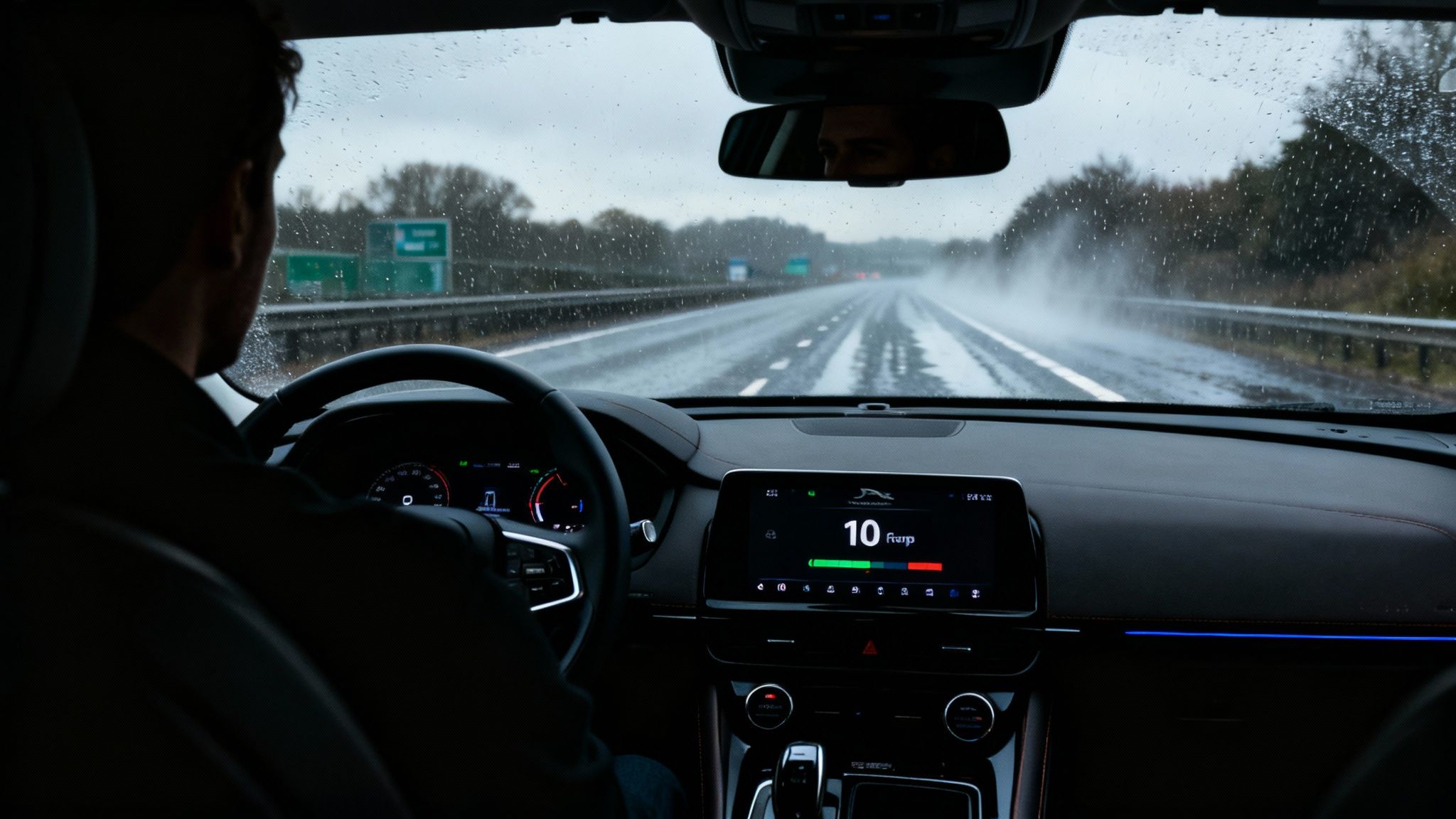
Now, let's smash-cut back to reality. You’re actually on the M6 near Birmingham, it’s February, the rain is coming down sideways, and the outside temperature is hovering just above freezing. You've got the heating on full whack, the wipers are going nineteen to the dozen, and your range is dropping faster than a lead balloon in a lift shaft.
This jarring disconnect is the central, unvarnished truth of owning any electric car, and the disarmingly handsome I-Pace is no exception. Those official WLTP figures are born in a laboratory, a sterile, joyless environment where every variable is controlled with scientific precision. The real world, however, is a chaotic mess of traffic jams, surprise detours, and weather that seems to have a personal vendetta against battery efficiency.
What The Brochures Don't Mention
The car industry has a long and storied history of, shall we say, optimistic performance figures. Fuel economy has been a running joke for decades, and electric range is simply the new frontier for this statistical dark art. The numbers aren’t outright lies, but they are the result of tests conducted under ideal conditions that you will almost certainly never replicate on your daily commute to Slough.
Here's what those perfect lab conditions conveniently ignore:
- Proper British Weather: Sleet, headwinds, and the kind of damp cold that seeps into your bones are kryptonite for EV batteries.
- Topography: The UK isn’t the Netherlands. Every hill and incline requires more power, which means fewer miles from your battery.
- Your Right Foot: The official tests involve gentle, saintly acceleration. They don’t account for that moment you need to put your foot down to overtake a lorry on the A1.
- Creature Comforts: Heating, air conditioning, and even your favourite banging playlist all draw precious power from the same battery that’s meant to be getting you home.
The greatest trick the devil ever pulled was convincing the world that WLTP range figures apply to a wet Tuesday in Stoke. The Jaguar I-Pace is a brilliant piece of engineering, but it's not immune to the laws of physics or the sheer misery of the British climate.
This isn’t to say the I-Pace is a bad car or that its range is a con. Far from it. It’s a stylish, comfortable, and genuinely thrilling thing to drive. But to truly understand it, you have to accept that the number in the brochure is just the starting point of a negotiation, not the final word.
Our mission here is to arm you with the gritty truth, so you know exactly what to expect when you swap the sanitised showroom for the sodden reality of the road. Let’s dive in.
WLTP Range: What The Brochure Says vs. What The Road Delivers
Let's start with the big number you'll see in every Jaguar I-Pace brochure: the official range of up to 292 miles . This figure comes from something called the Worldwide Harmonised Light Vehicle Test Procedure, or WLTP for short. It sounds terribly official, but in reality, it’s best viewed as a laboratory-bred fantasy.
Think of the WLTP figure as an EV's Tinder profile. It’s a photo taken in perfect lighting, from the most flattering angle, and it conveniently ignores all real-world complexities. This standardised test takes place in a controlled utopia where the temperature is a constant, balmy 23°C . There’s no headwind, no steep hills, and definitely no need to suddenly accelerate to get past a dawdling lorry.
The test cycle is a gentle, prescribed series of stops, starts, and mild acceleration phases. The imaginary driver is feather-light, and the car isn't weighed down with passengers, luggage, or the family dog. In this perfect, sanitised bubble, the I-Pace's range looks magnificent. But you and I don't drive in a lab. We drive in the UK.
The Reality Gap: From The Lab To The M25
The core problem is that the WLTP test ignores almost everything that defines a typical British journey, whether it’s a commute through town or a blast down the motorway. It simply doesn't account for the variables that chew through your battery.
Here are just a few things the official test conveniently overlooks:
- British Weather: That ideal 23°C test temperature is a rare treat. When the mercury drops towards freezing, an EV’s battery chemistry becomes sluggish. You can easily see your available range drop by 20-30% before you’ve even switched on the heater.
- Creature Comforts: The test doesn't run with the heated seats and steering wheel on full blast on a frosty morning. It doesn't factor in windscreen wipers working overtime in a downpour or the air-con keeping you cool in a summer heatwave. All these essentials draw power directly from the battery.
- Your Right Foot: The WLTP’s sedate acceleration is nothing like flooring it to merge onto a fast-moving A-road. How you drive is the single biggest factor influencing your range, and the lab test assumes you have the patience of a saint.
In short, the WLTP figure is a best-case scenario achieved under conditions you will almost never encounter. It's a useful benchmark for comparing different EVs, but it is not a promise of what you'll get day-to-day.
This gap between the official number and what you see on the dashboard is common to all electric cars. For a deeper dive, our guide on electric car real-world range lays out the unvarnished truth for any EV, not just the I-Pace.
The key takeaway? Treat that 292-mile figure with a healthy dose of scepticism. It’s not a lie, but it’s the automotive equivalent of someone rounding up their height by a couple of inches. It’s a good starting point, but the real story begins when the tyres hit the tarmac.
What Really Kills Your I-Pace Range in the UK?
You’ve got the keys to your I-Pace, and the official WLTP range figure of up to 292 miles is buzzing around your head. But before you plan a non-stop trip from London to Newcastle, let's talk about the real world. That official number is a bit like a car's top speed – it’s theoretically possible, but you’ll rarely, if ever, achieve it in day-to-day driving.
The truth is, your actual range is a moving target. It’s influenced by a handful of factors that can chip away at your mileage, sometimes dramatically. Let’s look at the big three culprits every UK driver will face: how you drive, the glorious British weather, and the rubber connecting you to the road.
The Heavy Right Foot
The single biggest factor you control is your driving style. That instant, silent shove of acceleration is one of the best things about the I-Pace, but it comes at a cost. Flooring it away from every set of traffic lights is the electric equivalent of pouring petrol on the ground and setting it alight for a laugh.
Aggressive driving forces the battery to discharge energy at a massive rate. Think of it like this: a smooth, gentle acceleration is like sipping a pint, while a hard launch is like downing it in one. Both empty the glass, but one is far more frantic and wasteful. Smooth, progressive driving is the key to preserving those precious miles.
The relationship between your accelerator and the I-Pace's range is brutally simple. The more you treat it like an on/off switch, the faster you’ll be looking for a charging station.
Let's break down the difference with two familiar UK scenarios:
- The Urban Stop-Start: Darting between roundabouts, braking hard for speed bumps, and generally rushing around town. This style forces the car to constantly overcome inertia, absolutely hammering its efficiency.
- The Motorway Cruise: Maintaining a steady 65-70 mph . This is far more efficient as the motors are working consistently, not in power-hungry bursts. Smoothness is your best friend.
This chart shows just how big the gap is between lab-perfect conditions and what you'll actually see on a wet Tuesday in November.

As you can see, the real-world figure takes a hit straight away. Aggressive driving and poor conditions only widen that gap.
The Great British Weather Factor
Electric car batteries are a bit like us – they have a preferred temperature range. They are happiest and most efficient in mild, T-shirt weather. When the temperature drops on a frosty morning, the chemical reactions inside the battery slow down, reducing its ability to release energy effectively.
This can slash your potential range by up to 30% in a cold snap before you've even turned a wheel. Then you jump in and switch on the cabin heater, heated seats, and demisters. All these creature comforts draw significant power directly from the drive battery, meaning your predicted 250-mile summer range can quickly look more like 175 miles .
The Unsung Hero: Your Tyres
Finally, let's talk tyres. It’s easy to overlook them, but they play a surprisingly large role in your I-Pace's efficiency. The simple physics of rolling resistance – the energy lost as the tyre deforms against the road – is the enemy of range.
Two key things to keep an eye on:
- Tyre Pressure: This is the easiest win. Under-inflated tyres create a larger contact patch and more friction, needlessly draining your battery. A few minutes with an air pump each month can genuinely add miles to your range.
- Tyre Choice: Not all rubber is created equal. The wide, grippy performance tyres that help the I-Pace handle so brilliantly also create more rolling resistance than a dedicated, low-resistance EV tyre. It's a classic trade-off: maximum grip versus maximum miles.
Range Killers: A Realistic Look At Mile Munchers
So, how do all these factors stack up in the real world? Here's a look at what you can realistically expect from an I-Pace in a few common UK scenarios.
| Factor | Official Range Claim (Up to) | Realistic UK Winter Motorway Range | Realistic UK Summer City Range |
|---|---|---|---|
| Jaguar I-Pace EV400 | 292 miles | 170-190 miles | 240-260 miles |
The takeaway here is stark. A winter motorway trip with the heating on full blast is the I-Pace's toughest test, often cutting the official range by nearly 40% . In contrast, gentle urban driving in the summer, where you can make the most of regenerative braking, gets you much closer to that headline figure.
Understanding Battery Health and the Dreaded Degradation
Unlike a fine wine or a classic E-Type, your I-Pace's battery won't get better with age. It's a hard truth of EV ownership that from the moment the car is built, its battery starts a slow, unavoidable process called degradation. It sounds a bit grim, but knowing what it is and how to manage it will save you a lot of grief down the road.
So, what are we talking about? Battery degradation is simply the gradual loss of the battery's ability to hold a full charge. A brand new 90 kWh battery in an I-Pace can store, well, 90 kWh of usable energy. After a few years and thousands of miles, that same battery might only be able to store 85 kWh , which directly impacts your maximum range.
We measure this using a metric called State of Health (SOH) . Think of it as a percentage of the battery's original, as-new capacity. A factory-fresh battery has 100% SOH. One that's lost 10% of its capacity is at 90% SOH. It's a natural chemical process, and there’s no stopping it completely.
How To Be A Battery Saint, Not A Sinner
The good news is that you have a massive amount of influence over how quickly your battery ages. A bit of mechanical sympathy can add years to its life and keep your range figures looking healthy. Think of it as an anti-ageing regime for your car.
Here are the golden rules for keeping your I-Pace's battery happy:
- Avoid the Extremes: Lithium-ion batteries really don't like being left at 100% or near 0% for long periods. For day-to-day driving, charging to 80% is the sweet spot. Only push it to 100% right before you head off on a long motorway trip.
- Rapid Charging is a Treat, Not a Diet: Constantly hammering the battery with 100 kW+ DC rapid chargers generates a lot of heat, which is enemy number one for battery longevity. They're brilliant for a quick top-up on a long journey, but for your regular charging, a slower 7 kW home wallbox is far, far kinder.
- Don't Park it and Forget it: If you're heading off on holiday for a few weeks, try to leave the car with a charge of around 50-60% . Parking it up at 100% for a month is a surefire way to speed up degradation.
Jaguar is pretty confident in its battery tech, mind you. They provide a warranty that covers the battery for 8 years or 100,000 miles , guaranteeing it will retain at least 70% of its original capacity. If it drops below that threshold within the warranty period, they’ll sort it out.
What Is Normal Degradation?
So, what should you actually expect? Most modern EVs, the I-Pace included, are proving pretty robust. Real-world data from owners suggests an average degradation of around 2-3% per year is fairly typical. This means after five years of ownership, you might have lost about 10-15% of your original range. It's a noticeable drop, but it's certainly not a disaster.
Of course, a battery can fail more spectacularly, and when that happens, the bill can be eye-watering. To get a sense of the potential financial sting, our guide to the UK EV battery replacement cost paints a rather sobering picture.
Ultimately, the key is mindful ownership. By avoiding the habits that stress the battery—like leaving it at extreme states of charge and over-relying on rapid chargers—you can easily keep degradation to a minimum and ensure your I-Pace delivers a healthy range for many years to come.
Our Top Pick: A Used I-Pace Bargain
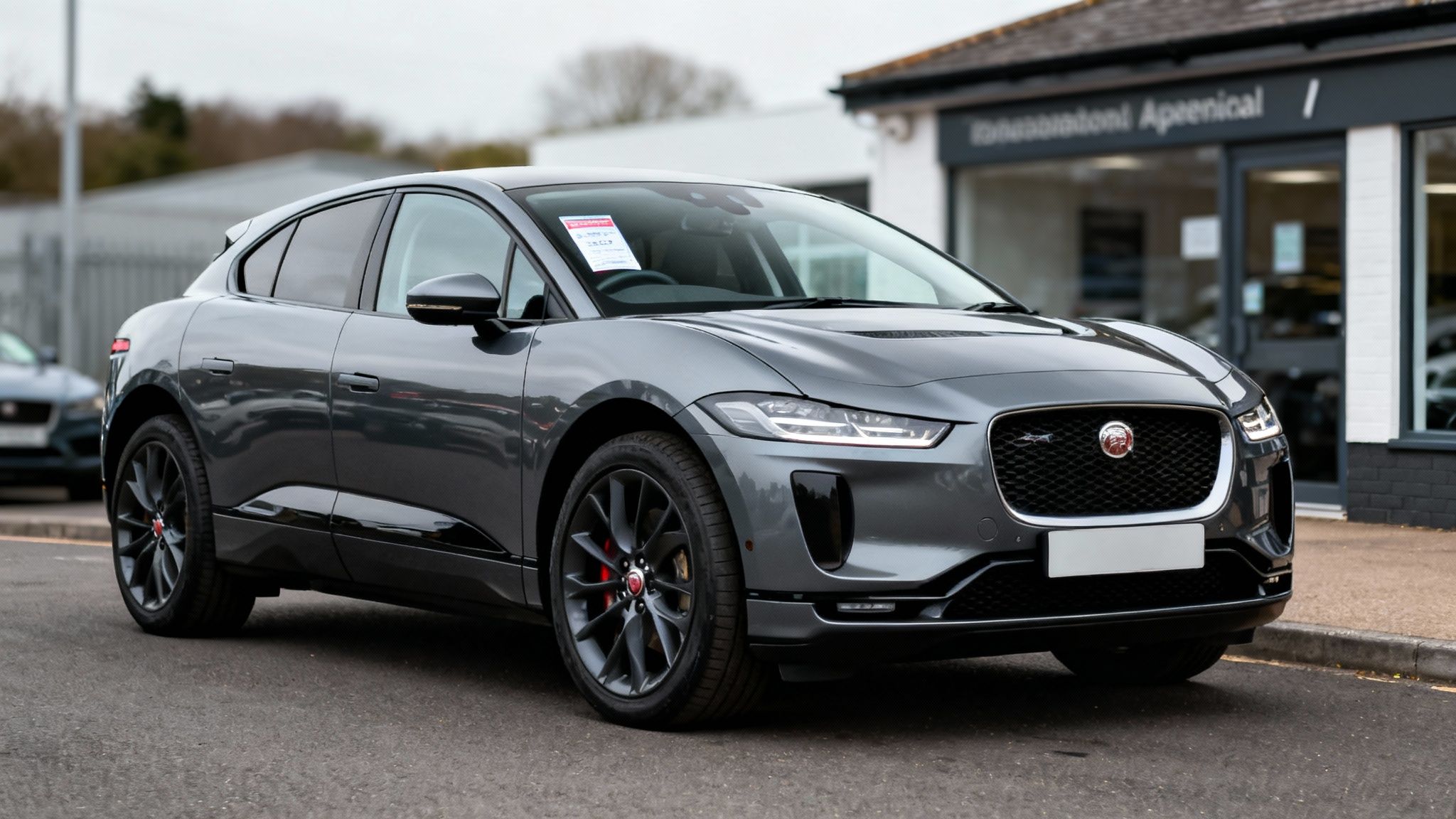
Right, that’s enough theory. All this chat about degradation, driving styles, and winter woes is crucial, but let's get down to the brass tacks: actually getting your hands on one of these electric cats without selling a kidney. The new car market is one thing, but the used market is where the real value is hiding.
We’ve been trawling the classifieds, dodging the dodgy dealers and sifting through the dross to find you a genuine bargain. This week, our coveted 'Deal of the Week' award goes to a rather handsome 2021 Jaguar I-Pace EV400 HSE we’ve spotted. It’s a perfect example of how much car you can get for your money once that brutal first wave of depreciation has done its work.
This particular model, finished in a menacing Eiger Grey, is up for sale at a reputable dealer in the North West for just under £26,000 . With around 35,000 miles on the clock, it’s barely broken in. That represents a staggering saving of over £40,000 compared to its original list price. It’s not just a discount; it’s practically daylight robbery.
Why This Car Is A Smart Buy
So, what makes this specific I-Pace such a savvy purchase? First off, it’s the HSE trim, which was the top-of-the-range model back then. That means you get all the toys: the glorious panoramic roof, premium Windsor leather seats, a stonking Meridian sound system, and those clever Matrix LED headlights. It's the full-fat experience for the price of a mid-spec family hatchback.
More importantly, its mileage is right in the sweet spot. At 35,000 miles , it's been used enough to prove its reliability but not so much that you need to start worrying about significant battery degradation. It still sits comfortably within Jaguar's 8-year/100,000-mile battery warranty, giving you a crucial safety net. The dealer also provides a full service history, which should be completely non-negotiable when buying any used EV.
Finding a great used EV deal isn't just about the lowest price. It’s about finding that perfect balance of age, mileage, specification, and warranty. This 2021 HSE ticks every single box, offering near-new luxury for less than half the original cost.
What To Look For When Viewing
If you were to go and kick the tyres on this (or a similar) I-Pace, there are a few key things you absolutely must check. The most critical is the battery’s health. Insist on seeing the car with a 100% charge and check the predicted range on the dash. In mild weather, you'd hope to see something in the region of 240-250 miles displayed. A figure significantly lower could be a red flag. For a much deeper dive, you should check out our guide on the truth about battery health reports on used EVs.
Beyond the battery, check for the usual suspects:
- Infotainment System: Make sure the Pivi Pro system is snappy and responsive. Early I-Pace models had notoriously laggy software, so this is a must-check.
- Tyre Wear: The I-Pace is a heavy and powerful car, so it can be hard on its tyres. Check for even wear across the full tread of all four.
- Charging Ports: Test both the AC and DC charging ports. Plug them in and make sure they connect and start a charge correctly.
- Panel Gaps: Walk around the car and look for consistent panel gaps. Any major inconsistencies could hint at previous accident damage.
This I-Pace represents a ticket to silent, stylish, and properly thrilling motoring for a fraction of the original cost. It just goes to show that with a bit of savvy shopping, the premium EV lifestyle is far more accessible than you might think.
So, Should You Actually Buy One?
Right, let's get down to brass tacks. We've looked past the shiny brochure numbers, faced the grim reality of a freezing UK motorway slog, and seen how a heavy right foot is the biggest enemy of your battery. So, after all that, is the Jaguar I-Pace a game-changing electric marvel or just an expensive driveway ornament that’ll give you a constant case of range anxiety?
Well, the frustratingly honest answer is: it really depends on you. The I-Pace's range isn't some fixed, reliable number. It’s a dynamic figure, heavily influenced by the weather, your speed, and even how willing you are to turn the heating down a notch to claw back a few extra miles.
The first step is to accept that the official 292-mile WLTP figure is optimistic at best. If you can get your head around a more realistic 240 miles in summer , and a slightly nerve-wracking 180 miles in the depths of a British winter , then you’re on the right track. This is a car that blends stunning design with fantastic driving dynamics, but it needs the right kind of owner.
Who Is The I-Pace Perfect For?
This electric Jag truly shines for the driver whose life doesn't revolve around the motorway network. It’s ideal for someone who spends most of their time on A-roads or pottering around town, and crucially, has a home charger installed. It’s built for the person who values a premium feel and an engaging drive over squeezing out every last possible mile from the battery.
You're the ideal I-Pace owner if:
- Your daily round trip is comfortably under 100 miles , leaving plenty of juice in reserve.
- Long motorway journeys are an occasional trip, not a daily grind.
- A beautifully finished cabin and sharp acceleration matter more to you than an extra 30 miles of theoretical range.
- You grasp that pre-heating the car on a frosty morning while it’s still plugged in isn't just a gimmick; it's a vital part of your winter survival kit.
The I-Pace is for the driver who buys with their heart but has already done the sums with their head. It rewards a little forethought with a driving experience that feels genuinely special, something few rivals can truly match.
Who Should Look Elsewhere?
On the other hand, let's be blunt. If you’re a sales rep practically living on the M1 and covering 300 miles a day , this is absolutely not the car for you. If the mere thought of pulling up to a public charger and finding it out of order brings you out in a cold sweat, just walk away now. And if you honestly expect to hit the advertised range while driving it like you’ve stolen it with the heated seats and windscreen on full blast, you're setting yourself up for serious disappointment.
Frankly, your money would be better spent on something a bit less thrilling but far more practical for high-mileage life. The I-Pace is a brilliant, characterful, and deeply desirable EV, but it’s no universal solution. It demands you meet it halfway. If you can embrace its quirks, it will reward you every time you get behind the wheel. If you can’t, well, there are plenty of sensible German diesels out there waiting for you. The choice is yours.
Got a Few More Questions About the I-Pace's Range?
Alright, we've covered the big stuff, but you probably still have a few specific questions buzzing around your head. These are the ones that tend to pop up after you've read the brochure and watched the reviews.
Let's tackle some of the most common queries we get from drivers thinking about making the switch.
Do the Heated Steering Wheel and Seats Drain the Battery?
They do, but it’s nowhere near as bad as you might fear. In fact, using the heated seats and steering wheel is much more efficient than blasting the main cabin heater to keep warm.
Think of it this way: the heated accessories warm you directly, like an electric blanket. The climate control has to heat all the air in the entire car, which is a massive energy drain. On a frosty morning, stick to the heated seats and wheel first – you’ll stay comfortable without watching your range disappear.
How Much Range Will I Really Lose with a Roof Box?
Quite a lot, unfortunately. Bolting a box to the roof seriously messes with the car's aerodynamics, acting like a small parachute, especially at higher speeds.
Depending on the box and how fast you're driving, you can easily knock 10% to 20% off your total range. That could turn a comfortable 180-mile winter motorway trip into a nail-biting 145-mile one. If you can possibly pack everything inside the car, you'll be glad you did.
An I-Pace with a roof box is an aerodynamic brick. It’s a necessary evil for that one family holiday a year, but for day-to-day driving, leave it in the garage. Your range will thank you.
Should I Just Leave It in Eco Mode All the Time?
If your absolute priority is wringing every last mile out of the battery, then yes. Popping the I-Pace into Eco mode makes a noticeable difference. It softens the throttle response, encouraging you to drive more smoothly, and it also puts a leash on the power-hungry climate control system.
It’s not a magic button, but over a long journey, it genuinely helps. Just know that it dulls that instant Jaguar performance, making the car feel a little more sluggish than you might like.
Does Regenerative Braking Still Work When the Battery's Full?
No, and this is a key detail that catches a lot of new EV drivers out. The whole point of 'regen' is to capture braking energy and send it back to the battery. If the battery is already at 100% , there's simply nowhere for that energy to go.
So, if you live at the top of a big hill and set off with a full charge, you won't get any regenerative braking on the way down. The car will coast more freely, meaning you'll have to use the physical brake pedal until you've used up a bit of charge.
At VoltsMonster , we cut through the noise to give you the real story on EV ownership. For more brutally honest reviews, guides, and tips, check out the rest of our content at https://www.voltsmonster.com.
VoltsMonster Electric Vehicle Blog