Tesla Test Drive: A Survivor's Guide to Booking One in the UK
So, you're flirting with the idea of taking a Tesla for a spin. A fine choice. It's the only real way to cut through the mountain of online hype and fanboy fury to decide if an EV, specifically one of Elon's brainchildren, is for you. Unlike the old-school palaver of visiting a dealership, booking a Tesla test drive is a refreshingly modern, almost entirely digital affair.
Forget the awkward small talk over a mug of lukewarm Nescafé; this is all handled with Silicon Valley slickness.
Getting Your Bum in a Tesla Seat
Let's be honest, you're curious. You’ve seen them glide silently past you in traffic, heard the breathless evangelism from the faithful, and now you want to know if the reality lives up to the hype. The good news is that Tesla's approach is fundamentally different from your local Vauxhall garage. They aren't desperate to flog you a car on the spot.
Instead, they operate on a simple, fantastically arrogant principle: once you’ve experienced the instant torque and one-pedal driving, the car will pretty much sell itself. This translates into a low-pressure, hands-off experience where you’re in control from the very beginning.
Navigating the Booking Portal
First things first, point your browser at the official Tesla UK test drive page. The layout is clean and minimalist—no confusing pop-ups or pushy sales jargon here. You’ll find a simple form asking for the basics: which car has piqued your interest and where you live.
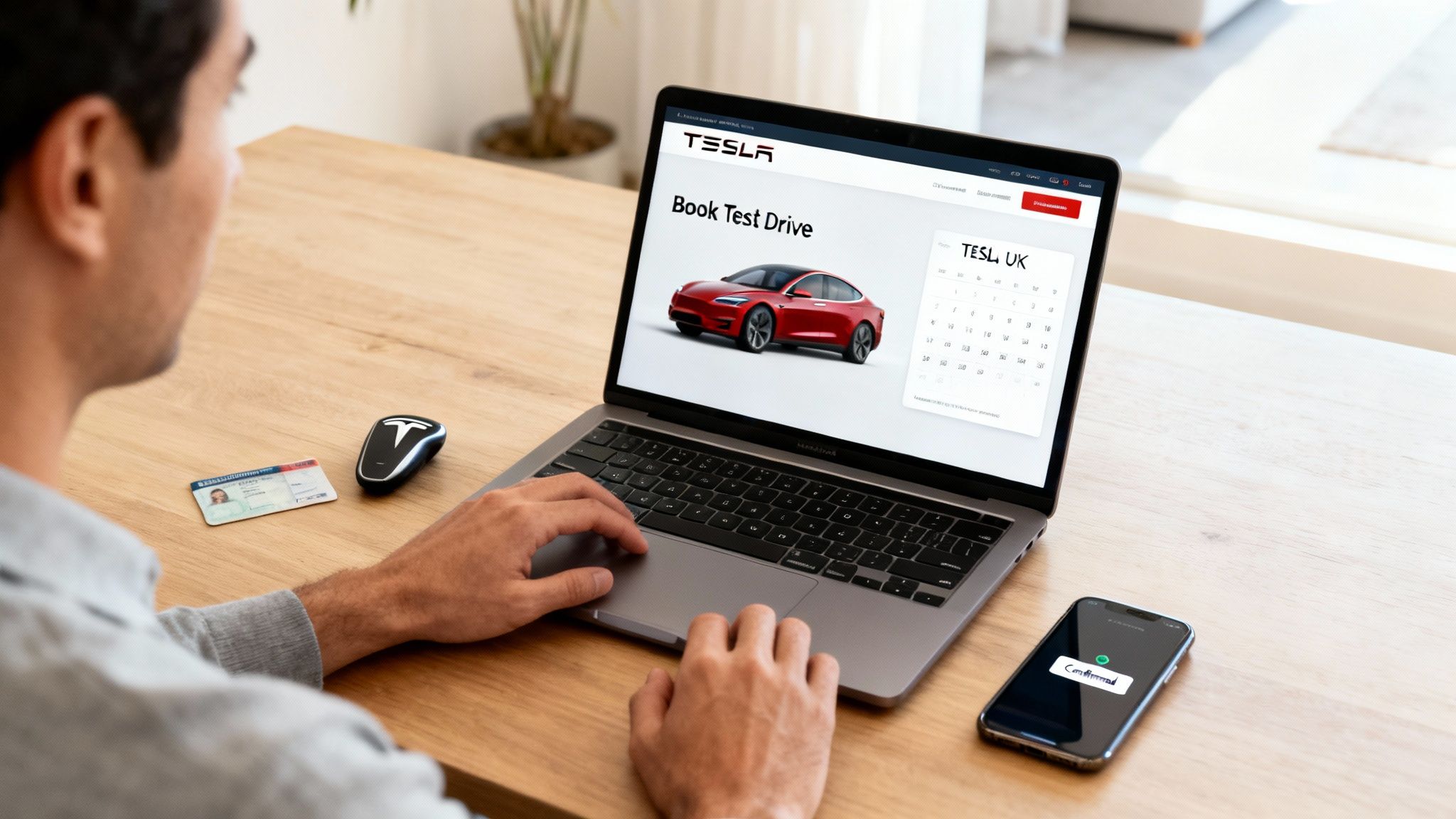
After you pop in your postcode, a map will show your nearest Tesla centres. Pick one, and a calendar with available dates and times will appear. It’s a bit like booking a dentist appointment, only infinitely more exciting and with less chance of a lecture about flossing.
A word of warning: slots, especially on weekends, can get snapped up sharpish. It's a smart move to book at least a week or two in advance to get the time that suits you best.
Once you’ve nabbed a slot and entered your details, a confirmation email will land in your inbox. That’s it. No follow-up calls trying to upsell you on rust protection or fancy floor mats. This email will have everything you need to know, which brings us to the crucial part: preparing for the day.
Your No-Nonsense Pre-Drive Checklist
Just rocking up for your test drive without a plan is a rookie error. This isn't a quick spin around the block; it's your chance to properly evaluate a car that could cost you upwards of £40,000 . To get the most out of your 30 or 60-minute slot, you need to be prepared.
The whole experience is less of a traditional sales pitch and more of a 'here are the keys, have fun, don't crash' vibe. This puts the responsibility squarely on you to properly assess whether the car fits your life.
To make sure you're ready to put the car through its paces, I’ve put together a simple checklist. Some of these might seem screamingly obvious, but you’d be surprised what gets forgotten in the heat of the moment.
Your No-Nonsense Tesla Test Drive Checklist
| Item | Why It's Not As Obvious As It Seems |
|---|---|
| Your Photocard Licence | Seems basic, right? But people forget. No licence, no drive. Simple as that. It must be the physical card, and yes, they will check it’s valid. |
| A Pre-Planned Route | Don't just follow their suggested loop around a pristine business park. Plan a route that includes roads you actually drive. Think bumpy B-roads, a tricky parallel park, and a stretch of dual carriageway. |
| A Healthy Dose of Scepticism | Go in with an open mind, but be ready to challenge the hype. Is that giant screen really a good idea when you're driving? Is the ride too firm for Britain’s pockmarked roads? |
| A Passenger (Optional) | Bringing a partner or friend is a brilliant idea. They can poke around on the massive screen while you focus on the road, and you'll get a valuable second opinion. Even if it's just to mock your driving. |
| The DVLA Check Code | This is a big one. You need to generate a licence ‘check code’ from the DVLA website within 21 days of your test drive. They need it for their insurance. Bring it with you. |
| Your Questions List | Jot down everything you want to know beforehand. In the moment, it’s easy to forget things like charging costs, service intervals, or real-world range in winter. |
Being prepared means you walk away with real answers, not just a lingering buzz from that neck-snapping acceleration. The goal is to figure out how a Tesla fits into your life, not just how it performs in perfect conditions.
Putting the Model Y and Model 3 to the Test
So, you’ve navigated Tesla's booking system and you’re standing there, keycard in hand. This is it. This is where the real evaluation begins, where the spec sheets and forum arguments fade away. Your 30-minute slot is all about how these cars handle dreary, potholed British tarmac – a world away from the pristine highways of California.
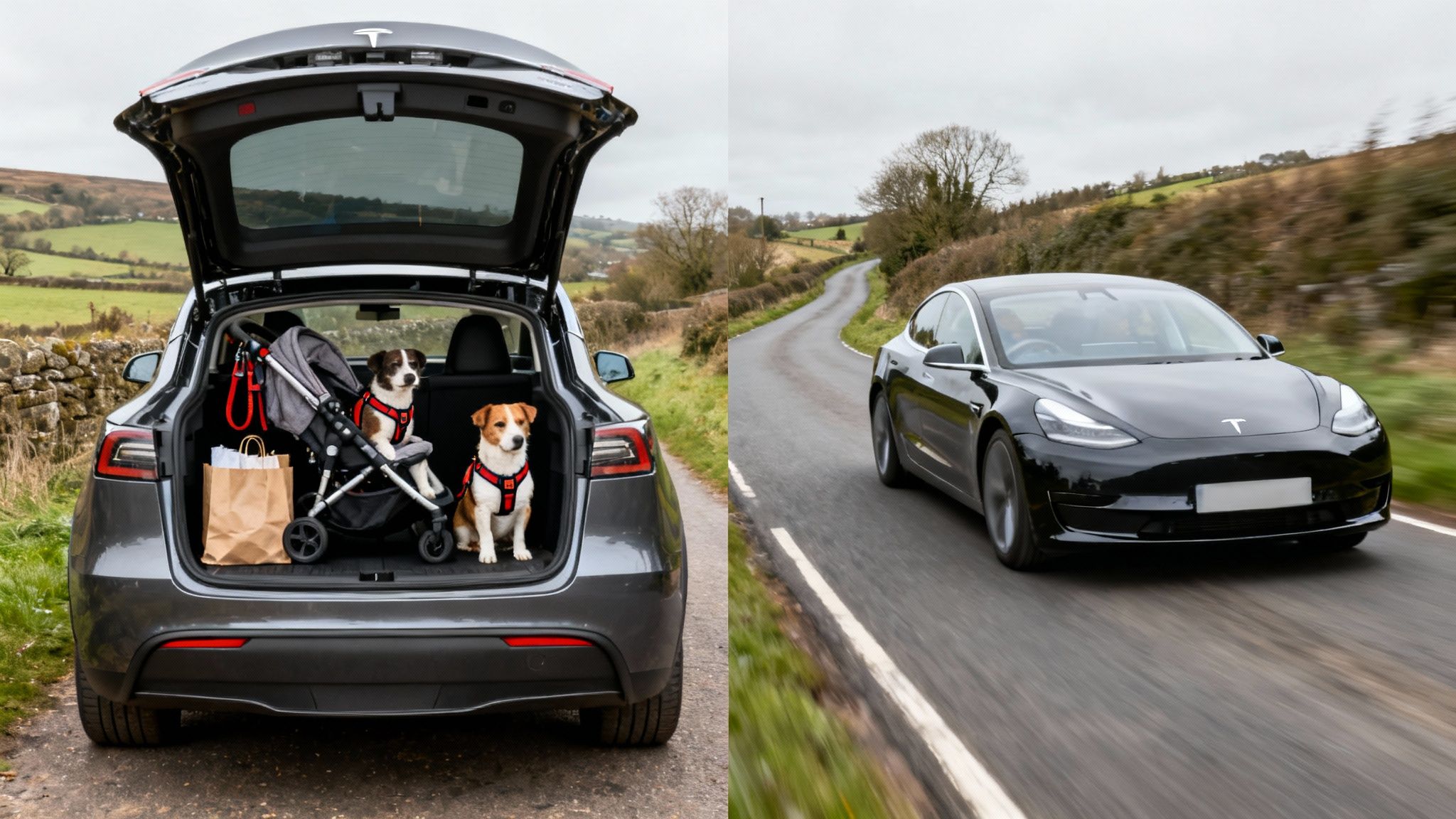
We're zeroing in on the two titans of the UK Tesla scene: the Model Y and the Model 3. They might share a lot of DNA, but they’re built for entirely different stages of life. Think of it as the difference between a quick pint after work and signing a mortgage application.
The Model Y: A Practicality Interrogation
The Model Y is Tesla’s answer to the ubiquitous family crossover. It’s the weapon of choice for the school run, the weekend trip to the tip, and everything in between. Its popularity is no accident; despite a wider sales dip, the Model Y was still the UK's best-selling EV with 24,298 registrations, beating the Model 3's 21,188 . This dominance, explored further on the RAC's website , is exactly why you need to get behind the wheel.
But numbers on a page don't tell you if it’ll actually cope with your life. Your mission is to assess its real-world practicality with ruthless efficiency.
- The B-Road Bulge: Find a narrow, winding country lane. Does the Model Y feel like a cumbersome barge, making you suck in your breath every time a tractor rumbles past? Or is it surprisingly nimble for its size?
- Suspension Inquisition: Seek out some potholes. This is Britain; it won’t take you long. Early Model Ys had a reputation for a ride that was firmer than a drill sergeant's handshake. Get a proper feel for how it copes now. Is it jarring over bumps, or does it feel composed?
- The Boot Challenge: Forget the official litre measurements. Can you actually picture your life in that boot? The pram, the big shop from Aldi, and a grumpy Labrador. Pop the 'frunk' (front boot), too. Is it genuinely useful storage, or just a glorified glovebox for charging cables?
A Model Y test drive isn't really about raw speed; it’s about picturing your daily grind. Don’t forget to check the visibility – that rear view, in particular, can feel a bit like looking through a letterbox.
Your main question for the Model Y should be: "Does this car make my complicated life easier, or is it just a big, expensive gadget?" The answer lies in how it handles the mundane, not the magnificent.
The Model 3: A Lesson in Dynamics
Now for the Model 3. This is the driver's car of the pair, feeling much more like a sharp sports saloon than a sensible EV. Its lower centre of gravity and lighter frame make it feel noticeably more agile. This is the car where you can, and absolutely should, explore the performance.
Here, your focus shifts from day-to-day practicality to the pure sensation of driving.
- Unleash the Beast (Sensibly): On a clear stretch of road, like a dual-carriageway slip road, give the accelerator a firm, deliberate push. That instant, silent surge of power is the Tesla party piece. Does it make you giggle, or does it just feel unnervingly quick?
- Master One-Pedal Driving: This is fundamental to the Tesla experience. Crank the regenerative braking up to its strongest setting and try to drive using only the accelerator. Lifting off slows the car smoothly for junctions and traffic. It feels bizarre for about five minutes, and then it suddenly clicks.
- Go-Kart Handling: Chuck it through a few roundabouts. Notice how flat and planted it feels? The steering is quick and direct. You need to know if it inspires confidence and makes you feel connected to the road.
Don’t get so swept up in the performance that you forget the basics. Listen for road and wind noise at motorway speeds. And that minimalist interior is a make-or-break feature for many. Can you live with no buttons, or will adjusting the wing mirrors via a touchscreen drive you absolutely bonkers?
Don't Forget the Silly Stuff
Finally, a crucial part of any Tesla test drive is to play with the toys. I know, it sounds frivolous, but the tech is a massive part of the ownership experience.
- Engage Autopilot: On a well-marked dual carriageway, give the basic Autopilot a go. Hands on the wheel, eyes on the road. The goal isn't to test its limits, but to see if it genuinely reduces your stress in stop-start traffic. Does it feel trustworthy or terrifying?
- Explore the Infotainment: Park up for a couple of minutes and just poke around the screen. Find the sketchpad, the silly emissions testing mode (yes, the one with the fart noises), and the games. It’s all part of the car's quirky personality.
These test drive principles hold true whether you're looking at a brand-new car or a used one. If you're considering the latter, our guide on the top 5 things to look for when inspecting a used EV is well worth a read. Ultimately, it’s all about balancing that exhilarating performance with the day-to-day realities of UK driving.
Questions to Ask Your Tesla Advisor
Right, you’ve had your fun, and now you’re back at the Tesla centre with a grin plastered across your face. While most of your Tesla test drive is a solo affair, you'll usually get a chance to chat with a Tesla Advisor before or after you hand back the keycard. This is your moment.
Don't waste it asking about the cupholders. These advisors aren't your typical forecourt sharks working on commission, so trying to haggle is a complete non-starter. Think of them as product specialists. Your mission is to pull out the crucial, real-world information they might not volunteer.
Think of it as a friendly interrogation. You need to come armed with sharp, specific questions that cut through the marketing gloss and get to the reality of owning one of these things. Being prepared means you walk away with facts, not just a fuzzy feeling from that silent, instant acceleration.
The Nitty-Gritty on Charging and Costs
The first, and arguably most important, topic should be the lifeblood of any EV: charging. Vague answers here are a massive red flag, so press for details that apply to your actual life, not some idealised scenario.
Get specific with the numbers. It’s one thing to know you can charge at home, but it’s another to understand what that really means for your wallet.
- Supercharger vs Home Charging Costs: Ask them for the current pence-per-kilowatt-hour rate on their local Supercharger network. Then, follow up by asking what a typical overnight charge might cost on a popular off-peak home tariff like Octopus Go. The difference is often staggering.
- Installation Hassles: Who do they recommend for home charger installations? Crucially, what’s the average wait time for an installation in your area right now, and what's a realistic all-in cost?
- Real-World Range in Winter: This is a big one for anyone in the UK. Ask them to be brutally honest about how much the range drops when it’s 3°C outside and you’ve got the heating and wipers going full blast. A drop of 25-30% is perfectly normal, but it's best to hear it from them.
Forget the glossy brochures and official WLTP figures for a moment. Your goal is to get a frank assessment of what it costs in pounds and pence to run one of these things through a miserable British winter.
Unpacking the Tech and Warranty Promises
Next up, it’s time to probe the promises of futuristic tech and the warranty that backs it all up. This is where some of the biggest misconceptions about Tesla ownership live, and a few pointed questions can save you a world of confusion—and potential expense—down the line.
Don’t just nod along when they mention "Autopilot" or the battery warranty. You need to dig deeper to understand the limitations and find out what’s actually covered if things go south.
The Elephant in the Room: Full Self-Driving
The topic of "Full Self-Driving" (FSD) is a minefield of hype versus reality. It’s an expensive option, so you need to be crystal clear on what you’re actually paying for today, in the UK.
- What does FSD actually do right now? Press them on this. In its current form, it's a very advanced driver-assist system, not a chauffeur. It does not make the car autonomous on UK roads.
- What’s the real cost? Ask about the one-off payment versus the monthly subscription. Do the maths on how long you’d need to subscribe to equal the outright purchase price – it might surprise you.
- Phantom Braking Reports: Gently bring up the reports of "phantom braking," where the car can brake suddenly for no apparent reason. Ask what the latest software updates have done to address this. It’s a known issue, and their response will be telling.
Finally, get clarity on the warranty details. Ask specifically for the battery and drivetrain coverage in both years and mileage. The battery warranty, for instance, covers degradation only if it drops below 70% within the warranty period—a crucial detail to understand. Being an informed buyer isn't confrontational; it’s just plain smart.
Navigating UK Insurance and Running Costs
Right, let's slam the brakes on the exhilarating acceleration for a moment. You’ve had your fun, the grin is permanently etched onto your face, and you’re already mentally redecorating your garage. But before you get carried away planning a silent, emission-free grand tour of the UK’s finest service stations, we need to discuss the decidedly less thrilling topic of grown-up finances.
Welcome to the world of Tesla insurance.
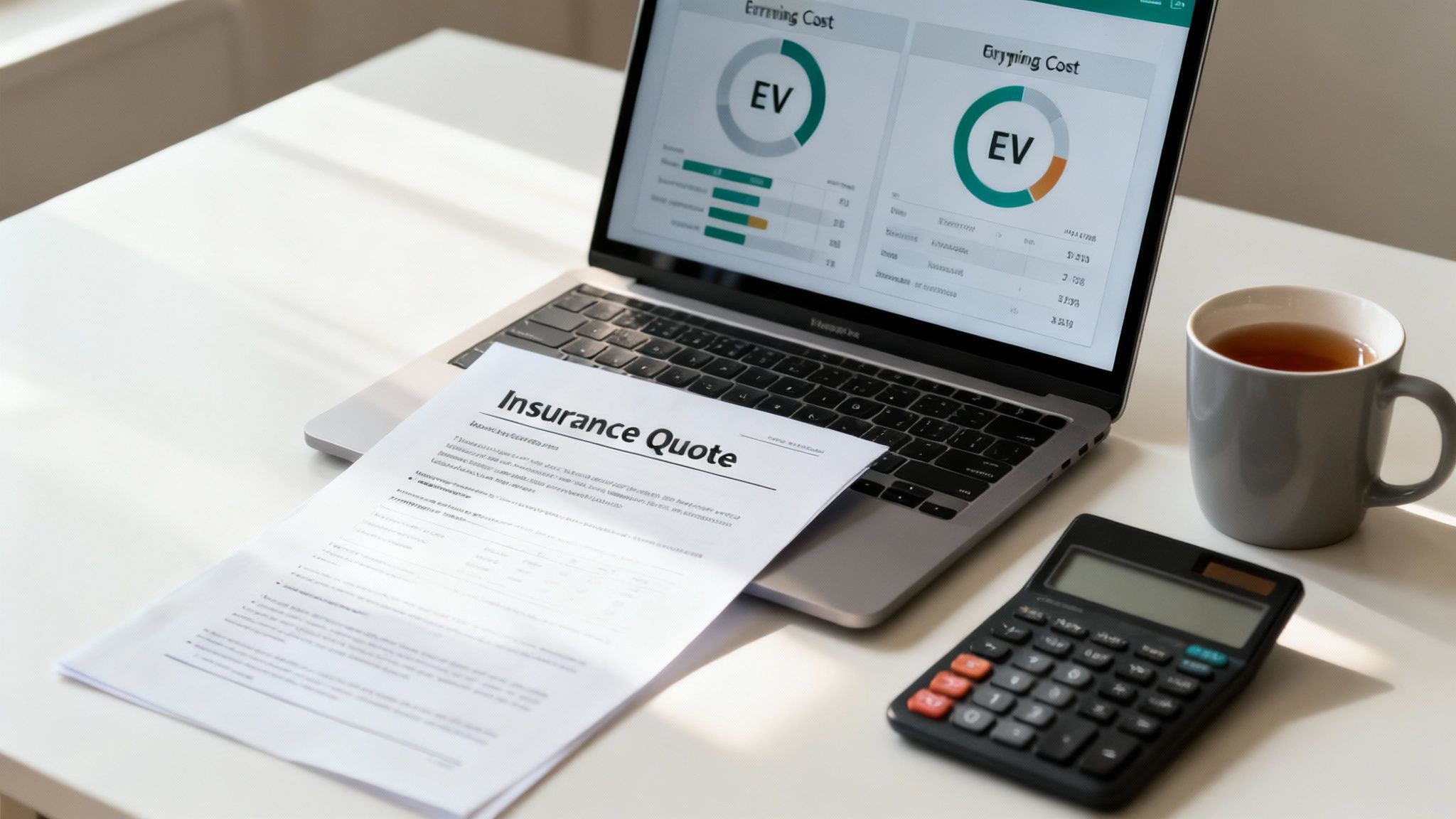
Insuring a Tesla can be a bit of a shock to the system, especially if you’re coming from a sensible petrol hatchback. Many traditional insurers see the badge and immediately picture pound signs flashing before their eyes—and not in a good way. The premiums can be eye-watering, and there are a few very good, albeit frustrating, reasons for this.
Why Your Insurer Is Scared of Your New Tesla
First off, there's the raw performance. Even the most basic Model 3 can leave a lot of hot hatches for dust, which automatically puts it in a higher-risk category. Insurers hear " 0-60 in 4.2 seconds " and immediately imagine you attempting to recreate a scene from The Fast and the Furious in a Tesco car park.
Then there's the cost and complexity of repairs. You can't just pop down to your local garage for a new wing mirror after a minor scuffle. Fixing a Tesla often requires specialist technicians and parts that aren't exactly sitting on a shelf in Halfords. This drives up the potential cost of any claim, which in turn inflates your premium.
- Specialist Parts: The aluminium body panels and integrated battery packs are expensive and complicated to fix.
- Approved Bodyshops: Repairs must be done by a limited network of Tesla-approved centres, which reduces competition and can increase labour costs.
- Tech-Heavy Components: That giant screen and the array of cameras and sensors are very costly to replace if they get damaged.
Before you even dream of placing an order, you absolutely must get some real insurance quotes. Use a comparison site, but also contact specialist EV insurers directly. Doing this after your Tesla test drive but before paying a deposit is the smartest move you can make. It’s the essential, slightly dull homework that could save you a massive financial headache down the line.
Don’t fall into the trap of assuming your current provider will give you a reasonable quote. Many legacy insurers are still catching up with the EV revolution, and their pricing often reflects a deep-seated fear of the unknown.
Understanding the Test Drive Waiver
During the booking process, you'll agree to Tesla's test drive terms. This isn't just a formality you can skim past. In essence, you’re agreeing that you’re covered by Tesla’s fleet insurance for the duration of the drive, but you're also accepting liability for any damage caused by negligence. It’s their polite way of saying, "Have fun, but if you treat it like a bumper car, you're buying it."
This really underscores the importance of having your own fully comprehensive insurance sorted before you take ownership. For a more in-depth look at this often-confusing topic, you might be interested in our guide to decoding electric car insurance costs. Getting your head around these figures is a critical step in turning that thrilling test drive into a savvy purchase.
Making Sense of Your Tesla Experience
The door thunks shut. Suddenly, the drone of your old petrol car feels deafening, and the world outside seems to be moving in slow motion. You’ve just finished your Tesla test drive , and your brain is a fizzy cocktail of instant torque, regenerative braking, and a nagging question about how on earth you were meant to adjust the wing mirrors.
So, what’s next? It’s incredibly easy to get swept up in the novelty of it all and rush to place an order. But hold your horses. That thrilling 30-minute joyride needs a reality check against the grind of your actual life—the tedious commutes, the school runs, and the weekend trips to B&Q.
The trick is to think beyond that face-melting acceleration. Yes, it’s a brilliant party piece, but you won’t be using it to escape the multi-storey car park on a Tuesday afternoon. Now is the time to be brutally honest with yourself about what you just experienced.
From Thrill Ride to Considered Choice
Let's start with the basics. That minimalist interior is a massive point of contention for many. Did you find it refreshingly modern, a zen-like cabin free from the clutter of a thousand buttons? Or did having to navigate three sub-menus just to open the glovebox drive you completely round the bend? There’s no right answer here, but it’s a fundamental part of living with a Tesla every single day.
And then there's the one-pedal driving. Was the regenerative braking a revelation, making you feel like a driving genius as you smoothly glided to a halt without ever touching the brake pedal? Or did it just feel plain weird, maybe even a bit nauseating? Try to picture yourself in stop-start traffic on the M25; will it be a blessing or a curse?
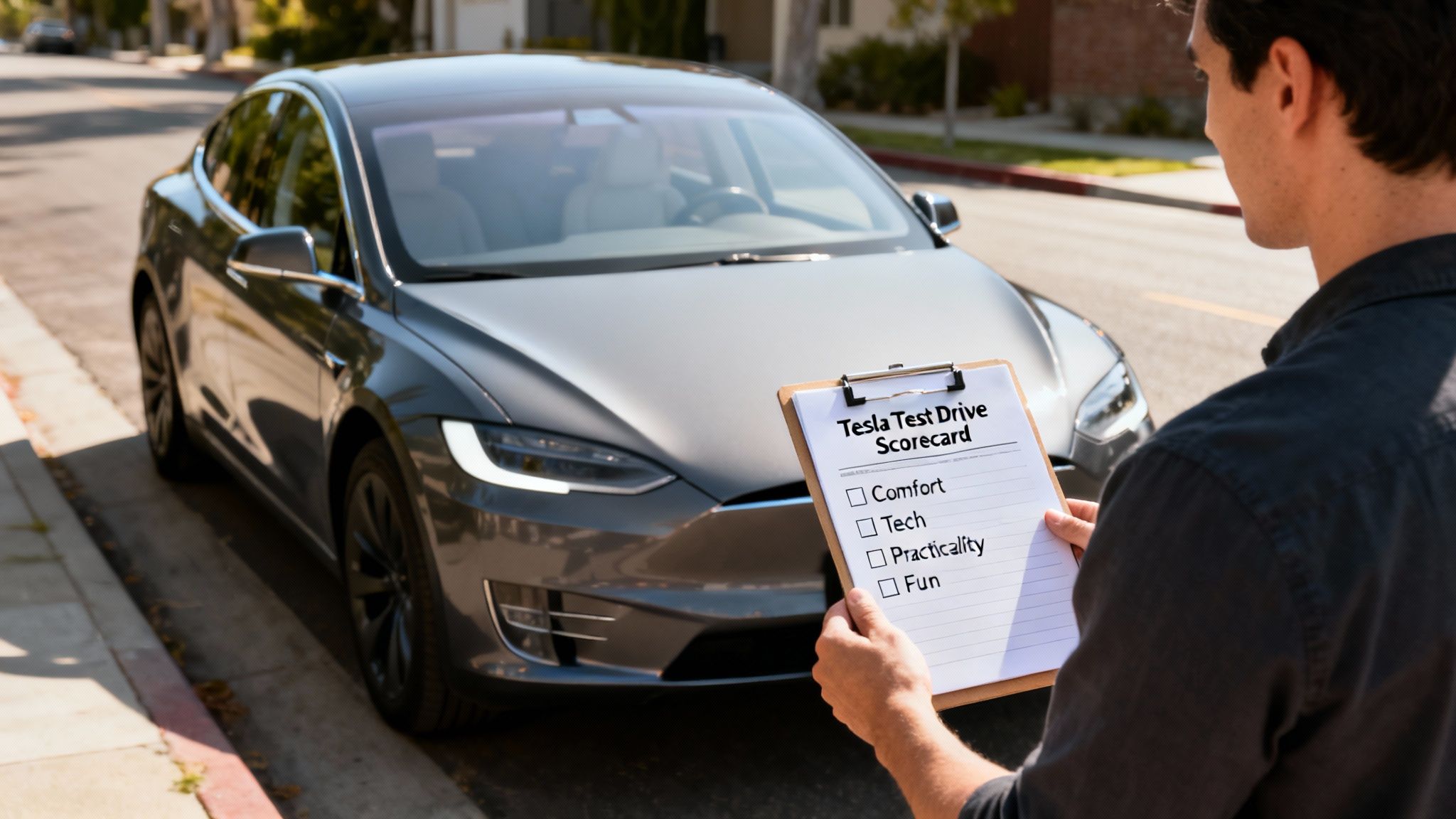
To help organise your thoughts, it's a good idea to score the key aspects of the drive. This small step helps turn a purely emotional reaction into something a bit more objective.
- Comfort: How did your back feel? Was the suspension forgiving on Britain’s gloriously potholed roads, or did you find it uncomfortably firm?
- Tech Usability: On a scale of ‘intuitive genius’ to ‘infuriating gimmick,’ where did that giant screen land for you? Could you actually perform basic functions without getting lost?
- Practicality: Forget the official boot space figures for a moment. Could you realistically fit your life in there? Think about the pushchair, the golf clubs, or the inevitable flat-pack furniture haul.
- The Fun Factor: Don't forget this one. Did it put a massive, silly grin on your face? A car should bring you a bit of joy, after all.
Your task now is to contextualise the experience. The test drive is designed to wow you with performance and tech. Your job is to sift through that and find the reality of day-to-day ownership.
Living with the Reality
Thinking about real-world performance is also crucial. A recent Tesla Model 3 Standard Range stunned observers in UK testing by clocking an impressive 339 miles on a single charge—smashing its official WLTP figure. This kind of everyday capability is a massive tick in the 'pro' column when you’re weighing everything up. You can read more about these impressive real-world range findings on DHINSA.
Ultimately, this post-drive analysis is the most critical part of the process. It's where you decide if you're buying a car that genuinely improves your life or just a very expensive gadget. For a deeper dive into the next steps, have a look at our survivor’s guide to buying a Tesla in the UK. It’s the perfect follow-up read once the initial excitement has worn off.
Voltsmonster's Deal of the Week
So, you’ve done it. You’ve had your Tesla test drive, the neck-snapping acceleration has left a permanent grin on your face, and now you’re back home, staring at your bank account with a cold sweat. Don’t panic.
Every week, we dive headfirst into the UK’s used car market to fish out one genuinely brilliant Tesla deal. We’re not hunting for the absolute cheapest car out there, but the smartest buy for your money.
Forget trawling through endless listings for a knackered, high-mileage Model S. We’re looking for that sweet spot: a nearly-new model loaded with the right options, a low-mileage ex-demonstrator with a tasty discount, or a lease deal that won't make your wallet weep. We do the digging so you can get straight to the good stuff.
This Week’s Top Find
Our pick of the bunch this week is a late 2023 Model 3 Long Range 'Highland' that popped up on a major used car site. It's only clocked 6,000 miles , so it’s barely even run-in.
What makes this one so good? Simple. You get all the fantastic 'Highland' updates – the whisper-quiet cabin, those lovely ventilated seats, and the much-improved suspension – but you completely sidestep the brutal 15-20% depreciation hit that the first owner took.
This specific car, finished in Pearl White with the standard 18-inch Photon wheels, works out to a saving of nearly £7,000 against ordering the same one from Tesla today. It’s the perfect way to make that test drive thrill a reality without paying the new-car premium. All the best tech, none of the financial sting.
Your Tesla Test Drive Questions Answered
Right, you’ve probably got a head full of specs and charging stats by now, but a few practical questions are likely still nagging at you. Let's run through some of the most common queries we get from UK drivers, so you can walk into that test drive feeling completely prepared.
Think of this as the final checklist before you press the start button.
How Long is a Tesla Test Drive in the UK?
You're looking at about 30 minutes behind the wheel. It's not a weekend loaner, so forget any dreams of a leisurely jaunt to the coast. This is a concentrated dose of the Tesla experience, designed to give you a real feel for the car in a short space of time.
Some centres might be a little more lenient on a quiet weekday, but don't count on it. That half-hour will fly by, which is exactly why having a planned route is so important. You need to make every one of those 1,800 seconds work for you.
Do I Need to Pay for a Tesla Test Drive?
Not a penny. It’s completely free, and perhaps more importantly, there’s no hard sell attached. Tesla's approach is famously hands-off. You book online, show up with your driving licence, and they hand over the keycard. Simple as that.
You won't find a pushy salesperson hovering over your shoulder, waiting to pounce the second you get back. The car is expected to do the selling, which is a refreshing change for anyone used to the traditional dealership dance.
Can I Test Drive a Specific Model and Colour?
Yes and no. You can absolutely request a specific model. If you’ve booked a Model Y Long Range, that’s precisely what you should get. They know you need to drive the version you’re actually thinking of buying.
Colour and wheel options, however, are a different story. You’ll have to drive whatever they have in the test fleet on the day. Its purpose is to showcase the driving dynamics, not the paint catalogue. So, even if your heart is set on that gorgeous Ultra Red, be ready to spend your 30 minutes in a standard white model.
Ready to dive deeper into the world of electric vehicles? At VoltsMonster , we provide honest reviews, practical guides, and entertaining content to demystify EV ownership. Explore more at https://www.voltsmonster.com.
VoltsMonster Electric Vehicle Blog