Electric Car Charger Manufacturers: Your Sceptic's Guide to Not Buying a Dud
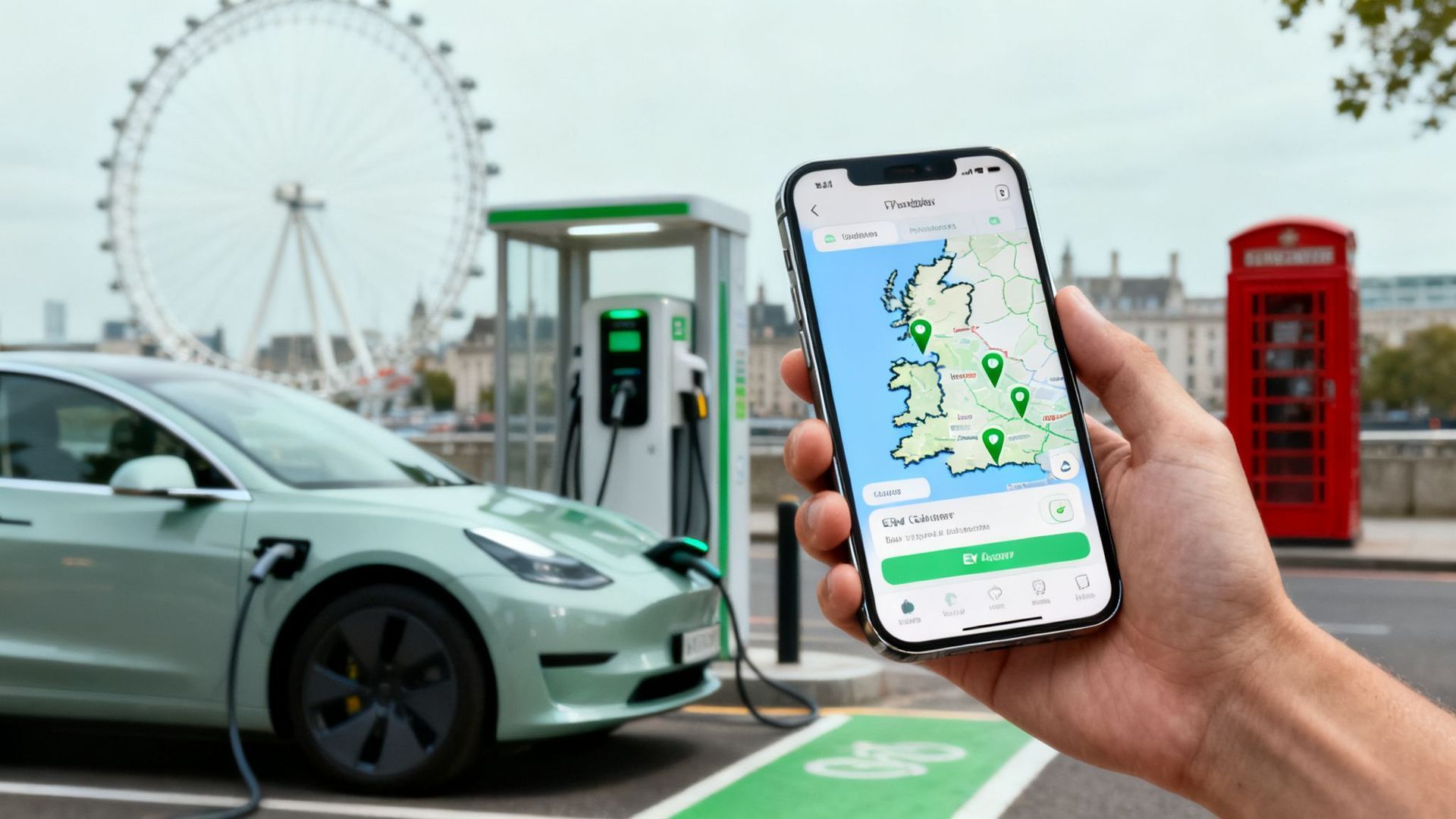
Welcome to the wild west of EV charging. It feels like every bloke with a shed and a soldering iron is suddenly calling himself one of the UK's top electric car charger manufacturers . With new names popping up faster than potholes on the M25, this boom is both a blessing and a curse for anyone who just wants a reliable way to get some juice into their motor.
Who's Actually Knocking These Things Together, Then?
Let’s be brutally honest for a moment: the world of EV chargers is a bit of a circus right now. You’ve got a motley crew of companies all scrapping for that prime spot on your garage wall. Picking the right one is about so much more than finding the prettiest plastic box; it’s a decision that affects day-to-day reliability, ease of use, and whether your car is actually full of electricity when you need it for the morning commute.
This isn't like buying a toaster. The hardware itself is only half the story. The other, and arguably more critical, half is the software—the app on your phone that you’ll be prodding at every single day. A clunky, bug-ridden app can quickly turn a state-of-the-art charger into an expensive and deeply frustrating wall ornament.
The Rogues' Gallery of Charger Brands
The market for electric car charger manufacturers is generally split into a few distinct tribes. Knowing who’s who is the first step in not making a complete horlicks of your purchase.
- The Plucky British Upstarts: These are the homegrown heroes, often founded by engineers who looked at the market and thought, "Cor, we can do better than that." They tend to promise innovation and local support, which is brilliant, but sometimes they haven't yet achieved the scale of the bigger fish.
- The International Giants: These are established global brands that have muscled their way into the UK. They bring enormous R&D budgets and polished products to the table, but their customer support can sometimes feel a bit distant and faceless when you run into a problem.
- The Energy Company Rebrands: You'll notice many big energy suppliers now offer their own branded chargers. More often than not, these are simply rebadged units from another manufacturer, bundled with an electricity tariff designed to lock you into their ecosystem for all eternity.
Your job is to see past the marketing guff. A manufacturer's real value isn't found in its glossy brochures, but in the long-term reliability of its products, the quality of its app, and how responsive its customer service is when things inevitably go pear-shaped. Think of this guide as your essential briefing before you dive into this electrifying—and occasionally infuriating—world.
Decoding the Alphabet Soup of Charger Bollocks
Right, let’s cut through the noise. When you start shopping for an EV charger, you’ll be hit with a dizzying blizzard of acronyms and technical terms. It’s easy to feel overwhelmed, but understanding a few key concepts puts you firmly in the driver's seat.
Let's start with the big one: AC vs DC charging .
Think of it like this: your home is supplied with Alternating Current (AC) from the National Grid, but your car's battery can only store Direct Current (DC). The vast majority of home chargers ( 99% , in fact) are AC chargers. They simply act as a safe, smart gateway, passing the AC power to your car, where an onboard converter handles the job of turning it into DC to fill the battery.
DC chargers, on the other hand, are the huge, super-fast units you find at motorway service stations. They contain massive internal converters that bypass your car's system, pumping DC power straight into the battery. This is why they can add hundreds of miles of range in minutes, but it's also why they are incredibly expensive and need a commercial-grade power supply. For home charging, you're looking at an AC unit. Simple as that.
The market itself is a fascinating mix of specialist upstarts and huge multinational corporations all fighting for a piece of the pie. This creates a really dynamic environment for buyers.
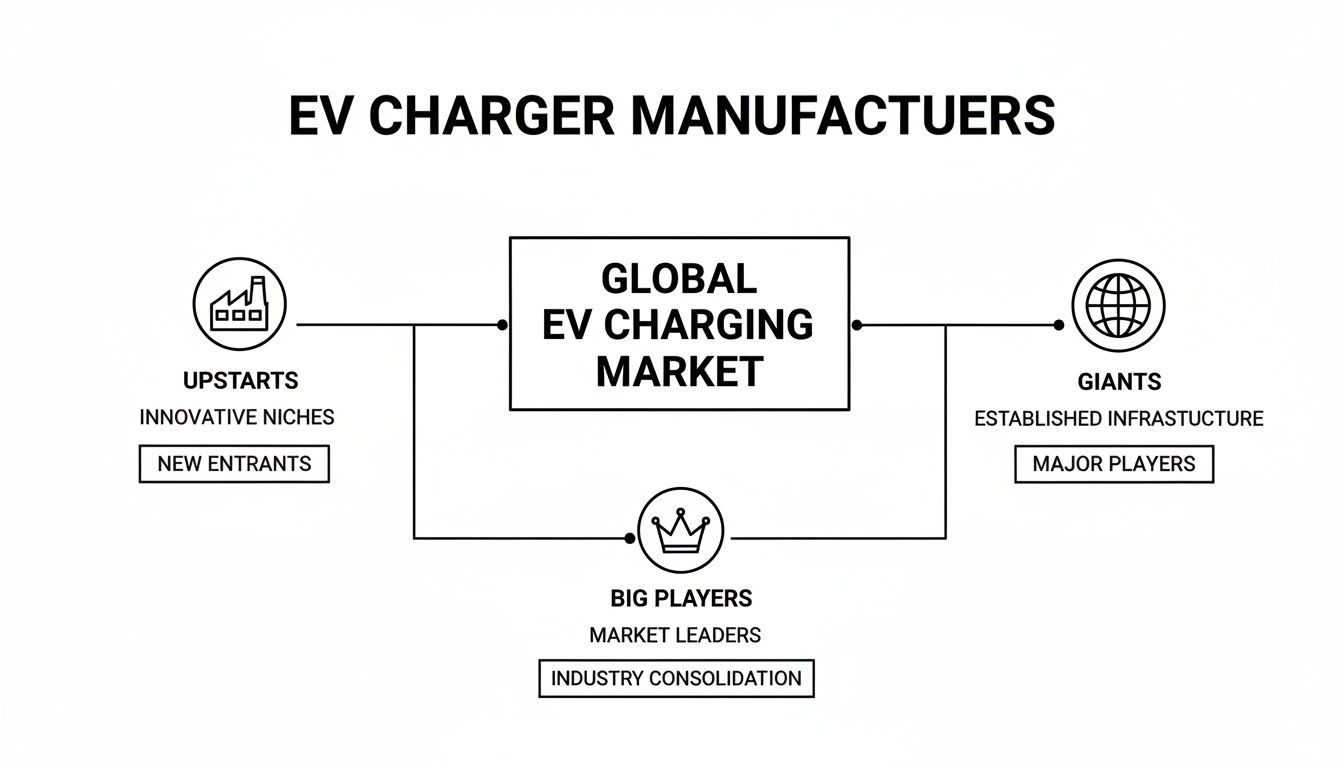
This competitive landscape means more choice, better features, and sharper pricing for you. But it also means you need to know what you’re looking for.
Getting to Grips with Specs and Standards
Once you understand the AC/DC difference, the next thing you'll see is power levels, measured in kilowatts ( kW ).
- 7kW Chargers: This is the sweet spot for most UK homes. A 7kW charger connects to a standard single-phase electricity supply and will typically add around 25-30 miles of range for every hour it’s plugged in. For overnight charging, it’s more than enough.
- 22kW Chargers: These are significantly faster, but there's a catch. To run a 22kW charger, you need a three-phase electricity supply. While common in commercial buildings, it's about as rare as hen's teeth in British houses.
Beyond the power, there's one piece of jargon that's actually your best friend: OCPP .
OCPP , or the Open Charge Point Protocol, is an open-source "language" that allows chargers, vehicles, and management software from different companies to communicate with each other. It’s a bit like USB for chargers – a universal standard that ensures things just work together.
Why is this so important? An OCPP-compliant charger isn't locked into the manufacturer's own ecosystem. If you find their app is slow, buggy, or just plain awful, OCPP gives you the freedom to switch to a different, better software platform without having to rip the charger off the wall. It’s your get-out-of-jail-free card, preventing you from being held hostage by a terrible user experience.
If you’re interested in how different physical plug types work together, our UK driver's guide to CCS and CHAdeMO adapters is a great place to learn more. But when it comes to software, always, always ask if a charger is OCPP certified before you buy.
To help you translate some of the other terms you'll encounter, here’s a quick-and-dirty reference table.
Charger Specs Translated Into Plain English
This table cuts through the jargon to tell you what the key technical specifications really mean for your day-to-day charging experience.
| Technical Term | What It Actually Means For You | Why You Should Give a Toss |
|---|---|---|
| IP Rating (e.g., IP55) | How weatherproof the charger is. The first number is for dust/solid protection; the second is for water. | A higher number means better protection against the great British weather. IP55 is a good baseline for outdoor installation. |
| IK Rating (e.g., IK10) | How resistant the charger casing is to physical impacts (like a knock from a car bumper or a stray football). | A high IK rating (IK08 or above) means the unit is tough and built to last, protecting your investment from clumsy oafs. |
| Tethered vs Untethered | A tethered charger has a permanently attached cable. An untethered one just has a socket, requiring you to use your own cable. | Tethered is convenient (no fumbling for cables). Untethered is neater and more flexible if you have cars with different plug types. |
| Load Balancing | A smart feature that monitors your home's total electricity use and automatically reduces the charger's power to avoid tripping your main fuse. | This is crucial for safety and convenience. It lets you run the washing machine and charge your car at the same time without worrying about a blackout. |
| PEN Fault Detection | An internal safety device that protects against a rare but serious electrical fault, removing the need for an external earth rod. | This simplifies installation, making it cheaper, faster, and tidier, as the installer doesn't need to hammer a copper rod into your garden. |
Having a basic grasp of these terms will empower you to compare different models effectively and choose a charger that’s perfectly suited to your home and vehicle.
Meet the Contenders: A Guide to UK Charger Brands
Right, let’s get to the main event. Now that you can tell your AC from your DC, it’s time to line up the usual suspects in the UK’s electric car charger market. This isn’t just a list of names; think of it as a personality parade of the brands vying for a spot on your wall. From plucky British upstarts to international heavyweights, they all want a piece of the action. Let's see who's actually worth your money.
Choosing a manufacturer is a bit like picking a partner for a very slow, electricity-based dance. Some are flashy and promise the world, while others are the quiet, reliable type. The trick is figuring out which is which before you’ve bolted one to the side of your house. We're going to give you the unfiltered take on the big players, looking past the glossy marketing to see what real drivers actually think.
The Homegrown Heroes
Flying the flag for Great Britain are a few key brands that have built formidable reputations right here at home. They often have a better grasp of the unique quirks of UK houses and our national obsession with the weather.
-
Myenergi (Zappi): Hailing from Grimsby, Myenergi is the darling of the eco-conscious driver. Their Zappi charger is famous for its seamless integration with solar panels and home batteries, letting you charge your car with pure, unadulterated sunshine. The app is generally well-regarded for being feature-rich, though it can feel a little complex if you're new to it all.
-
Hypervolt: As a relative newcomer, Hypervolt has made serious waves with its stylish design and sharp focus on the user experience. They tend to bundle in features like load balancing and PEN fault detection as standard, things other brands often charge for as pricey extras. They’ve also built a solid reputation for responsive, UK-based customer service, which is honestly worth its weight in gold.
The International Giants
These global players have huge resources behind them, bringing polished, mass-market products to UK shores. They benefit from massive scale, but that can sometimes make the experience feel a bit impersonal.
-
Pod Point: Pod Point chargers are one of the most common sights in the UK, having been around since the dawn of modern EVs. Their units are straightforward and generally reliable, though some users find the app a bit basic compared to the competition. As one of the largest electric car charger manufacturers , their real strength lies in their vast public charging network.
-
Wallbox: Coming to us from Spain, Wallbox brings a dose of continental flair to the market with its sleek, compact designs. Their Pulsar Max is a popular choice for its tiny footprint and powerful features. That said, their reputation for aftercare can be a bit hit-or-miss, according to driver forums.
When you're comparing brands, you have to look beyond the initial price tag. Head over to the app store and read the reviews—that’s where you’ll find the real story on software quality. A buggy, frustrating app will sour your ownership experience far more than paying an extra £50 for a unit from a manufacturer known for solid software and support.
This is really just scratching the surface of the main contenders. For a much deeper dive, check out our https://www.voltsmonster.com/uk-ev-charger-reviews-the-brutally-honest-guide , where we properly get into the nitty-gritty of each brand's real-world performance. Ultimately, the best manufacturer for you is the one whose priorities—be it solar integration, slick design, or sheer simplicity—line up perfectly with your own.
Are Smart Features Genuinely Smart or Just a Gimmick?
Every single electric car charger manufacturer will tell you their unit is ‘smart’. It’s become the go-to marketing buzzword, slapped on the box to make a fairly simple bit of kit sound like it’s one circuit away from taking over the world. But what does ‘smart’ actually mean when it’s bolted to the side of your house?
In reality, ‘smart’ is just a catch-all term for a charger you can talk to through an app on your phone. This isn’t exactly ground-breaking stuff; we’ve been controlling our tellies this way for years. The trick is sorting the genuinely useful features from the expensive novelties designed to part you from a bit more of your cash.
The one function that makes a smart charger absolutely worth having is scheduled charging . This is the opposite of a gimmick. It lets you plug your car in the moment you get home from work but tell the charger not to actually start pulling power until, say, midnight, when your electricity tariff plummets to a much friendlier off-peak rate.
Using a smart charger to schedule your charging for off-peak hours is the single biggest money-saving trick in the EV owner’s handbook. It can easily cut your home charging costs by 50-75% , turning a significant running cost into a trivial one.
What Is Actually Required by Law
Thankfully, it’s not a total marketing free-for-all. The government stepped in with new regulations back in 2022, which now mandate that all new home and workplace chargers sold in Great Britain must have certain smart capabilities right out of the box.
This means every new charger you buy must have:
- Off-peak charging presets: The ability to automatically set charging sessions to avoid the most expensive peak hours (usually 8am to 11am and 4pm to 10pm on weekdays).
- Connectivity: The charger has to be able to connect to the internet to receive commands and send back data.
- Data Security: It needs to have basic cybersecurity measures built-in, just to stop any digital ne'er-do-wells from messing with your charge.
So, when a salesperson proudly tells you their charger can be scheduled, just remember they’re legally obliged to offer that. It’s not some premium, optional extra anymore—it's the bare minimum.
The Good, The Bad, and The Unnecessary
Beyond those legal basics, manufacturers are always trying to stand out from the crowd by adding extra bells and whistles. Here’s a quick rundown of what you’ll find.
- Energy Monitoring (The Good): Most smart apps give you detailed reports on exactly how much electricity your car has guzzled and what it cost you. This is brilliant for tracking your running costs and seeing just how much you’re saving compared to your old petrol car.
- Solar Integration (The Holy Grail): Now this is the killer feature for anyone with solar panels on their roof. Chargers like the myenergi Zappi can cleverly divert any surplus solar energy that you aren't using in the house straight into your car battery. You’re literally running on sunshine. It’s a fantastic bit of tech, but only worth paying extra for if you actually have solar.
- Voice Control (The Gimmick): Shouting "Alexa, start charging the car!" might feel wonderfully futuristic the first time you do it, but the novelty wears off fast. Your phone app is quicker and more reliable. This is a classic case of a solution looking for a problem that doesn't exist.
At the end of the day, your job is to figure out which of these features you’ll genuinely use. Don’t get upsold on functions designed for a lifestyle you don’t have. For the vast majority of drivers, rock-solid scheduling and clear energy monitoring are the only smart features that truly matter.
Navigating Installation, Warranties, and Aftercare
So, you've found the perfect charger. Fantastic. Now for the bit that can trip up even the most savvy EV owner: getting it installed correctly without invalidating the warranty or causing a domestic disaster.
It's a common trap. You find one of the best electric car charger manufacturers on the market, only to discover their approved installation network is a bit of a shambles.
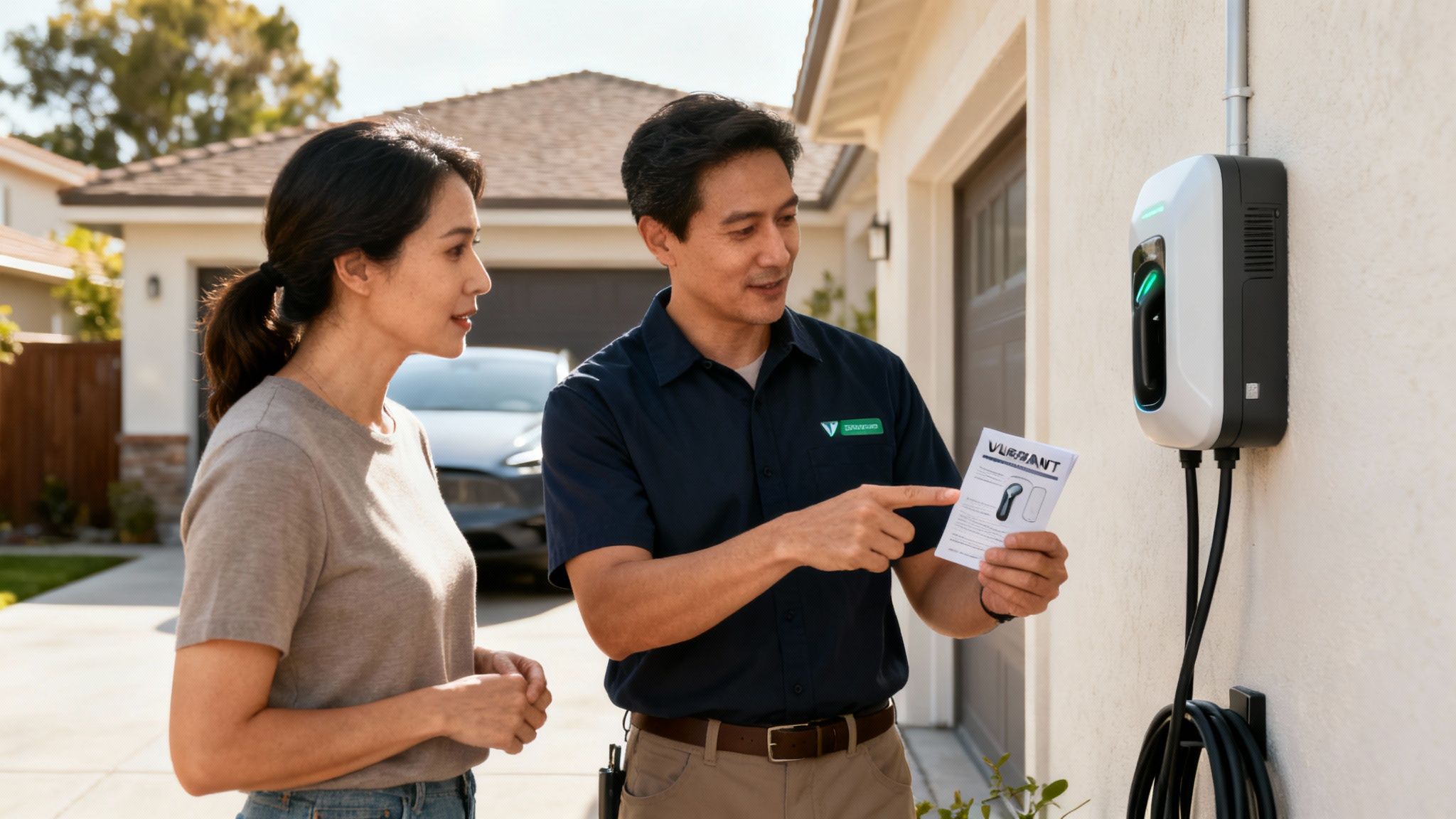
A manufacturer is only as good as the people they trust to fit their products. These certified installers are supposed to know the unit backwards. Before you part with any cash, check out the manufacturer's network. Can you easily find several approved installers in your area, or is it just one chap covering three counties? A thin-on-the-ground network is a major red flag for long waiting times and painful repair call-outs.
And please, whatever you do, avoid the temptation to get your mate's cousin's friend to "do it for a few quid." Using an uncertified electrician is the quickest route to voiding your warranty and could even jeopardise your home insurance. It's the definition of a false economy. To get the full picture on why a proper installation is so important, check out our guide to home EV charger installation.
Dissecting the Warranty Small Print
A warranty is the manufacturer's promise to you, but let's be honest, they're often full of get-out clauses. Don’t just look at the big number on the box— three years is pretty standard these days. You need to dig into the details.
Here’s what you should be looking for:
- Parts and Labour: Does the warranty cover the new part and the qualified person needed to fit it? Some policies only cover the physical component, leaving you with a hefty bill for the engineer's time.
- On-Site Support: This is critical. If something goes wrong, will they send someone out, or do they expect you to uninstall the charger and post it back? On-site support should be a deal-breaker.
- Software and Connectivity: Modern chargers are smart devices. If the app goes haywire or it drops its connection, is that covered by the warranty? Software support is just as vital as hardware support.
A high-tech charger is just a pricey plastic box on your wall if the company's support vanishes once the payment has cleared. A solid warranty and responsive aftercare are every bit as important as the charger's specs.
The last thing to check is the aftercare service. Before you buy, test them out. Drop a question to their support email or give their helpline a ring. How quickly they respond and how helpful they are tells you everything about the service you’ll get when you actually need it. A brand with a proper, UK-based support team is a brand that actually cares about its customers.
How to Spot a Good Deal and Avoid the Duds
Everyone loves a bargain. That rush of finding something brilliant for a song is practically a national sport. But in the world of EV chargers, chasing the lowest price can be a mug’s game that leads to some seriously expensive headaches down the road.
Spotting a genuine deal from a dud being flogged cheap for a reason requires a bit of savvy. A suspiciously low price often signals that corners have been cut somewhere. It might be a rubbish app, a non-existent customer support team, or a warranty that’s more hole than net.
You have to look beyond the headline price and think about the total cost of ownership . This isn’t just about the box on the wall; it’s about the entire experience of living with it.
Your Pre-Purchase Inspection Checklist
Before you get tempted by that shiny "50% Off!" banner, run through this mental checklist. Think of it as looking under the bonnet before you buy the car – it’s your best defence against buying a future paperweight.
- Manufacturer Reputation: First off, have you actually heard of them? A quick Google search for reviews from real-world UK drivers is essential. What are people saying on forums like Speak EV ? Silence can be just as damning as a flood of complaints.
- Warranty Terms: A three-year warranty is pretty standard, but the devil is in the detail. Does it cover on-site support and the electrician's time, or just the replacement part? If their policy expects you to uninstall the faulty unit and post it back yourself, run a mile.
- Software and App Quality: This is a big one. Head straight to the App Store or Google Play and read the reviews for the charger’s control app. If it’s riddled with one-star ratings complaining about bugs, crashes, and connection issues, that’s a preview of your future daily life.
A cheap charger with a terrible app isn't a bargain; it's a daily source of frustration you've paid for. The extra fifty quid for a unit from one of the reputable electric car charger manufacturers with proven, reliable software is the best money you'll ever spend.
Finally, keep an eye out for hidden costs. Some deals look fantastic until you realise the price doesn't include essential safety features like PEN fault detection, or that the best app features are locked behind a monthly subscription.
A true bargain is a reliable, well-supported product at a fair price—not just the cheapest box you can find.
Right, let’s wrap this up by tackling some of the most common questions we hear. Think of this as the quick-fire round – straight answers to those queries probably rattling around your brain.
Do I Have to Buy a Charger From My Car Manufacturer?
Absolutely not. Don’t let a slick salesperson in a dealership convince you otherwise, as it's one of the biggest myths out there.
As long as a charger has the standard Type 2 connector – which is pretty much universal across the UK and Europe – it will work just fine with your car. Car brands often just re-badge a charger from a well-known manufacturer, stick their own logo on it, and add a hefty premium for the privilege.
What’s Worse: Bad Hardware or a Rubbish App?
Honestly? A rubbish app will cause you far more day-to-day headaches.
The hardware itself is essentially a sturdy, weatherproof box designed to deliver electricity safely. But the app? That's what you'll be using constantly for scheduling charge times, monitoring energy use, and tracking costs. A buggy, slow, or poorly designed app will drive you mad.
In our experience, a reliable and user-friendly app is just as important as the physical charger. Always – and we really do mean always – check the latest app store reviews from real users before you buy.
Can I Save a Few Quid by Installing an EV Charger Myself?
In a word: no. This is definitely not a DIY job or a place to cut corners.
Unless you are a qualified electrician with specific training in EV charge point installation, don't even think about it. It’s incredibly dangerous, will likely invalidate your home insurance, and will instantly void the charger’s warranty. You must use a certified professional installer.
The demand for these professionals is soaring. The UK's electric vehicle charging market is projected to rocket from around £875 million to over £9.5 billion by 2034, fuelled by government targets and the sheer number of people switching to EVs. You can dive deeper into the UK's charging market growth statistics from the RAC.
For more brutally honest reviews, guides, and insights into the world of electric vehicles, check out VoltsMonster at https://www.voltsmonster.com.
VoltsMonster Electric Vehicle Blog