EV Charging UK: Your No-Nonsense Guide to Not Getting Stranded
Right then. You’ve got the shiny new electric car sitting on the drive, or maybe you’re just hovering over the ‘buy’ button, sweating gently. Now for the bit that gets glossed over in the showroom while you’re being blinded by chrome and promises of silent, saintly motoring: how the hell do you get electricity into the thing? Forget a five-minute splash-and-dash at the petrol station; welcome to a brave new world of kilowatts, connectors, and charging networks that feel like they were designed by a committee of sadists.
Your Slightly Sarcastic Guide to EV Charging
Let's be brutally honest, wading into the world of EV charging in the UK feels less like a technological leap and more like learning a new, and particularly stubborn, language. Suddenly, you're meant to know your 'CHAdeMO' from your 'CCS' and grasp why one plug fits and another looks at your car’s socket with utter disdain. Swapping the familiar fuel pump for an electric cable is like trading a simple kettle for a barista-grade espresso machine with a manual written entirely in Klingon.
But don’t panic. Or, panic a little, then read this. This guide is your no-nonsense translator for the UK's EV charging minefield. We’ll slice through the jargon, kick the myths to the kerb, and give you the unvarnished truth on everything from installing a home charger to navigating the frequently chaotic lottery of public charge points. Think of us as the mate down the pub who’s already made all the mistakes and is happy to tell you about them in excruciating detail, so you don’t have to.
The UK's Charging Infrastructure Is Exploding (Mostly in a Good Way)
It's easy to buy into the doom-mongering narrative that public chargers are as rare as a politician's apology, but the network is actually growing at a frankly alarming pace. By the end of December 2025, the UK had a massive 87,796 public electric vehicle charging points across 45,033 locations . To put that in perspective, it's a huge jump from just 28,460 points at the end of 2021 and represents a solid 19% growth since December 2024 alone. You can read more about the electric vehicle charging growth if you enjoy staring at spreadsheets.
This frantic expansion has led to a rather interesting tipping point:
The UK now has more public places to plug in an electric car than it has petrol stations. With over 45,000 charging locations versus about 8,400 fuel forecourts, finding a plug is, in theory, becoming easier than finding a pump.
So, while charging an EV definitely requires more forward planning than a spontaneous trip for unleaded, the infrastructure is racing to keep up. Now, let’s get into what all this actually means for you, your shiny new car, and your rapidly fraying patience.
Decoding Charger Speeds: Slow, Fast, and Ludicrously Quick
Alright, let's talk speed. In the EV charging circus, you'll hear terms like ‘Slow’, ‘Fast’, and ‘Rapid’ thrown about like confetti. It all sounds a bit like the settings on a blender, but getting your head around the difference is vital unless you fancy spending your Tuesday afternoon loitering in a car park in Scunthorpe, questioning your life choices.
Think of your car's battery as a swimming pool. A Slow charger is like trying to fill it with a garden hose. It gets there, but you'll be old and grey by the time it's full. A Rapid charger , on the other hand, is like calling in the fire brigade to unleash a high-pressure cannon. One gets the job done overnight; the other gets you back on the motorway before your service station coffee has had a chance to go cold.
The Great AC Versus DC Debate (Try to Stay Awake)
This is where things get a tad technical, but stick with me because it’s the key to everything. The electricity from the National Grid is Alternating Current (AC). Your EV battery, the fussy diva that it is, can only store Direct Current (DC). This means a conversion has to happen somewhere.
-
AC Charging (Slow and Fast): When you use a home wallbox or a slower public charger, the AC electricity flows into your car. An onboard converter inside your vehicle then has the tedious job of turning it into DC to fill the battery. The speed is limited by the size of this converter, typically topping out at a leisurely 7kW or 22kW .
-
DC Charging (Rapid and Ultra-Rapid): These are the big boys you find at motorway services, looking all futuristic and expensive. They do the AC-to-DC conversion before the electricity even gets to your car. Because the powerful converter is in the massive charging unit itself, not your vehicle, it can deliver a huge wallop of DC power straight to your battery—from 50kW all the way up to a blistering 350kW .
In essence, with AC charging, your car is doing the hard work, which is why it's slow. With DC charging, the charging station is doing all the heavy lifting, which is why it's so much quicker. And more expensive. Obviously.
Understanding where to find each type is key to planning any journey that involves going further than the local shops. This diagram gives a simple overview of the UK's EV charging ecosystem, showing how it all fits together.
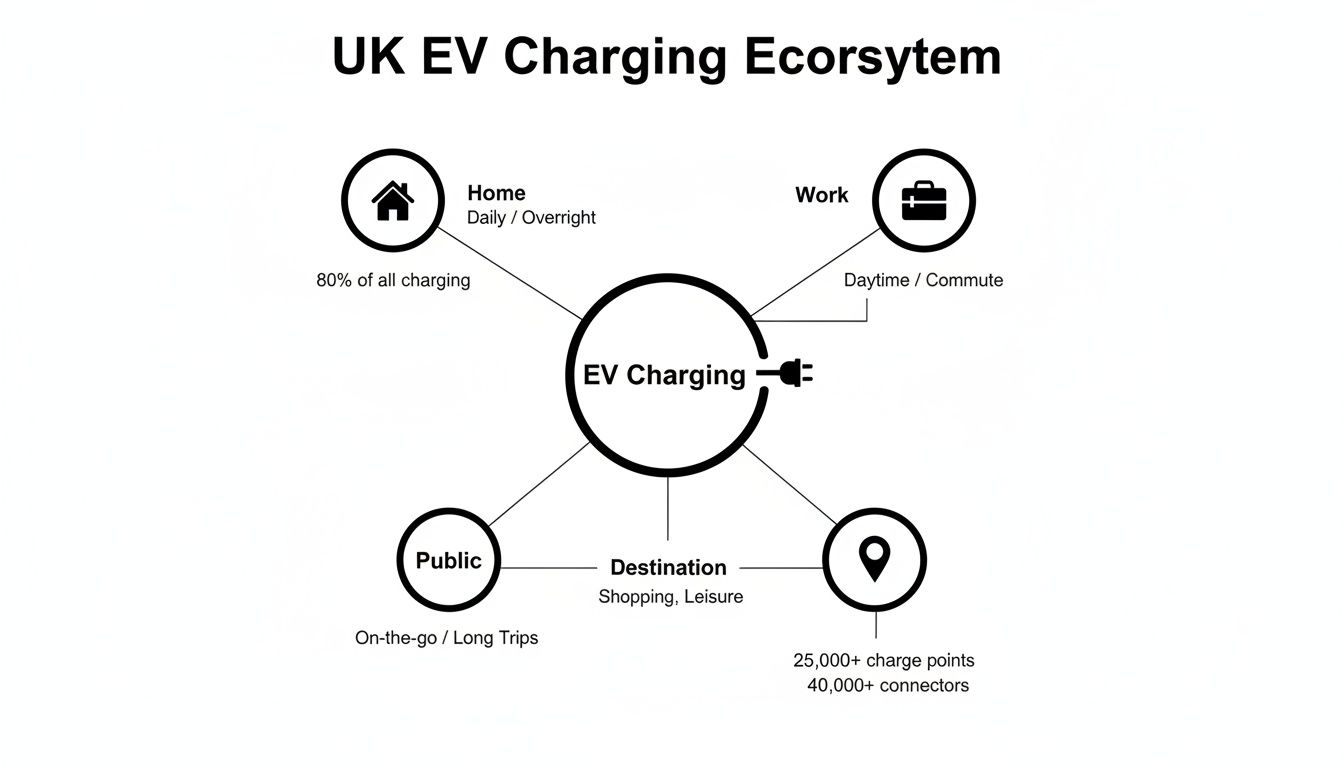
As you can see, the charging experience is a mix of convenient home and work top-ups for daily drudgery and the essential public network for those longer, more ambitious trips.
Plugs That Actually Fit (A Novel Concept)
Now, let’s talk about the business end of the cable. Showing up to a charger with the wrong connector is the EV equivalent of bringing a diesel nozzle to a petrol car. Thankfully, it’s much simpler than it looks here in the UK, as we’ve mostly settled on a couple of standards.
-
Type 2: This is the universal standard for AC charging across the UK and Europe. Your home charger will have one, as will almost all slower public chargers at supermarkets, gyms, and hotels. It’s the one you’ll use 90% of the time.
-
CCS (Combined Charging System): Meet the undisputed king of DC rapid charging. It’s basically a Type 2 plug with two extra-large pins underneath for the high-power DC current. The vast majority of new EVs sold in the UK use this connector. If your car is new, it's got this.
-
CHAdeMO: The main rival to CCS, primarily used by the Nissan Leaf and a few other Japanese models. While you'll still find them across the UK network, it’s being phased out on new cars in favour of CCS, making it a bit of a Betamax in a Netflix world. A relic of a bygone era.
UK Charger Types and Real-World Waiting Times
To cut through the jargon, what really matters is how long you’ll be standing around, kicking your tyres and waiting for a decent top-up. This table breaks it down into terms a human can understand.
| Charger Type | Power Output (kW) | Time to Add 100 Miles (Approx.) | Where You'll Find Them |
|---|---|---|---|
| Slow (AC) | 3-6kW | 5-10 hours | Home (overnight), some workplaces |
| Fast (AC) | 7-22kW | 2-4 hours | Supermarkets, car parks, destinations |
| Rapid (DC) | 50-149kW | 20-40 minutes | Motorway services, public charging hubs |
| Ultra-Rapid (DC) | 150kW+ | 10-20 minutes | Major motorway routes, dedicated EV forecourts |
As you can see, the difference between plugging in at the supermarket and pulling into a dedicated motorway hub is the difference between having a leisurely lunch and having a full-blown existential crisis.
The UK's charging network is clearly skewed towards enabling longer journeys. As of early 2025, the network boasted about 15,000 rapid chargers (50kW+) , including 3,500 ultra-rapids (150kW+) , alongside around 10,000 on-street residential units. This highlights a clear focus on enabling long-distance travel, with on-route charger numbers surging by over 30% from a base of 15,000 in just one year. You can discover more about UK charger statistics from Zest.
Setting Up a Home Charger: The Ultimate Convenience
For all the chatter about public charging networks, let's be honest: the holy grail of owning an electric car is charging it at home. This is the dream. Waking up every morning to a full ‘tank’ without ever having to visit a grimy, depressing petrol station forecourt again. It’s the single biggest life-hack for any EV driver, turning range anxiety into a distant, almost laughable memory.
But is it a huge faff to set up? Honestly, it’s easier than wrestling with a piece of flat-pack furniture, as long as you know what you’re getting into. The whole point is to make charging a thoughtless, overnight activity – just like plugging in your phone.
Tethered or Untethered: That Is the Question
Before you even glance at brands or power ratings, you’ll face the first great philosophical debate of home charging: tethered versus untethered. It’s a surprisingly passionate topic that can divide EV forums faster than a debate about pineapple on pizza.
-
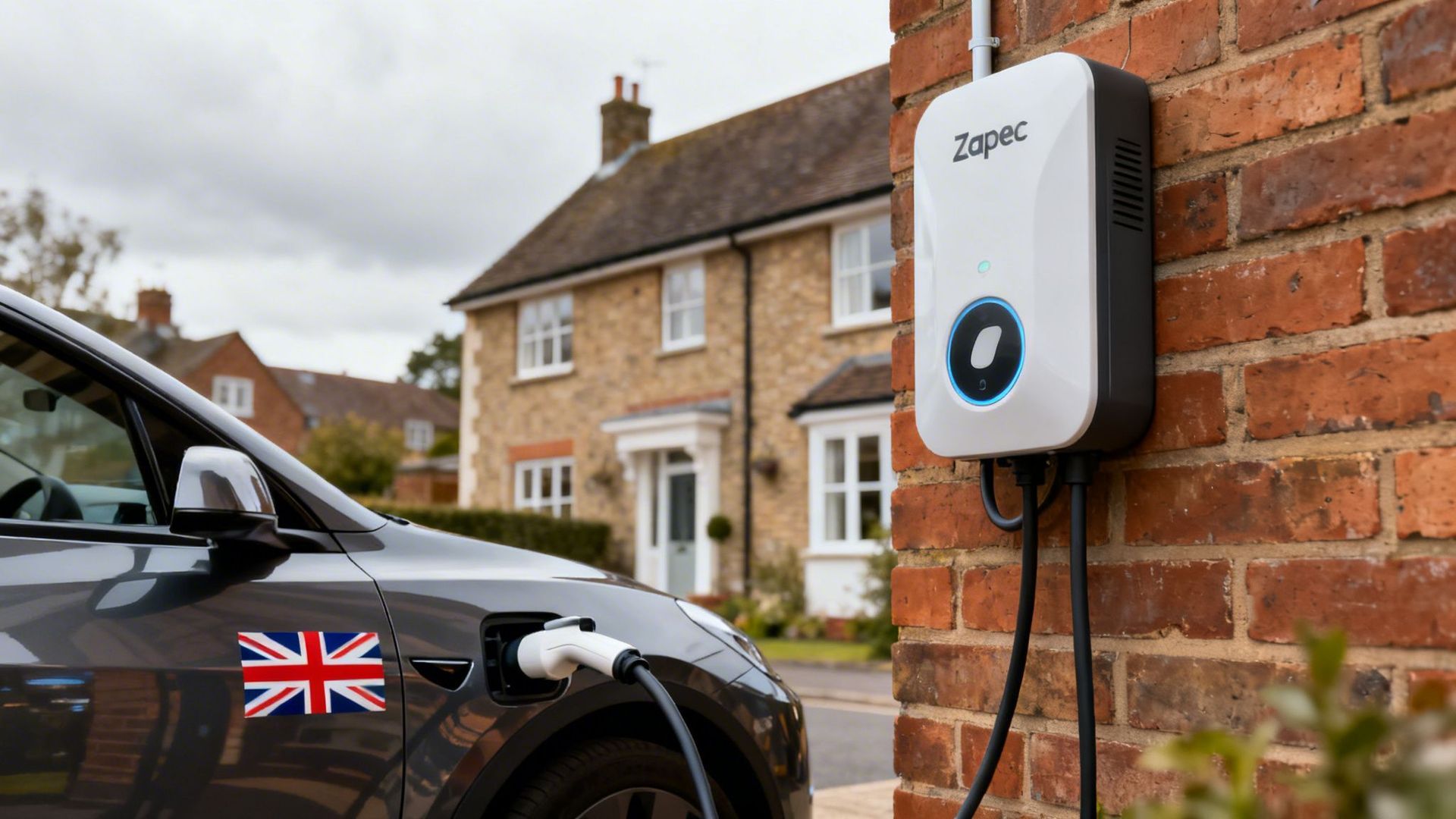
Tethered Chargers: These units come with the charging cable permanently attached. The big win here is pure convenience; you just pull up, grab the cable, and plug in. Simple. The downside? You’re stuck with that specific cable length and connector (though pretty much all are the standard Type 2). It can also look a bit messy, with a thick, ugly cable coiled up on your wall.
-
Untethered Chargers: This is just a socket, like a beefed-up version of a regular plug socket. You use the separate charging cable that came with your car (or one you bought) to connect the charger to your EV. It looks much tidier when not in use and gives you the flexibility to use different cables if needed. The only minor drawback is having to get the cable out of your boot every time you want to charge. A Herculean effort, I know.
There’s no right or wrong answer here; it’s all down to personal preference. Are you all about grab-and-go speed, or do you prefer a cleaner, more flexible setup?
Understanding Power and Smart Features
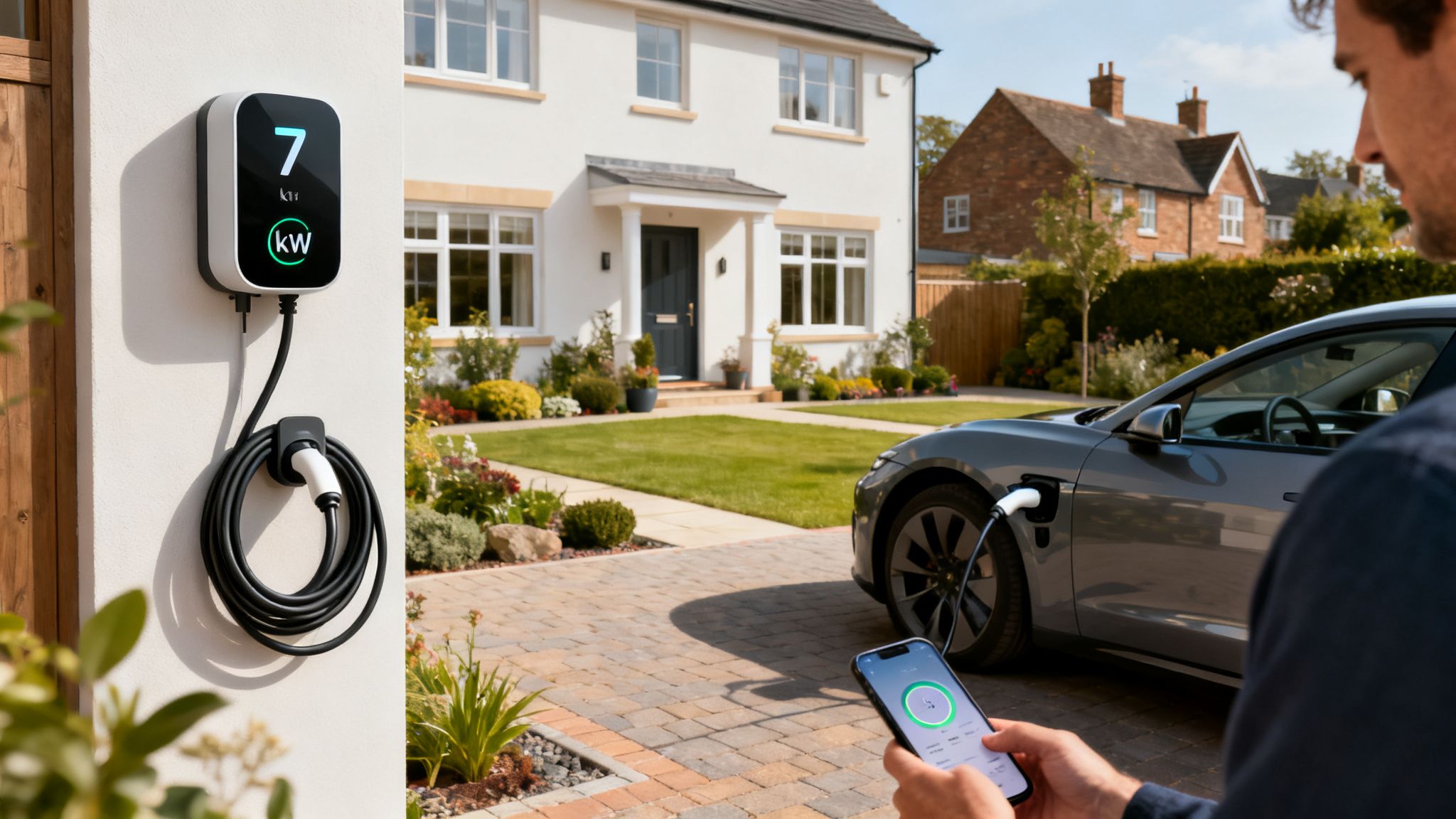
For most UK homes, a 7kW charger is the absolute sweet spot. It runs on a standard single-phase electricity supply – the kind in almost every house – and is powerful enough to add around 25-30 miles of range per hour . That's more than enough to completely refill even the biggest EV battery overnight. While faster chargers exist, they usually need a three-phase supply, which is rare in residential properties and far more expensive to install.
The real game-changer, though, isn’t raw power – it’s intelligence. Since 2022, all new home charger installations in the UK must legally be smart chargers . This isn't just bureaucratic red tape; it’s a genuinely brilliant feature.
A smart charger connects to the internet, letting it talk to you via an app and, crucially, to your energy supplier. This unlocks the ability to schedule your charging for off-peak hours when electricity is dirt cheap, track every penny of your energy use, and even link up with your solar panels.
This functionality is the key to keeping your running costs ridiculously low. It’s the difference between charging at expensive daytime rates and filling up for just a few quid overnight on a specialist EV energy tariff.
Government Grants and Finding an Installer
Ah, the part about getting money off. The UK government used to offer a generous grant for most homeowners, but those days are long gone. The main scheme is now the EV Chargepoint Grant , which can provide funding of up to £350 towards the cost of buying and installing a charger.
The catch? Eligibility is now much tighter. You generally need to be a renter or own a flat to qualify. For most people living in houses with their own drive, that ship has unfortunately sailed. It's always worth checking the latest government guidance though, just in case they’re feeling generous.
Grant or no grant, choosing the right installer is absolutely critical. Don't be tempted by the cheapest quote you find on Facebook Marketplace from a bloke called 'Dave'. You need a reputable, OZEV (Office for Zero Emission Vehicles) approved installer . These are electricians who are properly certified to fit EV chargers safely and to all the required standards. Get a few quotes, check their reviews, and make sure they give you a proper certificate for the work. Trying to save a few quid with a cowboy installer is a recipe for very expensive disaster.
If you want to dive deeper into the nitty-gritty, check out our complete guide to home EV charger installation.
Navigating the Public Charging Safari
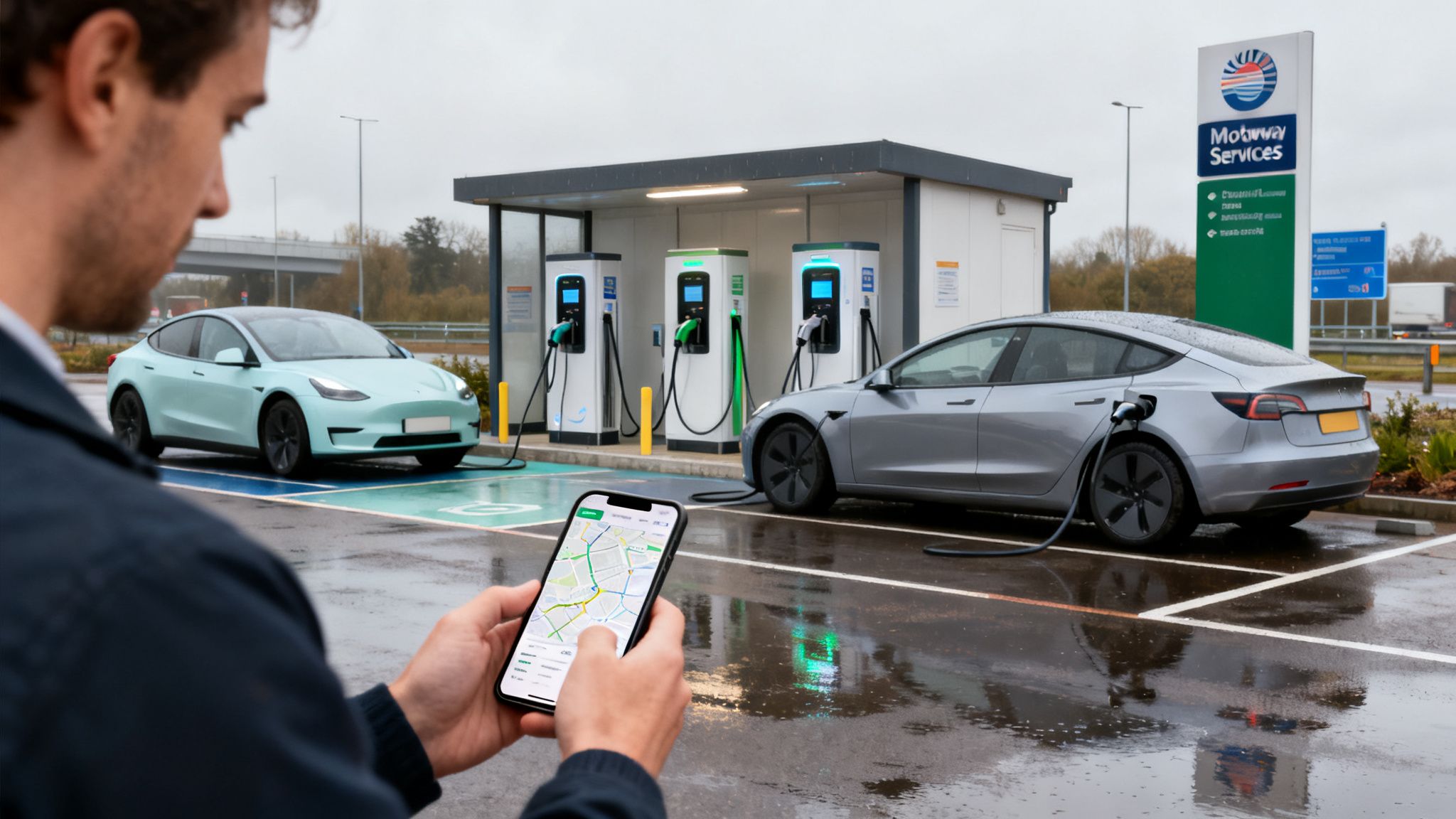
Alright, welcome to the jungle. If charging at home is the calm, predictable, civilised side of EV ownership, then public charging is the wild safari you have to tackle on longer trips. The UK's public charging network is a glorious, infuriating mess—a patchwork of different companies, each with its own app, its own pricing, and, most importantly, its own unique interpretation of what 'reliable' actually means.
Leaving the comfort of your driveway means you're not just buying electricity anymore; you're entering a whole new world of providers. This isn't like pulling into a petrol station, where a Shell and a BP offer pretty much the same depressing experience. Out here, your day can swing from seamlessly brilliant to wanting to kick a lamppost in pure, unadulterated frustration.
The Big Players in the Charging Game
You'll quickly learn the names that pop up on motorway service signs and in supermarket car parks. Think of these as the main tribes you'll encounter on your travels. Knowing who's who, and who to avoid, is half the battle.
- Gridserve Electric Highway: You’ll find these guys dominating motorway services. They’re known for their big, multi-charger ‘Electric Forecourts’ and are generally a solid, reliable choice. They offer a mix of speeds and, thankfully, now accept contactless payment.
- InstaVolt: Often voted the UK's favourite network, and for good reason. Their chargers are famously dependable, dead simple to use (just tap your bank card), and they seem to be popping up everywhere from McDonald's to local retail parks.
- Pod Point: These are the chargers you'll spot at places like Tesco and Lidl. They're typically 7kW or 22kW Fast chargers, which are brilliant for a decent top-up while you do the weekly shop but not what you’d rely on for a rapid refill mid-journey.
You'll also run into other names like Osprey, bp pulse, and Shell Recharge. Each has its own personality, and it won't take long before you have your own list of go-to networks and a mental blacklist of ones that are dead to you.
How They'll Relieve You of Your Cash
The way you pay for a public charge can sometimes feel like it was designed by a committee that never spoke to each other. While things have improved dramatically, you still need to be ready for a few different systems.
The single biggest improvement in recent years has been the mandatory rollout of contactless payment on all new rapid chargers. This has been a massive step forward, ending the infuriating days of needing a dozen different apps just to get from A to B.
Even so, you'll still come across a few payment models in the wild:
- Pay-As-You-Go (PAYG): The simplest way. You just tap your contactless card or use the provider's app to start and stop, paying only for the electricity you use (priced in pence per kilowatt-hour, or p/kWh ).
- Subscriptions: Some networks, like bp pulse, offer a monthly subscription. You pay a small fee and, in return, get a lower p/kWh rate. This can save you money if you're a heavy user of that specific network, but you need to do the maths.
- Connection Fees & Overstay Penalties: Always read the small print, you fool. Some providers add a small connection fee just for plugging in, and almost all will hit you with hefty penalties if you stay parked in the bay after your car is fully charged. And rightly so.
Your Essential Survival Kit: The Right Apps
Even with contactless becoming standard, your smartphone is still the most critical tool for navigating the public charging safari. A dead phone can be almost as bad as a dead car battery.
The one app you absolutely, unequivocally must have is Zapmap . Think of it as the Google Maps for EV chargers. It shows you a live map of nearly every public charger in the UK, from every single network. More importantly, its community of users leaves real-time updates on whether a charger is working, broken, or has a queue of angry-looking EV drivers waiting. It will save you from a wasted journey to a faulty charge point—a genuine sanity-saver.
For a deeper dive into planning your routes, our guide on the best EV charging points in the UK is a great place to start.
How Much Does This Electricity Malarkey Actually Cost?
Right, let's get down to brass tacks. Is running an electric car actually cheaper than pouring endless fivers into a petrol tank? The answer, in classic British fashion, is a firm ‘it depends’. It’s not a simple yes or no; it’s a sliding scale from ‘laughably cheap’ to ‘crikey, that was a bit steep’.
The cost of your EV charging in the UK is a tale of two extremes, and it all boils down to where and when you plug in. Think of it like buying a pint – you can get one for a reasonable price at your local, or you can pay a king’s ransom for a warm one at a festival. Electricity is no different.
The Home Charging Advantage
This is where the magic happens. Charging at home is, by a country mile, the most cost-effective way to run an electric car. If you just plug into your wallbox on a standard electricity tariff, you might be paying around 25-30p per kilowatt-hour (p/kWh) . It’s still cheaper than petrol, but honestly, we can do much, much better.
The real game-changer is switching to an off-peak EV tariff. These are special deals from energy suppliers that give you a window of ridiculously cheap electricity overnight, often between midnight and 5 am. We're talking rates that can plummet to as low as 7.5p/kWh .
This is the secret sauce to minimal running costs. By using a smart charger to schedule your top-ups for these off-peak hours, you’re essentially filling your car for pennies while you sleep. It’s the closest thing you’ll get to free fuel.
The Wild West of Public Charging
Now for the other end of the spectrum. Using a public rapid charger on the motorway is the most convenient option for long journeys, but you absolutely pay for that convenience. Prices can be eye-watering, often ranging from 65p/kWh to over 85p/kWh . Suddenly, the cost gap between electric and petrol starts to shrink alarmingly.
Slower ‘destination’ chargers at supermarkets or car parks sit somewhere in the middle, typically costing between 40-60p/kWh . Some are even still free to use, which is always a welcome bonus.
A Real-World Cost Breakdown
Let’s put some numbers on this using a common example: a Kia Niro EV with a 64.8kWh battery and a real-world range of about 250 miles .
-
Charging at Home (Off-Peak):
- Cost per kWh: 7.5p
- Full Charge Cost: 64.8 kWh x £0.075 = £4.86
- Cost per Mile: £4.86 / 250 miles = 1.9p per mile
-
Charging on a Public Rapid Charger:
- Cost per kWh: 79p
- Full Charge Cost: 64.8 kWh x £0.79 = £51.19
- Cost per Mile: £51.19 / 250 miles = 20.5p per mile
The difference is stark, isn't it? Driving 10,000 miles a year would cost you just £190 if you only charged at home overnight. If you exclusively used pricey motorway rapids, that figure would rocket to £2,050 . For comparison, a petrol car doing 45mpg would set you back around £1,450 over the same distance.
The lesson is simple: home charging is for daily driving, public rapids are for long-haul top-ups. For a more detailed look, our guide on understanding UK electric car charging costs goes into even more detail.
Your EV Charging Questions Answered
Right, we've covered a lot of ground, and it's totally understandable if your head's still buzzing with acronyms and kilowatt-ratings. To cut through the confusion, let's tackle some of the most common questions we hear about EV charging here in the UK.
We’ll get straight to the point – no jargon, no waffle. Just the clear, simple answers you need to get going with your electric car.
Can I Just Use a Normal Plug Socket to Charge My Car?
Technically, yes, you can use a standard 3-pin plug with what’s known as a 'granny charger'. But honestly? Don't. It is painfully, excruciatingly, soul-destroyingly slow. For a lot of modern EVs with big batteries, you’d be looking at over 24 hours for a full charge.
It’s a last resort. Fine for an emergency or a very slow trickle top-up when you’re visiting your actual granny, but it’s completely impractical for day-to-day life. A dedicated 7kW home wallbox is the proper tool for the job.
Not only is a wallbox massively faster, but it's also much safer. Plus, all new ones have smart features that let you schedule charging for when electricity is cheapest overnight, which will save you a serious amount of money. Think of the 3-pin lead like the space-saver spare tyre in your boot: you're glad it's there, but you wouldn't dream of using it for your daily commute.
Why Are There So Many Different Apps for Public Charging?
It’s a complete pain, isn't it? For years, almost every charging network insisted on you using their own specific app and signing up for an account, because of course they did. The result was a phone screen cluttered with dozens of apps you’d use once and then forget about.
Thankfully, things are finally getting better. New regulations now mean that most new rapid chargers must accept contactless payment. You can just tap your bank card and get on with your day, like a normal person.
That said, it’s still a good idea to have a couple of the major network apps installed, alongside an aggregator like Zapmap. The apps are often the only way to see if a charger is actually available in real-time, and some networks even offer slightly cheaper rates if you pay through their app instead of with a bank card. It’s a bit of a faff, but a necessary one for the time being.
What Happens If I Run Out of Charge on the Motorway?
First of all, your car will have given you about a million warnings before this actually happens, probably with an increasing sense of panic in its beeps and alerts. But if you do manage to ignore them all and grind to a halt, it’s much like running out of petrol, only with less flammable liquid and more quiet shame.
You'll need to call your breakdown service, like the AA or RAC. The vast majority of their patrols are now equipped with mobile EV chargers that can give you just enough juice to limp to the next service station. It's not a situation you want to be in, and it might be a bit embarrassing, but it's certainly not the end of the world. Just try not to make a habit of it.
Is It Bad for the Battery to Always Use Rapid Chargers?
The general thinking on this is that relying exclusively on high-power DC rapid chargers can, over the long term, degrade the battery slightly faster than slower AC charging. Your car has a clever battery management system to protect itself, but repeatedly slamming it with huge amounts of power isn't ideal for its long-term health, a bit like only ever eating takeaways.
The best practice is really simple:
- Use slower AC charging at home or work for all your day-to-day driving needs. This is the battery’s equivalent of a healthy, home-cooked meal.
- Save the rapid chargers for those long-distance journeys when you genuinely need the speed. Think of them as a convenient, if slightly unhealthy, drive-thru.
A healthy mix of both is absolutely fine. It's how most of us use our EVs, and it causes no issues whatsoever.
At VoltsMonster , we cut through the noise to give you the real story on electric cars. For more honest takes, car reviews, and guides that don’t treat you like an idiot, plug into our latest content. Check out our thoughts at https://www.voltsmonster.com.
VoltsMonster Electric Vehicle Blog