Your Essential Guide to the Electric Car Portable Charger (AKA The Granny Charger)
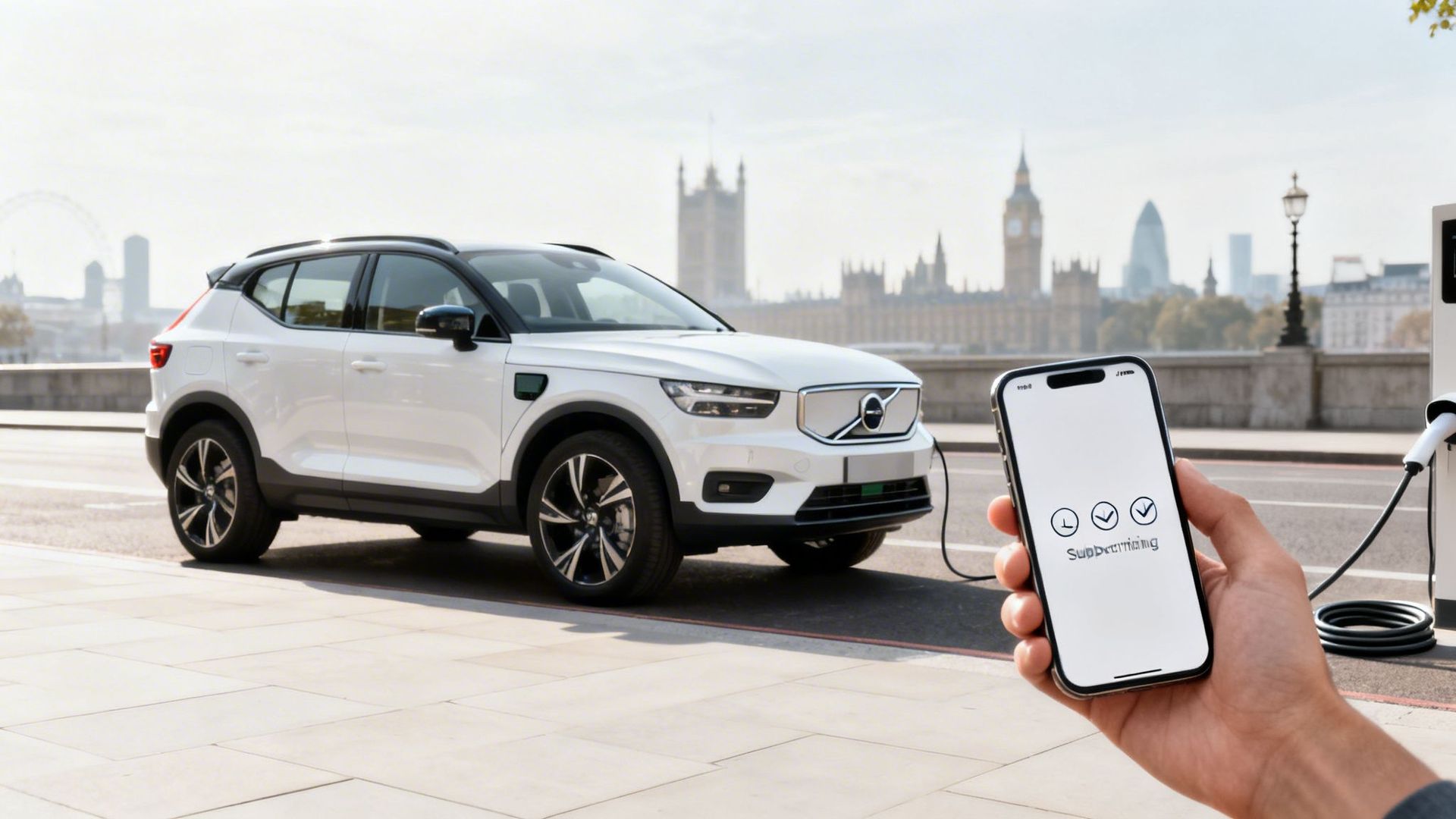
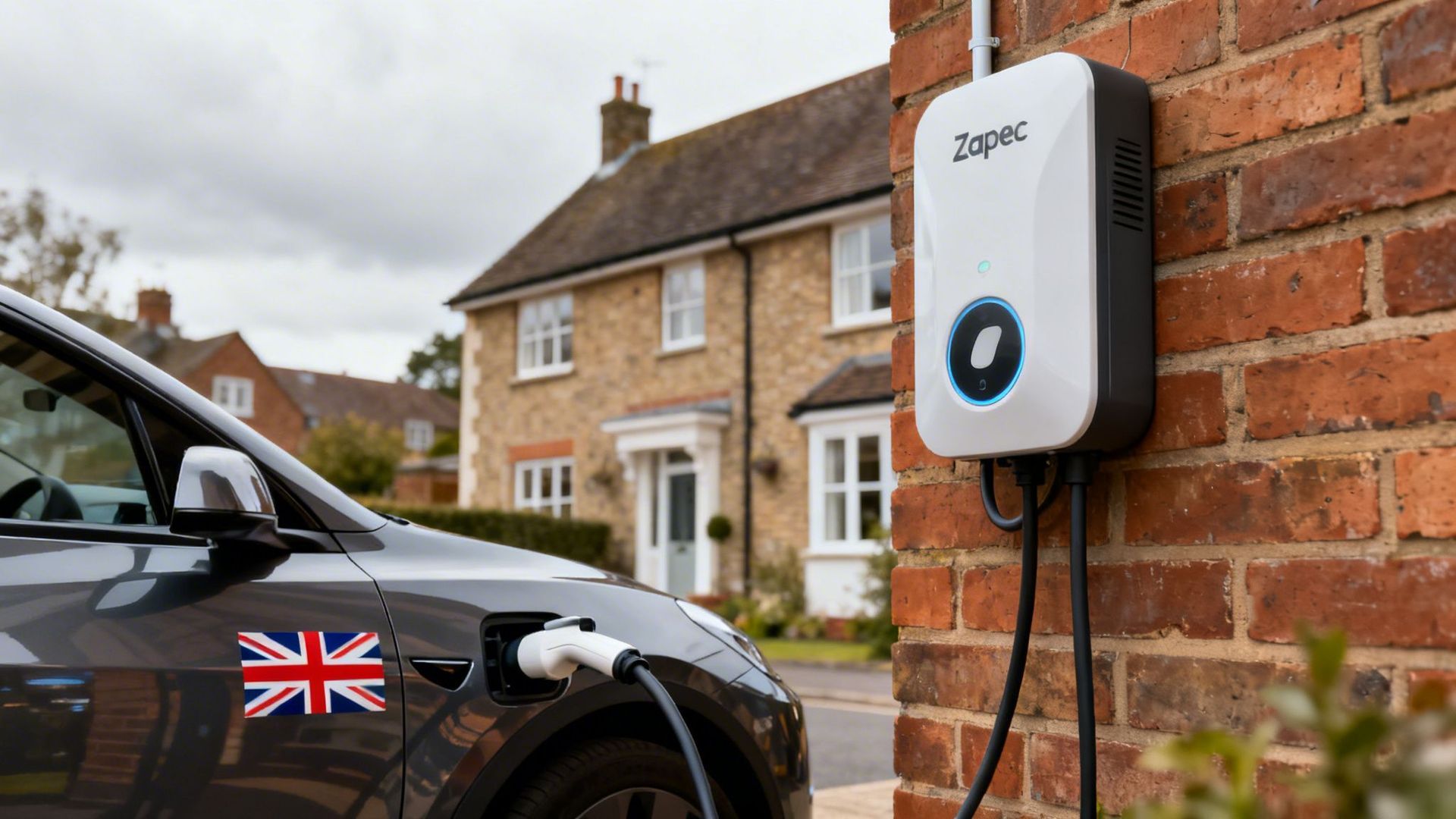
An electric car portable charger is, in essence, a clever cable that lets you plug your electric car straight into any standard UK three-pin wall socket. It’s more affectionately known as a 'granny charger', a fitting nickname for what is, let's be honest, the ultimate get-out-of-jail-free card for topping up your battery when a proper charger is nowhere to be found.
The Unsung Hero of EV Charging
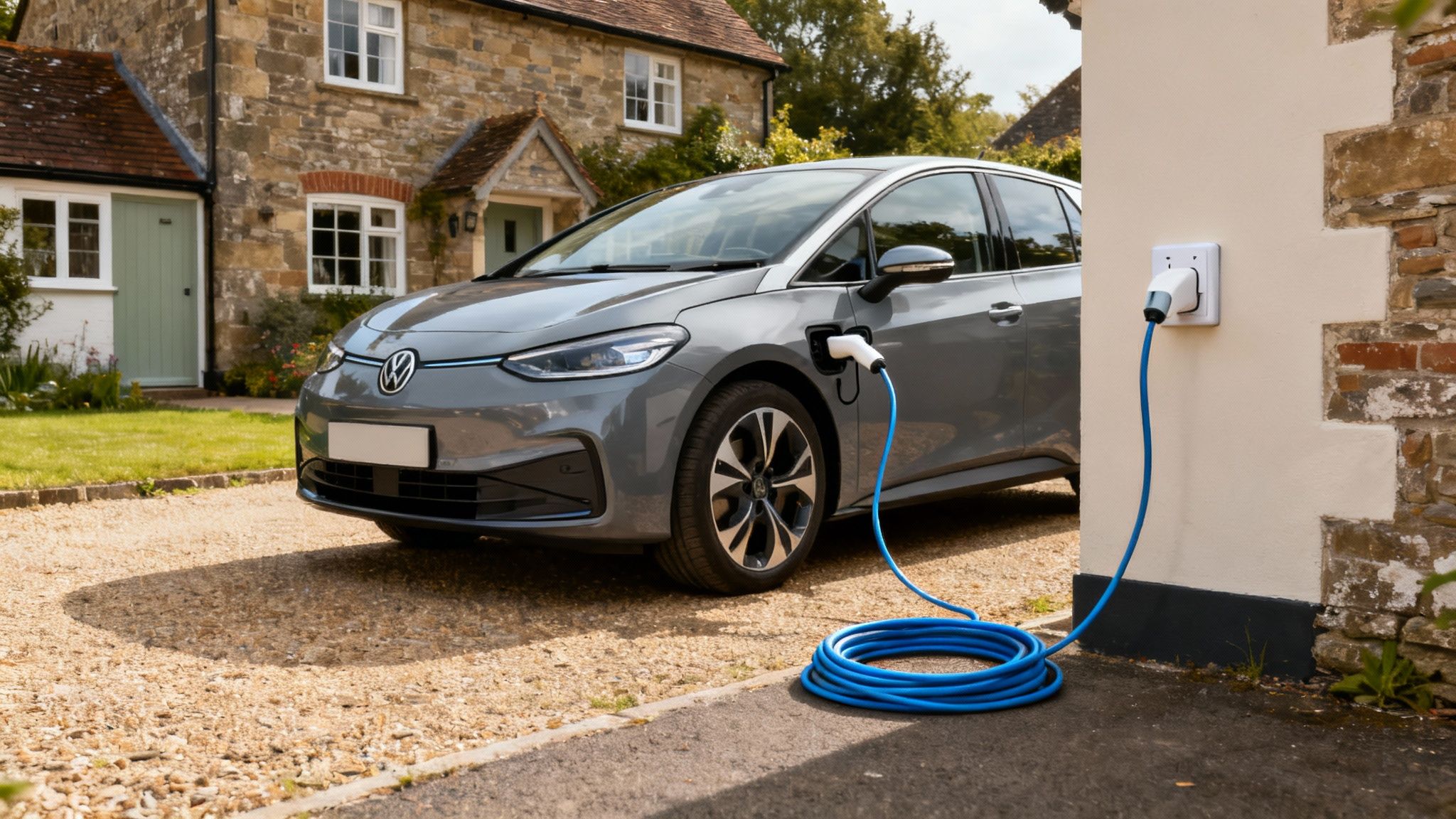
Let's be blunt—the portable charger is the EV equivalent of a spare tyre. You sincerely hope you’ll never need it, but you'd be a particularly brave (or foolish) soul to go on a long trip without one rattling around in the boot.
It's the unsung hero that saves you from that gut-wrenching feeling when a bit of range anxiety turns into a full-blown, "Oh dear, I've made a terrible mistake" problem. This humble cable is your get-out-of-jail-free card, rescuing you from being utterly reliant on the hit-and-miss world of dedicated charging points.
So, What Exactly Is This Granny Charger Thing?
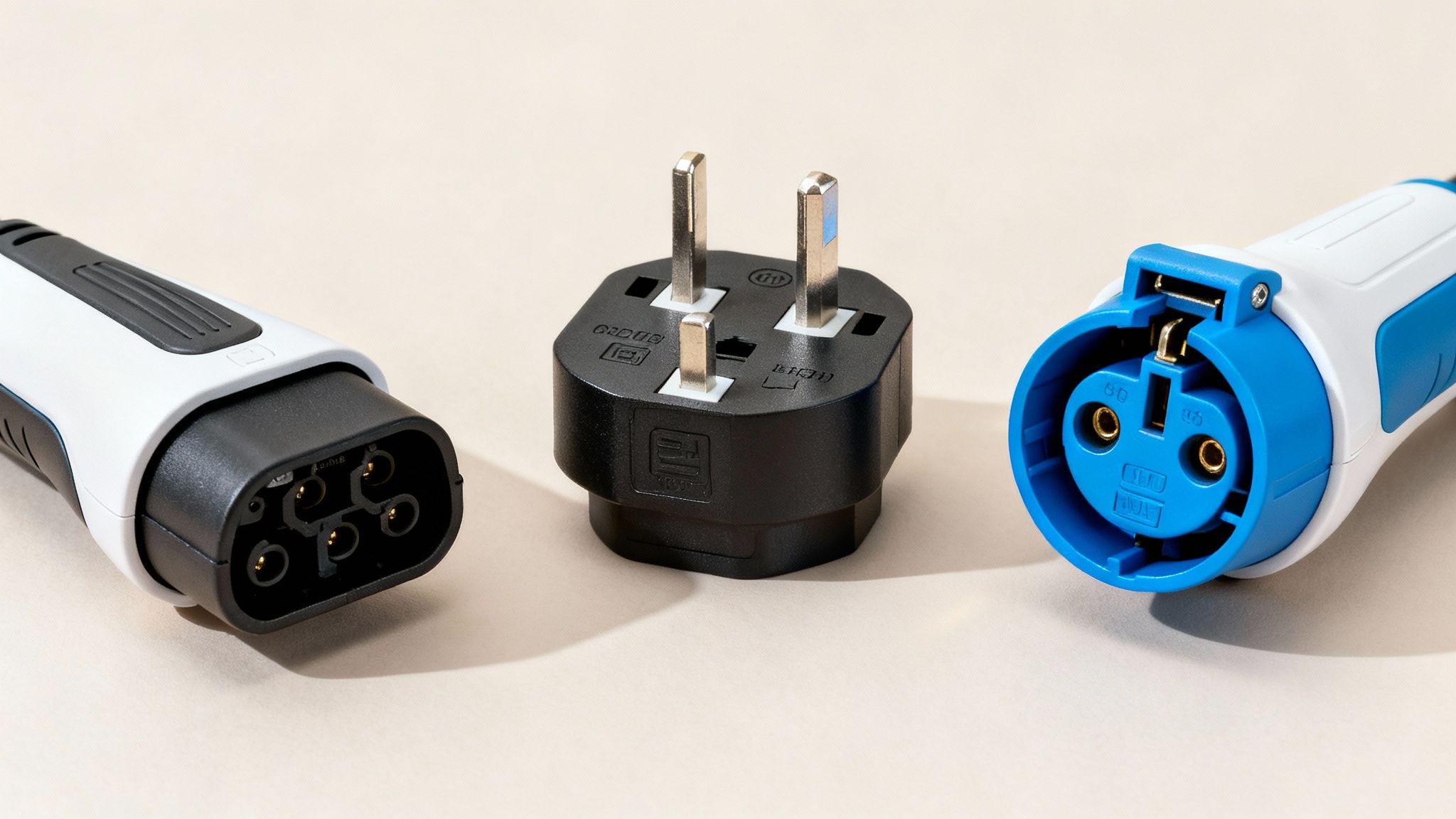
At its heart, a portable EV charger is a mobile cable with a bog-standard three-pin plug on one end and a Type 2 connector (the standard for any self-respecting UK or European EV) on the other. Sandwiched in the middle is a small control box—the brains of the operation—that makes sure electricity flows from the socket to your car without anything catching fire.
Think of it less as a replacement for a proper home wallbox or a lightning-fast public charger, and more as a universal key. It unlocks a charging opportunity from literally any standard wall socket in the country. This makes it an absolute godsend for situations like:
- Visiting family or friends: Heading to see relatives in the sticks? You won't have to fret about finding a charger in a village that's barely discovered the internet, let alone EV infrastructure.
- Overnight stays: Holing up in a hotel, a mate's house, or a chintzy B&B? If you can park within spitting distance of a socket, you can add a decent chunk of range overnight.
- Emergency top-ups: It's a slow but dependable lifeline if you find yourself running low on juice miles from the nearest fast charger.
Let's Set Some Realistic Expectations, Shall We?
It's crucial to be clear about what this charger isn't. It isn't fast. In fact, 'glacial' is probably the kindest way to describe its charging speed. A granny charger typically delivers power at around 2.3kW , which can mean well over 24 hours to fully charge a big EV battery from completely flat.
A portable charger is the gentlest way to top up your battery. Slow charging is generally better for long-term battery health than frequent ultra-rapid charging, as it puts less strain on the battery cells. Your car's clever management system will handle the rest.
This leisurely pace is precisely why it's a backup tool, not your day-to-day workhorse. Relying on it every day would be like trying to fill a swimming pool with a watering can—you'd get there eventually, but you'd probably die of old age first.
For adding a useful 30-40 miles of range overnight, however, it's absolutely spot on. It’s the trusty fallback every EV driver should have.
Decoding Plugs, Wires and Charging Speeds
Welcome to the occasionally baffling world of EV connectors, cables, and acronyms. It can feel like a spaghetti junction of jargon when you're just starting out, but don't panic. We're here to untangle it all so you can sound like you know what you’re on about down the pub.
First up, the classic question: tethered or untethered? A tethered charger has its cable permanently fixed, a bit like an old landline phone your nan used to have. An untethered one—which covers pretty much all portable chargers—lets you unplug the cable at both ends. This offers a hell of a lot more flexibility and makes it far easier to chuck in the boot.
Having a separate cable is a real bonus. If it gets damaged or you find yourself needing a longer one to reach a ridiculously placed socket, you can just swap it out. For a portable charger, untethered is really the only way to go.
The Glacial Pace of ‘Granny’ Charging
Let's get straight to the point about speed. Or, more accurately, the distinct lack of it. Your standard electric car portable charger , when plugged into a normal UK three-pin socket, delivers power at a very leisurely 2.3kW . To put that into perspective, it's a bit like trying to fill a swimming pool with a garden hose. While someone else is using it to water the petunias.
It absolutely gets the job done, but you'll need a healthy dose of patience. For a typical family EV with a 64kWh battery, you could be staring at over 27 hours for a full charge from empty. It's best thought of as an overnight top-up tool, adding a modest but useful 8-10 miles of range per hour.
This slow-and-steady approach isn't all bad news, though. Trickle charging at 2.3kW is incredibly gentle on your car's battery, putting far less strain on the cells than repeated rapid charging. This can actually contribute to better long-term battery health. Your battery will thank you for it.
If you're lucky enough to have access to a blue commando socket (the sort you often see at campsites), you can get a slightly brisker 3.6kW charge with the right kind of portable charger. It's a noticeable improvement, but still firmly in the 'tortoise' category compared to a dedicated home wallbox.
Here's a straightforward look at how long you'll be waiting for a charge depending on your chosen method.
UK Portable Charger Speeds vs Other Methods
| Charging Method | Typical Speed (kW) | Time to Add 100 Miles (Approx.) | Best Use Case |
|---|---|---|---|
| Portable Charger (3-Pin) | 2.3kW | 10-12 hours | Overnight top-ups, emergencies, visiting friends |
| Portable Charger (Commando) | 3.6kW | 7-8 hours | Campsites or workshops with the right socket |
| Home Wallbox | 7.4kW | 3-4 hours | Primary method for reliable overnight home charging |
| Public Rapid Charger | 50kW - 150kW+ | 15-30 minutes | Long journeys, motorway service stations |
As you can see, a portable charger is never going to win a race, but it holds its own as a crucial backup and convenience tool.
Making Sense of Connectors
In the UK and across Europe, the Type 2 connector is the undisputed king. It’s the standard plug that connects the charging cable to your car for AC charging—which is what all portable chargers and most home wallboxes provide. Pretty much every new EV sold here uses one.
The Type 2 connector is a clever seven-pin plug that handles both the power transfer and the crucial communication between the charger and your car, making sure everything happens safely and doesn't end in a small explosion.
This is where things can sometimes get muddled, especially when you're out and about dealing with older public chargers or different standards. For instance, the older CHAdeMO standard is still found on vehicles like the Nissan Leaf, which can be a pain when most new rapid chargers use the CCS standard. Thankfully, there are solutions, as we explore in our guide to CCS to CHAdeMO adapters, which can bridge the great divide for drivers of older EVs.
The key takeaway? For your portable charger, all you really need to worry about is the three-pin plug for the wall and the Type 2 connector for your car. Everything else belongs to the much faster, and far more complex, world of public rapid charging.
What It’s Really Like to Live with a Portable Charger
So, you’ve got your hands on a new electric car portable charger . It’s easy to imagine a life of pure convenience, plugging in anywhere you fancy while your car serenely sips electricity. But let's pump the brakes for a moment. The day-to-day reality of relying on a "granny charger" is a bit more… British. It requires patience, a bit of planning, and a solid understanding that not all sockets are created equal.
First up, let’s talk about that old extension lead you’ve got gathering dust in the garage. You know the one – it’s probably seen more action than it should have and might have a few battle scars from the lawnmower. Whatever you do, don't even think about using it for your car.
Plugging an EV charger into a standard, flimsy extension lead is just asking for trouble. These chargers pull a steady 10 amps for hours on end, a load most domestic extension cables simply aren't designed to handle. At best, you'll keep tripping the fuse. At worst, you're creating a serious fire hazard.
Safety First, You Maniac
If you find yourself in a tight spot and absolutely must use an extension, it has to be a proper heavy-duty, 13A-rated cable. Crucially, it must be fully uncoiled. A coiled cable can overheat, melt, and turn into a puddle of plastic despair. Honestly, the safest move is always to plug directly into a properly wired wall socket.
This leads us to regulations. Any charger worth its salt will have a 'CE' marking. This isn't just a sticker; it’s a guarantee that the product meets EU (and therefore UK) health, safety, and environmental standards. Using an uncertified charger is a risk you simply shouldn't take with a car that costs tens of thousands of pounds.
Look for key safety certifications on your electric car portable charger . A CE marking is the absolute minimum, while the UKCA mark shows it's been specifically assessed for the Great British market. These symbols mean the device has been properly tested and won't turn your pride and joy into a very expensive paperweight.
The Tortoise in a World of Hares
Now, it's time for a dose of realism. If you drive a big EV with a battery the size of a small country, like a Kia EV9 or a long-range Tesla, relying solely on a granny charger is a form of self-inflicted torture. With a huge 100kWh battery, you could be waiting for more than two full days to get from empty to full. It just isn't practical for your main charging source.
This is where the portable charger truly shines: as a backup plan, not your daily go-to. It’s perfect for those emergency top-ups or when you’re visiting family in the middle of nowhere and the nearest public charger is miles away. If you ever get stuck, you can always check our guide on how to find EV charging stations near you with top UK apps.
Practical Tips for a Happy Life Together
Using your portable charger day-to-day is all about the little things. Cable management is a must to avoid a tangled spaghetti monster in your boot or a trip hazard on the drive. A simple velcro strap or a dedicated carry case makes a world of difference.
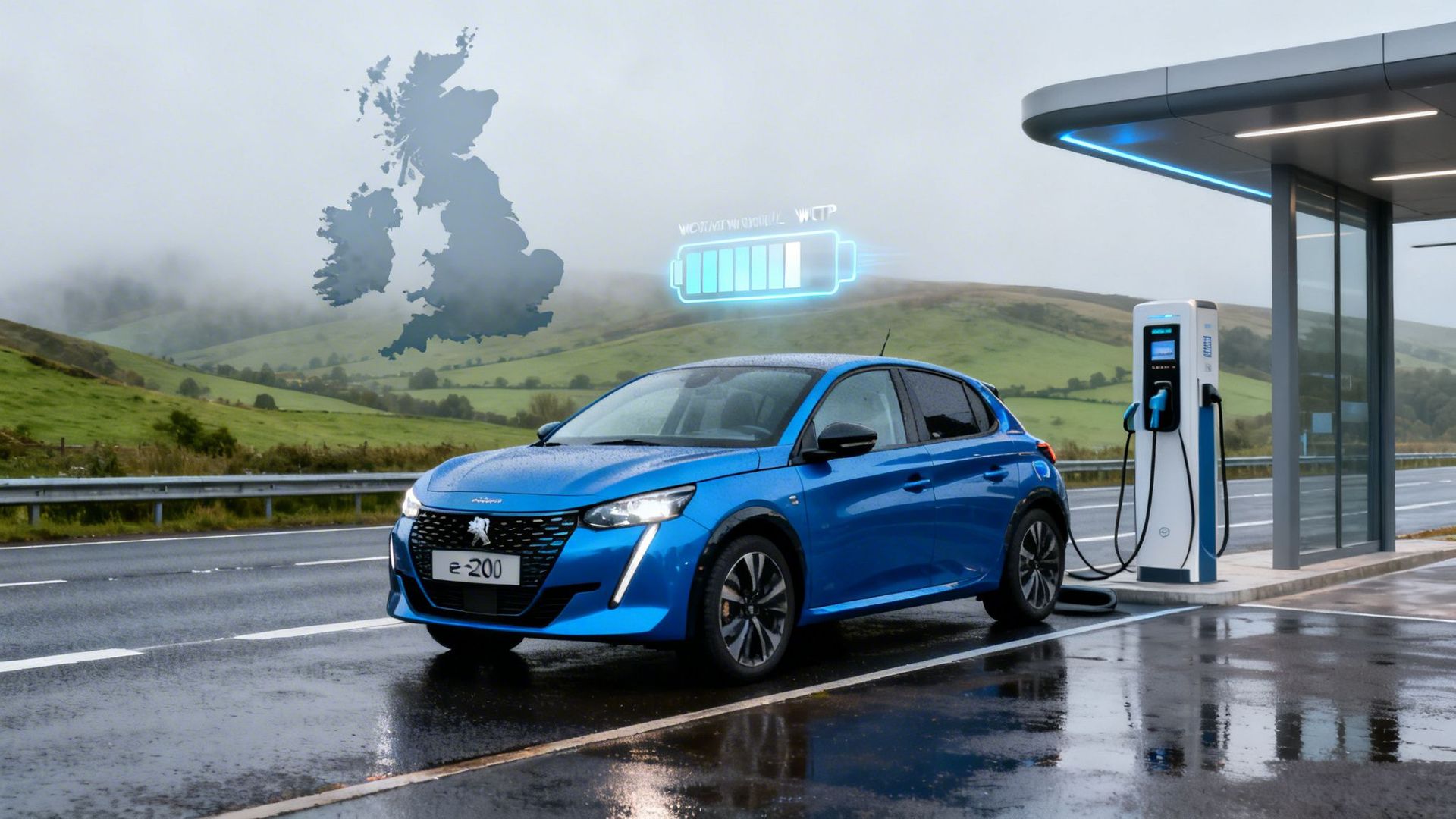
Weather protection is another big one. While most chargers have a decent IP rating (like IP65 ), which means they’re dust-tight and can handle a splash, the three-pin plug at the other end is most definitely not waterproof. You must make sure the plug and socket are sheltered from the classic British downpour. Investing in a DriBox or a weatherproof outdoor socket cover is a smart move to prevent any shocking surprises.
Ultimately, a portable charger is an essential bit of kit. But like any tool, you need to know how to use it properly and respect its limits. Treat it well, and it'll be the trusty companion that saves your bacon time and time again.
The Cost Conundrum: Public Charging vs. Home Charging
Let's talk brass tacks. In the glorious world of electric motoring, your running costs can swing wildly from "smug and cheap" to "did I just remortgage my house for a top-up?" The key difference often comes down to where you get your juice.
The electric car portable charger is your golden ticket to the cheap seats. By plugging into a standard domestic socket, you’re buying electricity at your home tariff rate. This is, without a shadow of a doubt, the most cost-effective way to charge an EV. We’re talking pennies per mile—the kind of savings that make you want to send your old petrol receipts a sarcastic thank-you card.
On the other hand, public charging can feel like the Wild West of pricing. Pulling up to a motorway rapid charger can feel like playing a slot machine where the house always wins. Prices can soar to 75p per kWh or more, which suddenly makes your eco-friendly motor feel as expensive to run as a small hatchback powered by unicorn tears and Chanel No. 5.
Doing the Maths: Home vs. Away
Let’s put some numbers on this. Say your home electricity tariff is a not-unreasonable 25p per kWh . Charging an average EV with a 64kWh battery from empty to full would cost you a tidy £16 . That’s enough for around 250 miles of driving, working out to a frankly brilliant 6.4 pence per mile .
Now, let's take that same car to a pricey public rapid charger. At 75p per kWh , that same full charge will set you back a whopping £48 . Your cost per mile has just tripled to 19.2 pence , which is dangerously close to what you’d pay in a frugal petrol car. Ouch.
The financial argument for charging at home is monumental. Your portable charger transforms any standard plug socket into your own private, ultra-cheap fuel station, shielding you from the often-extortionate world of public charging networks.
This is where the portable charger proves it's not just a backup but a seriously savvy financial tool. It empowers you to sidestep those eye-watering public charging fees whenever possible, whether you’re at home, visiting relatives, or staying overnight somewhere with a friendly plug socket.
The Wallbox Question and Renter's Revenge
Of course, the other home charging option is a dedicated wallbox. These are faster, sleeker, and offer smart features. They are also, however, a significant upfront investment—often costing over £1,000 with installation—and a complete non-starter if you’re renting or live in a flat without designated parking.
This is the portable charger's trump card. For a fraction of the cost, it delivers the same cheap electricity without any of the commitment. It’s the perfect solution for:
- Renters: No need to ask for your landlord's permission or worry about leaving your investment behind when you move.
- Budget-conscious owners: You get the primary benefit of home charging (low cost) without the hefty installation fee.
- Those waiting on a wallbox: It’s an ideal stopgap to keep you on the road cheaply while you wait for an installer.
The public charging network is certainly improving. The UK's infrastructure saw massive growth, reaching 86,021 public chargers by late 2025, a 23% increase in just one year. While this expansion is welcome, especially the focus on rapid chargers, it doesn't change the fundamental cost disparity. You can find out more about these impressive UK EV charging network growth statistics on futuretransport-news.com.
Ultimately, the choice between home and public charging is a crucial one for any EV owner. If you're weighing your options, our guide on whether you should invest in a home charger or stick with public networks offers a deeper dive into making the right decision for your circumstances. For many, the portable charger strikes the perfect balance between affordability and flexibility.
How to Buy a Good Charger and Avoid Dodgy Kit
Diving into the online world of electric car portable chargers can feel a bit like the Wild West. You're faced with a chaotic mix of too-good-to-be-true deals, mysterious unbranded kit, and products that look like they were cobbled together in a garden shed. But fear not. With a little bit of know-how, you can easily tell the reliable workhorses from the downright dangerous duds.
Let's get one thing straight: not all portable chargers are created equal, and grabbing the cheapest option is rarely the smart move. You're entrusting this device with a car that's worth tens of thousands of pounds, so this isn't the place to scrimp. Think of a good charger as an investment in safety and reliability—a trusty backup that won’t let you down or, even worse, become a fire hazard.
This simple decision tree helps visualise when a portable charger is your best bet compared to a public one.
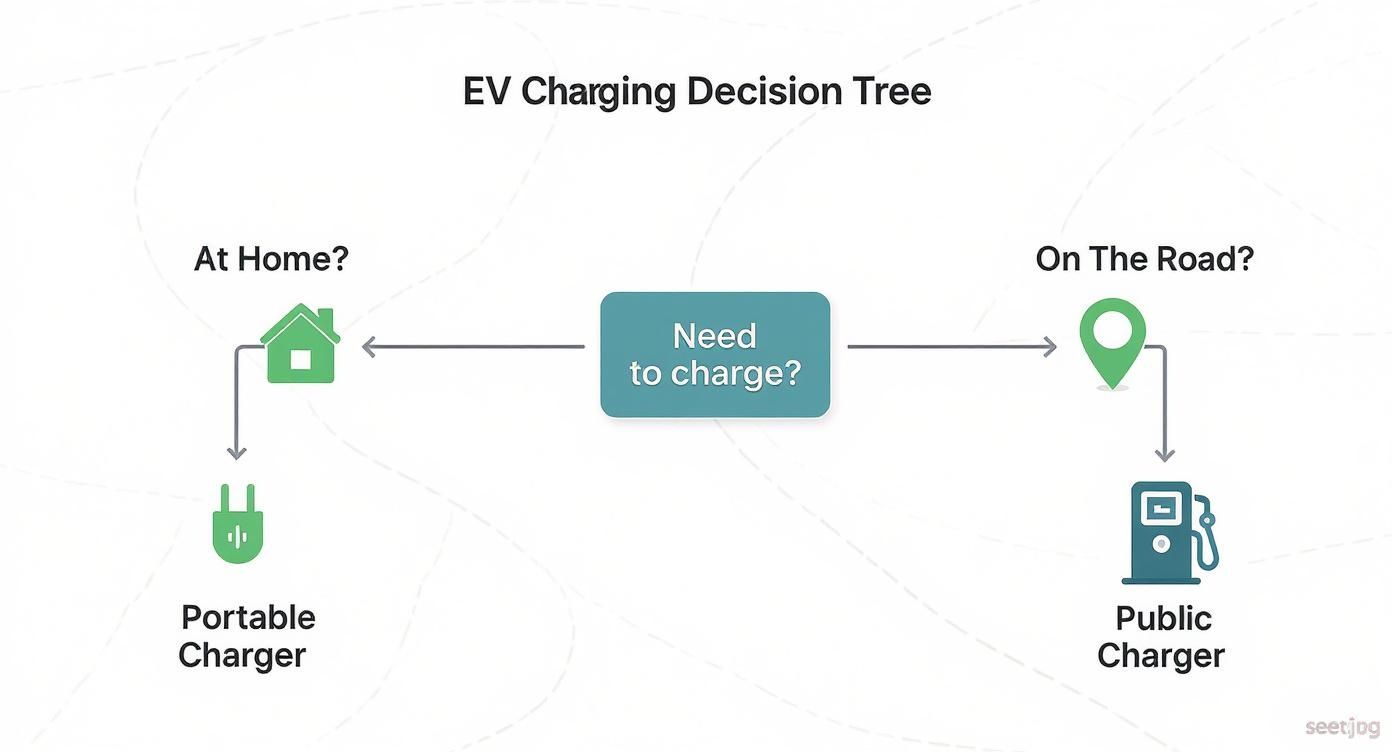
As you can see, the choice really boils down to convenience and location. Your portable charger is the perfect sidekick for predictable, slow charging at home or a destination where you'll be parked for a good long while.
Your Buying Checklist: What Really Matters
When you’re weighing up your options, you need to focus on the fundamentals. Ignore the glossy marketing fluff; what truly counts are the build quality and safety specifications. Here’s a rundown of what to look for to make sure you’re buying a quality piece of kit.
- Safety Certifications (CE and UKCA Marks): This is absolutely non-negotiable. The CE and UKCA marks are your proof that the product has been properly tested to meet UK and European safety standards. If you don't see the marks, don't buy it. It really is that simple.
- IP Rating for Weatherproofing: Let’s face it, Britain isn’t exactly known for its sunny disposition. The IP rating (Ingress Protection) tells you how well sealed the device is against dust and water. You should be looking for IP55 at a bare minimum, but IP65 or higher is much better. That means it can handle a proper downpour without giving up the ghost.
- Adjustable Current Settings: This is a brilliant feature you'll find on better-quality chargers. The ability to adjust the current—often between 6A, 8A, and 10A —is incredibly useful. If you’re plugging into an older socket or one you're not entirely sure about, you can simply dial down the power draw to avoid tripping the circuit.
- Build Quality: You can often spot a dodgy charger from a mile off. Look for sturdy connectors that feel solid in your hand, a thick and durable cable, and a robust control box. Flimsy plastic, wobbly pins, and a lightweight feel are massive red flags.
Red Flags That Scream 'Run Away!'
Knowing what to look for is only half the battle; knowing what to avoid is just as important. If you spot any of these warning signs, it's time to close the browser tab and walk away. Your car (and your home insurance provider) will thank you for it.
A suspiciously low price is the biggest red flag of all. Quality components, proper safety testing, and durable materials cost money. If a deal seems too good to be true, it almost certainly is, and you’re likely buying a dangerous piece of uncertified tat.
Here are the other tell-tale signs of a charger you should steer well clear of:
- Unknown or Generic Brands: Stick to reputable brands that have a UK presence and a history of positive customer reviews. A faceless seller with a generic-sounding name is a gamble you don’t want to take.
- No Clear Warranty or Support: Any reliable manufacturer will stand by their product with at least a 12-month warranty and provide clear contact details for customer support. If this information is hidden or missing entirely, it’s a very bad sign.
- Over-the-top Claims: Be very wary of chargers claiming "super-fast" speeds from a standard three-pin plug. It’s technically impossible. These sellers are either lying through their teeth or have a dangerous misunderstanding of electrical safety.
Here’s a quick checklist to help you separate the good from the bad.
Portable Charger Buying Checklist
This no-nonsense checklist is designed to help you spot a great deal and avoid the dodgy kit that could put you and your EV at risk.
| Feature to Check | What to Look For (The Good Stuff) | Red Flags (Avoid at All Costs) |
|---|---|---|
| Safety Marks | Clearly visible CE and UKCA markings on the product and packaging. | No markings, or markings that look poorly printed or fake. |
| Weatherproofing | An IP55 rating at a minimum. IP65 or higher is ideal for UK weather. | No mention of an IP rating, or a rating lower than IP55. |
| Current Control | The ability to adjust the current (e.g., 6A, 8A, 10A ) for safer charging. | Fixed current only, offering no flexibility for older wiring. |
| Build & Materials | Feels solid and well-made. Thick, sturdy cable and robust connectors. | Flimsy plastic, wobbly pins, thin cable, or a lightweight feel. |
| Brand & Support | A reputable brand with a UK website, positive reviews, and clear warranty info. | Generic or unknown brand, no contact details, no mention of a warranty. |
| Price | Seems reasonable for a certified piece of electrical equipment. | A price that looks "too good to be true." It always is. |
Keep this checklist handy, and you'll find a charger that’s both safe and reliable.
While having a dependable portable charger in your boot is vital, it's reassuring to know the public network is constantly improving. For instance, data from Q3 2025 shows the UK added 3,928 new charge points in just one quarter, including a 51% year-on-year increase in ultra-rapid chargers. You can read more about this impressive expansion in the latest Zapmap statistics. Even so, nothing quite beats the peace of mind that comes from having your own trusted charger ready to go whenever you need it.
Your Portable Charger Questions Answered
Right, let's tackle some of the common questions that pop up once you've got a portable charger in your hands. You've got the basics, but there's always that little bit of doubt when you're using new kit for the first time. Think of this as the practical FAQ section, minus the jargon.
We've all been there – staring at a new gadget and wondering about the "what ifs". Let's get them sorted.
Can I Use an Extension Lead with My Portable EV Charger?
Let’s be direct about this: you really shouldn't. The best and safest approach is always to plug your charger straight into a proper wall socket. No ifs, no buts.
However, we all know life isn't always ideal. If you're completely stuck and it's your only option, then you can use an extension lead, but it absolutely cannot be any old one you find in the shed. It must be a heavy-duty, 13A-rated cable , and you have to uncoil it completely before use. If you leave it coiled, it can overheat and become a serious fire hazard. That flimsy orange lead you use for the lawnmower? Absolutely not. Forget it.
Is It Safe to Charge My Car in the Rain?
Yes, but this is where a healthy dose of common sense comes in. Any decent portable charger will have an IP rating – something like IP65 – which means the main control box and the bit you plug into your car are built to withstand a proper British downpour.
The real point of failure is the domestic three-pin plug and the socket. These are not waterproof. It's crucial that you keep this connection dry and sheltered from the elements. A good way to think about it is that the charger itself can handle getting wet, but the plug that goes into the wall definitely can't.
Where does the term 'granny charger' come from?
It's a classic bit of British car chat. The name comes from the idea that you could take it with you when visiting your gran, plug into any standard socket in her house, and top up the car while you're having a cup of tea. It also cleverly hints at the charging speed – slow, steady, and dependable. Just like granny.
Will a Portable Charger Damage My Car's Battery?
It's actually the other way around. Using a portable charger regularly is one of the better things you can do for the long-term health of your car's battery. This slow, steady trickle of power is much gentler on the battery cells compared to the high-stress blast of a rapid DC public charger.
Your car’s own Battery Management System (BMS) is always in charge, carefully regulating the flow of electricity to protect the cells from any damage. Think of it like this: slow charging is a long, gentle yoga session for your battery, while rapid charging is a high-intensity sprint. Both have their place, but relying only on the sprints can lead to wear and tear over time.
At VoltsMonster , we cut through the noise to give you honest, entertaining, and practical advice on all things EV. For more straight-talking reviews and guides, check out our latest content at https://www.voltsmonster.com.
VoltsMonster Electric Vehicle Blog