VW ID Buzz Review: Electric Nostalgia or Just a Posh Van?
Right, let's get straight to it. The VW ID. Buzz is a triumph of design, a brilliant-looking electric box on wheels that plays a powerful tune on the heartstrings of anyone who's ever owned a surfboard or a tie-dye T-shirt. But—and it's a but the size of a double-decker bus—its eye-watering price tag and so-so real-world range make it a tricky proposition for the pragmatic British buyer. It’s a fantastic thing to look at, but whether it’s a sensible purchase is another matter entirely.
Is the ID. Buzz All Flower Power and No Go?
Volkswagen has finally sent its electric love letter to the swinging sixties, and the ID. Buzz has landed on UK shores looking every bit the California dream. It’s dripping with retro cool and turns more heads than a royal scandal. The nostalgia is potent; the charm, frankly, impossible to ignore.
Beneath the two-tone paint and impossibly cheerful face, however, lies a vehicle with a bit of an identity crisis. It’s flogged as the spiritual successor to the much-loved Type 2 camper, a symbol of freedom and skint adventure. Yet, with a starting price that could land you a very well-specced premium SUV, it’s about as accessible as a penthouse flat in Knightsbridge.
This leaves us with a rather large, bus-shaped question: who on earth is this actually for?
The Heart vs. The Wallet Conundrum
The emotional pull is immense. It’s a vehicle that makes people smile, a rolling piece of feel-good design in a sea of homogenous grey SUVs. But the moment your rational brain kicks in, the fantasy starts to wobble.
- The Price: Let's be blunt, it’s astonishingly expensive for what is, essentially, a five-seat MPV with van DNA. It commands a premium that style alone struggles to justify.
- The Practicality: While it’s huge inside for five people, the lack of a seven-seat option at launch puts it at a major disadvantage against rivals. It’s a family bus that can’t carry a particularly large family.
- The Range: An official figure of around 258 miles sounds reasonable on paper. A wet, windy Tuesday on the M1 with the heating on full blast will tell a very different, and much shorter, story.
The ID. Buzz isn't just a car; it's an expensive lifestyle accessory. You're not just buying transport; you're buying into an image, a story, and a hefty dose of Volkswagen's marketing budget. The real test is whether the daily driving experience can justify the steep cost of admission.
Before we dive deeper, here's a quick look at the core dilemma facing potential punters.
The ID. Buzz at a Glance: The Good, the Bad and the Baffling
This table sums up the conflict at the heart of the Buzz. It's a vehicle that excels in some areas while leaving you scratching your head in others.
| Aspect | The Upside (Why You'll Want One) | The Downside (Why You'll Hesitate) |
|---|---|---|
| Styling | Unbeatable retro-cool design. Nothing else on the road looks like it. A genuine head-turner. | The novelty might wear off, leaving you with a very expensive, quirky-looking van. |
| Interior Space | Cavernous and airy for five passengers and their luggage. Feels incredibly spacious. | No seven-seat option at launch in the UK. Many cheaper MPVs offer more flexibility. |
| Driving Feel | Smooth, quiet, and surprisingly nimble for its size. Easy to drive in town. | It's based on a van, and while refined, it doesn't offer the handling of a car-based SUV. |
| Value for Money | Strong predicted residual values thanks to its unique appeal and high demand. | The initial purchase price is incredibly high for the range and practicality on offer. |
| Image | You're driving a feel-good, eco-conscious statement piece. It’s impossible not to smile at. | Could be seen as a classic case of 'style over substance'. Is it all just clever marketing? |
Ultimately, the table highlights a car you'll fall in love with on sight, but might have second thoughts about when you sit down with a calculator.
Despite the hype, its arrival in the UK has been more of a gentle ripple than a tidal wave. Official figures from Volkswagen UK show that in the first three months of 2025, a mere 417 units were registered. To put that in perspective, the more conventional ID.4 SUV found 2,966 British homes in the same period, suggesting UK buyers are still voting with their wallets for value over vibe. You can dig into the numbers yourself over on the official VW press site.
This slow start really gets to the heart of this VW ID. Buzz review. It’s a machine that captures the imagination but struggles to convince the bank manager. It's a glorious, charming, and deeply flawed proposition.
Looks That Kill, but Can It Carry the Shopping?
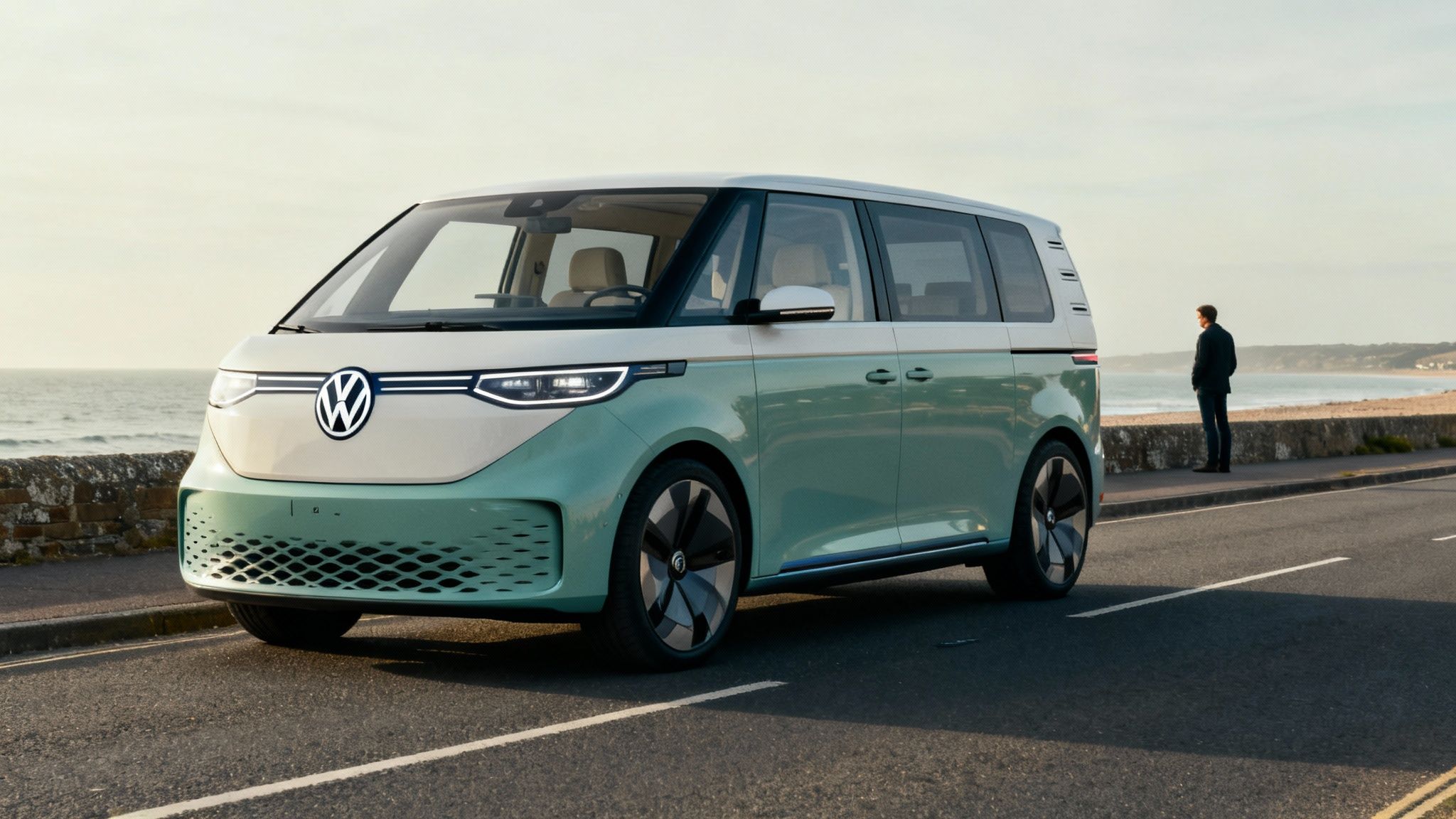
Let’s get one thing straight from the off: the Volkswagen ID. Buzz is an absolute design triumph. It's the sort of vehicle that genuinely makes people smile, a rolling piece of feel-good art that cuts through the grey monotony of British roads. You'll get more waves, thumbs-up and curious looks in a week with this than you would in a supercar.
VW has walked a tightrope here, managing to bottle the spirit of the original Type 2 campervan without creating a lazy, bloated pastiche. The two-tone paint, that massive VW badge on the nose, the friendly, rounded shape – it’s all there. It’s a brilliant piece of retro-futurism that feels both nostalgic and completely up-to-date.
The attention to detail is spot on. Everything from the clean body lines to the wheel designs feels deliberate and well-executed. This isn't just a van; it's a statement piece, a conscious decision to drive something with character.
Stepping Inside the Dream
However, slide open one of those huge, practical side doors, and the groovy dream takes a bit of a knock. The interior is bright, airy, and undeniably spacious, but it's also a festival of hard, scratchy plastics. While the design is clean and modern, you can't shake the feeling this is a very expensive vehicle with an interior built to a very specific budget.
Those lovely light-coloured plastics on the dash and doors look fantastic in the photos, but you just know they're destined to become a canvas for scuff marks and grubby fingerprints after one trip to the beach with the kids. It’s a sea of grey and white that, while functional, lacks the warmth and charm the exterior promises.
It’s not all bad news, of course. The driving position is superb, giving you a commanding, van-like view of the road, and the sheer amount of glass lets light flood in, creating a wonderfully open feel. But it feels more like a very well-appointed commercial vehicle than a £60,000 family car.
The cabin is a bit of a paradox. It’s brilliantly spacious and smartly laid out, yet feels disappointingly utilitarian in places. You're paying a premium for the way it looks on the outside, but the interior doesn't always feel like it got the same budget.
The British Family Litmus Test
Now for the big question in any VW ID. Buzz review: can it actually handle the delightful chaos of family life? The answer is a slightly frustrating 'yes, but…'.
For five people, the space is simply vast. There’s acres of head and legroom for everyone, and you can genuinely fit three adults across the rear bench without a fight breaking out. The completely flat floor is a real win, meaning the person in the middle seat isn't wrestling with a transmission tunnel for foot space.
The boot is also colossal. With the seats up, you have a massive 1,121 litres to play with – more than enough for the family holiday luggage, the big weekly shop, and a damp dog. Fold the seats down, and you're looking at a cavernous, van-like 2,205 litres .
- The Good Stuff: Those sliding rear doors are an absolute godsend in tight supermarket car parks, saving you from cringe-inducing dings in other people's cars.
- The Clever Touches: The optional 'Multiflex' board in the boot is well worth it. It creates a flat load floor when the seats are folded and gives you some handy hidden storage underneath.
- The Big Problem: In the UK, it’s currently only available as a five-seater. For a vehicle this large and this expensive, the lack of a seven-seat option is a baffling decision that immediately rules it out for many larger families.
Ultimately, its unique style doesn't compromise its core substance—the Buzz is hugely practical. The real sticking point is that its immense practicality is limited to carrying just five people, a restriction that feels completely at odds with its grand, family-friendly vibe.
So, How Does the ID. Buzz Actually Drive on UK Roads?
Right then, the sixty-thousand-quid question. Volkswagen makes a big song and dance about the ID. Buzz driving like a car, not the stylish van it’s clearly based on. We decided to see if that claim holds up on the glorious, and often grim, reality of British roads – from pockmarked B-roads and tight city centres to the soul-crushing crawl of the M25.
First impressions? It's genuinely surprising. Pull away, and the first thing that hits you is the silence. The second is the immediate shove from the electric motor. The rear-wheel-drive model has 282 bhp on tap, and it feels far quicker than its friendly face suggests. It just surges forward with this smooth, decisive whoosh that makes diving into gaps in traffic an absolute doddle.
Let's be clear, it's not a sports car. But for something weighing well over two tonnes, it gets out of its own way with an enthusiasm that will catch many drivers off guard. It feels brisk, responsive, and utterly effortless around town.
Conquering the Concrete Jungle
In the city, the ID. Buzz is nothing short of a revelation. Its secret weapon? A turning circle that seems to defy physics. At just over 11 metres , it can pull a U-turn in less space than a VW Golf. This is genuinely game-changing for a vehicle this big, turning dreaded multi-storey car parks and tight urban manoeuvres into non-events.
The high driving position gives you a commanding, king-of-the-road view over other cars, and the huge windows mean visibility is fantastic. It’s surprisingly easy to place on the road, almost shrinking around you in a way its dimensions would have you believe is impossible. It’s calm, serene, and almost laughably nimble.
The Infotainment Elephant in the Room
Now, let’s talk tech. A huge touchscreen dominates the minimalist dashboard, acting as the nerve centre for pretty much everything. And honestly, it’s a bit of a let-down. Volkswagen’s latest infotainment software is a known weak spot across its entire range, and the Buzz is no exception.
The system feels like a masterclass in adding needless complexity. Simple tasks, like changing the cabin temperature, require a distracting dive into sub-menus. Worse still, the touch-sensitive sliders below the screen aren’t backlit, making them completely useless in the dark. It’s a classic case of form over function.
While Apple CarPlay and Android Auto are present and work well, the native system itself can be laggy and counter-intuitive. It’s a real shame, as this frustrating interface takes the shine off an otherwise brilliantly designed and user-friendly cabin. We can only hope a future software update sorts it out.
Out on the Open Road
Venture onto faster A-roads and motorways, and the ID. Buzz settles into its role as a comfortable cruiser. It’s exceptionally quiet, with wind and road noise kept firmly at bay, making it a properly relaxing place to be on a long journey. The ride is generally smooth, soaking up most lumps and bumps with real composure.
However, find a properly twisty, undulating British B-road, and its van-based origins start to peek through. While it handles tidily enough for what it is, there’s no escaping its height and weight. You’ll notice a fair amount of body roll if you press on through the corners, and the steering, while perfectly light for town, offers very little in the way of feedback. It’s safe and predictable, but a barrel of laughs it is not.
Despite some strong global sales figures, there have been whispers of production adjustments at the Hanover plant. Volkswagen Commercial Vehicles reportedly scaled back some production plans for 2025, partly due to softer-than-expected demand in certain European markets. This could, in time, have a knock-on effect on UK availability. You can read more about these production shifts and what they might mean for buyers.
So, where does that leave us? The driving experience lives up to about 80% of VW’s grand claim. In the urban and motorway environments where it will spend most of its life, it feels remarkably car-like. It’s only when you really push it on a challenging road that you’re reminded you’re piloting a very stylish, very heavy, and very brilliant box.
The Great British Range Test
Let’s get straight to the heart of the matter. Forget the funky colours and clever cubby holes for a moment; the single most pressing question for anyone thinking about an electric car is range. What can you actually expect from the VW ID. Buzz on a wet Tuesday on the M6?
Volkswagen’s official lab-tested figure is a perfectly respectable 258 miles . That’s a lovely number, achieved under ideal conditions where headwinds and torrential rain simply don’t exist. But we live in Britain, so let's talk about the real world.
Summer Breezing vs Winter Freezing
During the warmer, kinder months of a British summer, the Buzz gets impressively close to its on-paper promise. If you're just pottering around town on local runs, you can genuinely see 240-250 miles from a full battery. Head out onto the motorway for a long journey at a steady 70mph, and that number will dip to a still-very-usable 210-220 miles . It’s predictable and more than enough for most family trips.
Then winter bites.
Cold weather is the arch-nemesis of all EV batteries, and the Buzz is no exception. As soon as the temperature plummets and you crank up the heating, that range figure begins to shrink. In mixed winter driving, you’re looking at around 180-200 miles . A long, cold motorway slog? You’ll be nervously eyeing up charging stops after about 160 miles .
It’s a significant drop, and something you absolutely have to account for. Curing electric car range anxiety for good starts with understanding and planning for this seasonal reality.
The infotainment screen gives you some useful data on how your driving affects efficiency, which is a nice touch.
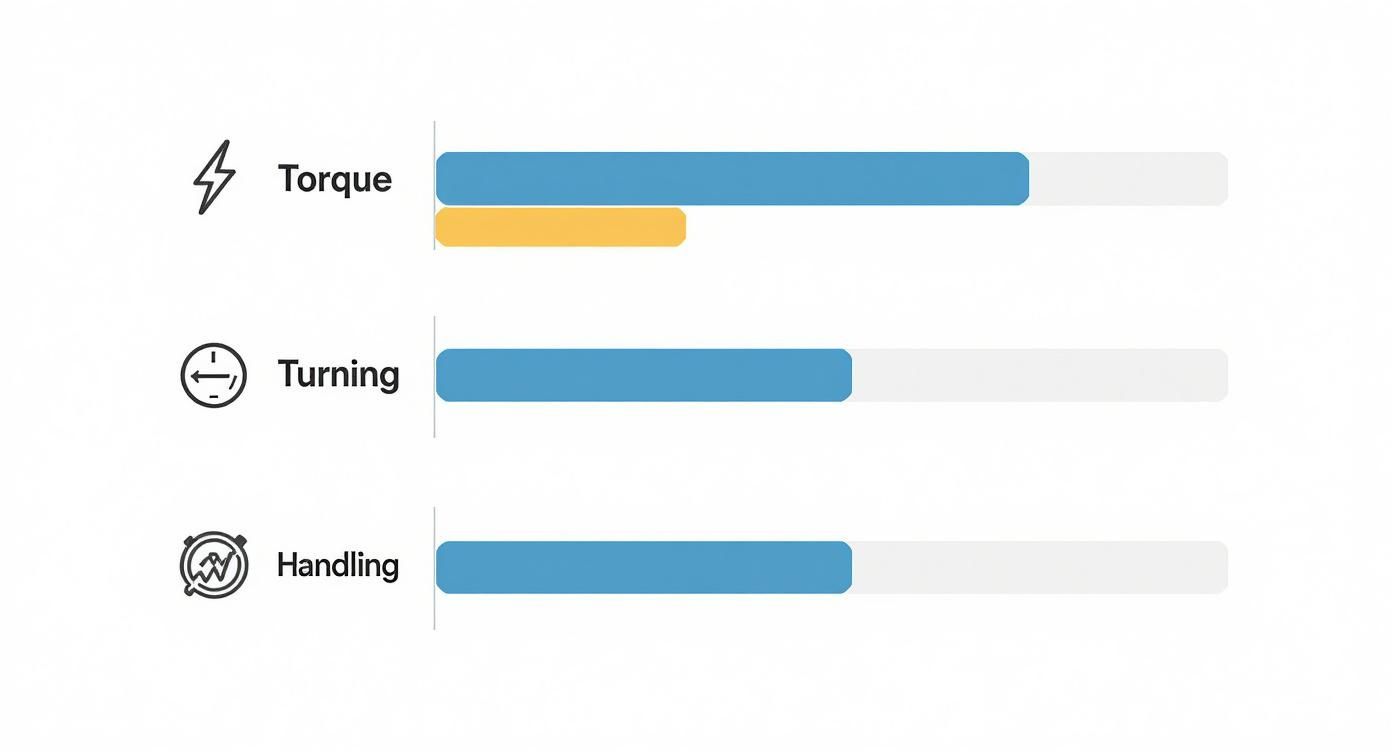
This graphic highlights the Buzz's secret weapon – its incredibly tight turning circle – alongside its perfectly safe but unremarkable handling. It’s a van, after all.
The Service Station Showdown
Okay, you’ve drained the battery. Time for the glamorous experience of public charging. The ID. Buzz can handle a peak charging speed of 170kW , which sounds fantastic on paper. In a perfect world, connected to a powerful enough charger, this means you could theoretically zip from 10% to 80% charge in just 30 minutes .
Of course, the reality at a typical British motorway service station can be a bit... different.
Finding a 170kW+ charger that isn't already in use, or out of order, can sometimes feel like you've won a small lottery. You're far more likely to end up on a common-or-garden 50kW unit, which changes the game entirely.
Here's a practical breakdown of what that means for your service station stop:
- At a 170kW+ Ultra-Rapid Charger: A 10-80% top-up really does take about 30-35 minutes . It’s a proper splash-and-dash. You’ll be back on the road before your coffee gets cold, though it will set you back roughly £45-£50 . Quick, but not cheap.
- At a 50kW Rapid Charger: That same 10-80% charge will now take closer to 75-90 minutes . Your quick pit stop has just turned into a long, solitary lunch. It might be slightly cheaper, but the time you lose is significant.
The takeaway here is simple: the ID. Buzz is more than capable of charging quickly, but your experience will always be dictated by the UK's slightly hit-and-miss charging network. Planning your long journeys with apps that show real-time charger availability and speed isn't just a good idea—it's essential for keeping your cool.
Counting the Cost of ID. Buzz Ownership
Right, let's talk brass tacks. You’ve seen the funky two-tone paint, you’ve smiled at its cheerful face, and now it’s time for the cold, hard slap of financial reality. Brace yourself, because the Volkswagen ID. Buzz is not what you’d call a bargain.
With a starting price knocking on the door of £60,000 , this isn't some quirky, affordable people carrier. It's a premium product competing squarely with high-end electric SUVs from the likes of Audi and BMW. That's a serious amount of money for a vehicle that, underneath all the charm, shares its bones with a commercial van.
This steep entry fee is a major hurdle. The ID. Buzz is an object of real desire, but its price tag firmly plants it in the world of luxury buys rather than a truly sensible family wagon.
Running Costs and Other Nasty Surprises
Once you’ve recovered from the initial shock of the purchase price, the day-to-day running costs are, thankfully, a bit more palatable. Swapping petrol pumps for a plug socket will certainly save you a few quid, especially if you can top up at home overnight on a cheap electricity tariff.
But the savings might not be as colossal as you think. For a full breakdown, check out our deep dive into the real cost of owning an EV compared to petrol cars. Public charging, especially at the rapid chargers you'll need on long trips, can be eye-wateringly expensive, often costing as much per mile as a frugal diesel.
Here’s a quick look at where the money goes after you've bought the thing:
- Insurance: The ID. Buzz sits in a fairly high insurance group, typically around group 35-40 depending on the specific trim. This is on par with some pretty powerful SUVs, reflecting its high value and potential repair costs.
- Servicing: Like most EVs, servicing is simpler and generally cheaper than a combustion car. There are fewer moving parts and no messy oil changes to worry about. You can expect a visit every two years or so for checks and fluid top-ups.
- Tyres: Don't forget the rubber. The Buzz is a heavy beast, and its large, specialist EV-rated tyres won't be cheap to replace when the time comes.
The Depreciation Dilemma
This is the great unknown. Will the ID. Buzz become a future classic, holding its value like an original Type 2? Or will its high price and niche appeal see values plummet like a stone? The initial hype and limited supply suggest it will perform better than your average electric SUV, at least to begin with.
Volkswagen is banking on nostalgia and style to command that premium price, but the market will ultimately decide. The Buzz’s financial success hinges on whether enough buyers see it as a long-term investment in cool, rather than just another expensive electric van.
The wider UK market offers a bit of a cautionary tale here. In the first half of 2025, the ID. Buzz accounted for just 1.5% of Volkswagen’s total UK EV sales. It was utterly dwarfed by the more pragmatic ID.3 and ID.4 models, suggesting that when it comes to spending their own money, British buyers still tend to favour value over vibes.
Ultimately, the total cost of ownership is a significant commitment, one that demands a cool head to overrule a heart captivated by all that retro charm.
The Final Verdict: Should You Buy the VW ID. Buzz?
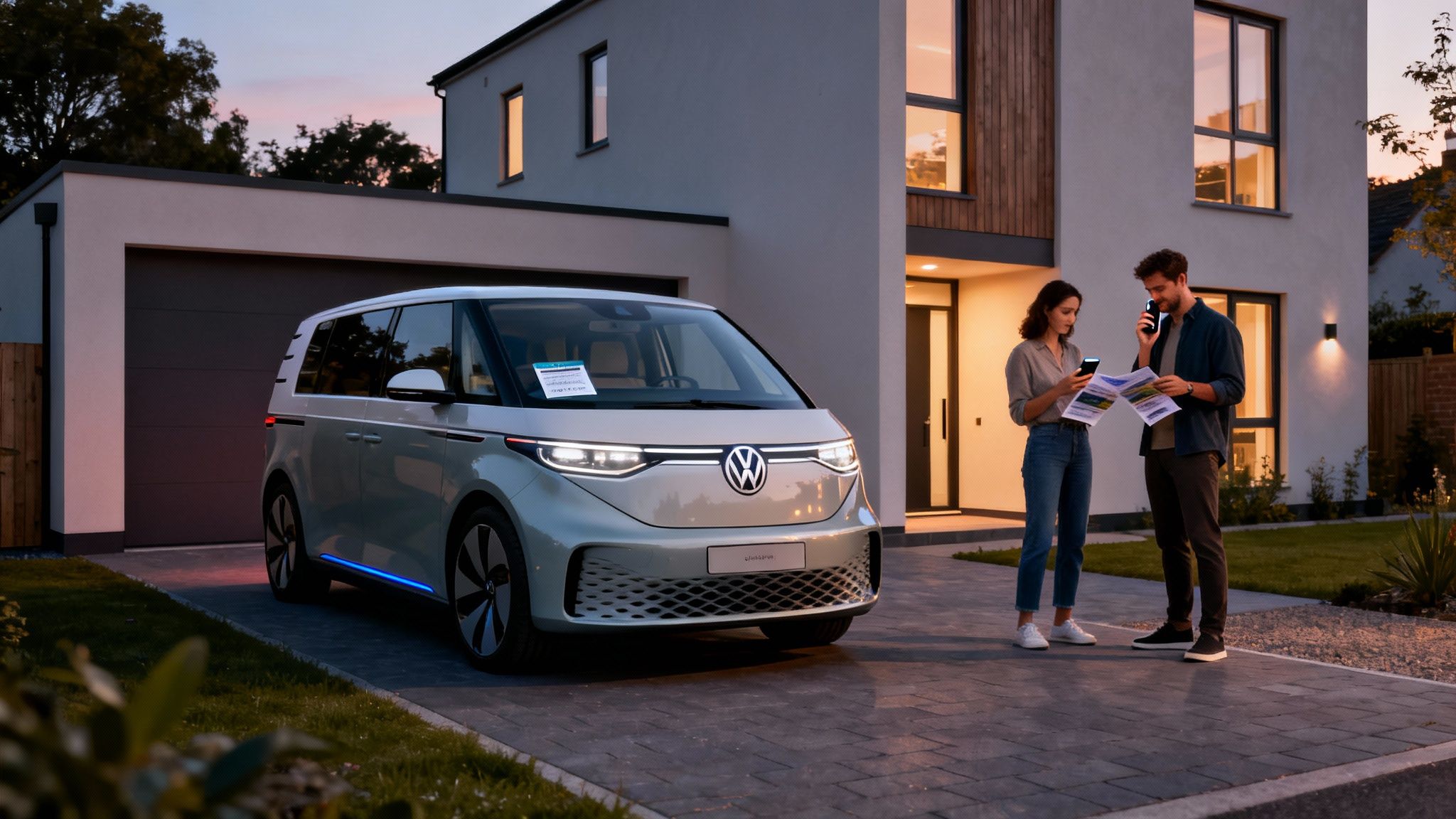
Right, let's get down to it. After living with the Buzz, running the numbers, and navigating the UK's charging network, it’s time to land on a final verdict. Should you actually part with your hard-earned cash for one? The answer, much like the van itself, is a mix of charm, complication, and a touch of frustration.
To be blunt, if you're making this decision with a spreadsheet, just stop now. The ID. Buzz makes almost zero sense on paper. For the same price, you could have a Kia EV9 with seven seats. For less, you could get a Hyundai Ioniq 5 with more tech or a Skoda Enyaq that does the family thing with quiet, sensible efficiency.
The Buzz is a heart-over-head purchase, pure and simple. It’s a decision you justify with smiles-per-mile, not pounds-per-range.
Who Is This Van Really For?
The ID. Buzz is aimed squarely at the family that’s allergic to boring cars. It’s for the design-led, eco-aware buyer who sees their vehicle as part of their identity, not just a tool for the school run and the big shop at Tesco. You want the space of a van without feeling like you're driving one.
Ultimately, it’s a flawed masterpiece. It gives up a bit of on-paper practicality for an absolute ton of character. Need seven seats? Look elsewhere. Hunting for the absolute best range for your money? There are better options. And if you believe a car is just a metal box to get you from A to B, this is definitely not the one for you.
The VW ID. Buzz isn’t the smartest electric car you can buy, but it is one of the most desirable. You are paying a colossal premium for the design, the heritage, and the way it makes you—and everyone else on the road—feel.
Weighing Up the Rivals
When you start to properly compare, the rational case for the Buzz starts to crumble. It’s a unique machine, but it’s up against some seriously capable alternatives. Our electric car comparison UK guide is a good place to start your research.
- Kia EV9: The new benchmark for big, seven-seat electric SUVs. It’s massive, cleverly designed, and offers more space and seats for similar money.
- Skoda Enyaq iV: This is the sensible choice. It’s supremely comfortable, hugely practical, has a solid range, and costs a fair bit less. It’s everything the Buzz isn’t: understated and logical.
- Mercedes-Benz EQV: If you truly need a premium electric people-mover, the EQV delivers more space, but it feels much more like a converted van and comes with an even steeper price tag.
So, here’s the final word: buying an ID. Buzz is a glorious, irrational, and deeply satisfying indulgence. It is objectively overpriced and compromised in a few key areas. But my goodness, what a wonderful thing it is. If you can stomach the premium and its quirks fit your life, you won't regret it. You’ll be driving the most cheerful, head-turning vehicle on the road.
A Few Lingering Questions About the ID. Buzz
Still got some questions? I'm not surprised. When you're looking at a vehicle with this kind of price tag, a bit of healthy scepticism is a good thing. Let's get straight to the point on some of the most common queries I hear.
Is the ID. Buzz a Practical Family Car in the UK?
Honestly, it's a bit of a mixed bag. For a vehicle this massive, it's almost baffling that Volkswagen currently only sells it as a five-seater here in the UK. If you've got a bigger family or regularly do the school run with your kids' mates, you're out of luck.
The space you get for those five people is absolutely cavernous, and the sliding doors are a genuine game-changer in tight supermarket car parks. But for many, the lack of a third row is an immediate deal-breaker. A long-wheelbase, seven-seat version is promised, but for now, you have to be certain that five seats will be enough.
What’s the Real-World Winter Range?
Right, let's be blunt. Forget the official 258-mile figure when the temperature drops. In the middle of a grim, damp British winter with the heating cranked up, you'll be looking at a much more realistic 180-200 miles on a full charge for mixed driving.
If you’re heading out on a long motorway slog in freezing conditions, expect that number to shrink even further. This is one of the most important things to grasp; you have to plan your winter journeys around this reality and treat the van's optimistic range "guess-o-meter" with a healthy dose of suspicion.
Is the ID. Buzz Actually Worth the Money?
If we're talking purely about value for money, then no. Absolutely not. It is an incredibly expensive way to move five people around. You could buy a fantastic electric SUV with a longer range, more standard equipment, and similar practicality for many thousands of pounds less.
The ID. Buzz's eye-watering price is almost entirely propped up by its one-of-a-kind design and the powerful tug of nostalgia. You are paying a huge premium for style. Whether that's 'worth it' is a decision for your heart, not your head. It’s a wonderful, feel-good machine, but it is not a sensible purchase.
Ready to dive deeper into the world of electric vehicles? At VoltsMonster , we cut through the noise with honest reviews, practical advice, and a healthy dose of humour. Find your next EV obsession or just have a laugh at our latest vlog by visiting us at https://www.voltsmonster.com.
VoltsMonster Electric Vehicle Blog