Kia Soul Electric Review: Is This Quirky Box on Wheels Any Good?
Let's be honest, the Kia Soul EV is the automotive equivalent of Marmite. In a world of electric cars desperately trying to look like sleek, wind-cheating pebbles dropped by an alien civilisation, the Soul wears its boxy shape with the swagger of a toaster that knows it’s cool. That quirky, upright stance is a refreshing and unapologetic stand against convention, making it a genuinely standout choice in a market obsessed with teardrop silhouettes.
Britain's Best Kept Electric Secret?
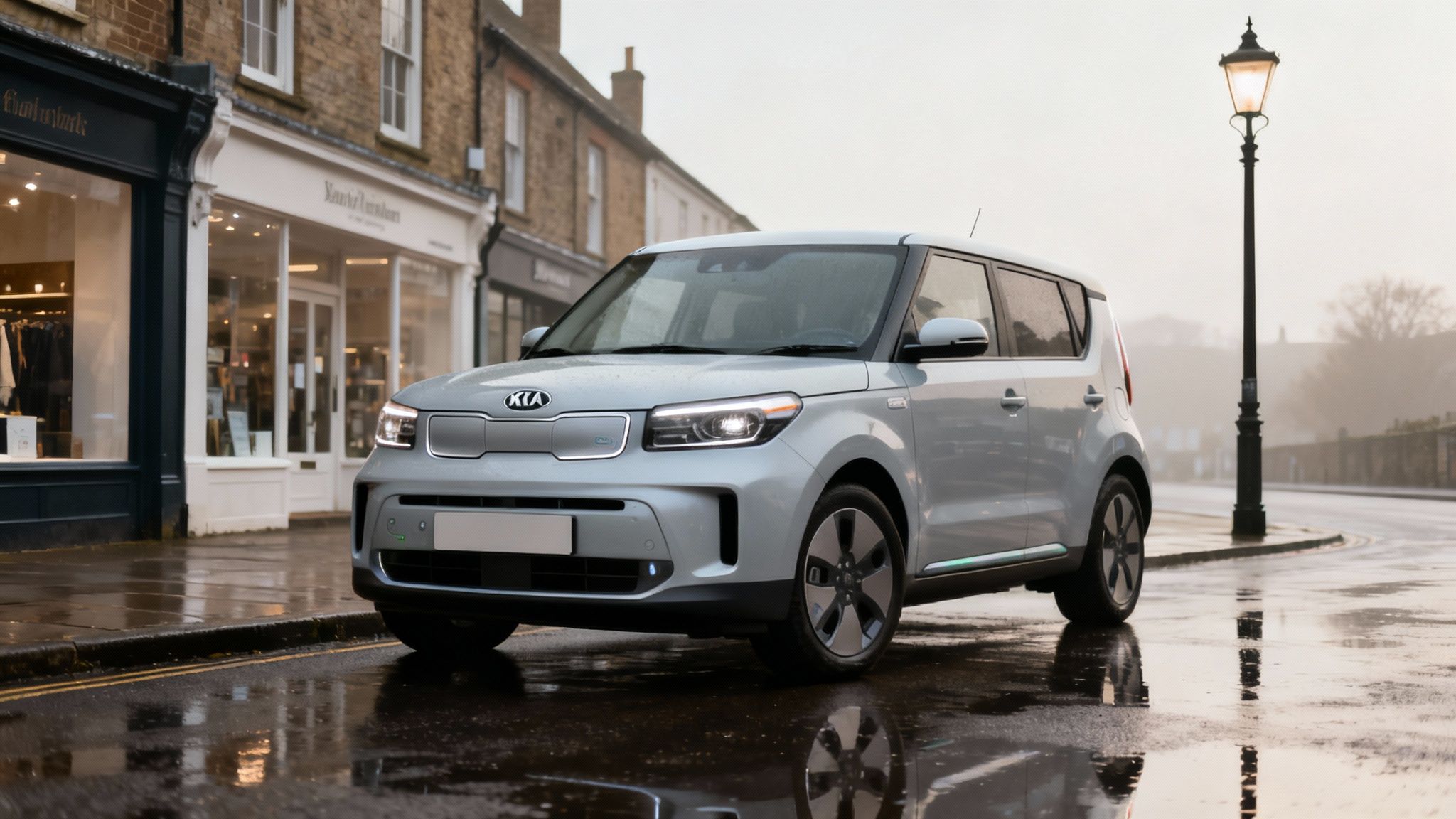
The Kia Soul EV has actually been knocking about on UK roads for longer than many people realise, quietly getting on with the job while flashier rivals steal the headlines. But this persistence is precisely its strength. It’s not some half-arsed concept car rushed to production; it's a refined, practical, and surprisingly capable machine that has learned a thing or two over the years.
And while other car makers bombard you with a baffling array of trim levels designed to confuse you into spending more money, Kia has kept things wonderfully simple. The current model comes in a single, high-spec 'Explore' trim. This no-nonsense approach means you get all the good stuff as standard, without needing a degree in marketing waffle to decipher the brochure.
What You Get For Your Money
So, what exactly has Kia crammed into this 'Explore' trim? Well, the equipment list is seriously impressive and, frankly, makes some of the premium German alternatives look a bit stingy. They've basically thrown everything but the kitchen sink at it.
Here’s a quick gander at the highlights:
- The big battery as standard: You get the long-range 64kWh battery pack right out of the gate. There's no stingy entry-level model to accidentally order and regret for the next three years.
- All the tech you need: A crisp 10.25-inch touchscreen with sat-nav, Apple CarPlay, and Android Auto is included. You also get a punchy Harmon Kardon sound system, which is a brilliant touch for drowning out the kids on the school run.
- Proper creature comforts: Heated front seats and a heated steering wheel come as part of the package. If you’ve ever endured a British winter, you’ll know these are less of a luxury and more of an essential survival tool.
- A full suite of safety kit: It’s loaded with clever tech like adaptive cruise control, lane-keeping assist, and blind-spot monitoring. It’s always there to give you a gentle electronic slap when your attention wanders.
This generous specification is a huge part of the Soul EV's charm. It doesn't just compete on its unique looks but on sheer, unadulterated value for money—a compelling argument in today's crowded market.
The Kia Soul EV doesn't pretend to be something it isn't. It’s a practical, well-equipped, and slightly eccentric electric car that offers a genuine alternative to the usual suspects. Its charm is in its honesty.
Squaring Up To The Competition
The Soul EV’s distinctive design means it doesn’t have many direct rivals that look anything like it. But when you look at price and practicality, it finds itself in a proper scrap with some of the UK’s most popular electric cars. It's going toe-to-toe with the likes of the MG ZS EV, the Hyundai Kona Electric (its corporate cousin), and the stylish Peugeot e-2008.
While it might not win every fight on paper—boot space being a key one—it carves out its own brilliant niche. This is a car for the buyer who wants the practicality of a small crossover but is utterly bored of the bland styling that dominates the sector.
Choosing a Soul EV is a bit of a statement. It says you value substance but aren’t willing to sacrifice personality. If you're weighing up your options, our guide on the best electric cars in the UK is a great place to see how it stacks up. This review will show you exactly where its strengths—and, just as importantly, its weaknesses—really lie.
What It’s Actually Like To Drive On UK Roads
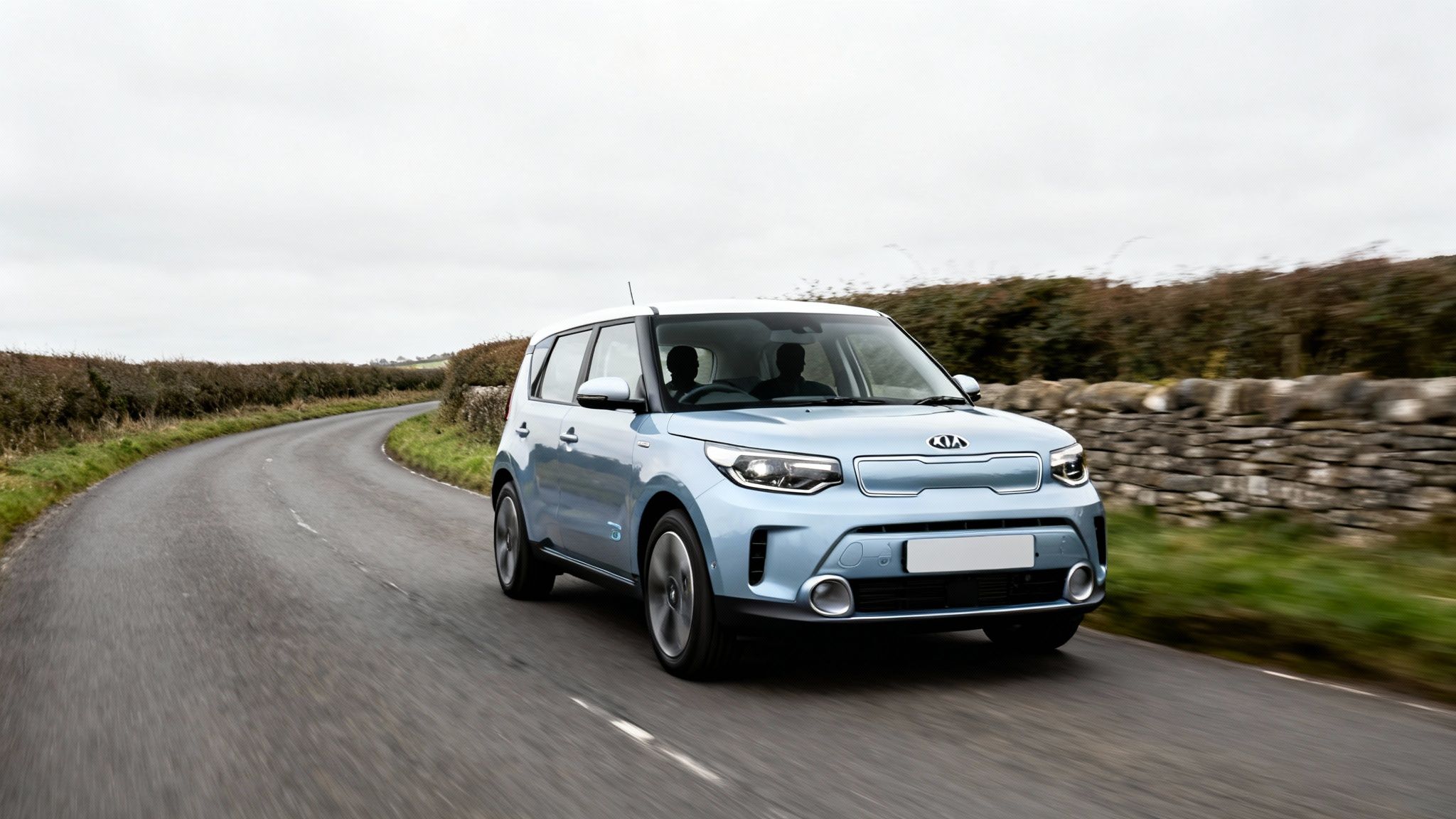
Right, let’s get one thing straight. Every electric car has that instant shove off the line. It's the universal EV party trick, and the Kia Soul EV is more than happy to play along. The silent surge away from the lights, leaving a surprised boy-racer in their souped-up Corsa for dust, is a simple joy that never really gets old.
But a car is more than just a traffic-light drag-race winner. The Soul EV puts down 201 bhp and a hefty 395 Nm of torque , which translates to a 0-60 mph time of a very respectable 7.6 seconds . It’s not going to worry a Tesla, but it’s more than quick enough to feel genuinely punchy when you need to nip past a tractor on a winding B-road.
This immediate response makes city traffic an absolute doddle. A gap opens up, you flex your big toe, and you’re in it. No lag, no fuss, just clean, silent progress. It’s deeply satisfying.
Does It Handle Like A Tidy Brick?
You’d be forgiven for looking at the Soul’s boxy, upright shape and assuming it handles with all the grace of a shipping container. In reality, Kia’s engineers have worked a small miracle here. By placing the heavy battery pack low down in the chassis, they've given it a surprisingly low centre of gravity.
This means it feels far more planted and stable through corners than you might expect. Yes, there's some body roll, but it's well-controlled. The car doesn’t lurch about like a blancmange; instead, it feels composed and predictable, even on our typically twisty British back roads. The steering is light and accurate, which is perfect for town, though it could do with a bit more feel when you're really pressing on.
Ride comfort is another real highlight. It soaks up the UK’s pockmarked and poorly maintained roads with impressive composure. It isn't as pillowy-soft as some French rivals, but it strikes a fantastic balance between comfort and control, making it a perfectly pleasant companion on a long motorway slog.
Gimmicky Modes And Clever Braking
Like most EVs these days, the Soul EV comes with a few driving modes: Eco, Normal, and Sport. Let’s be blunt, Sport mode is mostly a gimmick. It sharpens the throttle response to the point of being jerky and seems to exist purely to watch the range meter plummet at an alarming rate.
Normal mode is where you’ll live 99% of the time, offering the best blend of performance and efficiency. Eco mode, on the other hand, blunts the accelerator so much it feels like you're driving through treacle, but it’s a handy friend to have if you’re trying to squeeze out every last mile.
What’s far more interesting is the regenerative braking system. You can tweak its strength using paddles behind the steering wheel, going from a gentle coasting feel all the way to a strong 'one-pedal' driving mode. In heavy traffic, it’s a game-changer.
This system allows you to slow the car right down just by lifting off the accelerator. Not only does this make stop-start city driving less of a chore, but it also sends precious energy back into the battery, eking out a little more range. It takes a few minutes to get used to, but once you do, you’ll wonder how you ever drove without it.
The Verdict: Fun Or Just Functional?
So, is the Kia Soul EV a hoot to drive? Well, it’s not a sports car, and it won't set your hair on fire. But it is far more enjoyable and capable than its quirky looks might suggest. The instant torque is addictive, the handling is secure, and the ride is genuinely comfortable.
It manages that rare trick of being both incredibly functional for the daily grind and genuinely fun when the mood takes you. This engaging driving experience is a key part of the car's charm and a massive point in its favour. It proves that practical doesn't have to mean boring.
Real-World Range and Charging in the UK
Right, let's get straight to the big question that hangs over every electric car: how far does it actually go? Manufacturers love to quote the official WLTP figures – numbers cooked up in a lab that rarely reflect the reality of British roads. For the Kia Soul EV, that headline figure is a rather hopeful 280 miles from its 64kWh battery.
In the real world, hitting that number would require perfect weather and the kind of gentle driving that’s almost impossible outside of a village fete. So, what can you actually expect on a cold, wet Tuesday in Stoke?
The good news is the Soul EV is genuinely one of the more efficient cars in its class. In summer, when the sun decides to show up, you can realistically expect between 230 and 250 miles from a full charge with mixed driving. That's more than enough for a week's worth of commuting, school runs, and supermarket trips without ever feeling a flicker of range anxiety.
The Inevitable Winter Drop
Of course, when winter rolls in and you start cranking up the heater and heated seats, that figure takes a predictable hit. Cold batteries are unhappy batteries, and you should expect the real-world range to fall to around 180-200 miles . It’s a noticeable drop, for sure, but it’s still a very usable amount of range for day-to-day life.
This performance puts it firmly in the 'very decent' camp. To see exactly how it stacks up against its rivals, our electric car range comparison for the UK cuts through the marketing fluff to give you the on-road facts. You’ll find the Soul EV holds its own surprisingly well.
Plugging It In
So, when the battery is running low, how long are you stuck waiting for it to charge? This is where the Soul EV plays a very strong hand, thanks to its ability to handle DC rapid charging speeds of up to 100kW .
What does that actually mean? Well, if you find one of the high-powered, ultra-rapid chargers you see at motorway services, you can theoretically pump the battery from 10% to 80% in as little as 47 minutes . That’s just enough time to grab a lukewarm coffee and a slightly sad-looking sausage roll.
The reality of the UK’s public charging network is often a bit less glamorous. The 50kW rapid chargers you'll find at the local supermarket are far more common, and these will do the same 10-80% top-up in about an hour and a quarter. It’s perfectly acceptable, just not quite the lightning-fast future we were all promised.
Most owners, naturally, will do the vast majority of their charging at home overnight. This is where owning an EV really makes sense, both for convenience and cost.
Kia Soul EV Charging Times and Estimated Costs
Here’s a practical look at what to expect from the most common charging methods available in the UK, from a slow trickle to a high-speed blast.
| Charger Type | Power | Time (10-80%) | Estimated Cost (per kWh) |
|---|---|---|---|
| 3-Pin Plug | ~2.3kW | A geological age (~26 hours) | £0.28 (variable) |
| Home Wallbox | 7.4kW | Around 7 hours | £0.07-£0.15 (off-peak tariff) |
| Public AC Charger | 11-22kW | Around 7 hours (car limited) | £0.45-£0.60 |
| Public DC Rapid | 50kW | ~75 minutes | £0.65-£0.79 |
| Public DC Ultra-Rapid | 100kW+ | ~47 minutes | £0.65-£0.79 |
As the table shows, getting a 7kW wallbox installed at home is an absolute no-brainer. It completely transforms the ownership experience, turning charging from a logistical puzzle into a simple nightly routine.
You just plug in when you get home, wake up to a full battery, and get to take advantage of much cheaper off-peak electricity tariffs. Trying to rely solely on the public network is a recipe for frustration and a much lighter wallet.
Interior Space and Practicality for Daily Life
Let's be honest, the Kia Soul EV looks like the box it was delivered in. But does that boxy shape translate into Tardis-like interior space, or is it just a bit… cramped? Stepping inside for the first time is a pleasant surprise. That upright, almost van-like design creates a wonderfully airy and spacious cabin, making it feel much larger than its compact dimensions would have you believe.
The dashboard design is a refreshing dose of common sense. In an era where car makers seem determined to hide every essential function inside a touchscreen sub-menu, Kia has given us proper, physical buttons for the climate controls. Revolutionary, I know. It means you can tweak the fan speed or temperature without taking your eyes off the road – a simple, brilliant piece of design that puts safety first.
At the heart of the dash sits a bright and snappy 10.25-inch touchscreen . It's intuitive, quick to respond, and comes with both Apple CarPlay and Android Auto as standard. It’s a genuinely great system that just works, putting it miles ahead of some of the laggy, infuriating interfaces you’ll find in cars costing twice as much.
Posh Plastic or Genuinely Premium?
When it comes to the materials, it’s a bit of a mixed bag. The bits you touch regularly, like the top of the dashboard and door panels, are finished in nice, soft-touch plastics. It all feels rather pleasant.
However, start exploring the lower parts of the cabin and you’ll find plenty of harder, scratchier plastics that feel built to a budget. It’s all perfectly functional and feels solid enough to handle the chaos of family life, but it’s certainly not going to give Audi or BMW execs any sleepless nights. Think ‘durable and pleasant’ rather than outright luxury. The synthetic leather seats, though, are comfy and supportive – exactly what you need on a long drive.
Can You Fit Humans and Their Stuff Inside?
This is the big question, isn't it? Is it actually practical? Up front, space is abundant. That high roofline means there’s loads of head and legroom, even for taller drivers. It’s a similar story in the back, where two adults can sit comfortably with plenty of knee room and headroom to spare – a real advantage over rivals with more swooping rooflines. Shoving a third person in the middle is a squeeze, but it’s doable for short journeys.
The Soul EV's practicality is a tale of two halves. The passenger cabin is wonderfully spacious, making fantastic use of its boxy shape. The boot, however, is where the magic wears off.
This infographic shows the Kia Soul EV's UK range under different conditions, which is crucial for planning those family trips.
As you can see, the summer range is perfectly respectable for most trips, but that winter drop-off is something you really have to factor in for any long-distance weekend getaways.
And for those getaways, you’ll need to pack very, very carefully. At just 315 litres , the boot is frankly a bit dismal. It’s smaller than a Ford Focus’s and is absolutely dwarfed by the massive 448-litre boot you get in the MG ZS EV. It’ll handle the weekly food shop, no problem, but a proper family holiday will either involve some serious packing Tetris or a trip to Halfords for a roof box. It’s the car's single biggest weakness and a real shame in an otherwise very clever package.
UK Running Costs And Ownership Value
Right then, let's talk brass tacks. Buying an electric car is meant to be a smugly sensible financial decision, saving you a fortune on fuel while you glide past petrol stations with a saintly glow. But does the Kia Soul EV actually deliver on this promise, or is it just an expensive way to feel virtuous?
The initial price of any new EV can still make your wallet clench, but the real story unfolds in the day-to-day running costs. The first, most obvious win is the complete lack of Vehicle Excise Duty (VED), or road tax as most of us call it. That's a tidy sum you get to keep in your pocket each year, which is a very nice start.
Then there's the 'fuel'. Charging at home, especially if you can get onto a sensible off-peak tariff, can cost as little as 7.5p per kWh . Do the maths, and a full "tank" in the Soul EV could cost you less than a fiver. Compare that to what it costs to fill up a petrol-powered equivalent, and the savings quickly become eye-watering.
Insurance and Maintenance Costs
Before you get too carried away, it's worth noting that some insurance companies are still a bit wary of these newfangled electric contraptions. The Soul EV sits in a reasonable, but not exactly cheap, insurance group 27 . It’s not ruinous by any means, but do get a quote before you sign on the dotted line – it might be a tad higher than you'd expect for a comparable fossil-fuelled car.
On the flip side, servicing is where you really start to claw back the savings. With no oil to change, no spark plugs, and far fewer moving parts to go wrong, maintenance bills are generally much lower. Your main consumables will be tyres, brakes (which last longer thanks to regenerative braking), and windscreen washer fluid. It’s a refreshingly simple ownership proposition.
Kia's seven-year, 100,000-mile warranty is the undisputed king of the industry. It's not just a marketing gimmick; it’s a genuinely brilliant piece of long-term reassurance that makes rivals’ three-year offerings look pathetic.
The Legendary Kia Warranty
This warranty is a massive selling point and a huge part of the ownership value calculation. Crucially for an EV, it covers the battery pack against significant degradation. Specifically, Kia guarantees the battery will retain at least 70% of its original capacity for the full seven years. This safety net effectively removes the single biggest fear for prospective EV buyers.
It’s this kind of long-term peace of mind that really sets Kia apart. You’re not just buying a car; you’re buying a commitment that it won’t leave you with a crippling bill for a new battery in year four.
Will It Plummet In Value?
Depreciation is the silent killer of car ownership—the money you lose without ever seeing it leave your account. Historically, EVs had a reputation for dropping in value faster than a lead balloon. Thankfully, that trend is changing as the technology becomes more mainstream and trusted.
The Soul EV, with its strong range and desirable features, holds its value reasonably well for a car in its class. It won't perform miracles, but its quirky appeal and solid fundamentals mean it should fare better than some of its more anonymous rivals. To get a proper handle on this, understanding the truth about electric car depreciation is essential for any savvy buyer looking to minimise their long-term costs.
Ultimately, the Kia Soul EV makes a compelling financial case for itself. The combination of rock-bottom "fuel" costs, reduced maintenance, zero VED, and that spectacular warranty creates a total cost of ownership that is genuinely attractive. It’s a purchase you can justify with your head as well as your heart.
A Decade of Soul: How Kia's Quirky EV Shaped the UK Market
To really get the Kia Soul EV, you need to turn the clock back. This isn't just another electric car hitting the showrooms; it’s one of the originals, a true pioneer that landed in the UK when choosing an EV was a brave, slightly eccentric move. We're talking about a time when finding a public charger felt like spotting a unicorn in a Tesco car park.
Cast your mind back to 2014. The electric car scene was pretty much a ghost town, dotted with a few odd-looking city cars and some very expensive, very early-adopter experiments. Most big car brands were still treating EVs as a bit of a joke. It was into this world that Kia launched the first-generation Soul EV – a funky, boxy electric car that nobody really saw coming.
A Gamble That Paid Off
Frankly, it was a bit of a bonkers move. Kia’s own sales forecasts were almost comically low; they were hoping to shift maybe a hundred of them in the UK. This wasn't some grand plan for market domination. It was more like dipping a toe into a freezing swimming pool, a brave punt on a future that felt a long way off.
When it launched, the infrastructure to support it was virtually non-existent. To put it in perspective, in November 2014, the entire UK had just 5,222 public charging points . Yet despite these massive hurdles, Kia persevered, quietly carving out a reputation as a serious EV player long before it became the fashionable thing to do. You can get more of the inside story on Kia's early EV commitment over at electrifying.com.
The first Soul EV was far more than just a car; it was a signal of intent. It showed everyone that Kia was serious about going electric, even while most of the industry was still clinging to diesel.
Laying the Foundations
The Soul EV's early arrival had a quiet but profound effect on the UK market. It started the long, slow process of making a practical, family-sized electric car seem normal. This wasn't a space-age sports car or a tiny two-seater; it was a proper, usable car that you just happened to plug in.
All that decade of experience is now baked right into the DNA of the latest model. While other manufacturers are still working through the teething problems of their first or second-generation EVs, Kia is drawing on a huge bank of real-world data and owner feedback.
The Soul EV was the trailblazer that did the hard work, proving a genuine appetite for well-made, sensible electric cars. It laid the groundwork for Kia's later blockbusters like the e-Niro and the EV6. Without the quiet persistence of this quirky electric box, Kia’s impressive EV line-up today simply wouldn't be the same. It earned its place the hard way.
Got Questions About the Kia Soul EV?
Still trying to figure out if the Soul EV is the right fit? Let's tackle some of the most common questions head-on. Here are the straight-up answers you need to make a decision.
What's the Real-World Range in the UK?
Kia claims an official 280 miles on a full charge, but you should take that with a pinch of salt. In the real world, you're looking at a much more realistic 230-250 miles during warmer months with a mix of driving.
When the temperature drops in winter, that figure will dip to around 180-200 miles . That's plenty for the vast majority of weekly commutes and school runs, but cross-country motorway journeys will definitely need a bit of forward planning for charging stops.
Is the Soul EV a Sensible Family Car?
For a smaller family, absolutely. The back seats are surprisingly spacious, offering enough room for two adults on shorter journeys or for the kids without any complaints.
The real compromise is the boot space. At just 315 litres , it’s on the smaller side compared to rivals like the MG ZS EV. It’ll swallow the weekly supermarket shop with ease, but packing for a proper family getaway will be a tight squeeze – you might want to start looking at roof boxes.
How Does it Stack Up Against the Hyundai Kona Electric?
They're essentially the same car underneath the metal. Both share the excellent 64kWh battery and electric motor, so performance and range are virtually identical. The real difference comes down to personality and packaging.
The Soul EV’s boxy, upright design gives it fantastic headroom and a light, airy feeling inside the cabin. The Kona Electric, on the other hand, plays it safer with more conventional SUV styling and offers a slightly bigger boot. Your choice will honestly come down to which one's looks you prefer.
Ready to find your next electric car? VoltsMonster cuts through the noise with honest reviews and practical advice for UK drivers. Check out more guides at https://www.voltsmonster.com.
VoltsMonster Electric Vehicle Blog