Kia e-Niro Review: A Shockingly Sensible EV
Our verdict on the Kia e-Niro is pretty simple: it’s a shockingly sensible electric car. It’s a workhorse, not a show pony, built for real-world family life, not for turning heads. For UK punters after a no-nonsense EV that just gets on with the job, its combination of a genuinely usable 282-mile range , a roomy cabin, and sensible running costs makes it a tough act to follow, even with newer alternatives now on the scene. This is the electric car for people who never thought they’d own one.
The Quiet Achiever That Rewrote the Rules
Let's not beat around the bush. The Kia e-Niro is the automotive equivalent of a sensible pair of shoes from M&S. It's not the car you see in pop videos or plastered on a teenager's bedroom wall. By any measure, it’s a deeply ordinary-looking crossover. But don't let the vanilla styling fool you. This unassuming box on wheels did something incredible for Kia in the UK—it made them a serious electric vehicle player, seemingly overnight.
Before the e-Niro rocked up, choosing an EV felt like you were constantly having to compromise. You could get a car with a decent range, but you’d have to put up with a cramped interior or a price tag that made your eyes water. The alternative was an affordable EV with a battery so small you’d get nervous just nipping to the local shops. The e-Niro simply refused to play that silly game.
What Was the Secret?
Kia's masterstroke wasn't some space-age battery technology or a wild design. Instead, they nailed a simple, incredibly effective formula that spoke directly to the pragmatic British car buyer.
- A Range You Can Actually Rely On: The 64kWh battery delivered a proper, grown-up range. It meant a trip from London to Manchester was possible without a mandatory three-hour stop-off at a grim service station halfway.
- Proper Family Practicality: It’s a five-door, five-seat crossover with a boot that can swallow the weekly big shop and a pushchair. Crucially, the back seats have enough room for actual adults, not just the kids.
- A Price That Didn't Feel Like a Joke: It was priced to be a real-world option, not a luxury item. This wasn't a toy for the well-off; it was a viable family wagon.
This straightforward, no-fuss approach struck a chord. The Kia e-Niro almost single-handedly established Kia as a major EV brand here in the UK. To put it in perspective, in 2020, Kia sold 7,426 electric vehicles in the UK, a massive 943% jump from just 712 the year before. The e-Niro was the engine room of that growth. This success was capped off when it was crowned the overall What Car? ‘Car of the Year’ for 2019 – a first for an EV and a first for a Korean brand. You can dig into the story of Kia's incredible growth in the UK EV market.
This wasn't just a good electric car; it was a great car that just happened to be electric. That subtle difference is the key to why it was such a runaway success. It made EV ownership feel normal for thousands of families.
The e-Niro showed that an electric car could be your one and only family vehicle, without forcing you to change your life to suit it. In this review, we'll dive in and see if that original magic still holds up against a flood of newer, more stylish competition.
Driving Experience and Real-World Range Test
Right, let’s get to the heart of it. Forget the glossy brochure figures cooked up in a lab by people in white coats. What’s the Kia e-Niro actually like to drive on Britain's gloriously pockmarked, traffic-choked roads? In a word: surprising.
The first thing that hits you when you get behind the wheel is the silence. It’s an almost unnerving, library-level quiet that suddenly makes you aware of every cough, sniffle, and muttered complaint from your passengers. The second thing you'll notice, once you give the accelerator a firm prod, is just how sprightly this sensible-looking car is.
Surprisingly Brisk Off the Line
Thanks to the instant shove from its electric motor, the e-Niro launches from a standstill with an urgency that will genuinely surprise a few hot hatch owners at the traffic lights. The official 0-60 mph time is around 7.5 seconds , which isn't going to rearrange your internal organs, but it feels more than quick enough for confident merging onto motorways or nipping into a gap in town.
It handles the UK’s B-roads with a decent level of composure, too. The steering is light and accurate, if a little devoid of feel, and the low-slung battery pack means it feels surprisingly planted through corners for a car of its height. It’s certainly not a sports car, but it never feels like a wobbly blancmange, which is more than can be said for some of its rivals.
One-Pedal Driving and That All-Important Range
One of the e-Niro’s neatest party tricks is its adjustable regenerative braking, which you control using paddles behind the steering wheel. You can set it to coast like a normal automatic or ramp it all the way up for proper one-pedal driving . In this mode, simply lifting off the accelerator slows the car down quite assertively, pumping energy back into the battery. It takes a few minutes to master, but soon you're gliding through traffic, barely ever touching the brake pedal. It’s oddly satisfying and brilliant for your efficiency.
Now, the main event: the real-world range test. Kia officially claimed 282 miles for the 64kWh model. A magnificent, headline-grabbing number. But what happens when you introduce it to a miserable Tuesday morning in February with the heating on full blast, wipers smearing grime across the windscreen, and the M25 doing its best impression of a car park?
During our real-world testing, we consistently saw between 230 and 250 miles from a full charge in mixed winter driving. In the warmer summer months, nudging 260-270 miles is genuinely achievable without having to drive like a saint. For most people, that’s more than enough for a week's commuting and school runs.
Charging Practicality for the UK
Range is only half the story; charging is the other critical piece of the puzzle. Plugging into a typical 50kW public rapid charger—the kind you’ll find at most motorway services—will get the battery from 10% to 80% in about an hour . It’s just enough time to grab a truly awful coffee and question your life choices.
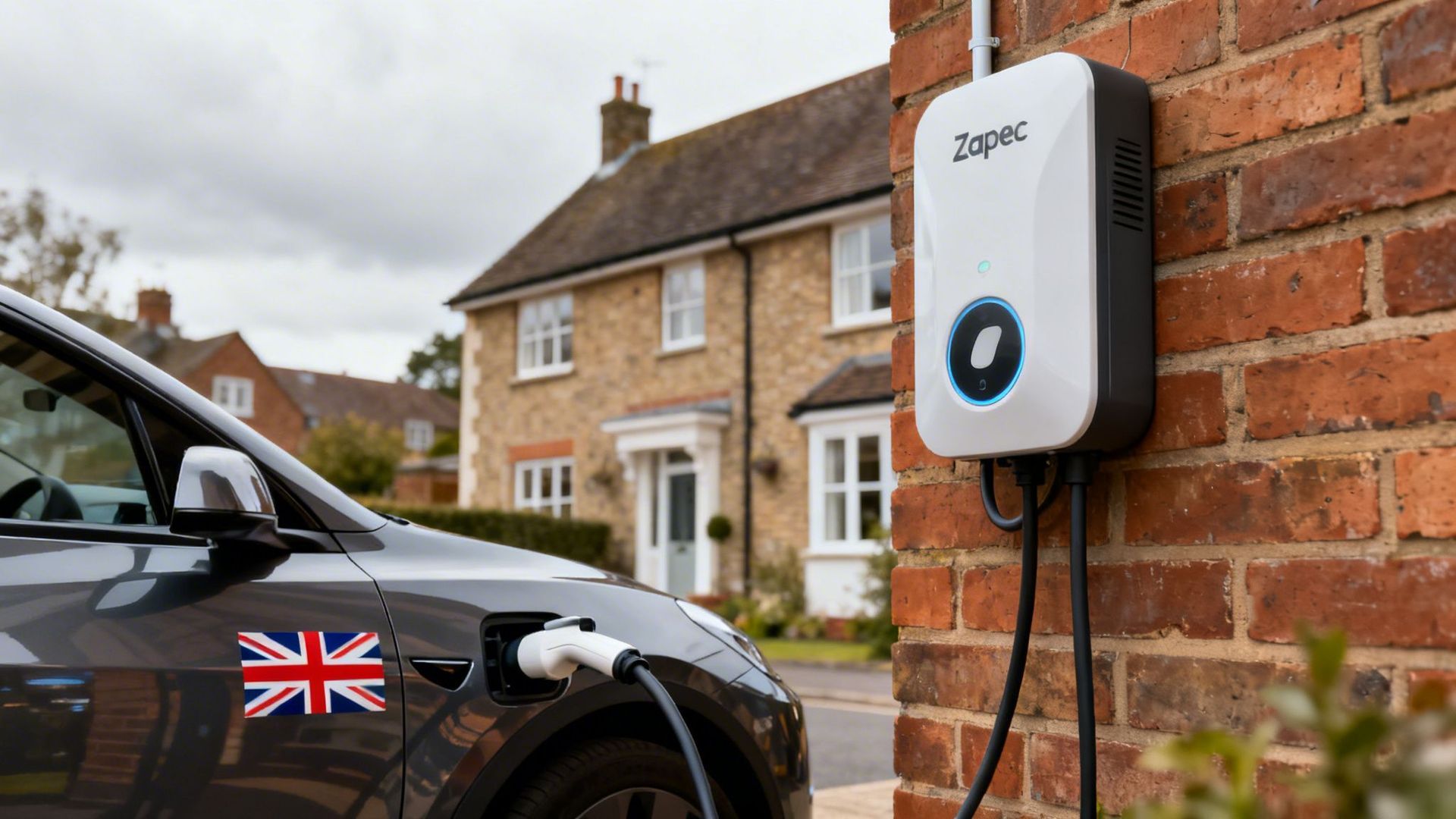
The reality, however, is that most owners will charge at home. Using a standard 7kW wallbox, a full charge from empty takes around 9.5 hours . In simple terms, you can plug it in when you get home from work and wake up to a "full tank" every single morning. It’s this day-to-day convenience that truly makes EV ownership work.
The following infographic gives you a sense of the incredible impact the e-Niro had on Kia's growth in the UK's electric vehicle market.
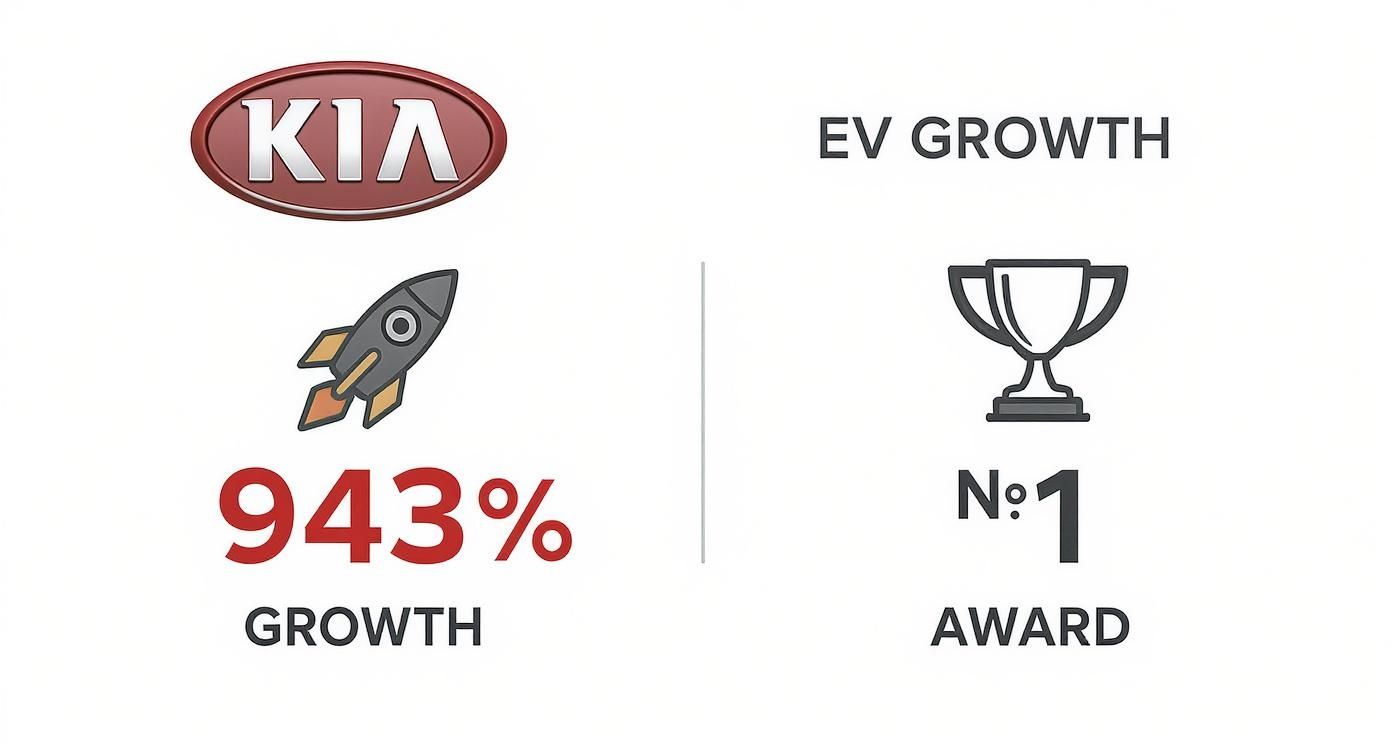
This explosion in sales and industry recognition shows just how perfectly the e-Niro's blend of range, practicality, and price met the needs of UK buyers. Of course, real-world range can be a slippery subject, influenced by everything from tyre pressure to how many pies you've had for lunch. If you want to dive deeper into this murky world, check out our guide on an electric car range comparison for the UK and other lies.
Interior Practicality and Tech You'll Actually Use
Step inside the Kia e-Niro, and what do you find? Well, a car interior. Shocking, I know. There’s no Starship Enterprise dashboard, no minimalist Scandi art installation, just a refreshingly normal cabin. It’s been designed by people who seem to have actually met a human family before, and frankly, that’s its greatest strength.
This isn't a car trying to impress your trendy mates with a gigantic, distracting screen that controls everything down to the glove box. It’s a tool for the job of life. The buttons are where you expect them to be, the layout is logical, and the plastics, while not exactly plush, feel like they could survive a direct hit from a toddler’s sticky juice box. It’s robust, it’s sensible, and it’s gloriously, unashamedly normal in the best possible way.
This part of our Kia e-Niro review gets into the nuts and bolts of daily life. Does it work for a family? Yes, and surprisingly well.
Space: The Final Frontier of Family Cars
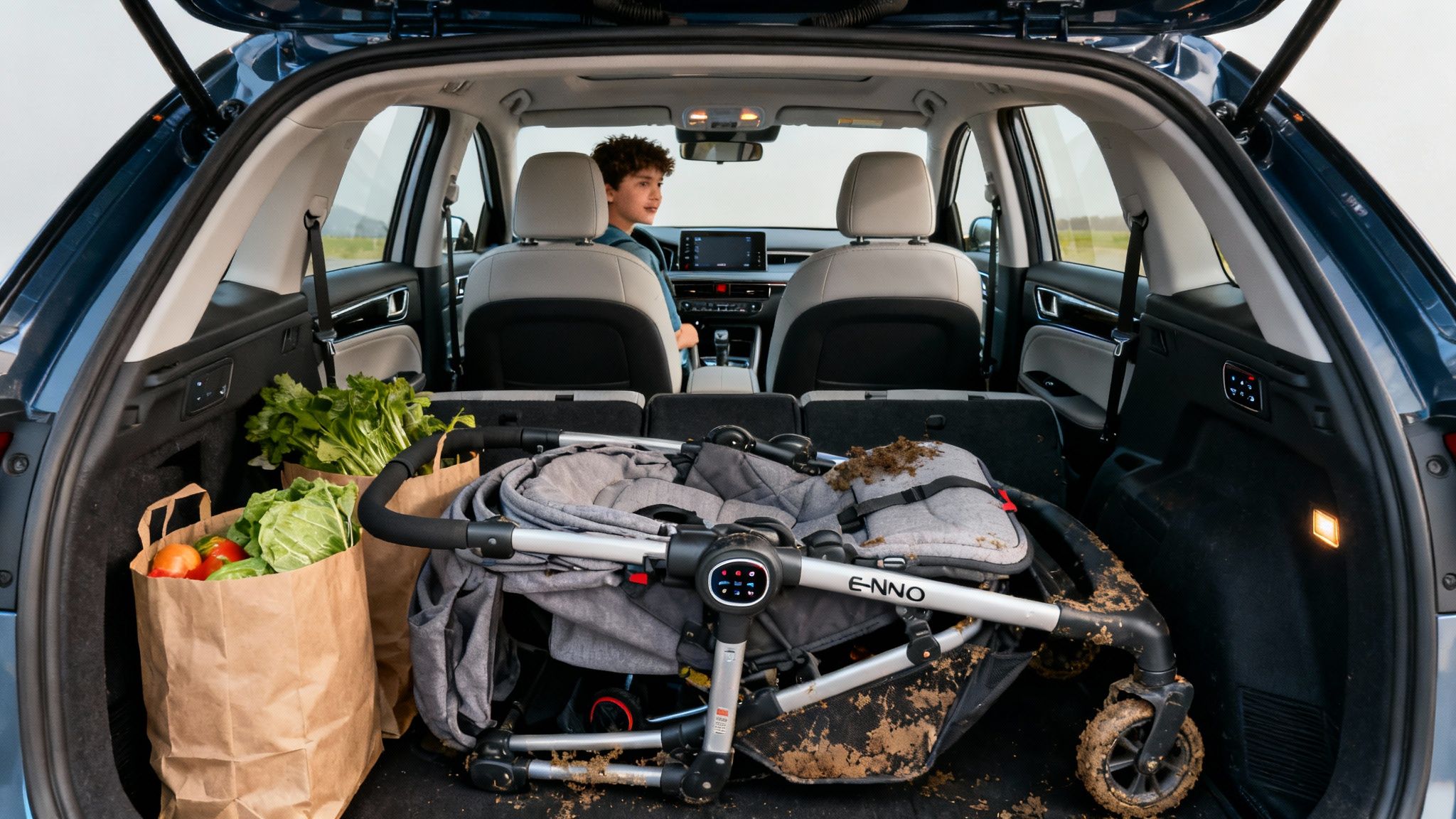
Let's talk about the real-world stuff that matters more than 0-60 times. Take the boot, for instance. It’s a very generous 451 litres . That’s just a number, but what does it actually mean? It means it swallows the weekly shop from Aldi with room to spare for a folded-down pushchair that's still caked in last week's mud. It's bigger than what you get in a VW ID.3 and completely annihilates the boot space in a Hyundai Kona Electric.
The practicality continues into the back seats. There’s enough headroom and legroom for a pair of lanky teenagers to sit without their knees being jammed into the front seatbacks. You can genuinely fit adults back there for more than a five-minute trip to the pub—a claim many rivals can't make without crossing their fingers.
Kia clearly understood the assignment: build a family crossover that just happens to be electric, not an electric car you try to cram a family into. The interior space and layout feel deliberate and thoughtfully designed for actual use, not just to look good in a brochure.
The cabin is also littered with useful cubby holes and decently sized door bins, perfect for stashing the endless detritus of family life. Cupholders are present and correct, and they’ll actually hold a modern, oversized coffee cup without it tipping over at the first roundabout. It’s the little things.
Tech That Doesn't Make You Want to Scream
The infotainment system is another area where Kia’s pragmatism really shines. On higher-spec models, you get a 10.25-inch touchscreen that’s bright, responsive, and blessedly simple to navigate. Crucially, it comes with Apple CarPlay and Android Auto as standard, so you can just bypass Kia’s own software and use what you’re familiar with.
Even better, Kia had the revolutionary idea of keeping physical buttons for the climate controls. No jabbing at a greasy screen three times just to turn the demister on. It’s a simple, effective layout that prioritises safety and ease of use over chasing a minimalist aesthetic.
Beyond the screen, the tech you’ll genuinely appreciate on a cold British morning includes:
- Heated Seats: Three stages of posterior-warming goodness. An absolute must.
- Heated Steering Wheel: Once you’ve had one, you can never go back. It’s the height of winter luxury.
- Decent Driver Aids: The adaptive cruise control and lane-keeping assist work smoothly, taking the sting out of motorway traffic jams without being overly intrusive.
It’s all technology you will actually use day-to-day. There are no pointless gimmicks, no voice assistant that only understands three phrases, and no augmented reality nonsense. Just solid, functional equipment that makes the car easier and more pleasant to live with, which is the entire point of the Kia e-Niro.
UK Trims, Pricing, and Ownership Costs
Right, let's get down to the brass tacks. You’ve heard about the sensible range and the family-friendly cabin, but what's this slice of electric motoring actually going to cost you? The sticker price is just the starting point; the real magic of the Kia e-Niro is found in its remarkably low running costs.
Thankfully, Kia kept the UK trim line-up refreshingly simple, especially for the popular 64kWh model. You're not forced to wade through a brochure with fifty confusing options. For the most part, buyers were choosing between the ‘2’, ‘3’, and the top-spec ‘4+’ trims.
Decoding the Trim Levels
You can think of the trims as a simple good, better, and best scenario. Even the entry-level ‘2’ was hardly basic, coming loaded with essentials like adaptive cruise control, an 8-inch touchscreen, and a reversing camera. It’s the one you bought if your head was firmly in charge of the decision.
The ‘3’ trim, however, was arguably the sweet spot of the entire range. It upgraded the interior with features you’d genuinely use and appreciate every single day:
- A much bigger 10.25-inch touchscreen for the infotainment system.
- Sumptuous heated front seats and a heated steering wheel – an absolute game-changer on a frosty British morning.
- Full leather upholstery, which just makes the whole cabin feel a bit more premium.
- Wireless phone charging, because who wants to be messing around with cables anymore?
At the top of the tree was the ‘4+’ trim, which basically threw in the kitchen sink. It added luxuries like a sunroof, ventilated (cooled) front seats for summer, heated outer rear seats, and an upgraded JBL sound system. It's all lovely kit, but for most people, the ‘3’ represented the best bang for your buck, balancing desirable features with a more palatable price tag.
The Real Cost of Ownership
This is where the Kia e-Niro story gets really compelling. The purchase price is one thing, but running it day-to-day is where you see the real financial genius of this car. It’s not just about fuel; the savings genuinely stack up across the board.
For a start, road tax (VED) is precisely £0 . That’s an immediate saving over any petrol or diesel car. Insurance groups are also very reasonable for an EV, typically sitting around group 20-22, which is right on par with many petrol-powered family crossovers. Servicing is another win; with far fewer moving parts, Kia’s service schedule is simpler and often cheaper than for a combustion-engined car.
But the biggest saving, of course, comes from what you put in the "tank".
Charging an e-Niro at home on an off-peak electricity tariff can cost as little as 4p per mile . A comparable petrol crossover, averaging 45mpg, would cost you around 16p per mile at today's pump prices. Over 10,000 miles a year, that’s a potential saving of over £1,200 on fuel alone.
This is the point where the argument for going electric becomes incredibly hard to ignore. To see a more detailed breakdown, it's worth exploring our guide on the real cost of owning an EV compared to petrol cars, which lays out all the numbers in stark detail.
Kia e-Niro vs Petrol Crossover Annual Running Costs
To put it all into perspective, we've put together a simple table comparing the estimated annual running costs for an e-Niro against a typical petrol rival like a Nissan Qashqai, based on 10,000 miles a year.
| Cost Area | Kia e-Niro (64kWh) | Petrol Crossover (e.g., Nissan Qashqai) |
|---|---|---|
| Annual 'Fuel' Cost (10,000 miles) | ~£400 (at 10p/kWh) | ~£1,600 (at £1.45/litre) |
| Annual Road Tax (VED) | £0 | £190 |
| Estimated Annual Servicing | ~£150 | ~£250-£350 |
| Total Estimated Annual Cost | ~£550 | ~£2,090 |
The numbers really don't lie. Over the course of a few years of ownership, the Kia e-Niro proves it's not just an environmentally sound choice; it’s a financially astute one that can save you a small fortune.
How The e-Niro Stacks Up Against Key Rivals
The Kia e-Niro didn’t arrive on a deserted island; it crash-landed in the middle of a fiercely competitive party where everyone was trying to shout the loudest. To really get a handle on where it sits, you have to measure it up against the other big names all vying for your attention. This isn't just about battery size or boot space; it’s about character, real-world usability, and which one is least likely to make you want to throw its infotainment screen out of the window.
The e-Niro has been a cornerstone of Kia’s electric strategy, and it’s a strategy that’s clearly working. In the first quarter of 2025, Kia recorded a whopping 35,063 new car sales in the UK, grabbing a 6.0% market share and cementing its place as the country's third best-selling brand. A massive chunk of that success—over 7,000 units —came from EV sales, marking a 47% jump from the previous year. You can dig into more of the details on Kia's record-breaking sales performance on shellymotors.com.
Now, let's line up the usual suspects.
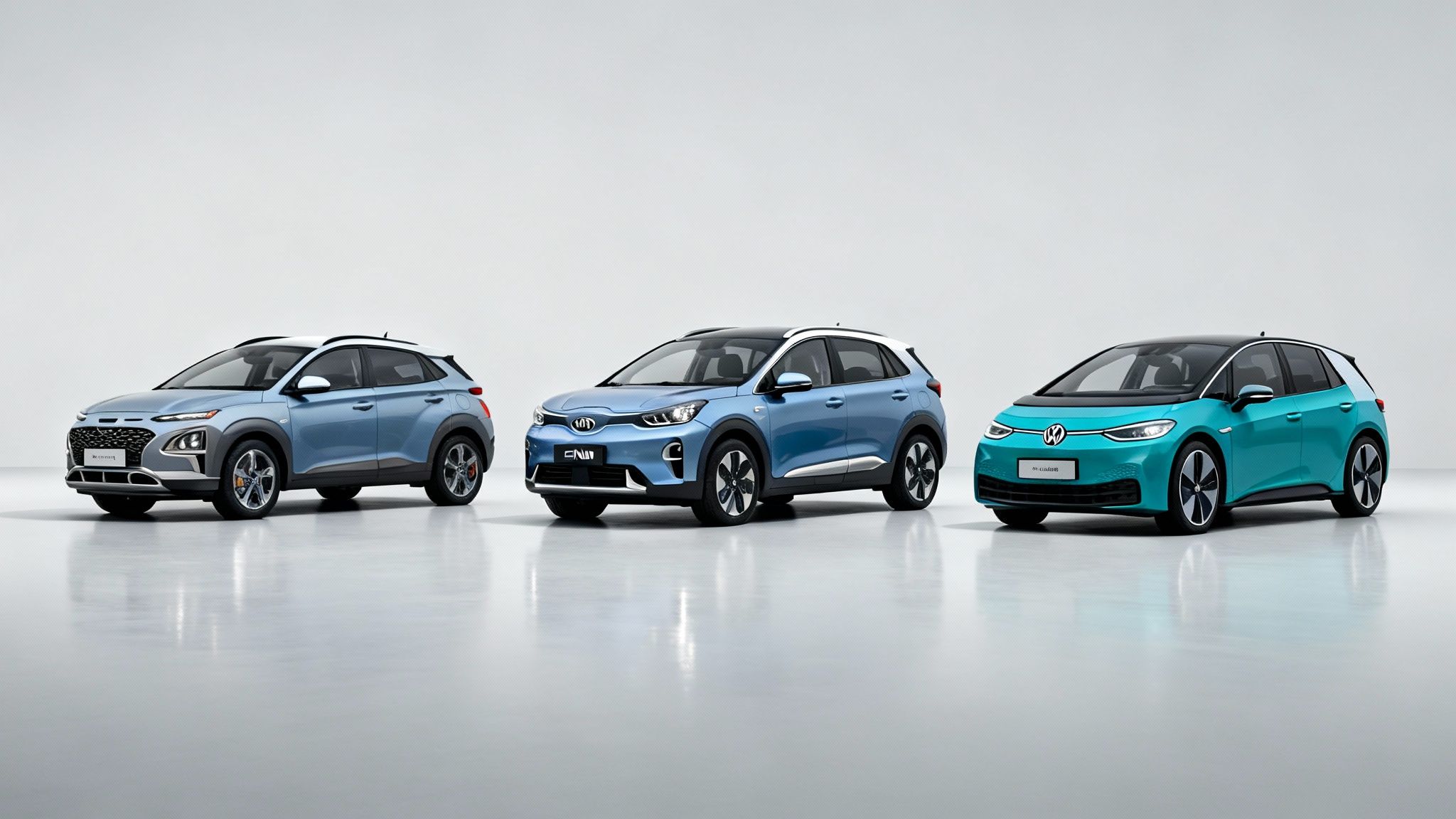
The Sibling Rivalry: Hyundai Kona Electric
Think of the Hyundai Kona Electric as the e-Niro’s slightly more flamboyant sibling. They’re built on the same brilliant foundations, sharing the 64kWh battery and motor, so on paper, their performance and range are virtually identical. The real difference is in the packaging and personality.
The Kona is a bit smaller, has funkier styling, and feels more like a pumped-up supermini than a family crossover. That style comes at a cost, though. Its boot is noticeably smaller, and rear passenger space is much tighter. If you’re trying to wrestle a car seat into the back while juggling the weekly shop, that extra room in the e-Niro makes a world of difference. The Kona is a great car, but for family life, the e-Niro is the more practical choice, hands down.
The German Futurist: Volkswagen ID.3
Next up is the Volkswagen ID.3, the car that was meant to be the people's electric champion. It looks like it’s driven straight out of a sci-fi film, with a minimalist, button-free interior that’s either sleekly modern or infuriatingly sparse, depending on your mood. Its rear-wheel-drive setup also makes it a bit more entertaining to pilot down a twisty B-road.
But oh, that interior. The early ID.3s were infamous for buggy, slow infotainment systems and a reliance on touch-sensitive sliders that are a genuine pain to use on the move. While the e-Niro’s cabin won’t win any design awards, it has proper physical buttons that just work. Every. Single. Time.
For many drivers, the e-Niro’s straightforward, functional approach is a massive selling point. It prioritises ease of use over futuristic flair, which is frankly a blessing during the chaos of a school run.
The Bargain Contender: MG ZS EV
The MG ZS EV is the value king of the group, the one that makes you double-check the price list to see if there’s a typo. It offers a similar crossover shape and a decent amount of kit for significantly less cash than the Kia. For anyone on a tighter budget, it's a very tempting offer.
So, where’s the catch? Well, the interior quality isn’t quite on par with the Kia’s, with more hard, scratchy plastics dotted around the cabin. More importantly, while its range is perfectly adequate for most, it can’t match the long-legged touring ability of the 64kWh e-Niro. The MG is a fantastic car for the money, but the e-Niro just feels like the more polished, complete package. And while we’re on the subject of quirky Kia models, our brutally honest Kia Soul EV review is well worth a read to see another side of their electric line-up.
The Final Verdict: Should You Buy One?
So, here we are. After all the tests, the number-crunching, and the real-world driving, we get to the big question: should you actually spend your hard-earned money on a Kia e-Niro? Especially now, with a market flooded with newer, flashier, and frankly, more eye-catching EVs.
The short answer? Absolutely. The Kia e-Niro remains one of the most sensible, well-rounded electric cars you can buy today. It’s perfect for a family that needs one car to do everything. Think of it as the Swiss Army knife of EVs—it might not be the absolute best at any single thing, but it’s remarkably good at almost all of them.
It nails the sweet spot, balancing a genuinely useful real-world range with a cabin and boot that can actually cope with the chaos of family life. It’s cheap to run, comfortable on the move, and doesn't try to bamboozle you with overly complex tech. It feels like a car first and an EV second, and that’s a huge part of its charm.
The Used Market: A Proper Bargain
This is where the e-Niro's story gets even better. Because it sold in such huge numbers, the used market is now full of well-cared-for examples. That initial whack of depreciation has softened the price, making a three or four-year-old model one of the shrewdest second-hand electric buys you can find.
And its popularity isn't just word-of-mouth. The e-Niro has a rock-solid reputation, which makes it a hot ticket for used buyers. In fact, data from November 2025 showed the all-electric Kia Niro was the UK's fastest-selling used car, taking an average of just 13 days to be snapped up. That's less than half the market average of 32 days. You can dig into more of that data on the UK's fastest-selling used cars on plc.autotrader.co.uk.
If you're browsing the classifieds, here are a few key things to look out for:
- Battery Health (SoH): Always ask for the 'State of Health' percentage. A healthy car should still be well above 90%, but it's a vital thing to check.
- Charging Port: Give it a good look. Make sure the pins are clean and the locking mechanism engages smoothly.
- Full Service History: This is non-negotiable. It’s essential for keeping that brilliant seven-year warranty intact, which also covers the battery.
Our verdict is pretty straightforward. If you’re looking for a statement EV that will turn heads at the traffic lights, this probably isn’t it. But if you need a dependable, practical, and affordable electric family car that just quietly gets on with the job, the Kia e-Niro is still one of the best choices out there, new or used. It’s the head-over-heart decision that your brain—and your bank balance—will thank you for.
Frequently Asked Questions About The Kia e-Niro
Right, you’ve made it this far, so you're clearly giving this sensible slice of electric motoring some serious thought. Let's tackle a few of the most common questions we get asked about the Kia e-Niro.
How Long Does the Kia e-Niro Battery Last?
This is the big one, isn't it? The fear that the battery will die a death like a cheap phone after just a couple of years.
You can put that worry to bed. Kia slaps a fantastic seven-year, 100,000-mile warranty on the car, and that includes the battery. They guarantee it won't drop below 70% of its original capacity during that time, which is a huge vote of confidence.
In the real world, degradation is proving to be incredibly slow. We've spoken to owners of older e-Niros who, after tens of thousands of miles, have seen barely any drop in range. This isn't a disposable piece of tech; it's engineered to last the life of the car.
What Are the Common Problems with a Used Kia e-Niro?
The e-Niro has a stellar reputation for reliability, but no car is completely faultless. If you're looking at a used one, there are a couple of well-known niggles to check for.
- 12V Battery Woes: It sounds ironic, but the little 12-volt battery (the one that boots up the car's systems before the main traction battery takes over) can sometimes go flat. It's a cheap and easy fix, but it can leave you stranded, so check its health.
- Noisy Motor Reducer: Some of the earlier cars developed a light clicking or tapping sound from the motor's reduction gear. Kia sorted this with a service fix, so listen out for it on a test drive and have a look through the service history.
- Sticky Charging Port Door: Make sure the charging flap opens and closes without a fight. The mechanism can get a bit temperamental, particularly if it's been through a few frosty winters.
Is the e-Niro Really Practical for Charging in the UK?
Absolutely, and its charging specs are a great match for the UK's public network as it stands today. The e-Niro can pull a maximum of 77kW from a DC rapid charger. On one of the common 100kW or 150kW units you see at service stations, that means a 10-80% top-up will take you about 45 minutes .
But the real magic for most owners is charging at home. Plugged into a standard 7kW wallbox, a full 0-100% charge takes around 9.5 hours . This is the everyday reality that makes EV ownership so simple – you just wake up to a full "tank" every single morning.
At VoltsMonster , we cut through the noise to give you brutally honest reviews and practical advice on making the switch to electric. For more no-nonsense guides and the latest on the best EV deals in the UK, explore our content.
VoltsMonster Electric Vehicle Blog