Honda e Review: A Flawed But Brilliant Used EV
Let's get one thing straight. The Honda e is a gorgeous piece of design, a tech-lover's dream, and an absolute riot to drive around the city. It's also a complete and utter sales flop that Honda has already binned—a brilliant, beautiful mistake that proves style isn't everything.
This Honda e review is a celebration of the car for what it is: a flawed gem, packed with charisma, and still one of the most desirable city EVs you can buy. But we won't be pulling any punches on why it ultimately failed.
A Retro-Futuristic Flop
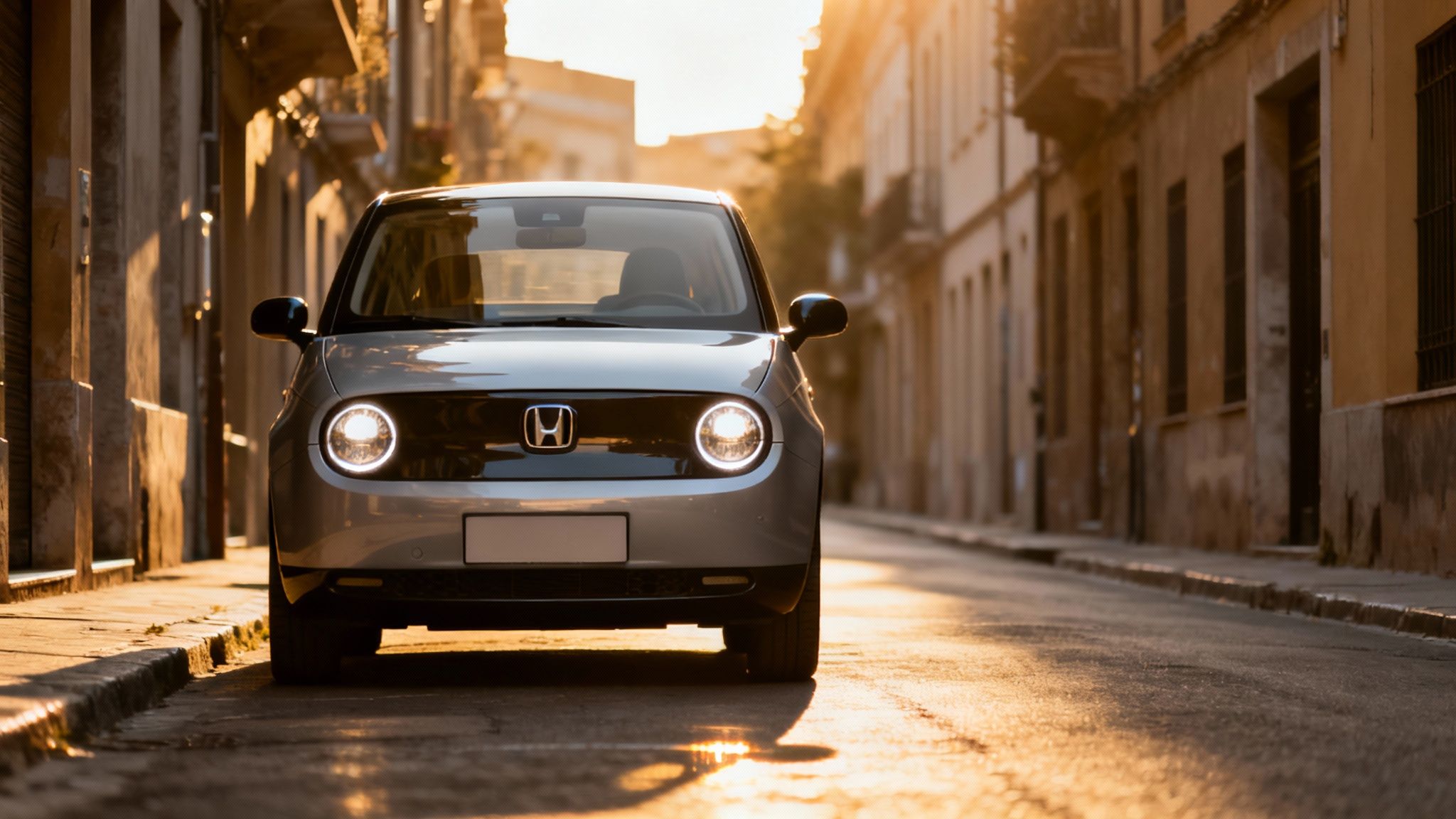
When Honda first showed off the e concept, the car world went into a collective frenzy. It was a proper breath of fresh air, a stunning mix of retro cool and future tech in a sea of generic electric SUVs. It felt like a glimpse into a fun, stylish electric future.
And then the production car landed, and reality came crashing down. The looks were there, and the zippy, rear-wheel-drive handling was everything we’d hoped for. But the car was hobbled by a few spectacular own goals that made it almost totally impractical for most UK drivers. Honda had created a beautiful, expensive gadget that just happened to be shaped like a car.
The Problem in a Nutshell
The core issues were obvious right from the start. It felt as though Honda had designed the e in a bubble, ignoring what British buyers actually need from an EV. The list of problems was, and still is, significant:
- A Tiny Battery: The real-world range was almost a joke, barely enough to get you across a large county on a good day.
- Impractical Space: The boot is comically small, and you’d only put people you don’t like in the back seats.
- A Premium Price: It was priced against far more capable and practical rivals, making it a head-scratching choice for most.
The Honda e feels less like a serious electric car and more like a design student’s final project that somehow got approved for production. It's a magnificent folly—a perfect example of what happens when style completely bulldozes substance.
A Swift and Inevitable End
The car arrived in UK showrooms in summer 2020, with a starting price of £26,160 . By late 2023, Honda had already pulled the plug, announcing production would cease in January 2024 after selling a meagre 12,500 units globally.
Its ever-increasing price tag, combined with that tiny battery and a shocking lack of practicality, meant it was destined to fail. The sales struggles that sealed its fate tell the whole story.
So, this review isn't just about what the Honda e is like to live with. It’s about whether this beautiful failure now makes sense as a second-hand bargain. Let's dive in.
An Unbeatable Drive Around Town
Right, let's get something straight. Forget the spec sheet, the slightly dodgy range, and the laughable boot for a minute. To really get the Honda e, you simply have to drive it. This is the moment it all clicks. The car’s entire reason for being suddenly snaps into focus, and it transforms from a list of compromises into one of the most entertaining city cars ever built.
From the second you touch the accelerator, the e just zings. It shoots forward with an infectious enthusiasm that's completely addictive. Its electric motor powers the rear wheels, giving it that peppy, pushed-from-behind feel you get in a classic little sports car. No, it's not going to win any drag races, but the instant torque makes it feel like a proper go-kart. It's perfect for darting through gaps in traffic and leaving sleepy diesel saloons for dead at the lights.
This car was born for the chaos of city driving, and boy, does it show.
Turning On A Sixpence
One of the Honda e’s best party tricks is its turning circle. At a frankly ridiculous 4.3 metres , it's tighter than a London black cab. This isn't just a nerdy pub fact; it fundamentally changes how you deal with tight spots.
So, what does that actually mean day-to-day?
- Effortless U-Turns: You can spin the car around on a narrow residential street in one go. No more awkward three-point-turn faff.
- Parking Nirvana: Those nightmarish multi-storey car park spaces? They become a doddle. The e pivots into spots you wouldn't even glance at in a normal car.
- Unbeatable Agility: Navigating mini-roundabouts and clogged-up junctions feels nimble and completely effortless.
This incredible manoeuvrability, paired with its dinky dimensions, makes the Honda e feel utterly at home in the urban jungle. It’s one of those cars that seems to shrink around you, giving you the confidence to squeeze through gaps and dive into parking spaces with comical ease.
More Than Just A City Slicker
While its natural habitat is clearly the city, the e is a surprisingly good laugh when you escape the 30 mph zones. The steering is beautifully weighted, giving you just the right amount of feedback without feeling nervous, and the chassis is wonderfully balanced. Throw it down a winding B-road and it responds with an eagerness that’ll have you grinning from ear to ear.
The suspension strikes a brilliant balance between comfort and control. It’s soft enough to soak up the pockmarked reality of Britain’s roads, but it’s also firm enough to stop it from wallowing about in the corners. It just feels planted, secure, and genuinely entertaining to hustle along.
Driving the Honda e is a constant reminder of what makes small cars so great. It’s a pure, unfiltered experience that’s all about fun, not outright speed or practicality. It’s a rolling contradiction—a car that’s objectively flawed in many ways, yet subjectively brilliant.
Of course, all this B-road fun is tempered by that little voice in the back of your head. As you’re enjoying the drive, you’re also watching the range meter drop like a stone. The joy is perpetually married to the anxiety of where your next charge is coming from. It’s an experience that perfectly sums up the Honda e dilemma: pure, unadulterated fun, served with a side of constant, low-level panic.
The Achilles Heel: Range And Charging Reality
If the driving experience is the Honda e’s moment of genius, its battery is the catastrophic, deal-breaking blunder. This is where the retro-futuristic dream comes crashing back down to earth with a thud you can feel in your wallet.
It’s the automotive equivalent of a flagship smartphone that starts the day with its battery already in the red.
On paper, Honda fitted a 35.5 kWh battery, which they claimed was good for a WLTP range of up to 137 miles . In the real world—especially the damp and chilly UK—that figure is pure fantasy. It’s a number cooked up in a lab, with no bearing on the grim reality of daily driving.
The Grim Reality Of Real-World Range
That official 137-mile figure is a cruel joke. The second you introduce real-world variables like, say, weather, hills, or the need to get somewhere in a hurry, the range plummets. And it’s not just a small drop; it’s a nosedive.
Here’s a more honest breakdown of what to expect from a full charge:
- A Cold British Winter: Turn on the heater and wipers, and you’ll be lucky to see 85-95 miles . The car essentially becomes a very stylish, very expensive local runabout.
- Motorway Speeds: Sit at a steady 70 mph, and the battery drains before your very eyes. Expect the usable range to dip to around 90 miles , making any journey beyond the next county a strategic military operation.
- Spirited Driving: Enjoying that brilliant chassis on a B-road? Fantastic. Just know that every grin-inducing corner is costing you dearly. You could easily see the range drop below 80 miles .
The Honda e doesn't have range anxiety; it has range certainty. You are certain you won't get very far. It forces you to plan your life around the car's limitations, not the other way around.
A Quick Coffee And Back On The Road
The charging situation is a little more positive, but it only highlights the battery’s core weakness. Honda equipped the e with CCS Combo 2 rapid charging, capable of replenishing the battery to 80% in about 30 minutes .
This sounds great, but when 80% of a tiny battery is barely 100 miles, it’s not much of a victory. It’s just enough time to grab a dreadful service station coffee before you’re already planning your next stop.
The car’s specs always positioned it as a city slicker, a critical miscalculation for British buyers who often need their car to do a bit of everything. This tiny range is the single biggest reason it failed to sell.
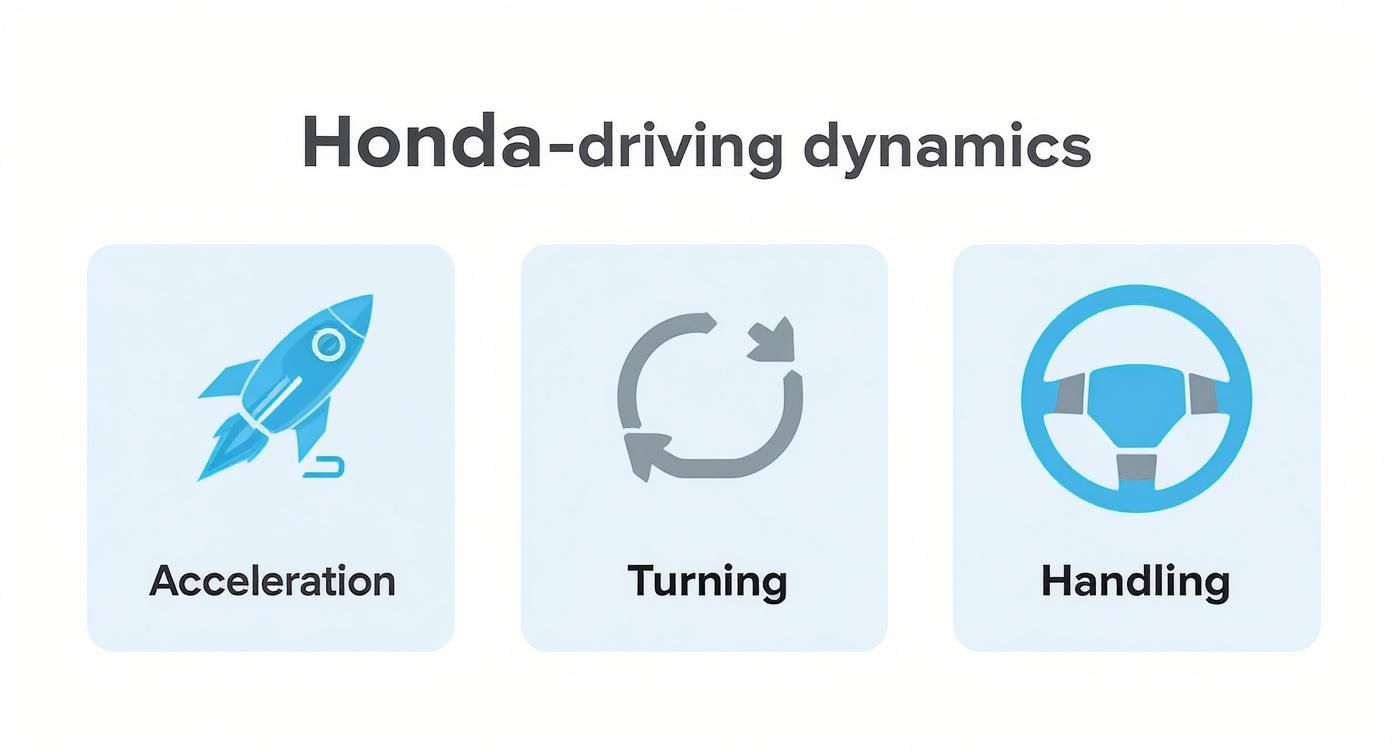
As this shows, the car’s dynamic strengths are undeniable, but you can only enjoy them in short, sharp bursts close to home before you’re tethered to a plug again.
How It Stacks Up Against Rivals
To truly grasp how badly Honda dropped the ball, you only need to look at its direct competitors from the same era. Cars like the Peugeot e-208 and Renault Zoe weren’t just slightly better; they were in a different league entirely.
The numbers speak for themselves. This isn't just a close-run race; it's a massacre.
| Feature | Honda e | Peugeot e-208 | Renault Zoe |
|---|---|---|---|
| Battery Size | 35.5 kWh | 50 kWh | 52 kWh |
| WLTP Range | Up to 137 miles | Up to 225 miles | Up to 239 miles |
| Real-World Winter Range | ~90 miles | ~150 miles | ~160 miles |
Both the e-208 and the Zoe offered nearly double the real-world range, transforming them from city-bound gadgets into genuinely usable all-rounders. This stark difference made the Honda e look like an overpriced, under-engineered toy.
For a deeper dive into how these figures translate across different models, check out our guide on an electric car range comparison for the UK and other lies. It’s a sobering read that puts the e’s fatal flaw into stark perspective.
A Tech-Laden And Impractical Interior
Stepping inside the Honda e for the first time is a proper ‘wow’ moment. Forget feeling like you're in a car; it's more like a minimalist Japanese tech lounge on wheels. It's a clean, modern space that makes most rivals look hopelessly old-fashioned and immediately promises a futuristic driving experience.
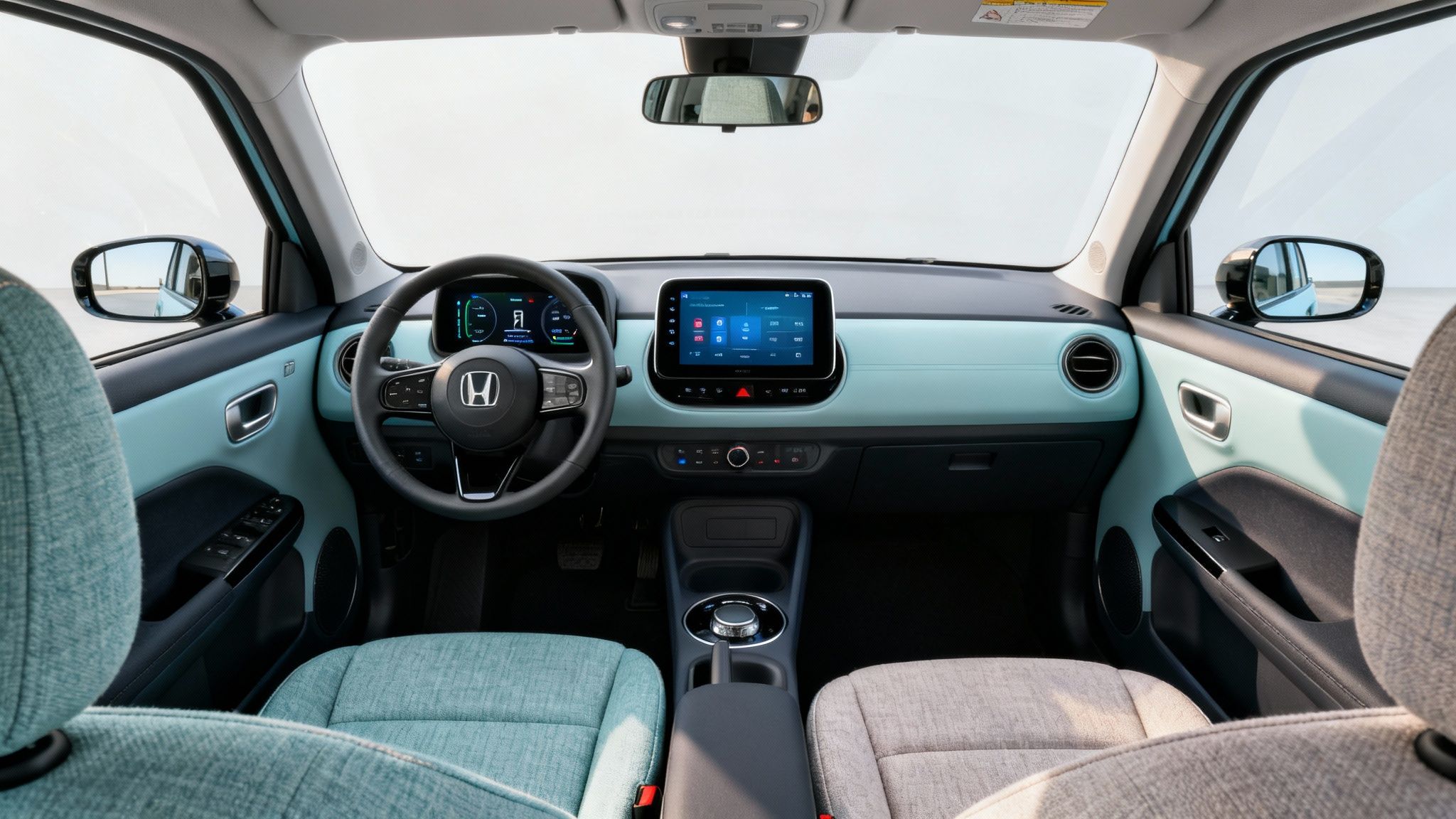
The undeniable showstopper is the full-width digital dashboard. It’s a vast expanse of screens, dominated by two vibrant 12.3-inch displays sitting side-by-side. The graphics are crisp, the layout is customisable, and the whole thing feels genuinely special. You can even swap the screens over, letting your passenger play DJ without reaching across and distracting you. It's brilliant.
But beneath the surface of this tech utopia lies an interior that is, in almost every practical sense, a complete disaster.
Screens For Mirrors And Other Gimmicks
Another feature that screams ‘concept car made real’ is the camera-based side mirror system, which comes as standard. Instead of traditional glass, you get two small cameras feeding a live video to six-inch screens at either end of the dashboard. They look incredibly cool and offer a wider field of view, which is particularly useful in the rain.
However, they are a classic case of a solution looking for a problem. Your brain, trained for decades to glance at a specific spot, has to completely relearn where to look. Judging the distance of approaching cars can also feel a bit like a video game, which is less than ideal on a busy roundabout. Some drivers love them; others find them a distracting gimmick. It’s a feature you absolutely must try for yourself before buying.
The Honda e's interior is a masterpiece of form over function. It's designed to impress your mates down the pub, not to cope with the messy reality of everyday life. It’s a beautiful, impractical, and ultimately infuriating place to be.
A Cabin Designed To Stain
That initial admiration for the design quickly fades when you start touching the materials. Honda opted for swathes of a light grey, lounge-style fabric across the dashboard and seats. It looks fantastic in a brochure but seems purpose-built to absorb every possible stain.
Just picture it:
- A takeaway coffee with a slightly loose lid.
- A child with a chocolate biscuit.
- A dog hopping in on a muddy day.
This upholstery isn’t just impractical; it feels like an act of deliberate sabotage against anyone with a normal, messy life. It’s a bizarre choice that prioritises a short-lived aesthetic over any semblance of long-term durability. One spillage, and your stylish tech lounge will look like a student flat after a heavy weekend.
Laughably Impractical For Actual Humans
Beyond the stain-magnet fabrics, the Honda e’s biggest interior failure is its shocking lack of space. This car isn’t just a bit small; it’s laughably, unforgivably impractical for anything more than a solo commute.
The boot is the first clue. At a pathetic 171 litres , it’s smaller than what you’d find in a Fiat 500. It’s barely big enough for a weekly shop for one person, let alone the paraphernalia that comes with a family or a hobby. You can forget about fitting a pushchair, a set of golf clubs, or luggage for a weekend away. It's a space for a couple of tote bags, and that's about it.
Then there’s the rear passenger space. Calling them ‘seats’ is generous; ‘penalty boxes’ would be more accurate. Legroom is virtually non-existent, and anyone taller than a garden gnome will find their head scraping the roof. It’s a space designed for small children on short trips, and even then, they’ll probably complain. For a car that was priced as a premium product, this level of compromise is frankly insulting. This is a two-seater car masquerading as a four-seater, and the illusion shatters the first time you try to use the back.
Running Costs And Finding A Used Bargain
Let's be honest, the Honda e was a commercial flop. It was a stunning but eye-wateringly expensive city car that cost Honda a fortune and its first owners even more. But here’s the brilliant part: that’s fantastic news for you.
What made for a truly terrible new car purchase has, thanks to the wonderful magic of savage depreciation, morphed into a very compelling used buy. For anyone looking for a stylish urban EV, the e's financial nosedive is a golden opportunity. The original buyers have absorbed that huge initial hit, so you don't have to.
This is the only context where the Honda e really starts to make a bit of financial sense. Let's look at the real-world costs of owning this flawed masterpiece and how to find a cracking deal.
Crushing Depreciation And The Used Market
The single biggest advantage you have is depreciation. The Honda e shed its value faster than a rocket in reentry. When it was brand new, the top-spec Advance model was pushing £30,000 —a completely bonkers price for a car with a battery that felt like it was powered by a couple of Duracells.
Fast forward to today, and you can pick up a two-year-old, low-mileage example for less than half of that. A quick browse through the classifieds shows plenty of immaculate models hovering around the £13,000 to £15,000 mark. That's a colossal saving and plonks the car right into a price bracket where its quirky limitations suddenly feel much easier to live with.
The Honda e’s catastrophic depreciation is its greatest redemption. It transforms the car from an expensive folly into a chic, affordable second-hand EV that stands out from the crowd of dreary electric superminis.
Day-To-Day Running Costs
Once you've found your bargain, the day-to-day running costs are refreshingly low, just as you'd hope from an electric car.
- Road Tax (VED): As a pure EV, the Honda e is currently exempt from Vehicle Excise Duty. That’s a nice little saving right off the bat.
- Servicing: Maintenance is about as simple as it gets. You're looking at an annual check-up, mostly just to look over the brakes, tyres, and change the pollen filter. It's worlds cheaper than keeping a petrol equivalent on the road.
- Insurance: Now, here's a slight sting in the tail. The base model sits in insurance group 25 , with the Advance climbing to group 29 . That’s surprisingly punchy for a little city car, likely a result of all its expensive tech and the potential repair costs for its aluminium body panels.
What To Check When Buying A Used Honda e
Buying any used EV means doing a bit of homework, but the tech-laden Honda e has a few specific things you need to keep an eye on.
The battery is, naturally, the main event. It’s small to begin with, so any degradation will be felt more keenly than in a long-range EV. Try to get a battery health report if you can. Next, give that huge infotainment system a proper workout. The wall-to-wall screens are a huge part of the car's appeal, so you need to check for any dead pixels, glitches, or sluggishness. While not a widespread issue, a few electrical gremlins have been reported by owners. For a more detailed guide, it's well worth reading our checklist on the top 5 things to look for when inspecting a used EV.
Finally, don’t forget to properly test the camera-based mirrors. They’re a real love-it-or-hate-it feature, and you definitely don't want to find out you're in the "hate it" camp after you've already handed over the cash.
So, Who Should Actually Buy One?
After all that, we land on the big question. Is the Honda e a car you should actually buy? The answer, I'm afraid, is a very firm "it depends." This isn't a car you buy with your head; it's a purchase driven entirely by your heart, probably after your logical brain has been bundled into the boot (which, to be fair, is so tiny it wouldn't take long to escape).
The Honda e is a car of spectacular contradictions. The good bits are genuinely brilliant, while the bad bits are monumentally, unforgivably awful. It’s a classic case of a beautiful, charismatic failure that’s hard not to love, despite its glaring, deal-breaking flaws.
Let's break it down in brutally simple terms.
The Good, The Bad, and The Impractical
On one hand, you have a car that offers things its rivals can only dream of.
- Pros: Unmatched retro-futuristic style that still turns heads, sublime driving dynamics that make it a city go-kart, and an incredible interior tech suite that feels like it’s from ten years in the future.
But on the other hand, you're faced with a list of cons so severe they single-handedly torpedoed its sales prospects right from the start.
- Cons: A dreadful real-world range that induces panic on any trip longer than a milk run, a high original price that made it a punchline, and a crippling lack of practicality that renders it useless for almost anyone with a normal life.
So, Who Is It For, Then?
This brings us to a very specific, almost comically niche buyer profile. If you can tick all the following boxes, then congratulations – the Honda e might just be the perfect, stylish second car for you.
The Honda e is the right car for all the wrong reasons. It’s an objectively terrible solution to the problem of personal transport, yet a subjectively wonderful piece of design and engineering. It's a triumph of style over substance, and for a very select few, that’s perfectly okay.
It makes a curious kind of sense if you're a city-dwelling individual or a couple with a dedicated home charger and a main car for sensible journeys. Think of it as a chic runabout for local trips, a fashion accessory, a gadget on wheels – a fun weekend toy that you can occasionally use to pop to the shops.
For absolutely everyone else? Run a mile. If you’re a family in the suburbs needing one car to do everything, it’s an utterly terrible idea. If you commute on the motorway or live rurally, it would be a constant source of stress. It is not, and never was, a practical primary vehicle.
A Lesson in Failure
The Honda e’s failure is a fascinating case study in a car manufacturer getting it so, so wrong. Discontinued in January 2024 after selling only around 12,500 units globally , it was a massive misread of the market and a huge blow to Honda's European electrification ambitions.
The company’s pivot to the bland but practical e:Ny1 SUV shows they’ve learned their lesson, albeit a painful and expensive one. The e's failure highlighted a wider issue, with the company seeing a significant decline in its EV performance in the periods that followed. You can discover more insights about the challenging EV market dynamics on eciu.net.
Ultimately, the Honda e will be remembered as a brilliant mistake. And now that depreciation has worked its magic, it’s a mistake that’s finally affordable enough for a few brave souls to enjoy.
Your Honda e Questions Answered
Still weighing things up? Let's tackle some of the most common questions we get from people thinking about buying a used Honda e. Consider this the final, practical check before you commit.
What's the Real-World Range of a Honda e in a UK Winter?
The official figure is up to 137 miles, but you really can't bank on that. Once the temperature drops and you've got the heater and wipers going on a gloomy British day, a realistic range is closer to 80-95 miles .
It’s even less if you’re sitting at 70 mph on the motorway. Think of it purely as a city car, especially during the colder half of the year.
Are the Camera Side Mirrors Hard to Get Used To?
Honestly, most people get the hang of them in a couple of days. The screens are positioned quite naturally where you'd glance anyway, and they give a surprisingly clear view, particularly when it's pouring with rain.
The main learning curve is judging distance. For the first few motorway lane changes, you might feel a bit hesitant. This is one of those features you absolutely have to try for yourself on a proper test drive to see if you can live with it.
When you're looking at any used EV, the battery's condition is everything. A smaller battery like the one in the Honda e means that any loss in capacity is felt more keenly, making a health check vital.
For anyone serious about buying a second-hand electric car, getting to grips with battery health is non-negotiable. We've put together a full guide on the truth about battery health reports on used EVs which is essential reading before you part with your money.
Is the Honda e a Good Car for a Small Family?
In a word? No. It might have four seats on paper, but the rear legroom is seriously tight for anyone other than small children.
And with a tiny 171-litre boot, you'll struggle to fit a pushchair, let alone the luggage for a family weekend away. It really shines as a stylish runabout for individuals or couples, not as a practical family workhorse.
At VoltsMonster , we give you the brutally honest reviews and insights you won't find anywhere else. Check out more content at https://www.voltsmonster.com.
VoltsMonster Electric Vehicle Blog