A Survivor's Guide to Buying a Tesla in the UK
So, you’re thinking about buying a Tesla? Let’s get one thing straight: it's not like popping down to your local Ford dealership. The whole process happens almost entirely online, swapping the art of the haggle for a few nervous clicks on a website. It’s a big step, one that trades petrol station queues for a new and frankly obsessive preoccupation with charging speeds.
Thinking of Getting a Tesla? Here’s What You Need to Know First
Alright, let's have a proper chat. Getting a Tesla feels less like buying a car and more like joining a very exclusive, tech-obsessed cult. Before you dive headfirst into the world of silent acceleration and over-the-air updates, it's worth understanding what you're really getting yourself into.
This isn't just about zero-emissions driving; it’s a complete shift in how you think about owning and using a car. If that sounds a bit daunting, it might be a good idea to read our proper British survival guide to electric cars first. It’ll give you the grounding you need before you commit.
What You're Really Signing Up For
The Tesla buying experience is famously unique. There are no pushy salespeople and no forecourts to wander around. It's just you, their website, and a decision to make. It’s refreshingly simple, but it comes with its own set of rules.
- The Mindset Shift: You’ll quickly find yourself thinking in kilowatt-hours instead of miles per gallon. Long journeys suddenly involve a bit more planning around rapid chargers, and you’ll develop an eagle eye for a free plug at the supermarket.
- The Tech Gamble: You’re essentially buying a sophisticated computer on wheels. This is fantastic when a free software update lands overnight, giving you a new feature. It's less amusing when a minor bug makes your windscreen wipers have a fit on a perfectly sunny day.
- The Market Volatility: Tesla’s popularity can be a rollercoaster. For instance, their new car deliveries in the UK took a massive hit, dropping by 45% in May 2025 compared to the previous year. It’s a good reminder that the market can swing wildly.
Your journey will almost certainly start on the official Tesla UK inventory page.
This clean, minimalist interface is your showroom. It lays out all the available models, prices, and locations without any of the usual dealership clutter.
The biggest adjustment isn’t the tech itself; it's retraining your brain. It's about learning to live with the quirks—from the phantom braking that Autopilot sometimes throws at you, to patiently explaining to your mates for the tenth time that "no, I don't constantly worry about running out of battery." This guide is here to give you the real-world insight you need to decide if you’re ready to make the leap.
Choosing Your Weapon: New vs Nearly New
Right, let’s get down to brass tacks. Picking a Tesla for UK roads feels a bit like trying to choose a favourite Bond. Do you go for the sleek, modern efficiency of a Model 3, or the family-hauling practicality of the Model Y? Maybe you’re tempted by the sheer, unnecessary grandeur of a Model S or X – the automotive equivalent of ordering the entire dessert menu just because you can.
It's a tough gig.
But the model choice is only half the battle. The real heavyweight bout is deciding between a brand-spanking-new one, complete with that intoxicating new-car smell and a price tag to match, or dipping your toes into the "nearly new" market. This isn't your typical used car hunt; we're talking about Tesla’s own pre-owned inventory, where cars with a few thousand miles promise a tempting discount.
The real question is: are you saving a bundle or just inheriting someone else’s panel gap nightmare?
The Great New vs Used Debate
Going new is simple. You hop onto the Tesla website, tap your way through the configurator, hand over a shocking amount of money, and then… you wait. The main upside is that you’re the first owner. Any quirks are yours to discover, and you get the full, unadulterated warranty from day one. You also get to peel off all the protective plastic, which, let’s be honest, is at least 10% of the ownership joy.
Opting for a nearly new model from Tesla’s inventory is where things get interesting. These are often ex-demonstrators, lease returns, or trade-ins with minimal mileage. The big draw is the price cut – you can often snag a higher-spec model for the price of a new base version, which feels like a genuine win.
The catch? You’re entering the infamous Tesla build quality lottery, but with a ticket someone else has already scratched. While Tesla has improved over the years, the horror stories of inconsistent panel gaps, paint defects, and interior rattles are legendary. Buying used means you need to be extra vigilant on inspection day, as the previous owner may have learned to live with flaws you absolutely won't.
Despite these quirks, Tesla's grip on the UK market is undeniable, even if the competition is getting fierce. The sales figures tell a fascinating story. By late 2025, the company had registered 35,455 vehicles in the UK, a 4.5% dip from the previous year. The Model Y was the clear favourite in 2024 with 32,862 registrations, nearly doubling the Model 3's 17,425 . Still, the Model 3 proudly held third place among the UK's most popular EVs. You can dive deeper into the numbers by checking out Tesla's UK market performance and projections on rac.co.uk.
This recent turbulence in Tesla's UK sales is starkly illustrated below.
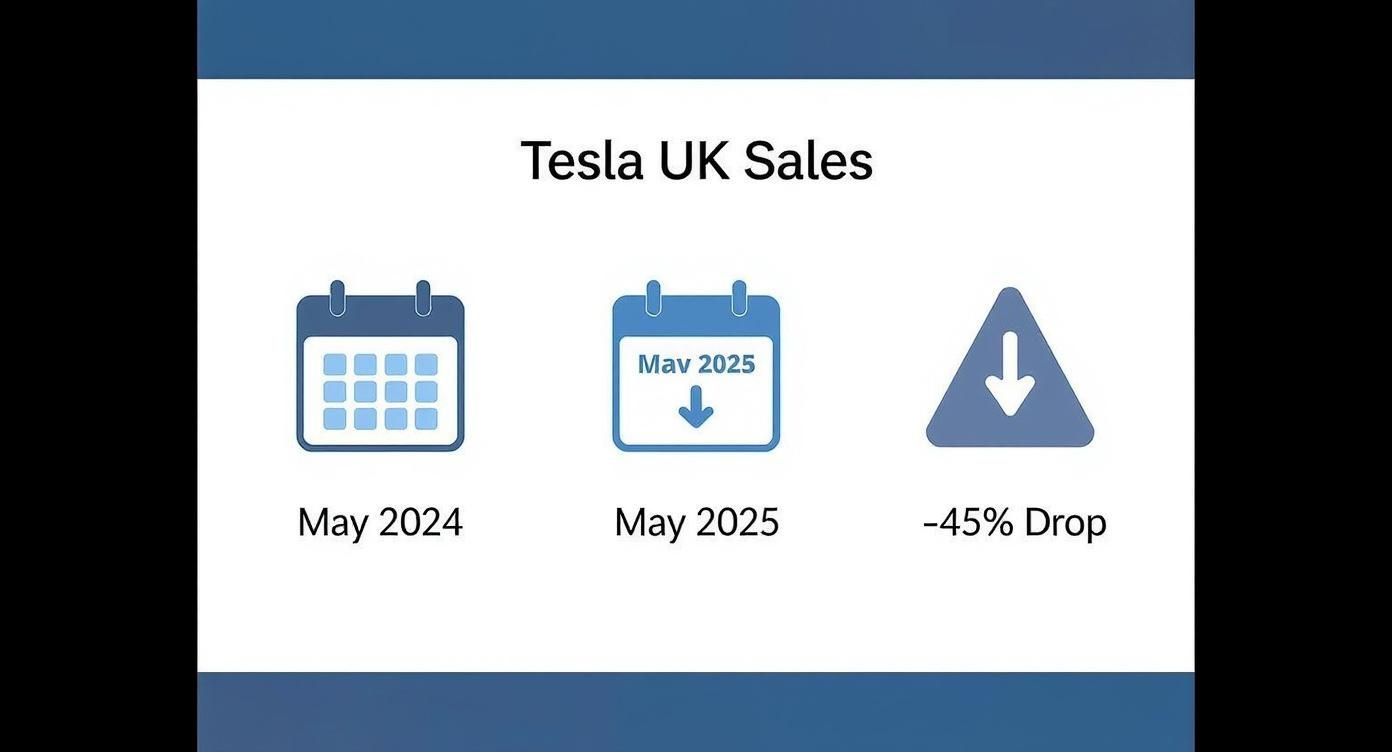
That 45% nosedive highlights just how volatile the market can be, rocked by new competitors, pricing strategies, and shifting public perception.
Tesla Model Smackdown: UK Edition
So, which Tesla should you actually consider? Let's cut through the marketing guff and get real. We've put together a no-nonsense look at what each model is really like to live with on British roads.
| Model | Best For | Real-World Range (What Tesla Won't Tell You) | Price Point | The Unvarnished Verdict |
|---|---|---|---|---|
| Model 3 | The company car hero, city dwellers, and anyone who still enjoys driving. | Expect 230-280 miles on a good day. Forget the official 300+ unless you drive at 50mph everywhere. | ££ | The sharpest handler of the lot. Agile, quick, and feels like a proper driver's car. Its saloon boot is a pain for bigger loads, though. |
| Model Y | Families, IKEA addicts, and anyone who's given up on sports car dreams for practicality. | About 220-270 miles . It’s bigger and blunter than the 3, so physics takes its toll. | £££ | It’s a Model 3 on stilts with a massive boot. Less fun to drive, but infinitely more practical for daily life. The UK’s best-selling EV for a reason. |
| Model S | Lottery winners and execs who want to silently smoke supercars at the lights. | A solid 300-350 miles . It has a huge battery, so it's a brilliant motorway cruiser. | £££££ | Ludicrously fast and dripping with tech, but it feels enormous on a B-road and the price is eye-watering. A statement piece. |
| Model X | Big families with a flair for the dramatic and a very wide driveway. | Around 270-320 miles . Those giant doors and sheer bulk mean it drinks electrons. | £££££ | The Falcon Wing doors are a party trick that never gets old (until they break). It's a seven-seat spaceship, but it’s utterly impractical for most UK towns. |
At the end of the day, the Model 3 and Y are the sensible choices for 99% of UK buyers. They hit the sweet spot of price, range, and practicality. The S and X are incredible machines, but they feel like they were designed for wide American highways, not the Sainsbury's car park.
Ultimately, the choice between new and nearly new comes down to your tolerance for risk versus your desire for a discount. A brand-new Tesla offers peace of mind, while a nearly new one offers better value – if you find a good one. Whichever path you choose, go in with your eyes wide open.
Getting Your Order In and Sorting the Finances
Welcome to the future of buying a car. Forget the stuffy dealership, the awkward small talk, and the lukewarm coffee. Buying a Tesla is a uniquely digital experience, often done from the comfort of your sofa with a credit card sitting dangerously close by.
There’s no haggling and no one trying to sell you dubious paint protection. It’s just you and the Tesla configurator – a minimalist and dangerously simple tool for spending a serious amount of money. The whole process is so slick you might accidentally order a top-spec model while waiting for the kettle to boil.
How to Navigate the Online Configurator Without Remortgaging
First up is the online configurator. It’s designed to be seductive, leading you down a path of tempting, wallet-busting options. Your mission, should you choose to accept it, is to emerge with a car that makes sense for you, not one that gives you a financial hangover.
This is where you need to keep your wits about you:
- Colour and Wheels: Tesla, in its infinite wisdom, usually makes one of the less exciting colours the free option. Fancy something with a bit more pop? That’ll be £1,300 , please. The same logic applies to the wheels; the standard ones are perfectly good, but those sexier, larger alloys will cost you range, ride comfort, and a couple of grand.
- The Tow Hitch Conundrum: Trust me on this one. Adding a tow hitch later is a massive, expensive faff. If you even think you might one day need to tow a tiny trailer to the tip, spend the £1,090 now. You’ll thank us later.
The biggest trap, however, is the one labelled "Full Self-Driving Capability."
Demystifying Autopilot and Its Fantastical Promises
Tesla’s driver-assist features are a minefield of confusing names and frankly ambitious claims. Let's break them down into plain English for a rainy Tuesday on the M25.
Standard Autopilot
This comes included on every car. It's essentially very good adaptive cruise control with lane-keeping. It’s absolutely brilliant in stop-start traffic, saving your sanity and your left leg.
Enhanced Autopilot (£3,400)
This option adds a few party tricks to the mix. It can change lanes for you on the motorway, navigate motorway junctions, and even park itself (though it can be a bit clumsy). It’s a definite nice-to-have, but you can live without it.
Full Self-Driving Capability (£6,800)
Right, this is the big one. For the price of a decent used hatchback, you get… a promise. Here in the UK, it currently does very little more than Enhanced Autopilot. You’re essentially paying for a software update that might, one day, in the distant future, allow your car to drive itself. It’s a massive gamble on a timeline that keeps shifting.
Our advice? Stick with Standard Autopilot. If you’re feeling flush, Enhanced Autopilot adds some genuine convenience. But avoid Full Self-Driving unless you have money to burn and an almost religious faith in Elon Musk's timelines. It's a feature you'll rarely use for a price you'll always feel.
Paying the Piper: UK Financing and Tax Perks
Once you’ve built your dream machine, it’s time to figure out how to pay for it. Most people don’t rock up with a briefcase full of cash, so you’ll probably be looking at finance.
Tesla offers two main routes:
- Personal Contract Purchase (PCP): This gives you lower monthly payments, but you won’t own the car at the end of the agreement unless you make a hefty "balloon" payment. It’s basically a long-term rental, which is ideal if you like swapping into a new car every few years.
- Hire Purchase (HP): With this, you’ll have higher monthly payments, but at the end of the term, the car is all yours. It's simple, traditional, and you actually own a valuable asset at the end.
For a much deeper dive into the world of car finance, you should check out our guide on the 7 best UK electric car finance deals that won’t leave you skint. It breaks down all the pros and cons in excruciating detail.
Now, if you're a company car driver, listen up. This is where a Tesla becomes an absolute no-brainer. The Benefit-in-Kind (BIK) tax rate for electric cars is currently a laughable 2% . This means you’ll pay a tiny fraction in company car tax compared to a petrol or diesel equivalent, potentially saving you thousands of pounds a year.
Finally, a word on your trade-in. Tesla will give you a quote for your old car, but frankly, it’s often insultingly low. Always get competing quotes from places like Motorway or WeBuyAnyCar.com first. You can almost always get a much better price by selling privately or to a third-party buyer, giving you more cash to put towards your shiny new EV.
Preparing for Arrival: Home Charging and Other Admin
So, your Tesla is on a boat, making its slow, majestic journey across the ocean. While you’re manically refreshing the app for shipping updates, don’t be fooled into thinking your work is done.
Welcome to the decidedly unglamorous but utterly essential preparation phase. Get this right, and you'll waft into the EV lifestyle with smug satisfaction. Get it wrong, and you'll be the one desperately trying to find a working charger at the grimmest motorway services imaginable.
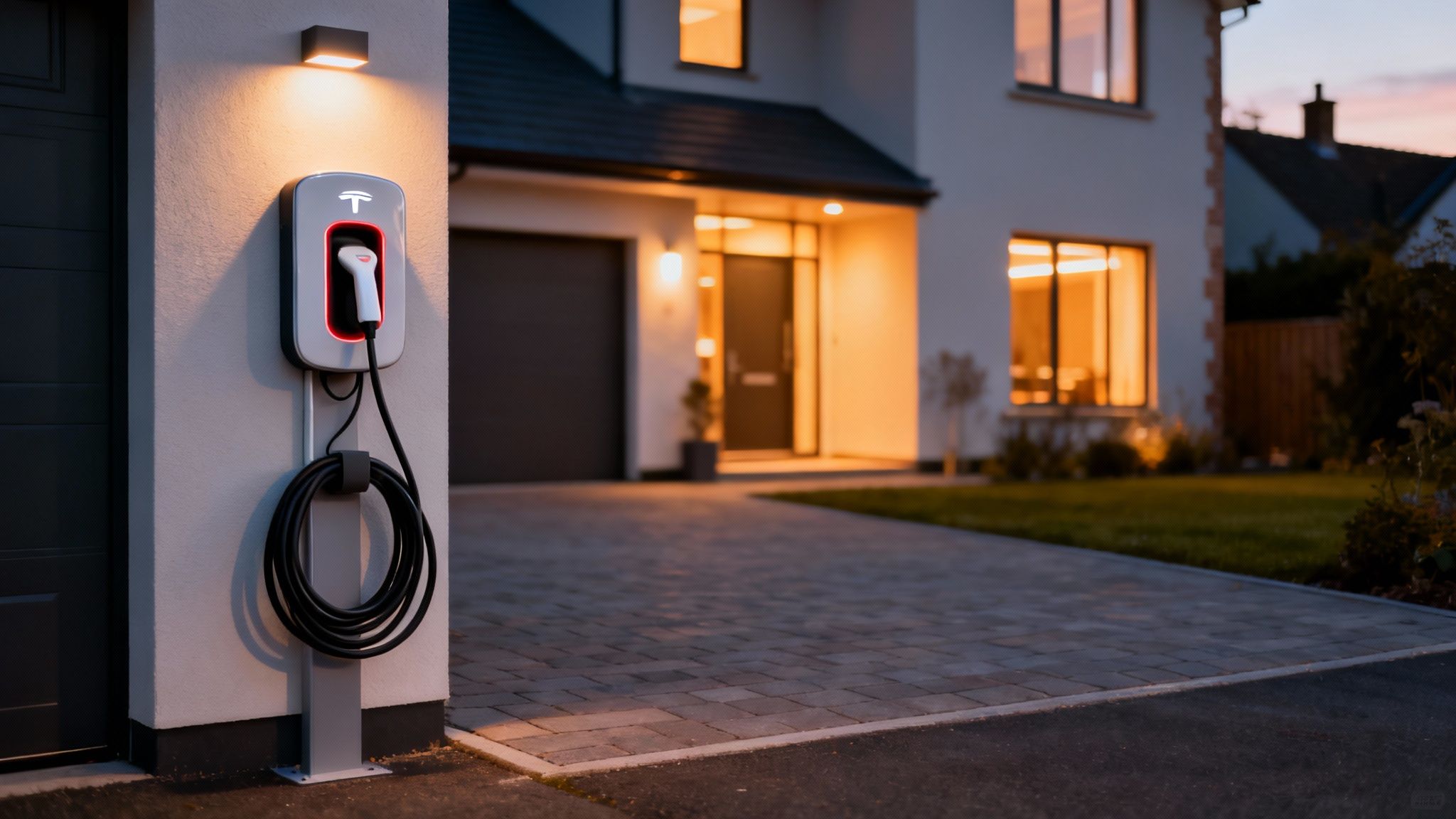
First on the docket is the big one: home charging. This single decision will define your day-to-day experience.
While you can technically survive by dangling a cable out of your kitchen window to a standard three-pin socket, this is the EV equivalent of living on Pot Noodles. It’s a slow, miserable existence, adding only about 4-5 miles of range per hour . It’s fine in a pinch, but as a long-term strategy, it’s frankly pathetic.
Sorting Your Home Charger Installation
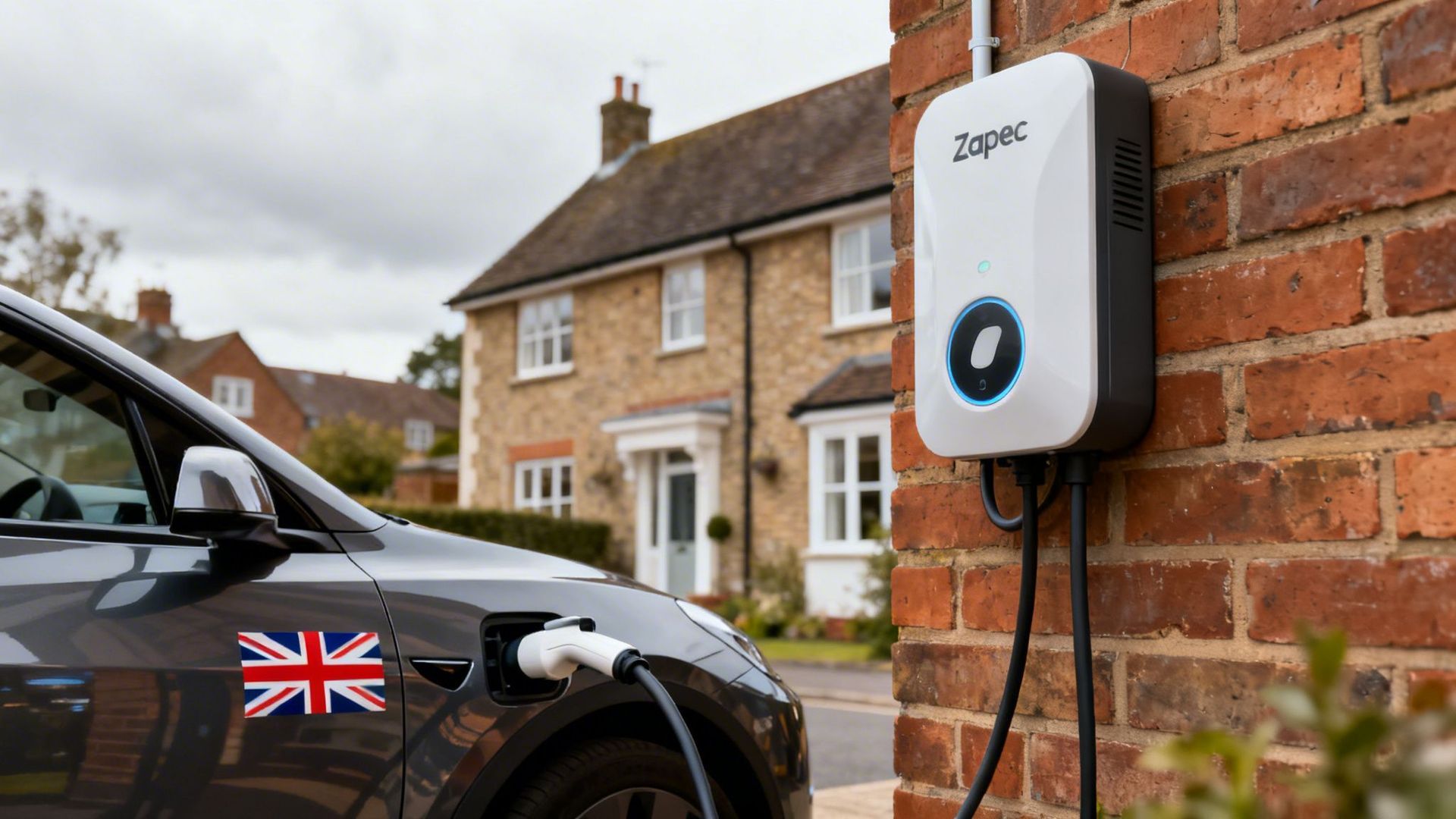
The smart move is a dedicated wall charger. A proper 7kW unit will comfortably give you a full charge overnight, turning your driveway into your personal petrol station. This is the dream.
You have two main choices here:
- Tesla’s Own Wall Connector: It’s sleek, minimalist, and has a handy button on the handle to open your charge port. It looks the part and works flawlessly with the car.
- Third-Party Chargers: Brands like Pod Point, Andersen, and Ohme offer chargers with more advanced features, such as smart scheduling to take advantage of cheaper overnight electricity tariffs and solar integration.
Finding a good electrician is your next mission. Don’t just get your mate Dave who’s handy with a socket set. You need a certified professional with specific EV charger installation experience. The process can be a minefield of confusing regulations and potential issues with your home’s main fuse.
For a proper walkthrough, read our guide to home EV charger installation so you don’t be a muppet — it covers the nitty-gritty in painful detail.
The Bureaucracy of Insurance and Running Costs
With charging sorted, it’s time to face the delightful world of admin, starting with insurance. Brace yourself. Some mainstream insurers still hear the word 'Tesla' and imagine you’ll be attempting to launch it into orbit. Premiums can be punchy, thanks to their blistering performance and specialist repair costs.
It’s crucial to shop around using comparison sites, but also get direct quotes from specialists like Direct Line or Admiral, who have more experience with EVs. Be prepared for a higher quote than you’re used to, especially for performance models.
The good news? While insurance might sting, other running costs are laughably low. For now, pure electric vehicles pay precisely £0 in Vehicle Excise Duty (VED), though the government plans to spoil that party from 2025. Still, compared to the hundreds you’d pay for a petrol equivalent, it’s a massive saving.
Let’s put this into perspective with a rough, back-of-a-napkin comparison to see how the numbers really stack up.
Real-World UK Running Costs: Tesla vs Petrol Car
This table lays it bare. We're looking at a Tesla Model Y against a similarly-sized petrol SUV to give you a feel for the real-world savings.
| Cost Item | Tesla Model Y (Annual Estimate) | Comparable Petrol SUV (Annual Estimate) | Notes |
|---|---|---|---|
| Fuel/Charging | £600 | £2,200 | Based on 10,000 miles/year. Assumes mostly overnight home charging at 15p/kWh vs petrol at £1.50/litre . |
| VED/Road Tax | £0 (for now) | £190+ | A huge saving for EV drivers, though this is set to change from 2025. |
| Maintenance | £150 | £400 | EVs have far fewer moving parts. Think tyres, brakes, and cabin filters, not oil changes and exhaust systems. |
| Insurance | £900 | £650 | This is the one area where the Tesla will likely cost you more. Quotes can vary wildly. |
| Total (Approx.) | £1,650 | £3,440 | Even with higher insurance, the EV comes out massively ahead. |
Even with a potentially heftier insurance premium, the day-to-day savings on fuel and tax are enormous.
Getting your head around these figures is a key part of buying a Tesla; it helps justify the initial purchase price when you see how much you’ll save in the long run. Sorting this admin before the car arrives means you can simply jump in and drive on delivery day, feeling unbearably smug.
Mastering the Delivery Day Inspection
The day has finally arrived. Your phone has pinged, the finances are sorted, and your brand-new Tesla is waiting for you. It's a genuinely exciting moment, the end of weeks of waiting and endlessly refreshing the app. In the minimalist calm of the delivery centre, it’s so easy to get caught up in the moment, tap 'accept' on the screen, and drive off into the sunset.
Resist that urge.
Now is not the time for giddy excitement. Now is the time for a cold, hard, and frankly forensic-level inspection. Tesla's build quality, to put it politely, can be a bit of a lottery. Think of this not as a handover, but as your one and only chance to play the role of a deeply unimpressed quality control inspector from a rival German car brand. Whatever you do, don't skip this step.
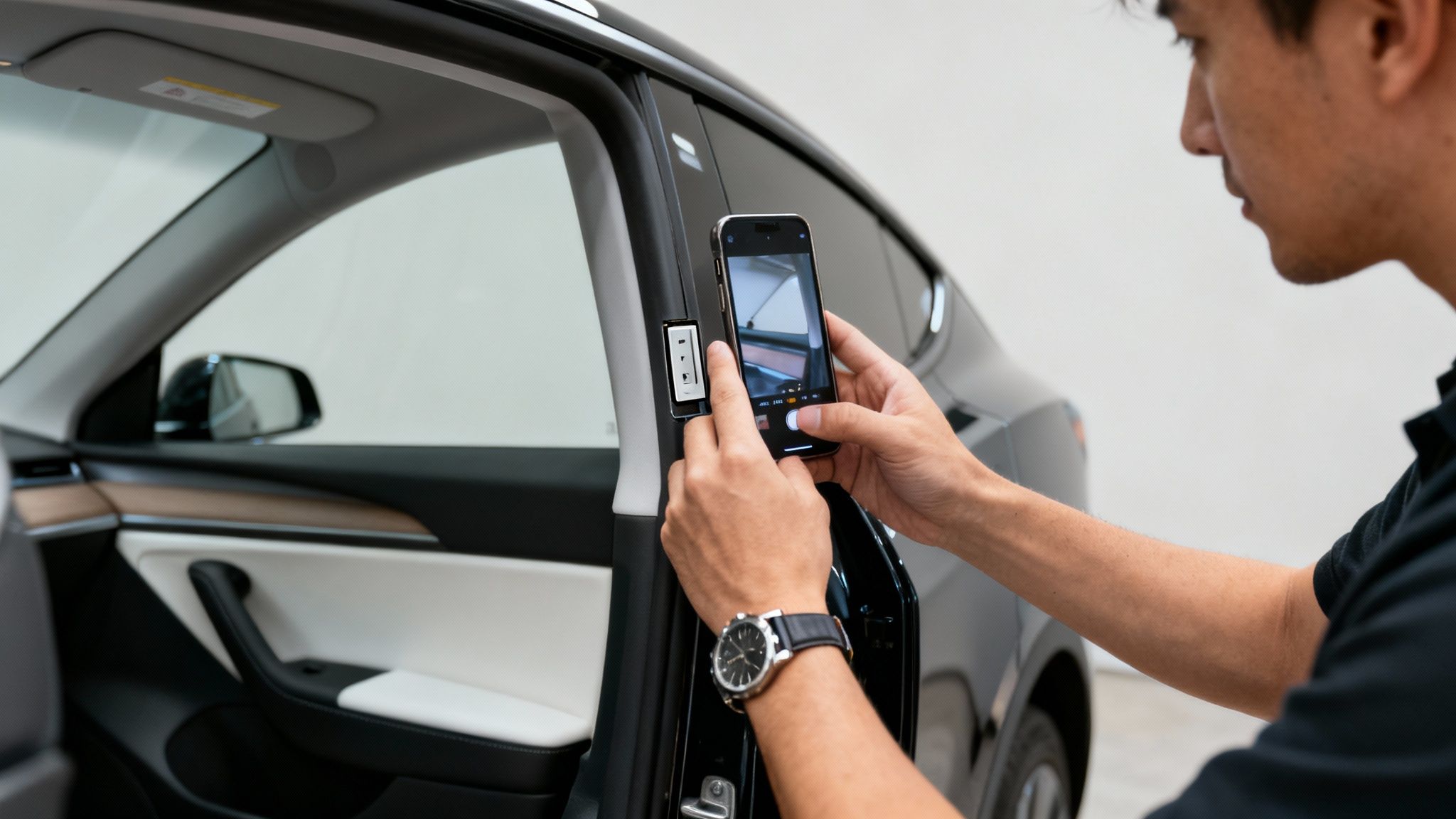
Your Pre-Flight Checklist
Before you even lay a hand on the car, get prepared. You’ll need your phone (with plenty of battery for photos and the app), a bright torch for spotting paint swirls (the one on your phone will do in a pinch, but a proper one is better), and a healthy dose of scepticism.
Crucially, download a comprehensive Tesla delivery checklist from a UK owners' club or forum. These guides are gold, built from the shared experience of thousands of owners who have been through this exact process.
When you arrive, don't let the delivery staff rush you. Politely but firmly let them know you’ll be taking your time to inspect the car properly. If they seem put out, that's their problem. This is a massive purchase, not a click-and-collect from Argos.
The Great Outdoors Inspection
Right, let's get to it. Your first job is to walk around the car like a hawk circling its prey, preferably in bright, natural light. This is where you’ll spot the most common and frustrating issues that can plague new Teslas.
What to look for:
- Panel Gaps from Hell: This is the big one. Check the consistency of the gaps between every single panel – bonnet, boot, doors, and wings. Are they even? You're not looking for millimetre-perfect precision, but you should instantly spot a gap wide enough to lose a tenner in.
- Paint and Finish: Get your torch out. Shine it at an angle across every panel and look for scratches, swirl marks, "orange peel" texture, or tiny dust nibs trapped under the clear coat. Also, check for mismatched paint shades between plastic bumpers and metal panels.
- Lights and Glass: Inspect all light clusters for any signs of condensation or cracks. Go over every inch of the glass, especially the huge windscreen and roof, looking for chips or distortions. Make sure the front windows have the "double-paned" acoustic glass fitted – it's a small detail that makes a big difference.
Key takeaway: Photograph everything. Any defect, no matter how small, must be documented with a clear picture. This is your evidence. If it’s not logged before you leave, Tesla can (and often will) argue that you caused the damage yourself.
Diving into the Interior
Once you're satisfied with the outside (or have a list of grievances), it’s time to get inside. The minimalist cabin is a real highlight, but its simplicity means there are fewer places for shoddy workmanship to hide.
Key interior checks:
- Seats and Upholstery: Inspect every stitch. Look for creases, scuffs, stains, or loose threads on the vegan leather. Test all the seat adjustments, including the heating and ventilation functions.
- Trim and Dash: Run your hands over the dashboard trim, door cards, and centre console. Does anything feel loose, rattle, or look misaligned? Check the headliner for any marks or sagging.
- Functionality Test: This is absolutely critical. Test every single button, switch, and function. Windows, wipers, indicators, speakers (play some music!), USB ports, and the wireless phone chargers. Check that both key cards work and that your phone pairs correctly as a key.
The Final Showdown: What to Do with Your Snagging List
So, you have your list of issues and your photographic proof. What now? You must report every single defect to the Tesla staff before you accept delivery . The proper way to do this is right there in the Tesla app.
Create a new service request and upload all your photos with clear, simple descriptions of each problem. Show this to the staff on-site. For minor things like a paint scuff or a piece of loose trim, they might be able to sort it for you there and then. For bigger problems, like a wonky door, they will book the car into their service centre.
Only when every single issue is logged in the app should you formally accept the car. Accepting delivery doesn't mean you accept the faults; it means you accept the car on the condition that the documented faults will be rectified under warranty. Driving off without logging these issues is the single biggest mistake you can make. Be vigilant, be thorough, and don't be afraid to be that picky customer.
Your Burning Tesla Questions Answered
So, you’ve made it this far. That tells me you’re either genuinely serious about buying a Tesla or you just enjoy reading long, detailed car guides. Either way, you've probably got a few questions buzzing around your head—the kind that surface late at night when you’re wondering if this is a brilliant financial move or a catastrophically expensive mistake.
Let's get into some of the most common ones with the straight-talking answers they deserve.
Do I Really Need the Performance Model?
In a word? No. Absolutely not.
Let's be brutally honest here: even the most basic, entry-level Tesla is quicker off the line than almost anything you'll encounter at the traffic lights. The standard models have more than enough acceleration to rearrange your internal organs and draw a nervous laugh from your passengers.
Going for the Performance version is pure, unadulterated automotive theatre. It’s for those who want to out-accelerate supercars on their way to pick up a pint of milk. While it’s undoubtedly immense fun, it’s about as useful as a chocolate teapot on the M4 during rush hour. Unless you have a pathological need for bragging rights, save your money.
What About the Infamous ‘Elon Factor’?
Ah, yes. The elephant in the room. Buying a Tesla used to feel like a straightforward vote for a greener future. For some people, it’s a bit more complicated now. The company's figurehead has become… well, a polarising character.
You’ll find a vocal group of owners who are deeply uncomfortable with the boss’s public antics. It’s even spawned a strange subculture, with some jokingly calling it "virtue-signalling" when they explain their purchase. It's not unheard of to see bumper stickers that read, "I bought this before Elon went crazy."
Ultimately, this is a personal one. You have to decide if you can separate the car from its creator. Is the product itself good enough to overlook the personality behind it? Only you can answer that, but it's become an undeniable part of the Tesla ownership experience.
Will My Electricity Bill Go Through the Roof?
This is a fair concern, but the answer is a resounding 'no'—as long as you're smart about it. The key is to avoid relying on expensive public rapid chargers for your daily driving. Instead, do the vast majority of your charging at home, overnight.
If you can get onto a cheap overnight electricity tariff (some energy providers offer rates as low as 7.5p per kilowatt-hour ), fully charging a Model Y could cost you less than a fancy coffee. When you compare that to forking out £80-£100 to fill a petrol tank, the maths becomes blindingly obvious.
Will the Battery Degrade and Become Useless?
In short, no. Battery degradation is a real phenomenon, but it’s far less dramatic than the scare stories suggest. Modern EV batteries are incredibly robust. You might lose a small percentage of capacity in the first couple of years, but after that, the rate of decline slows down significantly.
Tesla's battery warranty has you covered for 8 years or up to 120,000 miles , guaranteeing it will keep at least 70% of its original capacity. In reality, most cars do much better. Plenty of decade-old models are still running strong with over 90% of their original range. It’s simply not the ticking time bomb many people fear.
Ready to dive deeper into the world of electric cars, with a healthy side of sarcasm? At VoltsMonster , we cut through the noise to bring you brutally honest reviews, practical guides, and the latest UK EV news. Find your next electric obsession, or just have a laugh at our expense.
Explore our latest articles and reviews at https://www.voltsmonster.com.
VoltsMonster Electric Vehicle Blog