Mercedes EQC Range: The Grim, Real-World UK Truth
Let's get one thing straight: the range figure you see in a glossy car brochure is pure, unadulterated fantasy. For the Mercedes EQC, the official number is up to 255 miles , but that’s achieved in a hermetically sealed lab by people in white coats—a world away from a wet Tuesday morning on the M25. Think of that number as a theoretical maximum, like a politician's promise. Nice idea, but don't bank on it.
Ditching The Brochure For Reality
Car manufacturers are always desperate to shout about big, impressive range figures, and Mercedes is no different. That headline 255-mile number comes from a test called the Worldwide Harmonised Light Vehicle Test Procedure (WLTP). It's a standardised process, but it’s a bit like a student who only revises the questions they know will be on the exam. It’s technically accurate, but it tells you sod all about a proper British journey.
The moment an EQC's tyres meet actual British tarmac, that number starts to plummet. This isn't really a flaw in the car itself; it's just the hard reality of physics giving marketing spin a swift kick in the testimonials. What you'll actually get depends less on lab coats and spreadsheets and more on factors like:
- The outside temperature (batteries hate the cold more than a cat hates water).
- Your driving environment – are you crawling through city traffic or gunning it on the motorway?
- Your driving style – are you a smooth operator or do you drive like your hair's on fire?
- The weight you're carrying, from passengers to that flat-pack wardrobe you've been meaning to build.
The Real-World Numbers
So, what should you really expect? When the EQC rocked up in the UK back in 2019, it was a seriously plush and desirable first stab at a premium EV. However, real-world tests quickly exposed the chasm between its advertised potential and what it could deliver day-to-day.
Let's look at how the official figures stack up against what drivers typically experience on our delightful roads.
Mercedes EQC Range: Official Fiction vs. Gritty Reality
| Driving Condition | Official WLTP Range (Claimed) | Typical Real-World UK Range (Estimated) |
|---|---|---|
| Mixed Driving | 255 miles | ~200-220 miles |
| City Driving | Not specified | ~230 miles |
| Motorway (70mph) | Not specified | ~170-190 miles |
As you can see, the difference is rather significant. According to detailed UK-based reviews, a more realistic mixed-driving range is closer to 200 miles , not 255. While that was perfectly respectable when it launched, it put the EQC in a slightly awkward spot against some very capable rivals. You can get more insights into how the EQC stacked up against competitors on Carwow.co.uk.
The gulf between the official WLTP figure and what you'll see on the dashboard is the single biggest cause of range anxiety. Think of the 255-mile claim as a theoretical maximum, like the top speed of a supercar—fun to know, but you'll rarely, if ever, experience it without a private runway and a death wish.
What Really Smashes Your EQC's Range?
The range figure in a brochure is like a dating profile picture – a heavily curated version of reality achieved under perfect lighting. In the real world, your EQC's actual mileage is a moving target, influenced by dozens of factors from one day to the next.
Think of the battery's charge not as a fixed number, but as a budget. The official range is your starting balance, but every driving decision you make is a withdrawal. Understanding what makes the biggest withdrawals is the key to mastering your EQC and keeping that cold sweat of range anxiety at bay.
This chart shows the journey from that on-paper promise to what you're more likely to see on UK roads.
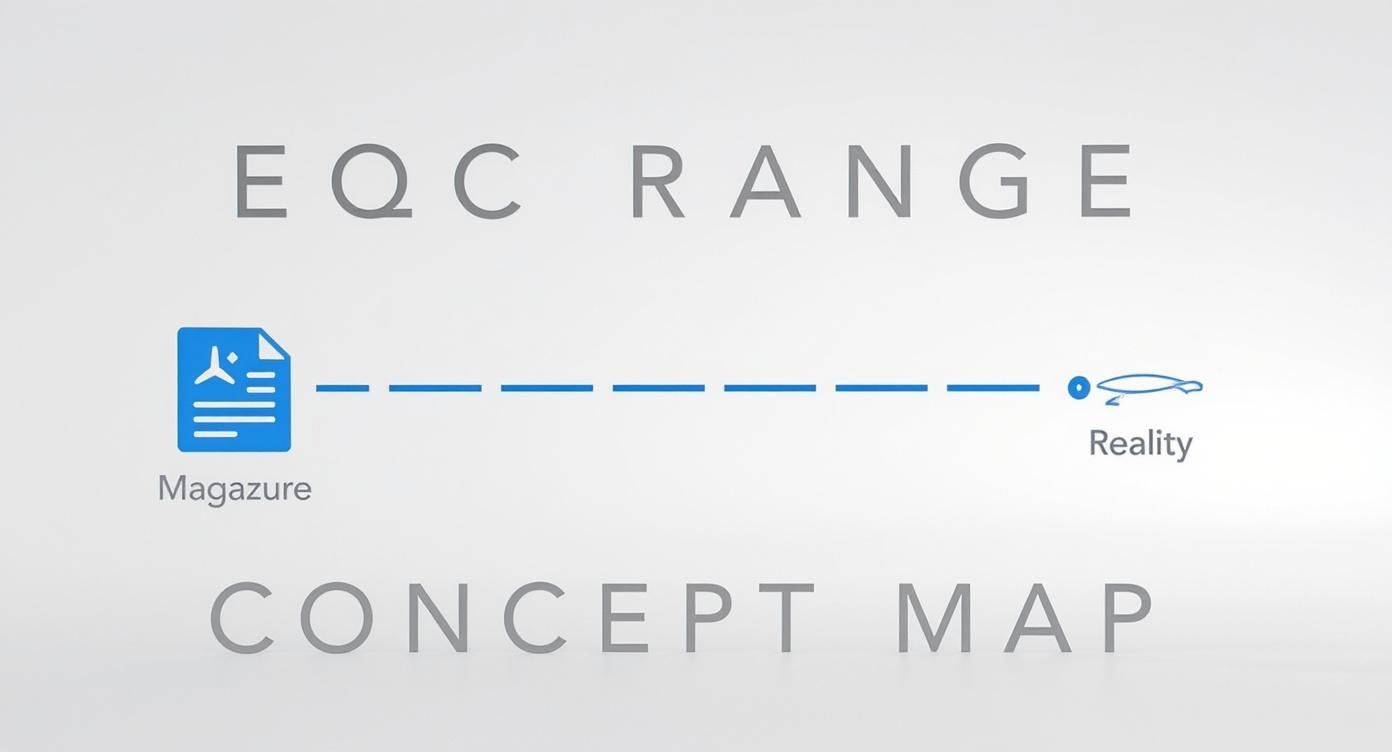
As you can see, reality has a way of mugging the official numbers in a dark alley. Let's look at the main culprits.
The Big Three Range Robbers
While plenty of things can kneecap your range, three factors do the most damage. Get a handle on these, and you've won half the battle.
-
Speed: The Energy Guzzler. There’s no getting around physics, I'm afraid. Pushing a hefty 2.5-tonne SUV through the air takes a huge amount of energy, and the faster you go, the more energy it drinks. It’s not a straight line; the energy required increases exponentially. The jump from 60 to 70 mph on the motorway will cost you far more in range than cruising from 40 to 50 mph. This is why a motorway dash can easily shrink a potential 200-mile range down to 170 miles or even less.
-
Temperature: The Cold Shoulder. Batteries are a bit like humans – they have a preferred temperature range and get awfully grumpy when it's chilly. On a freezing British morning, the battery chemistry is sluggish and less efficient. Just getting the battery to its happy operating temperature uses up energy before you’ve even pulled off the drive. Then you turn on the heating, the demisters, and the heated seats, and you can literally watch the range estimate drop like a stone. A cold snap can easily rob you of 20-30% of your available summer range.
-
Terrain: The Uphill Battle. Driving up a steep hill requires a massive, sustained burst of power. While the EQC's regenerative braking does a cracking job of recuperating some of that energy on the way back down, it’s never a 100% return. Think of it like a leaky bucket – you can pour some water back in, but you’ll never get back what you lost. A scenic drive through the Yorkshire Dales will always use more energy than a flat run across Lincolnshire.
The Sneaky Accomplices
Beyond the main three, a whole host of smaller factors are constantly nibbling away at your mileage. Individually, they don't seem like much, but they add up.
If your battery is a monthly budget, high-speed driving is the big, expensive holiday to Barbados. These smaller factors are the daily coffees and subscriptions – they quietly drain your account without you really noticing until you check the balance and let out a small shriek.
Keep an eye out for these other range thieves:
- Driving Style: Jack-rabbit starts and sudden braking are incredibly inefficient. Every time you brake hard, you're wasting momentum that could have been used to coast. A smooth, measured driving style makes a huge difference. Pretend you're chauffeuring a sleeping royal.
- Tyre Pressure: Under-inflated tyres create more drag on the road surface, known as rolling resistance. This forces the motors to work harder just to keep the car moving. It’s a simple check that can save you miles. And it's free. Do it.
- Excess Weight: Remember that junk you've been meaning to clear out of the boot? It's costing you range. The heavier the car, the more energy it takes to accelerate and climb hills.
By understanding how these factors work, you can start making smarter choices. It's not about hypermiling or driving at a crawl everywhere; it's about being aware of how you're 'spending' your energy, so the miles you have are the miles you can actually use.
How to Squeeze Every Last Mile Out of Your EQC
Right then, let's get practical. Complaining about physics and frosty mornings won't get you to your destination, but driving smarter definitely will. This is your guide to coaxing every last bit of juice from your EQC's 80kWh battery, turning you from a nervous range-watcher into a calm, confident EV driver.
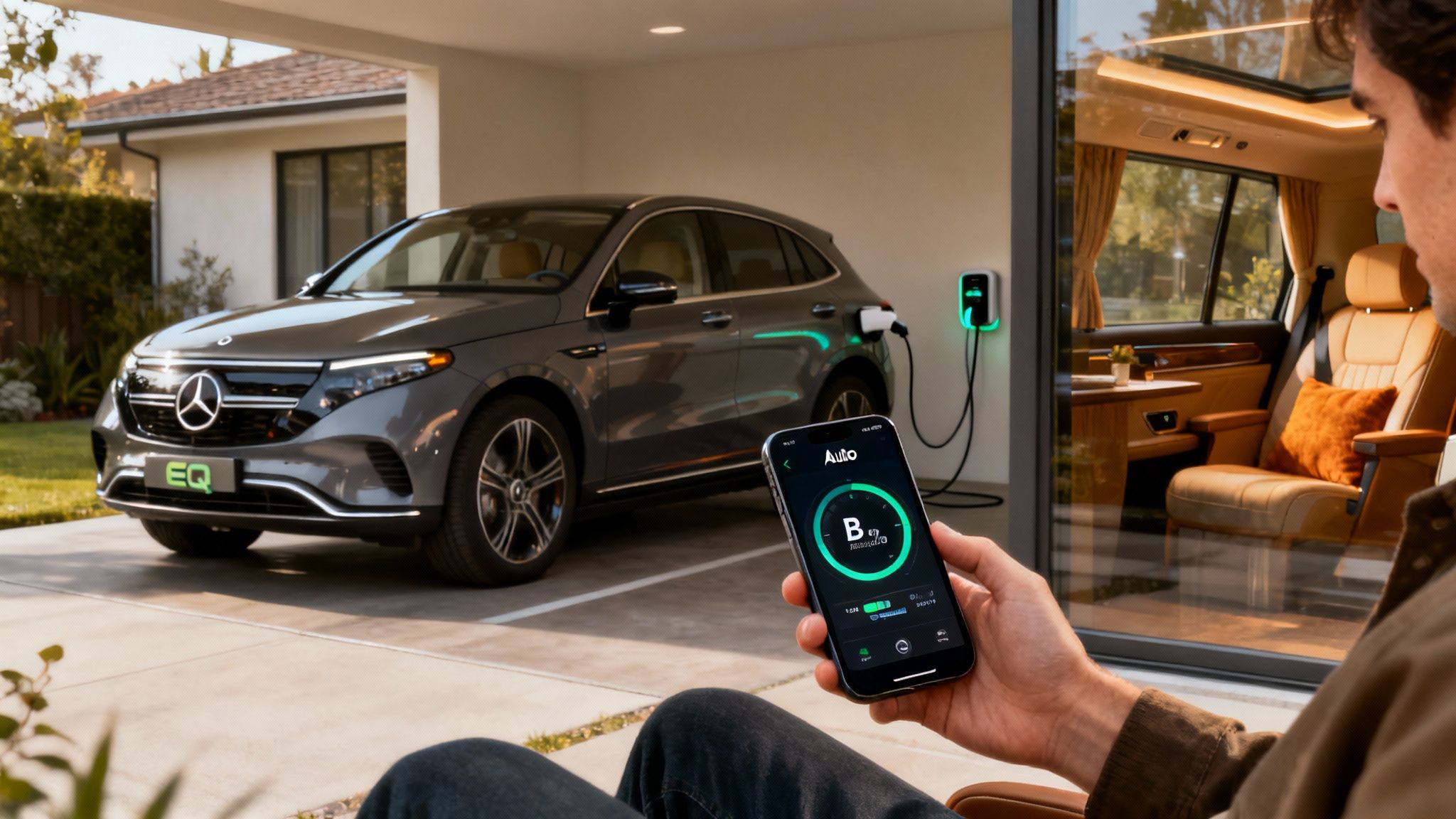
We’re going to move beyond the patronising "just drive slowly" advice. These are the genuine, easy-to-implement tips that will make a real difference to your Mercedes EQC range and stop you breaking out in a cold sweat every time you see a hill.
Master the Art of Preconditioning
This is the single biggest win for winter driving, yet it's criminally underused. Preconditioning is the simple act of warming (or cooling) the cabin and, crucially, the battery while the car is still plugged into your charger. So, why is this so brilliant?
Instead of draining your precious battery to defrost the windscreen and warm your seat, you're using cheaper electricity straight from the grid. You get into a perfectly toasty car with a battery that’s already at its optimal operating temperature. Your range estimate won't have plummeted before you've even left the driveway. It's a total game-changer on a cold morning.
Think of it like this: leaving without preconditioning is like starting a marathon by sprinting the first 400 metres. You’re burning through vital energy for a short-term gain, leaving you knackered for the rest of the journey. Precondition, and you start the race warm, limber, and with a full tank.
Become One with Regenerative Braking
Your right foot is your most important tool for extending range. The EQC has a fantastic regenerative braking system, which flips the electric motor into a generator the moment you lift off the accelerator, feeding energy back into the battery. To make the most of it, you need to shift your mindset.
- Embrace 'B Auto' Mode: Forget messing around with the paddles yourself. The 'B Auto' setting is pure genius, using the car's radar and navigation data to automatically decide the perfect level of regeneration. It will slow you down for junctions, roundabouts, and slower traffic ahead, all while recovering the maximum possible energy. It’s your new best friend for efficient driving. Let the car be the clever one.
- The Fragile Egg Technique: Imagine there's a delicate, unboiled egg sitting under your accelerator pedal. Smooth, gentle inputs are everything. Instead of braking late and hard, learn to anticipate the road ahead. Lift off the pedal early and let the regenerative braking do the work. Every time you have to hit the actual brake pedal, you're just wasting energy as heat.
Small Tweaks That Make a Big Difference
Beyond the main techniques, a few smaller habits can collectively add a surprising number of miles to your real-world Mercedes EQC range.
- Check Your Tyres: It's boring but true. Properly inflated tyres have lower rolling resistance, which means the car needs less energy to move. Just check the pressures once a month – it can easily boost your efficiency by 3-5% .
- Use Heated Seats, Not Cabin Heating: Heating the entire cabin space is incredibly energy-intensive. Heating just your seat and maybe the steering wheel uses a tiny fraction of the power but delivers a similar feeling of warmth where it counts. Toast your bum, not the air.
- Plan Your Route Wisely: If you have the choice, a route with fewer steep hills and more consistent speeds (like A-roads over constant 70 mph motorways) will often give you better range, even if it's slightly longer in distance.
Why Your Charging Habits Are Killing Your Range
How you top up your EQC’s battery is just as important as how you drive it, but it’s a detail many new EV owners overlook. It’s easy to fall into bad habits that slowly chip away at your battery's health, which ultimately reduces the usable range you can rely on. Let’s talk about how to treat that sophisticated battery pack sitting under the floor with a bit of respect.
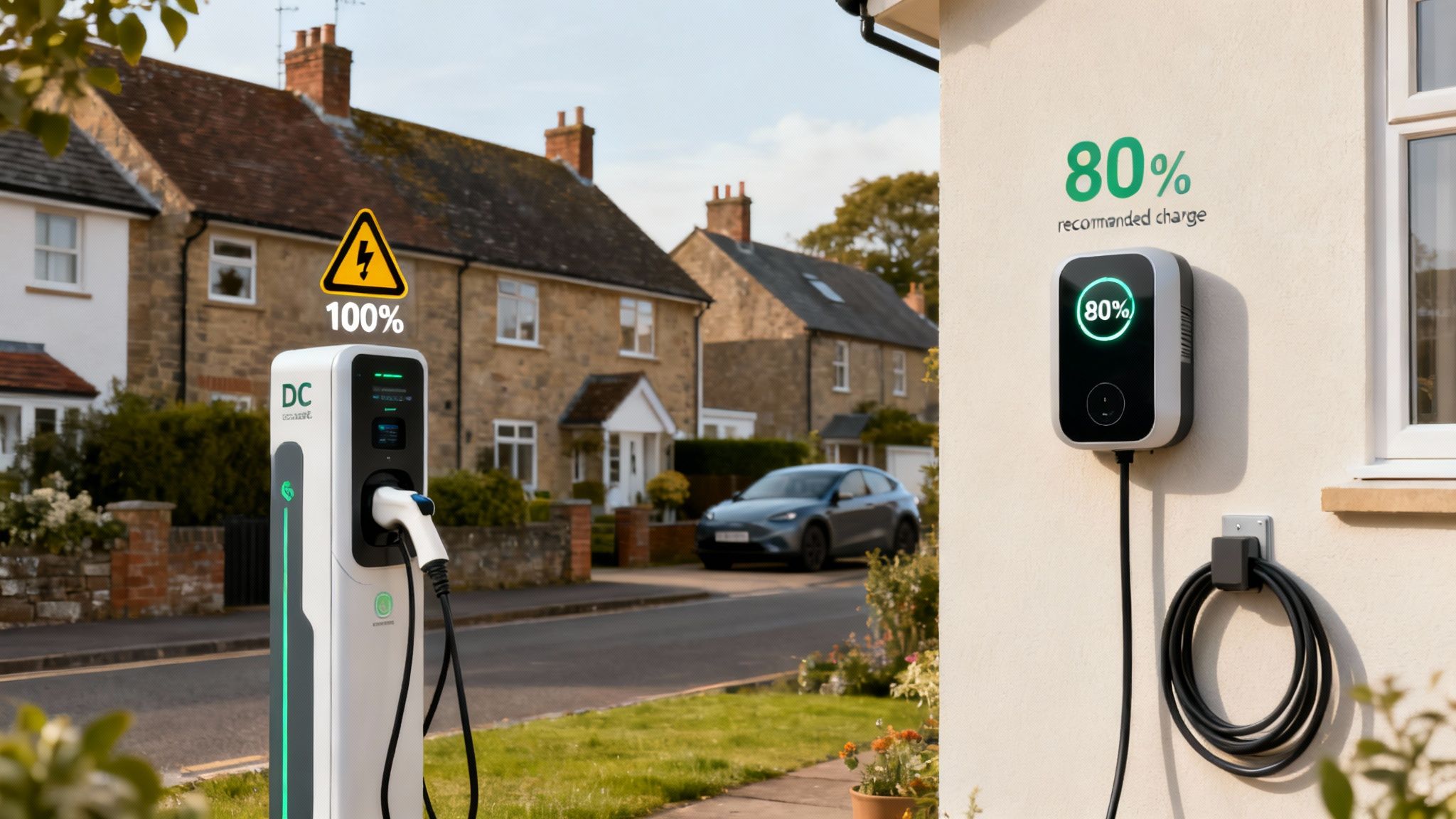
Relying solely on high-speed DC rapid chargers and pushing the battery to 100% every single time is the EV equivalent of only eating deep-fried kebabs. Sure, it’s quick and convenient, but the long-term health consequences aren't great. This kind of charging generates a lot of heat and puts stress on the battery cells, which can speed up their natural degradation over time.
The 80 Percent Sweet Spot
If you want to keep your battery healthy for years to come, get familiar with the golden rule of EV ownership: the 80/20 rule . For your regular day-to-day driving, it's best to charge up to 80% and avoid letting the charge drop below 20% too often. That middle 60% is where the battery is most comfortable and operates under the least amount of strain.
Think of it like a rubber band. You can stretch it to its absolute limit, but if you do that every day, it'll eventually lose its spring and snap. By keeping it in a relaxed, unstretched state most of the time, you ensure it stays in good shape for much longer. Save that full 100% charge for those rare long-distance trips when you really need every last mile.
Your battery's health is a finite resource. Consistently charging to 100% and running it down to zero is like redlining an engine in every gear—it'll work for a while, but you're drastically shortening its lifespan. Don't be that person.
AC vs DC: The Tortoise and The Hare
Developing a smart charging strategy starts with understanding the two main ways to charge your car. They work very differently and are designed for different situations.
- AC Charging (The Tortoise): This is the slow and steady power you get from a home wallbox or a workplace charger. It's much gentler on the battery and produces very little heat. This should be your go-to method for overnight charging, slowly and carefully bringing the battery up to that 80% target.
- DC Charging (The Hare): This is the super-fast rapid charger you'll find at motorway services. It bypasses the car's onboard charger to pump electricity directly into the battery at incredible speeds. It's a lifesaver for a quick boost on a long journey, but it’s best used sparingly, like a shot of tequila.
A sensible routine would see you using AC charging for about 90% of your needs. If you're still deciding on the best setup for you, our guide on whether to invest in a home charger or stick with public networks can help you weigh the pros and cons. Think of DC rapid chargers as a tool for special occasions, not your daily driver. This simple change in habit will do wonders for your battery's condition, helping your EQC deliver a consistent, reliable range for many years.
How the EQC Stacks Up Against Its Posh Rivals
Let's be honest, no one buys a premium electric SUV in a vacuum. You’re not just buying a car; you’re buying bragging rights at the golf club. So, how does the Mercedes EQC’s range measure up when it’s parked next to its natural enemies in the executive EV car park?
We need to forget the brochure fiction for a moment. This is all about which car gets you from London to Manchester on a miserable February morning without inducing a full-blown panic attack.
When the EQC launched, it entered a battlefield already populated by some seriously competent opponents. Its real-world range of around 200-220 miles was respectable at the time, but the game moved on quicker than a toupee in a hurricane.
Let’s see how it actually compares to the other usual suspects on the UK scene.
UK Premium EV SUV Range Showdown
When you're spending this sort of money, every single mile counts. The main rivals for a used EQC in the UK market are typically the original Audi e-tron, the Jaguar I-PACE, and the more modern (and often pricier) BMW iX. Here’s a quick look at how their vital statistics sit side-by-side.
| Model | Official WLTP Range | Estimated UK Real-World Range | Battery Size (Usable) |
|---|---|---|---|
| Mercedes EQC | 255 miles | ~200-220 miles | 80 kWh |
| Audi e-tron 55 | 241 miles | ~190-210 miles | 86.5 kWh |
| Jaguar I-PACE | 292 miles | ~220-240 miles | 84.7 kWh |
| BMW iX xDrive40 | 257 miles | ~230-250 miles | 71 kWh |
As the numbers clearly show, the EQC sits squarely in the middle of this pack of contemporary rivals. It generally pips the original Audi e-tron for real-world efficiency but often falls just a little short of the Jaguar I-PACE, which has long been praised for its surprisingly decent range and engaging drive.
The newer BMW iX, however, really highlights how quickly battery tech has advanced. It manages to squeeze out more miles from a noticeably smaller battery, which is just showing off.
When you're comparing these cars, a difference of 20 miles might not seem huge, but it's the psychological buffer that truly matters. It's the difference between arriving at your destination with a comfortable 15% charge left, or nervously watching the guess-o-meter plummet for the last 30 minutes of your journey while you clench everything.
It's About More Than Just Miles
Of course, range is only one part of the story. The Audi e-tron, for example, boasted faster 150kW rapid charging right from the get-go, which meant less time spent loitering at a grotty service station. The Jaguar I-PACE offers a much sportier, more dynamic driving experience, while the EQC majors on that classic Mercedes comfort and refinement.
Ultimately, the Mercedes EQC's range is perfectly adequate, but it isn’t class-leading. It was a strong first effort from a legacy brand, but it was quickly matched and then surpassed by its key rivals.
For a more detailed look at how these figures play out on British roads, you can check out our comprehensive electric car range comparison for the UK. It’s a battle of inches, and for many drivers, the EQC’s exceptional comfort and badge appeal will be more than enough to compensate for having a few fewer miles in the tank.
Is the EQC Still a Smart Used Buy Today?
So, where does that leave us? Is a used Mercedes EQC a savvy purchase for a UK driver, or just an expensive way to develop a nervous twitch every time you see a hill? It's a classic case of head versus heart.
Let's be blunt: the Mercedes EQC's range is a generation behind the curve. In a world where newer, and often cheaper, EVs can comfortably smash the 250-mile barrier in the real world, the EQC’s reliable 200-mile sweet spot feels a bit dated.
If you’re a sales rep clocking up motorway miles or someone regularly trekking from London to Manchester, this probably isn't the car for you. You'd simply spend too much of your life loitering at service stations, questioning your life choices.
But for a certain type of buyer, it could be a fantastic bargain.
Who Is the EQC Perfect For?
Think about your actual daily driving. If it’s mostly the school run, the weekly big shop at Tesco, and a local commute, the EQC’s range is more than enough. You get all the comfort, luxury, and badge prestige of a proper Mercedes for a fraction of its original price, without ever needing to worry about a public charger.
It truly excels as a supremely comfortable, high-spec local hero.
The EQC is for the driver who values serene comfort over ultimate mileage. It’s for someone who wants a luxurious cabin for their 20-mile commute, not a battery that can cross continents.
Of course, when you're looking at any used EV, the battery's health is paramount. For a proper deep-dive into what you should be looking for, it's worth understanding the truth about battery health reports on used EVs to make sure you're not buying a dud.
Ultimately, if its range fits your lifestyle, a used EQC offers a massive slice of electric luxury for the price of a brand-new, and far less posh, electric car.
A Few Lingering Questions on EQC Range
Still have a few questions about the Mercedes EQC's real-world range? Good. A bit of healthy scepticism is essential when you're looking to spend this kind of money. Let's tackle some of the most common queries that pop up.
What’s the Absolute Worst-Case Range in a British Winter?
Picture the scene. It's a bitter February morning, the mercury is hovering around freezing, and you're barrelling down the M1 with the heater and windscreen wipers going full pelt. In that sort of scenario, you should realistically budget for around 150-170 miles from a full battery.
That’s quite a drop from the official figures, but it’s the reality of winter EV driving. The good news is you can claw a few of those miles back by pre-warming the cabin while the car is still plugged in at home.
Does the EQC’s Range Drop as the Battery Ages?
Yes, but don't let that put you off. All lithium-ion batteries lose some capacity over time – it’s a slow, gradual process, not a sudden cliff-edge drop. To put your mind at ease, Mercedes covers the battery with an 8-year/100,000-mile warranty against any excessive degradation.
By adopting good charging habits, like favouring slower AC charging and avoiding constantly hitting 100% on a rapid charger, you can keep the battery in excellent health for a very long time.
Think of it like a quality leather jacket versus a fast-fashion t-shirt. Look after it properly, and it'll serve you for years. Thrash it, and it won't last nearly as long.
Is the Range Genuinely Enough for Long UK Road Trips?
For the most part, yes, but it does require a little more planning than a diesel equivalent. A journey from London to Manchester is straightforward, but pushing on to Edinburgh would almost certainly mean two charging stops.
The EQC’s peak charging speed of 110kW isn't class-leading anymore, but it's respectable enough. It can still add around 100 miles of range in roughly 30 minutes, which is just about the perfect amount of time for a coffee and a comfort break. With a bit of forethought, long-distance travel is entirely manageable.
At VoltsMonster , we cut through the marketing waffle to give you the real story on EVs. For more brutally honest reviews and practical advice, check out our latest articles at https://www.voltsmonster.com.
VoltsMonster Electric Vehicle Blog