VW ID 3 Review: The Electric Golf We Were Promised? Or Just a Beta Test on Wheels?
So, what's the verdict on the Volkswagen ID.3 in a nutshell? It’s a solid, practical electric family car that mostly delivers on the promise of being the electric Golf. Early software issues definitely soured its debut, but a steady stream of updates and a recent facelift have ironed out most of the wrinkles, making it a bloody strong contender for UK buyers.
Is The VW ID.3 Really The Electric Golf We Were Promised?
When Volkswagen first pulled the covers off the ID.3, their message couldn't have been clearer. This wasn't just another EV; this was the people's electric car, the natural heir to the Beetle and the Golf, built to make battery power mainstream. They were essentially promising a revolution wrapped up in a sensible, five-door hatchback.
The initial hype was huge. It had a dedicated electric platform (the now widely used MEB), rear-wheel drive for nimble handling, and a spacious, minimalist interior that felt genuinely futuristic. The idea was simple: this was the car that would make you trade in your petrol Golf without a moment's hesitation. For many, it did just that. For others, the reality was a bit more… glitchy.
The Elephant In The Room
Let's get it out of the way: the first ID.3s were famously buggy. The infotainment system, which is your command centre for everything from the sat-nav to the heating, was notoriously slow. Think slower than a dial-up modem connecting you to AOL. It was laggy, would often crash, and the touch-sensitive sliders for volume and temperature were a masterclass in how to infuriate a driver. For a brand famous for its bulletproof, intuitive interiors, it was a major misstep.
These software woes really took the shine off what was, fundamentally, a very good car. That early stumble created a golden opportunity for rivals like the Tesla Model 3 and the upstart MG4 to swoop in and steal some of the limelight.
The real shame was that beneath the digital drama, there was a brilliant piece of engineering. The car drove beautifully, the cabin felt airy and spacious, and the running costs were low – all the key ingredients for a great electric family runabout.
The Comeback Kid
Thankfully, Volkswagen got the message loud and clear. A series of over-the-air software updates and a major facelift in 2023 have systematically improved the ID.3. The infotainment is now much quicker and more reliable, and the cabin has been given a welcome lift in quality, swapping out some of the original hard, scratchy plastics for much nicer materials.
These changes have really turned things around. The ID.3 now feels much closer to the polished, complete package it should have been from day one. It’s finally shaken off that 'work-in-progress' feel and has matured into a top-tier choice. Throughout this comprehensive review, we'll dig into whether these improvements are enough to see off the fierce competition and finally establish it as Britain's true electric people's car.
Decoding The ID.3 Trims: Which One Should You Actually Buy?
Trying to figure out Volkswagen’s ID.3 trim structure can feel like a cruel IQ test. The names are vague, the options are confusing, and it seems designed to nudge you into spending more than you planned. Let’s cut through the marketing fluff and get straight to what matters.
Thankfully, for UK buyers, the choice has been simplified. It really boils down to two main flavours you need to care about: the Pro and the Pro S . Forget the rest for a moment. The real difference isn't the fancy alloy wheels or the ambient lighting colours; it’s what’s under the floor.
Pro vs. Pro S: The Battery Battle
The ID.3 Pro is the sensible one. It's the bread-and-butter model that will suit most people down to the ground. It comes with a 58kWh (usable) battery, which is your perfect daily driver for the school run, the weekly shop, and the commute into town. It’s more than enough for the vast majority of journeys most British families make.
The ID.3 Pro S, on the other hand, is the long-distance champion. It packs a much larger 77kWh battery. This is the one you choose if your weekends regularly involve a long trek up the M6 to see the in-laws or an ambitious bank holiday road trip to Cornwall. It gives you more range, but it also costs more and adds a bit of weight.
So, which is right for you? It's a classic case of head versus heart—or more accurately, bladder capacity versus bank balance.
- ID.3 Pro (58kWh): The smart choice for urban and suburban life. It’s cheaper, slightly more nimble thanks to less weight, and still offers a perfectly respectable real-world range that covers most needs without inducing panic.
- ID.3 Pro S (77kWh): The go-to for high-mileage drivers. If you frequently tackle long motorway journeys and the thought of stopping to charge fills you with dread, the extra range provides a valuable psychological safety net.
The decision is less about which car is "better" and more about honestly assessing your own driving habits. Paying thousands extra for a bigger battery you'll only use to its full potential twice a year is like buying a deep-sea diving watch just to wear in the shower.
To help you decide, we've put together a simple table comparing the key specs at a glance.
UK Volkswagen ID 3 Trim Comparison At A Glance
| Feature | ID.3 Pro (58kWh) | ID.3 Pro S (77kWh) |
|---|---|---|
| Usable Battery Size | 58 kWh | 77 kWh |
| Official WLTP Range | Up to 269 miles | Up to 347 miles |
| Motor Power | 204 PS | 204 PS |
| 0-62 mph | 7.4 seconds | 7.9 seconds |
| Max DC Charging | 120 kW | 170 kW |
| Ideal For | Daily driving, commuting | Long-distance, motorway miles |
As you can see, the Pro S offers a significant jump in range and charging speed, but it comes with a slight penalty on acceleration due to the heavier battery.
This simple flowchart helps visualise the core decision for any potential EV buyer, not just those looking at an ID.3.
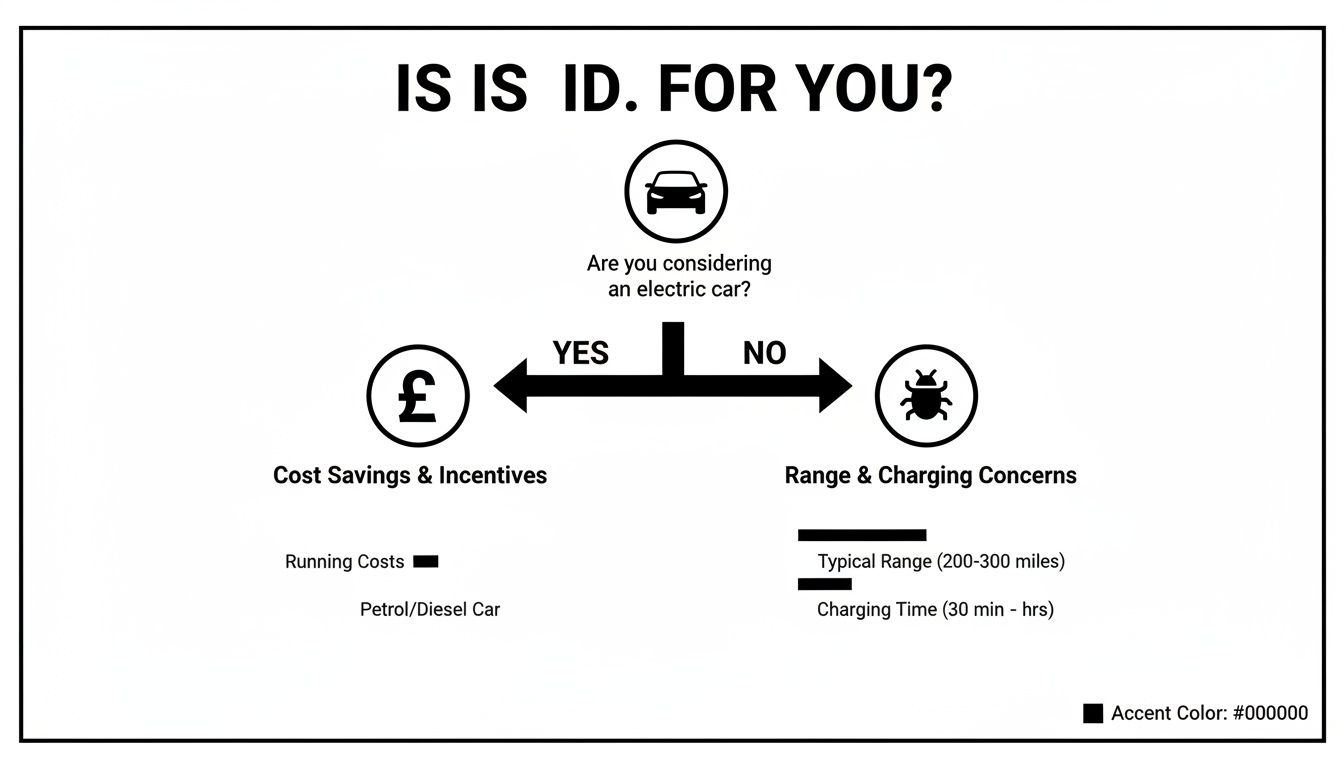
Ultimately, what the chart shows is that for many, the financial benefits of going electric are clear. For others, the practical hurdles still feel significant.
Cabin Upgrades And Why The Facelift Matters
Beyond the battery, the other big factor is the facelift VW rolled out in 2023. Early ID.3s were rightly criticised for feeling a bit cheap inside, with an abundance of hard, scratchy plastics that didn't feel very "premium German".
The facelifted models are a huge improvement. Volkswagen listened and swapped out the cheap stuff for soft-touch materials on the dashboard and door tops, which instantly makes the cabin feel more upmarket. They also upgraded the infotainment screen to a larger 12-inch display as standard, with much-improved software that is quicker and less likely to have a tantrum.
These changes genuinely make it a more pleasant place to sit, bringing the interior quality much closer to what you’d expect from a modern VW. The ID.3's popularity is certainly reflected in its UK sales, where it has carved out a solid niche. It recorded 1,831 registrations by early 2025, contributing around 3.4% to Volkswagen's total UK deliveries. You can check out Volkswagen's full sales figures for 2025 for more details on its performance.
Real World Range And Charging On UK Roads
Let’s be honest, official range figures cooked up in a lab are about as reliable as a weather forecast a week out. The brochure might boast a lovely 269 miles for the Pro and 347 miles for the Pro S, but what happens when you introduce the car to a cold, wet Tuesday on the M25? That's when the fantasy pops.
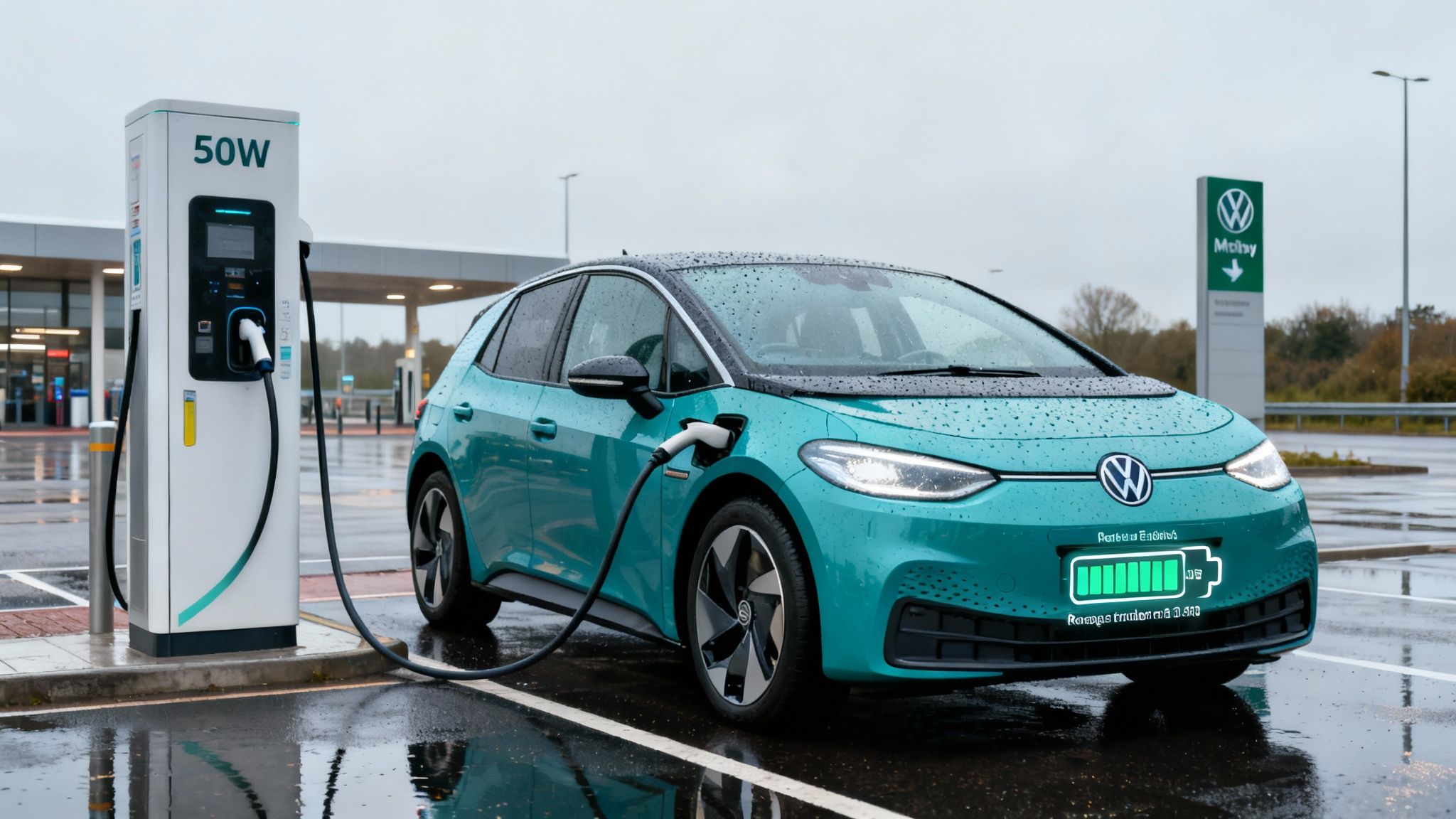
This is where we need to talk about the actual range you’ll get from the ID.3. In the real world of British motoring, you’ll need to shave a fair bit off those headline numbers. Think of the official WLTP range as its flattering online dating photo and the real-world range as what turns up for the date. Still looks good, but you can tell it’s seen a few winters.
The Great British Weather Tax
To put it bluntly, British weather is the arch-nemesis of an electric car battery. That miserable, damp cold we’re so famous for saps range like nothing else. Once the temperature drops towards freezing, you can expect your available mileage to fall by as much as 25-30% .
It's simple physics, really. The car has to work harder to keep both its battery and you toasty warm. Running the heater, demisters, and heated seats all takes a toll. This means your 269-mile Pro model might realistically deliver closer to 190-200 miles on a frosty morning commute. The 347-mile Pro S? Think more like 240-260 miles .
Motorway driving is the other big range-killer. Sustained high speeds are just not an EV's happy place. A long slog at 70 mph will drain the battery far quicker than nipping around town. Combine a motorway run with a cold day, and you've got the double whammy. It's not a deal-breaker, but it’s something you absolutely must factor into your planning for that cross-country trip to visit the in-laws.
On a more positive note, independent endurance tests have shown the ID.3's battery is impressively robust. A long-term trial saw a 77kWh model retain 91% of its original capacity after 107,000 miles , which is fantastic news for long-term ownership and the used market.
Charging The Beast: Pounds And Pence
So, you’ve made peace with the real-world range. Now, how do you top it up without needing a second mortgage? Charging is a tale of two very different worlds: the serene, cheap convenience of home charging, and the wild west of the public network.
Charging at home is the secret sauce to cheap EV motoring. Plug into a 7kW wallbox overnight, and you’ll wake up with a full "tank" every single morning.
- Home Charging (7kW Wallbox): A full charge for the 58kWh Pro model will take around 9 hours . On a cheap overnight electricity tariff (let’s say 10p per kWh), this costs a ridiculously low £5.80 . That works out to roughly 3p per mile .
- Public Charging (50kW Rapid): Find a typical service station charger, and you’ll get from 10% to 80% in about 45-50 minutes . The catch? At an average cost of 75p per kWh, that same top-up will sting you for over £30 . The cost per mile skyrockets to around 15-20p .
- Ultra-Rapid Charging (170kW for Pro S): The Pro S can handle faster speeds. A 10-80% charge can be done in around 30 minutes , but the cost will be similar, if not higher, than a 50kW unit.
The financial case is crystal clear. If you can charge at home, the ID.3 is incredibly cheap to run. Relying solely on the public network, however, can make running costs uncomfortably close to a frugal petrol car, which completely undermines one of the main reasons for going electric in the first place.
Living With The ID.3: Practicality, Pockets, and Peace of Mind
Specs and 0-60 times are great for bragging rights, but what’s the ID.3 actually like to live with? Does it cope with the grim reality of a British family's daily grind – the rainy Saturday supermarket run, the impromptu tip visit, the battle to get a buggy in the boot? Let's get into the nitty-gritty of everyday use and what it’ll actually cost you.
From the outside, the ID.3 looks like a Golf from the future, and its footprint on the road is pretty similar. The real magic happens when you open the door. Because it was designed as an electric car from the ground up, there's no bulky engine or transmission tunnel eating up space. The result is a cabin that feels surprisingly airy and spacious, almost like a Passat inside a Golf’s body. Your rear-seat passengers will thank you for the generous legroom.
Boot Space and Family Life
Right, the all-important boot test. Volkswagen quotes 385 litres of space, which is – almost to the litre – the same as you get in a regular Golf. On paper, that’s a solid number. In the real world, it swallows the weekly shop without a problem and you’ll get a pushchair in there, probably without having to resort to brute force.
But let's be realistic, it’s not an estate car. Packing for a two-week family holiday will involve some serious luggage Tetris. The boot itself is a nice, usable shape, but there is a bit of a lip to lift heavy things over, which can be a pain. For most day-to-day family duties, it’s perfectly fine, but don’t expect it to be a Tardis.
Interior storage is a bit of a mixed bag. You get decent door bins and a clever, flexible centre console for your coffees and water bottles. The overall vibe is minimalist, though, so don't expect the endless array of cubby holes you might find in a French MPV. A tidy mind is a definite advantage here.
The Real Cost of Ownership
This is where owning an ID.3 starts to feel like a very smart decision. Yes, the initial price is higher than a comparable petrol car, but the day-to-day running costs can be so low it’s almost comical, especially if you can charge up at home.
Let’s look at the key savings for UK owners:
- VED (Road Tax): As a pure EV, the ID.3 is currently exempt from road tax. That’s a straight saving of £180 a year compared to a new petrol equivalent. This is due to change in April 2025, but for now, it's a welcome bonus.
- Servicing: Electric cars have so few moving parts. There’s no oil to change, no filters or spark plugs to swap out, and no exhaust to fall off. Servicing is much simpler and cheaper, mostly involving checks on brakes, tyres, and the battery system.
- Company Car Tax: If you're fortunate enough to run one as a company car, the Benefit-in-Kind (BIK) tax is a tiny 2% . This makes it an incredibly tax-efficient choice that can save you thousands.
Owning an ID.3 feels a bit like swapping from Pay-As-You-Go to a cheap monthly mobile contract. The initial handset cost is higher, but the monthly bills are so low you’ll soon forget what it was like to pour £80 of petrol into a tank.
Insurance and Safety: A Pleasant Surprise
You might assume that a car with punchy, instant acceleration would come with a hefty insurance premium. But the ID.3 has an ace up its sleeve: it's incredibly safe, and insurers love that.
Volkswagen clearly didn't skimp on safety features, and the ID.3 aced the tough Euro NCAP crash tests. It scored a very impressive 86% for adult occupant protection and an even better 87% for child occupants. These top-tier ratings have a direct, positive effect on insurance costs. In fact, the average premium for an ID.3 owner in 2025 is around £450 annually , which is about 15% lower than the segment average . You can learn more about the ID.3's impressive safety record on Wikipedia.
When you add it all together – the minimal "fuel" costs, zero road tax (for now), cheaper servicing, and lower-than-expected insurance – the total cost of ownership starts to look very appealing indeed. That higher sticker price begins to feel less like a hurdle and more like a smart investment for the long run.
How The ID.3 Handles Britain's B-Roads
Every electric car has that same party trick: instant, silent acceleration that can embarrass a proper hot hatch at the traffic lights. But that’s the easy bit. The real question, especially for a car wearing a VW badge, is how it actually handles the unique punishment of a British B-road? We’re talking about those roads that look like they were paved by a disgruntled Roman, full of potholes, awkward cambers, and the occasional surprise sheep.
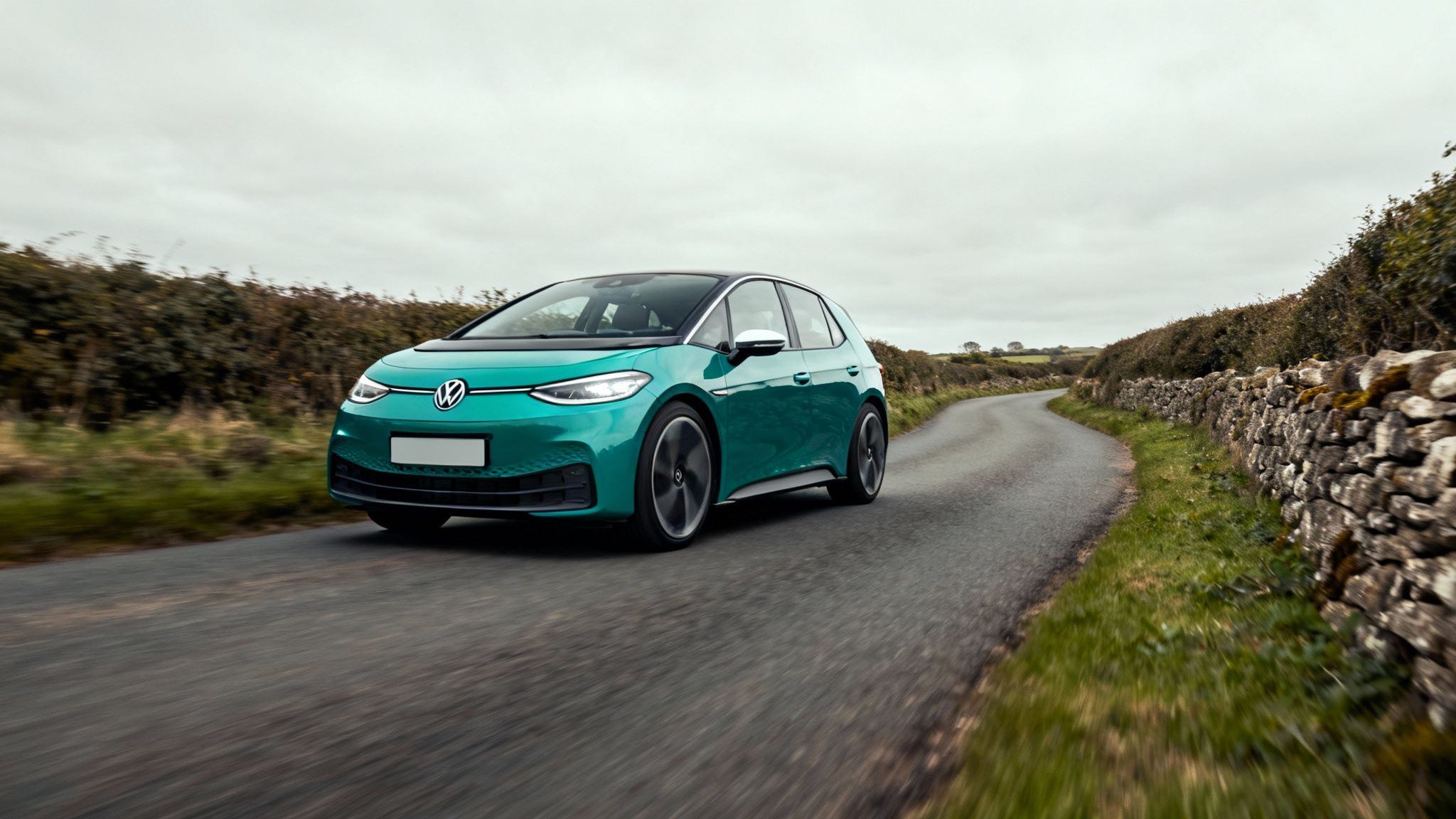
On paper, the ID.3 has all the right ingredients. It’s rear-wheel drive, for starters. The heavy battery is slung low in the chassis for a planted centre of gravity, and it even boasts a sophisticated multi-link rear suspension. This should be a recipe for a bit of fun. In reality, the ID.3 is less of a hooligan and more of a composed, sensible companion.
Composure Over Chaos
Tackle a typically bumpy, winding road, and the ID.3 remains impressively calm. It soaks up imperfections with a maturity you’d expect from a much larger car, refusing to get flustered by scarred tarmac. The ride is on the firm side, but it’s so well-damped that it doesn't crash through potholes or float about like a blancmange.
However, if you're hoping for the sharp, engaging feel of a Golf GTI, you might be a little disappointed. The steering is light and precise enough, but it doesn't offer a huge amount of feedback about what the front wheels are doing. It’s a car that clearly prioritises comfort and stability over outright thrills. It’s competent, safe, and predictable—all very German, but not exactly fizzing with excitement.
Think of it like this: the ID.3 is the sensible friend who makes sure you get home safely after a night out. Its sportier cousins from the same family, the Cupra Born and the Audi Q4 e-tron, are the ones egging you on to have one more for the road.
How It Stacks Up To Rivals
The family hatchback market is a brutal battlefield, and the ID.3 certainly doesn't have it all its own way. Its main rivals offer a slightly different flavour of electric motoring, and which one is "best" really depends on what you value most.
- Cupra Born: Essentially the ID.3's rebellious Spanish cousin. It shares the same basic platform and battery but has been tuned for a much sportier drive, with sharper steering and a firmer ride. It’s the one to pick if you genuinely enjoy driving enthusiastically.
- MG4: This is the disruptive new kid on the block that offers incredible value for money. It’s also rear-wheel drive and is surprisingly fun to hustle along a country lane, feeling more agile and playful than the VW. The ID.3 feels more premium inside, but the MG4 proves you don’t need to spend a fortune to have a good time.
Ultimately, the ID.3 carves out its own niche by being the most comfortable and refined of the bunch. It’s the grown-up choice. It handles everything with a quiet confidence that makes it a superb all-rounder, effortlessly transitioning from a B-road blast to a monotonous motorway slog without breaking a sweat. It might not set your heart racing, but its sheer competence is impressive in its own right, making it a brilliant partner for the varied demands of UK roads.
Buying A Used VW ID.3: A Shrewd Move Or A Risky Bet?
The first wave of ID.3s are now washing up on the shores of the second-hand market, with their original owners having paid the hefty "early-adopter tax". This creates a tantalising opportunity. So, is snapping one up a clever financial move, or are you just inheriting someone else's outdated tech and potential headaches?
Let's be blunt: the initial depreciation on many EVs has been savage. While that’s been painful for those who bought new, it's a gold rush for savvy used buyers. The bubble has well and truly burst, meaning you can now find a low-mileage, well-cared-for ID.3 for a fraction of its original price tag. It’s an absolute buyer’s market right now.
What To Look For When Buying Used
Kicking the tyres on an ID.3 isn't quite the same as checking over a petrol Golf. Your pre-purchase checklist needs a bit of a digital upgrade. Here’s what you absolutely must investigate before handing over your hard-earned cash.
Top of the list is the battery's State of Health (SOH) . This is the single most important metric, telling you how much of its original capacity the battery can still hold. Think of it as the battery's lifespan. Most decent dealers can run a diagnostic to give you this percentage; anything above 90% is a great sign.
Next, you need to play software detective. Ask the seller which version of the infotainment software the car is running. Early cars were notoriously glitchy, but a series of over-the-air updates have thankfully ironed out most of the gremlins. A car on the latest software is a much better prospect than one that’s been left behind.
And of course, don't forget the basics:
- Tyres: The instant shove of an electric motor can be tough on rear tyres. Check that tread depth carefully.
- Charging Cables: Make sure the car comes with both its Type 2 cable (for public chargers and wallboxes) and the three-pin "granny" charger for plugging into a standard socket in a pinch.
- Alloy Wheels: The ID.3’s long wheelbase and silent running can make it surprisingly easy to get too friendly with a kerb. Check all four alloys for any nasty scuffs or damage.
A Market Ripe For Bargains
The second-hand EV market is absolutely booming. The used Volkswagen ID.3 market in the UK is no exception, with a flood of available cars creating some fantastic value. In fact, used EV sales jumped by a massive 44% year-on-year in the first three quarters of 2025.
With prices dropping by around 25% since 2024, a 2021 ID.3 Pro with over 200 miles of real-world range can now be found for under £20,000. That’s a huge saving when you consider the average new EV still costs around £35,000. You can find more insights on the booming used EV market from Electrifying.com.
Worried about the battery degrading? You probably shouldn't be. Fleet tests right here in the UK have shown that the 58kWh battery pack retains around 90% of its capacity even after 50,000 miles . This proves the underlying tech is solid, making a used ID.3 a genuinely sound investment.
So, is it a risky bet? Not if you do your homework. A carefully chosen used ID.3 gives you all the benefits of modern EV motoring—the low running costs, the great drive, the practical space—for the price of a mid-spec supermini. That sounds less like a risk and more like an open goal.
Your VW ID.3 Questions Answered
Right, let's get down to the brass tacks. We've covered the big stuff, but I know there are always those little nagging questions that pop into your head. Here are the straight-up answers to some of the most common queries I hear about the ID.3.
Is The ID.3 Reliable?
Yes, but with a slight asterisk for the very early models. Mechanically, it’s as solid as you’d expect from a VW. The battery and motor are proving to be impressively robust, which is the most important bit.
The main headache, especially on the first cars, was the half-baked infotainment software. Thankfully, a constant stream of over-the-air updates has ironed out the worst of the glitches. If you’re buying a new or facelifted model (2023 onwards), the system is far more dependable. On older cars, just double-check the software is fully updated before you hand over any cash.
Can I Tow With A VW ID.3?
Barely. Let's be clear: this is not the car for hauling a caravan to Cornwall for the bank holiday. Officially, the ID.3 is only rated to tow a tiny 750kg (unbraked). That’s just about enough for a very small trailer for a trip to the tip. It’s really designed for carrying a bike rack, not for serious towing duties. If you need to lug anything substantial, you’ll need to look elsewhere.
The ID.3's battery is impressively durable. An independent test on a 77kWh model covering a whopping 107,000 miles found it still retained 91% of its original capacity. This proves the underlying tech is built to last, which is fantastic news for long-term ownership.
Will It Fit In My Garage?
Almost certainly. The ID.3 is a very similar size to a standard Volkswagen Golf, just a fraction taller and wider. Its exact dimensions are 4,261mm long and 1,809mm wide (excluding mirrors). Unless you have a garage built in the 1950s for an Austin A30, you should have absolutely no trouble tucking it in at night.
What About The Warranty?
Volkswagen UK provides a standard three-year/60,000-mile warranty on the car itself, which is decent but not class-leading – a few rivals offer more.
The crucial bit, however, is the battery warranty. VW guarantees the battery will retain at least 70% of its usable capacity for eight years or 100,000 miles , whichever comes first. This provides excellent peace of mind, particularly if you’re venturing into the used market.
Ready to find the perfect EV for you? At VoltsMonster , we cut through the noise with honest reviews and entertaining vlogs to help you make the right choice. Check out our latest content and join the community at VoltsMonster.
VoltsMonster Electric Vehicle Blog