UK Electric Cars Depreciation: Your Ultimate Survival Guide
Let's cut to the chase. You've heard the horror stories, probably from a bloke down the pub or your petrolhead mate: buy an electric car, and you might as well set fire to a pile of cash. The prevailing wisdom has long been that electric car depreciation is so savage your shiny new EV will be worth less than a soggy bag of chips by the time it’s due its first MOT.
But is that really the whole story, or just a bit of scaremongering from those who still get a thrill from the smell of unleaded?
Is Your EV Depreciating Faster Than a Politician's Promise?
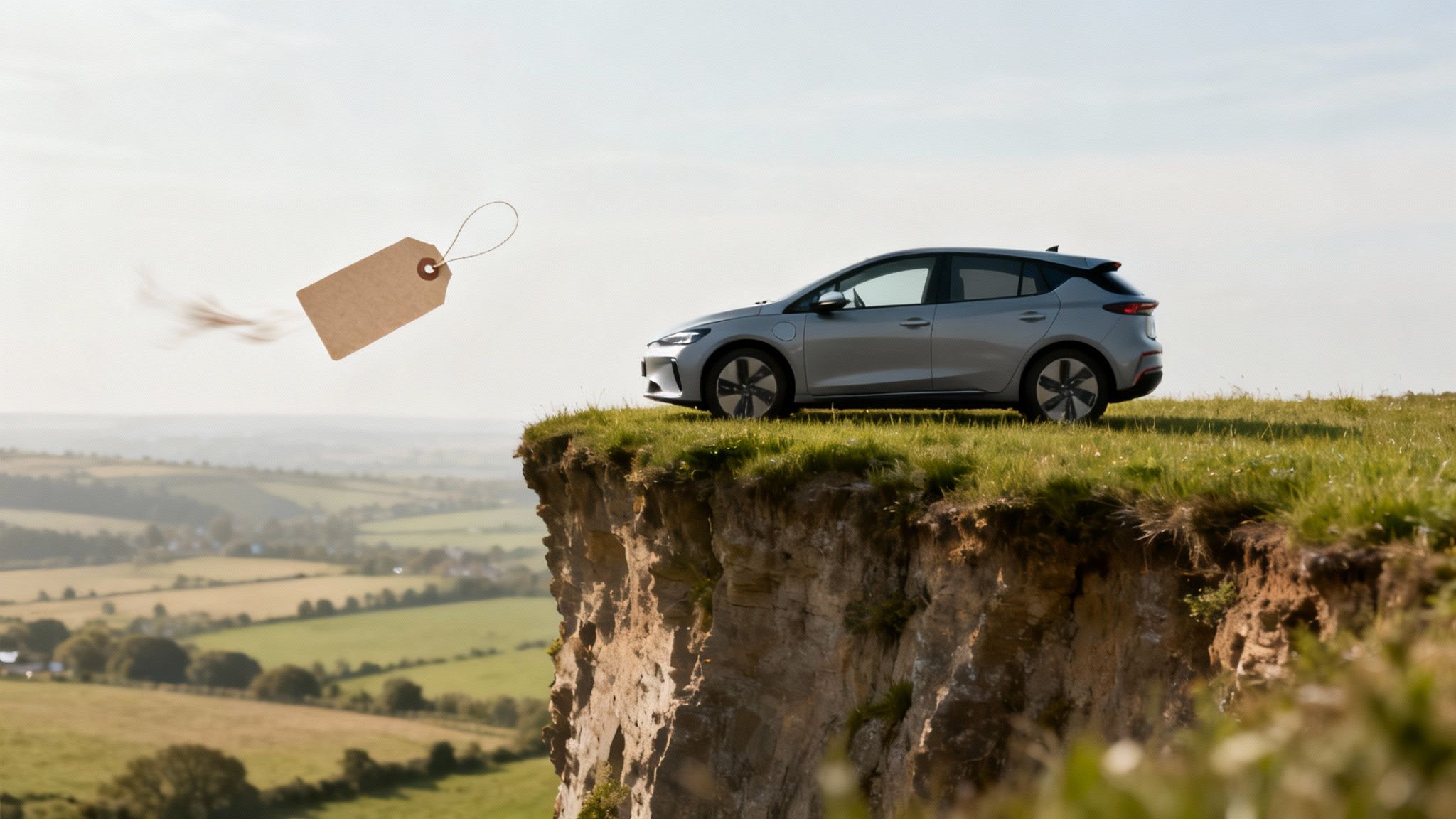
Alright, let's get one thing straight. The idea that all electric cars plummet in value faster than their fossil-fuelled cousins is, frankly, a load of old cobblers. It’s a narrative that held water in the early days of EVs—when ranges were pitiful and finding a charger was like spotting a unicorn—but the market has moved on significantly.
Think of depreciation as your car's financial decay rate. It's the silent thief that starts pinching value from your motor the second you drive it off the forecourt. Every single car suffers from it, whether it runs on volts, petrol, or pure optimism. The real question isn't if your car will lose value, but how fast.
The Shifting Tides of Value
Just a few years back, buying a used EV felt like a bit of a punt. Worries about battery life and the relentless pace of new tech meant early models shed their value at a frightening pace. Now, however, the game has completely changed. The depreciation gap between comparable electric and petrol cars in the UK has shrunk so much it's almost a photo finish.
These days, a typical three-year-old EV loses a similar percentage of its original price to an equivalent petrol model. The market has grown up. Buyers are more confident, and those juicy savings on fuel and tax are finally being properly priced into the total cost of ownership. This shift is a game-changer because it reframes the entire conversation.
The narrative has flipped. Instead of asking if EVs depreciate too fast, the smarter question is whether the lower running costs more than compensate for any perceived drop in resale value. For many drivers, the answer is a resounding yes.
What’s Really Going On?
So, why does the myth persist? It’s partly because the market is evolving so quickly, and partly down to some headline-grabbing price cuts from major manufacturers, which can temporarily send ripples through the used market. But on the whole, things are far more stable than the doomsayers would have you believe.
To get a proper grip on the situation, we need to look past the lazy generalisations and dig into the specific factors that dictate an EV's future worth. It’s never as simple as 'electric bad, petrol good'. The reality is a complex mix of:
- Battery Health: This is the big one. The battery's condition is the heartbeat of an EV's residual value.
- Technological Leaps: How quickly does today’s top-tier tech become yesterday's news?
- Brand & Badge Power: Let's be honest, some badges simply hold their value better than others.
- Government Shenanigans: Sudden changes to grants, taxes, or incentives can have a serious knock-on effect on the second-hand market.
Understanding these forces is the first step to making a smart buy and protecting your investment from taking an unnecessary financial kicking.
What Really Sinks Your Electric Car's Resale Value?
So, what’s actually chipping away at your EV's value? It isn’t some dark art known only to used car dealers. It's a surprisingly predictable process, and for electric cars, the culprits are a unique mix of new-world tech and old-school principles.
Let’s pull back the curtain on the main factors that turn your prized EV into someone else’s bargain find.
First, let's get a quick overview of the main players in this game. The table below summarises the key drivers we're about to dive into, giving you a snapshot of what matters most when it comes to your car's future worth.
Key Drivers of EV Depreciation: A Quick Glance
| Factor | Impact Level | Why It Matters |
|---|---|---|
| Battery State of Health (SoH) | Very High | Directly dictates the car's usable range and lifespan. It's the EV equivalent of engine health. |
| Technological Progress | High | Rapid advances in range and charging speed can make older models seem outdated very quickly. |
| Government Policy & Incentives | Medium | Changes to grants, taxes (like VED), and clean air zone rules can shift market demand overnight. |
| Brand Reputation & Desirability | Medium | A premium badge known for reliability (e.g., Porsche, Tesla) will always hold its value better. |
| Mileage & Overall Condition | Medium | The classic depreciation factors. High miles and visible wear and tear will always lower the price. |
As you can see, while traditional factors still play their part, the battery and the pace of innovation are the real kingmakers in the used EV market. Now, let's explore each of these in a bit more detail.
The Almighty Battery: State of Health is King
Forget 0-60 times. For a used EV, the single most important number is its State of Health (SoH) . This simple percentage reveals how much of its original juice the battery can still hold. Think of it like your phone battery after a couple of years – it just doesn't go the distance like it used to.
A new EV rolls out of the showroom with 100% SoH . After a few years of daily charging, motorway miles, and exposure to the glorious British weather, that number inevitably drops. A car with 95% SoH is still in fantastic shape and will fetch a strong price. One languishing at 80% , however, is starting to show its age, with a noticeably shorter range that will hammer its value.
This one metric is the absolute cornerstone of EV depreciation. It’s why two identical cars with the same age and mileage can have wildly different price tags. If you’re curious about the truly eye-watering sums involved, our guide on the UK EV battery replacement cost is a must-read.
The Relentless March of Technology
Remember when a 150-mile range felt like the future? Now, it’s barely enough to get you to the next set of services on the M1. EV technology is moving at a breakneck pace. Each new model that launches seems to have more range, faster charging, and smarter software than the last.
This incredible progress is a double-edged sword. While it’s brilliant for new car buyers, it can make a three-year-old EV feel like a Nokia in an iPhone world. A potential buyer will always be drawn to the newer model with a bigger battery, pushing down the value of what came before. It’s a brutal cycle of innovation that directly hits your car’s resale price.
The harsh reality is that today’s cutting-edge feature is tomorrow’s standard equipment. This technological churn is a primary driver of depreciation, as newer, more capable models make older ones look obsolete faster than their petrol counterparts.
Government Whims and Market Mood Swings
The used EV market is incredibly sensitive to what’s happening in Westminster. When the government was dishing out generous Plug-in Car Grants, it artificially suppressed the cost of new EVs. This had an immediate knock-on effect, forcing used prices down to stay in the game.
Now that most grants are history, the market is finding its natural balance. But don't get too comfortable. Any new tax, incentive, or regulation can send ripples through the second-hand market. For instance, the looming "EV tax" in 2025, which removes the zero road tax (VED) advantage, will almost certainly change how buyers weigh up a used EV against a petrol alternative. These external forces are totally out of your hands but play a huge part in the depreciation game.
Brand Power, Mileage, and Good Old-Fashioned Condition
Even in this new electric era, some things never change. A premium badge from a brand with a reputation for quality and desirability, like Porsche or Tesla, will always hold its value better than a lesser-known name. Brand power still counts for a lot.
And, of course, the fundamentals still matter. High mileage always drags a car's price down, suggesting more wear and tear on everything from the suspension to the interior—not just the battery. In the same vein, a car that’s clearly been cherished, with an immaculate interior, unscuffed alloys, and a full service history, will always command a higher price than one that’s been treated like a skip on wheels.
The market is definitely catching up. Data now shows that electric vehicles in the UK see an average depreciation of 38–42% after three years, which is nudging ever closer to the 35–40% seen in comparable petrol cars. This convergence shows the market is maturing, but understanding the unique EV factors we've just covered is your best defence against losing your shirt.
The Great Depreciation Showdown: Petrol vs Electric
Right then, let's get down to the main event. Forget the pub debates and playground squabbles – it's time to settle the score with cold, hard data. We're pitting electric cars directly against their petrol-powered ancestors in the ultimate depreciation showdown. Who really holds their value better once the showroom shine has worn off?
Let's be brutally honest: for years, the accepted wisdom was that an EV’s value would drop faster than a lead balloon. Early models with optimistic range estimates and a patchy charging network made them a risky bet on the used market. But things have changed. A lot. Today's EVs are a different beast entirely, and the financial reality is far more interesting than the old myths suggest.
That old narrative isn't just outdated; it's been turned completely on its head. Historically, the biggest depreciation gap between electric and internal combustion engine (ICE) cars in the UK was in the first three years. Petrol cars would typically shed around 60% of their value in that time, while early EVs often did even worse. Now, that gap has slammed shut as buyers wake up to the huge savings on running costs. You can explore more on how this perception has shifted by separating the facts from the fear on nextgencharge.co.uk.
A Tale of Two Depreciation Curves
The way EVs and petrol cars lose value isn't identical. Think of it like two different rollercoasters. The petrol car follows a fairly predictable, steady decline. It takes a big hit in year one, then keeps dropping at a reliable, if depressing, rate.
The EV, on the other hand, often has a slightly different journey. Its value is heavily influenced by factors like battery health, software updates, and government meddling, as this infographic shows.
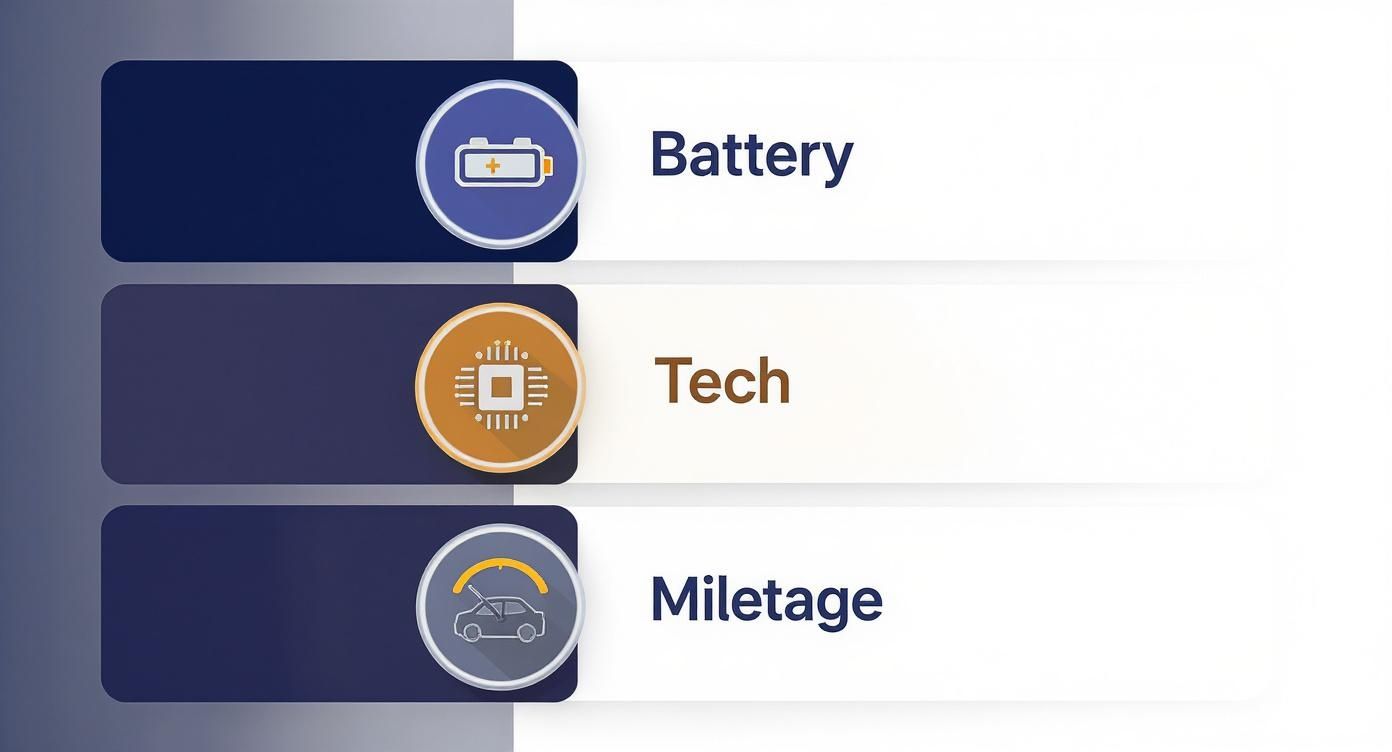
This highlights that while mileage is a classic value-killer for any car, battery health and the pace of tech evolution are the real kingmakers for an EV's long-term worth.
This means that while some EVs might see a sharp initial drop – especially if a new, much-improved model is released – their depreciation can level out more slowly over time. Why? Because a three-year-old EV with a healthy battery is still incredibly cheap to run, making it a very attractive used proposition compared to a petrol car facing ever-rising fuel prices and potential clean-air-zone charges.
Real-World Grudge Matches
Let's move from theory to the forecourt with a few real-world examples. We'll compare some of the UK's most popular models to see how they really stack up.
-
Tesla Model 3 vs BMW 3 Series: This is the classic executive saloon battle. For years, the BMW 3 Series was the benchmark for holding its value. But the Tesla Model 3, with its over-the-air updates, strong brand appeal, and Supercharger network access, has proven to be a proper depreciation-buster. In many cases, a three-year-old Model 3 retains a higher percentage of its original value than its Teutonic rival.
-
Kia e-Niro vs Nissan Qashqai: Over in the family crossover arena, things get even more interesting. The Nissan Qashqai has been a UK bestseller for yonks, but the Kia e-Niro’s blend of a long-range battery, practical design, and a seven-year warranty makes it a formidable used-market competitor. That warranty, in particular, is a huge factor as it covers the all-important battery, giving second-hand buyers massive peace of mind and propping up resale values beautifully.
The crucial takeaway is this: the best EVs are now outperforming their direct petrol and diesel competitors on depreciation. The combination of lower running costs, desirable technology, and growing consumer confidence has made them a genuinely sound long-term financial choice.
So, is the initial price premium of an EV still a barrier? For some, perhaps. But when you factor in the slower rate of value loss on top-tier models and the colossal savings on fuel, tax, and maintenance, the total cost of ownership paints a very different, and very compelling, picture. The showdown is over, and the electric contender is landing some serious punches.
How to Protect Your EV's Value from Evaporating
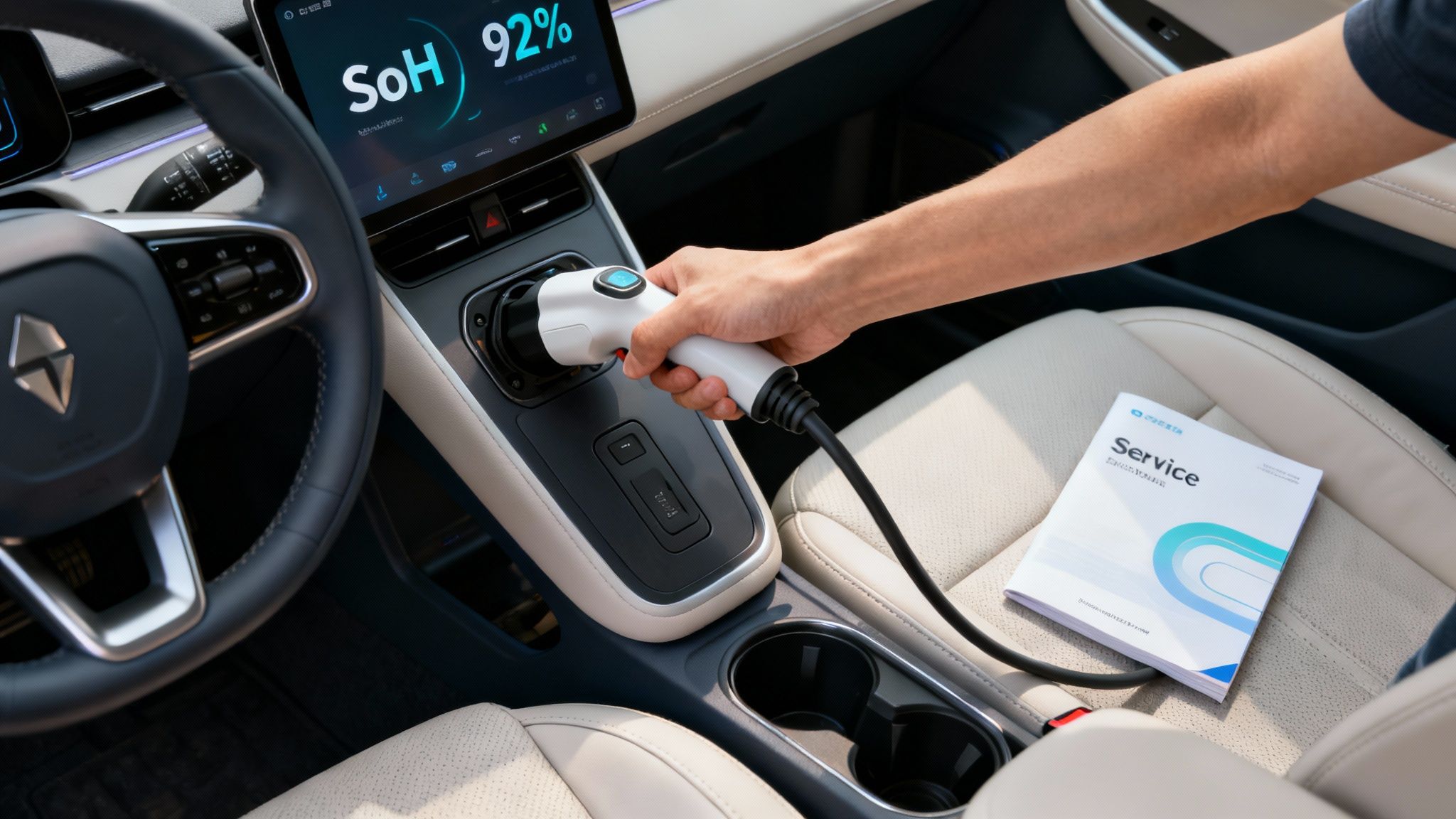
Right, let’s get one thing straight. You can't stop depreciation. It’s an unstoppable force of financial nature, like taxes or the crushing disappointment of a British summer. But you can certainly put up a fight and slow the blighter down.
Think of it less as preventing a flood and more like building a really solid sandcastle. This is your damage control manual for keeping as much cash in your pocket as possible when it’s time to part with your electric pride and joy.
Treat Your Battery Like a Spoilt Houseplant
The single biggest factor dictating your EV’s future worth is its battery. A healthy battery means a happy next owner and a healthier bank balance for you. Show it a bit of mechanical sympathy, and it’ll pay you back handsomely down the line.
This all starts with your charging habits. Constantly hammering it on a 150kW rapid charger is the battery equivalent of a diet consisting solely of kebabs and regret. It’s fine when you’re in a pinch, but do it every day and you’ll accelerate its degradation.
Here’s a simple routine to preserve its health:
- The 80/20 Rule: For daily use, try to keep the battery’s state of charge between 20% and 80% . Only push it to 100% when you genuinely need the full range for a long trip.
- Slow and Steady: Whenever you can, use a slower AC charger, like a home wallbox. It’s far gentler on the battery cells than the high-power DC alternatives.
- Mind the Temperature: Extreme heat is the enemy of lithium-ion batteries. If you can, park in the shade on scorching days to help protect its long-term health.
Choose Your Spec Wisely
When buying new, it’s tempting to go for the base model to save a few quid. This can be a false economy. Certain optional extras have a massive impact on desirability and, therefore, resale value.
You need to think like a future buyer. What features will they be hunting for in three or four years? A heat pump, for instance, is a must-have. It's far more efficient at warming the cabin in winter, which preserves precious range and makes the car a much more attractive used proposition.
Other desirable features include:
- Upgraded Sound Systems: A premium audio setup is a luxury touch that many used buyers will pay a premium for.
- Driver Assistance Packs: Advanced features like adaptive cruise control have become expected on modern cars and will be sorely missed if absent.
- A Panoramic Sunroof: This adds a premium feel and makes the cabin feel more spacious, which always helps with kerb appeal.
The Boring But Brilliant Basics
Even in the electric age, the old rules still apply. A car that looks like it’s been cherished will always sell for more than one that’s been treated with contempt. This means keeping on top of the simple stuff.
Maintain a full-service history, even if EV servicing schedules are less intensive. It shows a prospective buyer that the car has been looked after properly. Keep the paintwork clean and polished, and for goodness' sake, get any kerbed alloys refurbished. They’re an instant red flag that the car has been driven carelessly.
Keeping your EV in showroom condition isn't just about pride of ownership; it's a direct investment in its future value. A small spend on detailing or minor repairs before selling can yield a return of hundreds, if not thousands, of pounds.
Finally, timing is everything. Try to avoid selling just as a facelifted or brand-new version of your model hits the showrooms, as this will flood the market and drive prices down. Selling in spring often yields better results than in the depths of winter. Getting these elements right is key, and you can learn more about how to accurately value an electric vehicle in 2025 in our detailed guide.
How Government Policy Impacts Your Car's Worth
Trying to guess what your electric car will be worth in a few years without looking at government policy is a bit like trying to sail without checking the weather forecast. One minute it’s all calm seas and tax-free motoring; the next, a budget announcement hits you like a rogue wave, and your financial plans are suddenly all at sea.
The reality is, Westminster's decisions have a massive and often immediate impact on the EV depreciation game. These political and economic levers can be just as powerful as battery health or the badge on the bonnet.
The Ghost of Grants Past
Remember the Plug-in Car Grant? For years, the government gave buyers a hefty bung to go electric. This was great for new car buyers, but it also put an artificial cap on used values. After all, why would you pay top dollar for a second-hand EV when a brand-new one came with a government-funded discount?
The gradual phasing out and eventual scrapping of the grant has had a lasting effect. It's allowed the used market to find its own, more natural rhythm, where prices are set by real supply and demand, not Treasury handouts. Understanding this bit of history is crucial to making sense of today's market.
The end of purchase incentives was a watershed moment. It forced the used EV market to stand on its own two feet, leading to more predictable depreciation that better reflects an EV's genuine running-cost advantages.
The Looming VED Shake-Up
For years, one of the biggest perks of running an EV has been that sweet feeling of paying absolutely nothing in road tax (VED). But that all changes in April 2025 , and this single policy shift is poised to be the next big disruptor for EV values.
Government policies are constantly reshaping the market, with Vehicle Excise Duty being a perfect example. EVs registered between April 2017 and March 2025 have enjoyed zero VED, but that perk ends in April 2025 when they'll move to the standard rate. For a deeper dive, you can read the full report from electricvehicles.uk.
What does this mean for your car's value? Well, a used petrol car that costs £20 a year in tax might suddenly look more tempting next to an EV costing ten times that to tax. This directly chips away at one of the EV's key financial selling points, and you can be sure the used market will adjust prices to reflect that.
Clean Air Zones: The Unlikely Heroes of EV Value
While some policies threaten to pull the rug from under EV values, others are quietly propping them up. The relentless spread of Clean Air Zones and London’s Ultra Low Emission Zone (ULEZ) has turned many older diesel and petrol cars into financial burdens for anyone driving in a city.
This has created a huge surge in demand for affordable, ULEZ-compliant cars, and used EVs are right at the top of the shopping list. For city dwellers, an electric car isn't just a green choice; it's a financial no-brainer that saves them from hefty daily charges. This localised demand acts as a powerful buffer against depreciation, especially for smaller, city-friendly EVs. To see the bigger picture, you can learn more about the role of government policies in accelerating EV adoption in our dedicated guide.
So, What's the Real Deal with EV Depreciation?
Right, let's land this plane. We've sifted through the data, sidestepped the myths you hear down the pub, and untangled the ever-changing web of government policies. After all that, what’s the final, brass-tacks verdict on the great EV depreciation panic? Is your electric car’s value really going to vanish into thin air?
In a word: no. The whole narrative that EVs are a financial black hole is a hangover from the early days. Yes, the first-generation models did shed value at a frightening pace, but the market has grown up since then. Today, the depreciation gap between a good EV and its petrol equivalent is often razor-thin, and in some cases, it’s disappeared entirely.
The panic is officially overblown. The real story isn't one of catastrophic value loss, but of a fundamental shift in what makes a car valuable in the first place.
The New Rules of Resale Value
The game has completely changed. For decades, a car's worth boiled down to its mileage, its service book, and the badge on the bonnet. While those things certainly still matter, the EV world has a new kingmaker: battery health . A battery's State of Health (SoH) is now the single most critical factor, directly impacting its range, lifespan, and—crucially—its price tag on the used market.
This puts you, the owner, in the driving seat. You have more direct control over your car's future value than ever before. Looking after your investment is no longer just about avoiding kerbed alloys and biscuit crumbs in the back seats; it's about smart, deliberate habits that protect the most expensive component in the vehicle.
The bottom line is this: electric car depreciation is no longer a valid reason to avoid making the switch. It's simply a different beast to tame. When you factor in the massive savings on fuel, tax, and maintenance, the total cost of ownership often makes a compelling case, easily outweighing any perceived drop in value.
Thinking Like a Tech Custodian, Not Just a Car Owner
To protect your EV's value, you need a slight shift in mindset. Think less like a traditional car owner and more like a custodian of a sophisticated piece of technology. This really just means adopting a few simple, but vital, habits:
- Charge Smartly: Make slower AC charging your go-to and try to live by the 20-80% rule for day-to-day driving.
- Choose Wisely: When buying, go for desirable specs. Things like a heat pump or premium features will still be in high demand a few years down the line.
- Keep It Tidy: A full service history and a car in immaculate condition always command a better price, EV or not.
The used EV market is only going to get bigger, and demand for well-cared-for, healthy-batteried second-hand models will stay strong. While the initial ticket price can still feel steep, the evidence is clear: the right electric car, treated with a bit of care, is a perfectly sound financial decision. The depreciation boogeyman has been well and truly busted. Now you can get back to focusing on the fun parts of owning one—like silently leaving petrol cars for dust at the lights.
Frequently Asked Questions About EV Depreciation
Still have a few questions buzzing around? That’s completely normal. Getting to grips with electric car depreciation can feel a bit like learning a new language. Let’s clear up some of the most common queries.
Do Electric Cars Depreciate Faster Than Petrol Cars in the UK?
This is the big one, the myth that just won't quit. The short answer? Not anymore.
While it’s true that the first generation of EVs took a serious hit on resale value, the market has changed dramatically. Look at the numbers today, and you’ll find that a three-year-old EV holds its value just as well as a comparable petrol car. In some cases, even better.
Factor in the huge savings on fuel, road tax, and maintenance, and the total cost of owning an EV often comes out well ahead. Any small difference in depreciation is usually dwarfed by the money you’ve saved by avoiding the petrol station.
Which Electric Car Brands Hold Their Value Best?
You probably won’t be surprised to hear that the premium brands do very well. Marques with a strong reputation and a dedicated following, like Porsche and Tesla, tend to hold their value incredibly well. That brand prestige, combined with desirable tech, keeps them in high demand on the used market.
But don't overlook the popular mainstream models. Cars like the Kia e-Niro or Hyundai Kona Electric are also star performers when it comes to beating depreciation. Their winning formula of a reliable real-world range, everyday practicality, and long manufacturer warranties makes them a smart and safe choice for second-hand buyers, which keeps their values firm.
It's a tale of two strengths: premium brands hold value through sheer desirability, while practical, long-range mainstream models hold it through high demand and common-sense appeal.
Will a Dying Battery Make My Car Worthless?
In a word, no. It's a common fear, but it’s not how battery technology works in the real world. Modern EV batteries are built to last, with most manufacturers providing a solid 8-year or 100,000-mile warranty for peace of mind. They don't just suddenly give up the ghost; they degrade very slowly and predictably over time.
As a battery's State of Health (SoH) gradually decreases, the car's value will naturally reduce along with it, simply because it offers less range. But this is a gentle slope, not a sheer drop. It will be a very long time before a battery degrades to a point where the car is anywhere near "worthless".
How Can I Check an EV’s Battery Health Before Buying?
You wouldn't buy a house without a survey, so don't buy a used EV without a battery check. The most reliable way is to ask the dealer for a certified State of Health report. This gives you a clear, official figure.
If you're buying privately, you still have options. You can use a dedicated vehicle inspection service that specialises in EVs. Alternatively, you can buy an OBD2 scanner and use a compatible smartphone app (like LeafSpy for a Nissan Leaf) to pull the data yourself. It lets you plug directly into the car's onboard computer and see the battery's true condition.
Whatever you do, never buy a used EV without verifying its battery health . It’s the single most important piece of information you need.
At VoltsMonster , we cut through the jargon to give you the straight-talking reviews and guides you need. For more honest insights into the world of electric vehicles, check out our latest content at the VoltsMonster website.
VoltsMonster Electric Vehicle Blog