The Best Electric SUV UK Drivers Can Actually Agree On
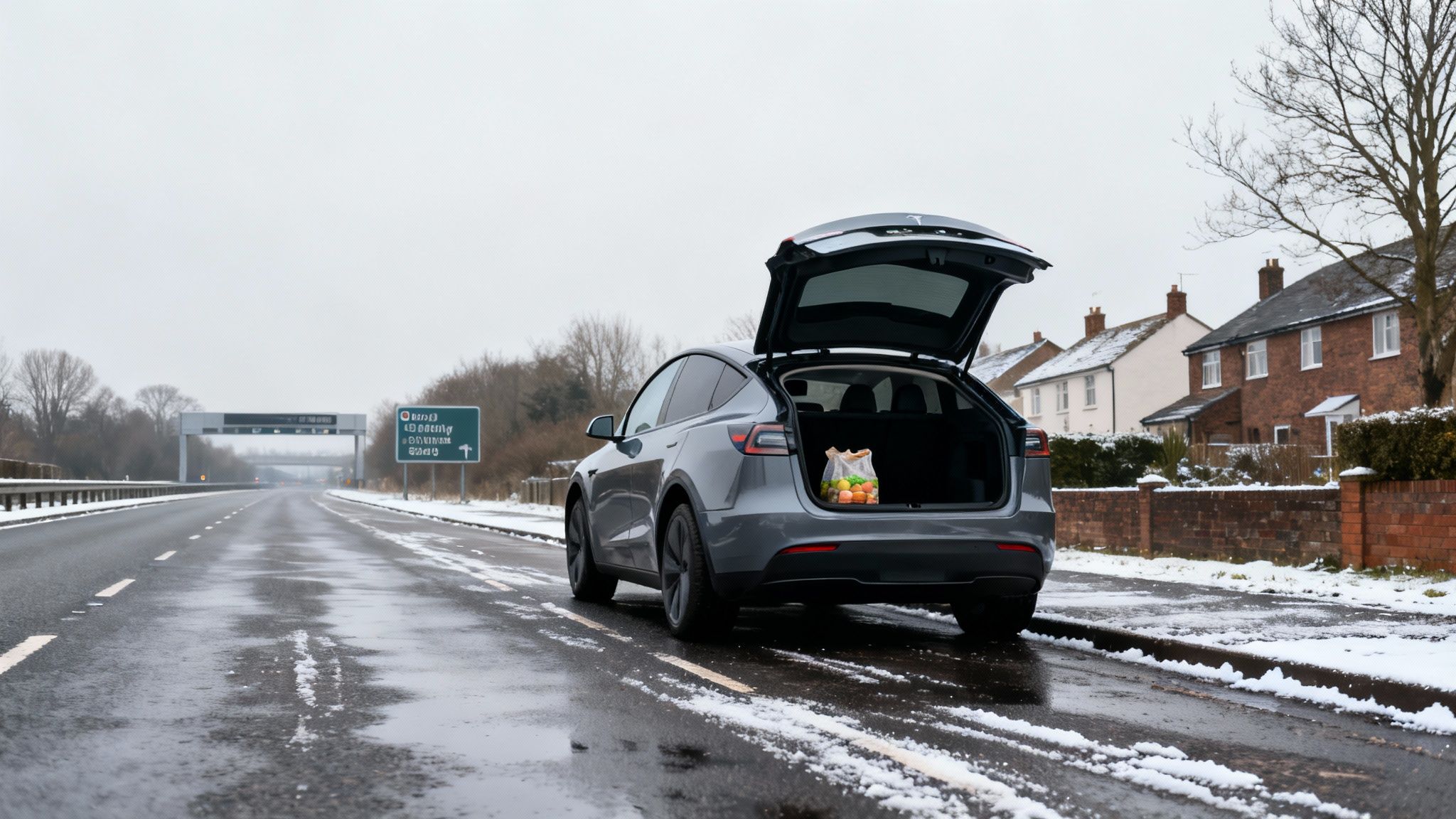
Let's be honest, trying to find the best electric suv uk drivers can agree on is a bit like trying to find a decent politician. It’s a deeply personal choice, full of compromises, and everyone has a surprisingly strong opinion on the matter. The real challenge is finding a car that can survive the M25 in winter on a single charge, swallow the weekly Aldi shop without needing a roof box, and not require a second mortgage.
Choosing Your Electric Behemoth
This guide is designed to cut through the marketing guff and get to the heart of what 'best' actually means for the average UK driver. We're now in an era where electric SUVs seem to be multiplying faster than potholes on a B-road, which can make the decision feel more baffling than ever.
The market has truly exploded. You've got everything from compact crossovers built for city living to enormous seven-seaters that could almost double as a small flat. You’re no longer just buying a car; you’re buying into an entire ecosystem of charging networks, software updates, and, let's face it, questionable resale values.
The Contenders We Will Scrutinise
We’re not going to present these cars as flawless machines. Instead, think of them as flawed champions, each vying for your hard-earned cash. Here’s a quick look at the usual suspects you'll see hogging the chargers at the motorway services:
| Contender | Defining Trait | Perfect For... |
|---|---|---|
| Tesla Model Y | The Tech Bro's Favourite | Infuriating and delighting in equal measure |
| Kia EV9 | The Big Friendly Giant | Drinking electricity like it's going out of fashion |
| Skoda Enyaq | The Sensible Choice | The one your dad would probably approve of |
| Volvo EX30 | The Stylish Scandi Option | Looking chic but being smaller than you think |
The rise of these vehicles isn't just a passing trend; it's a full-on takeover. Back in October 2025, battery electric vehicles (BEVs) hit a massive 25.4% market share in the UK. Even used BEV sales jumped by an incredible 44.4% . This surge shows that thousands of families are making the switch, with models like the Tesla Model Y and Kia EV6 becoming top choices for a zero-emission family wagon. You can discover more EV statistics and see just how fast the market is changing.
"Choosing an electric SUV is less about finding the perfect car and more about picking the set of compromises you can best live with. Is it range anxiety, software glitches, or a boot that won't fit the dog? You decide."
So, let's get into a brutally honest introduction to the top electric SUVs that might just be good enough for the chaotic reality of UK roads.
Meet The Contenders In The Electric SUV Arena
Right, let’s get the introductions out of the way. The electric SUV market has become a bit of a crowded zoo, full of loud, oversized beasts all vying for your attention. To help you tell your Teslas from your Skodas, here's a quick, warts-and-all summary of the main players we'll be dissecting. Forget the glossy brochure nonsense; this is the reality check.
First up is the Kia EV9 , the automotive equivalent of a big, friendly giant. It's a proper seven-seater that doesn’t require you to be a contortionist to use the third row, making it a genuine family wagon. However, its sheer size means it drinks electricity like it’s going out of fashion, and parking it in a typical British multi-storey is an extreme sport.
The Sensible And The Stylish
Then we have the Skoda Enyaq . If this car were a person, it would wear comfortable shoes and have a sensible pension plan. It’s practical, spacious, and does everything you ask of it without any fuss. It’s the kind of car your dad would approve of, which is both a compliment and a mild insult. It won't set your pulse racing, but it probably won’t let you down either.
Stepping into the ring with a completely different attitude is the Tesla Model Y . It’s the tech bro's favourite, brilliant and infuriating in equal measure. The performance is ludicrous, the Supercharger network is genuinely superb, and the minimalist interior is either a stroke of genius or a cost-cutting nightmare, depending on your mood. Be prepared for phantom braking and the constant feeling you're beta-testing the software.
Finally, we have the new kid on the block, the Volvo EX30 . It’s the stylish, minimalist Scandi option that looks fantastic in photos. In person, it's surprisingly compact, making it a doddle to park but perhaps less of an 'SUV' and more of a tall hatchback. It screams good taste but might feel a bit snug if you're lugging around more than a week's worth of Waitrose shopping.
These contenders represent the current state of play: from massive family haulers to tech-focused trailblazers. Each has a distinct personality, and none of them is perfect, especially when faced with the realities of UK roads and charging infrastructure.
While the EX30 brings compact chic, its larger, more luxurious stablemate is also on the horizon. To see how Volvo plans to tackle the premium end of the market, you can learn more about the upcoming Volvo EX90 and its high-tech features in our detailed preview.
Each of these vehicles offers a unique set of compromises, and now that you've met the motley crew, it's time to throw them into the gladiatorial pit of direct comparison. Let the games begin.
A Head-To-Head UK Electric SUV Comparison
Right, let’s get down to brass tacks. This is where we pit our electric contenders against each other in the categories that actually matter when you live and drive in Britain. We can forget the glossy brochure figures for a moment; it’s time to dive into the messy reality of owning one of these battery-powered beasts.
We're not just talking about the official WLTP range. We’re talking about the ‘Can I get from London to Manchester in December with the heating on full blast?’ range. We'll dissect charging speeds, not in kilowatts, but in ‘How many chapters of my book can I read at a desolate service station?’ It's time for some cynical, real-world context.
This chart gives you a quick visual rundown of the cars we're looking at, from the gargantuan Kia EV9 to the city-slicking Volvo EX30.
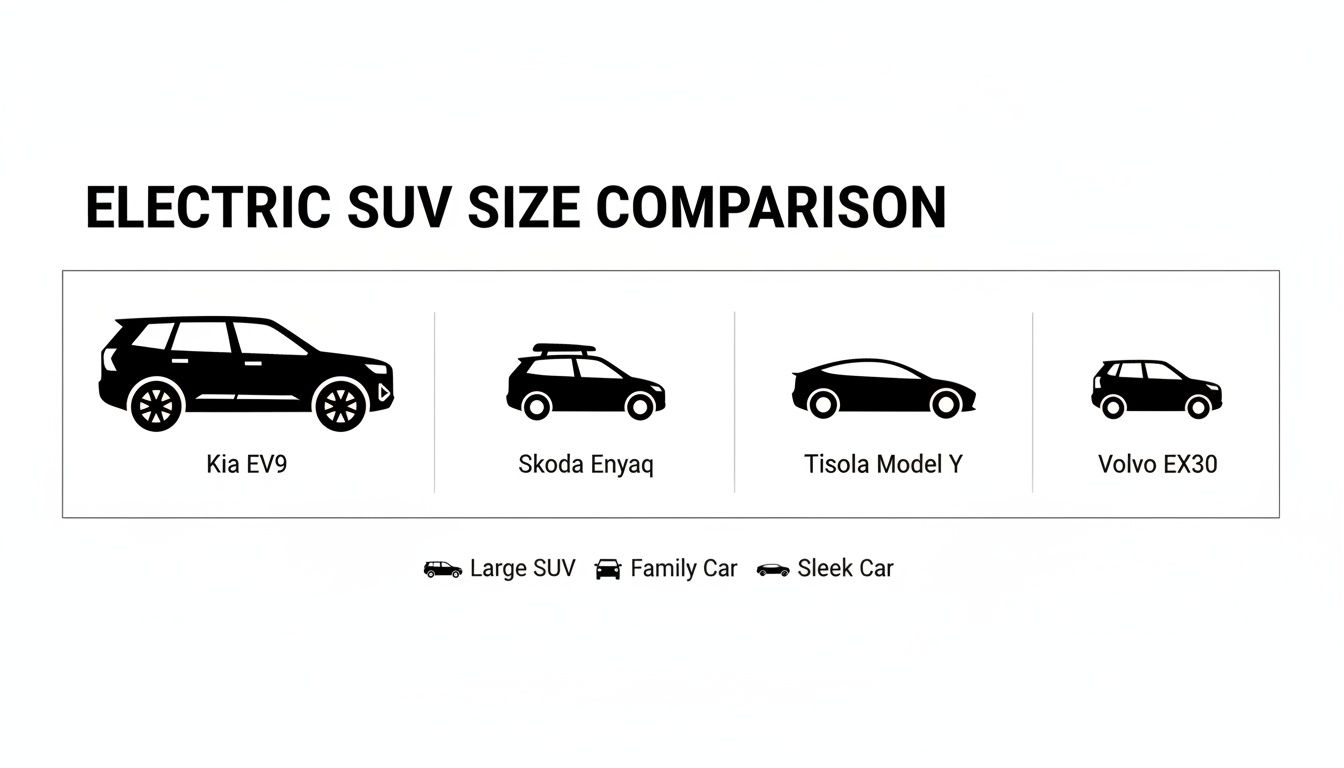
As you can see, the 'SUV' label covers a massive spectrum of vehicles, so it's vital to know what you're getting into.
Electric SUV Face-Off: The Brutal Truth
Numbers on a page can be deceiving. Here’s a side-by-side look at the specs that genuinely impact your day-to-day life, from realistic winter mileage to what it actually costs to top up the battery at home versus a pricey rapid charger on the M1.
| Metric | Tesla Model Y | Kia EV9 | Skoda Enyaq | Volvo EX30 |
|---|---|---|---|---|
| Realistic Winter Range | ~ 220 miles | ~ 240 miles | ~ 250 miles | ~ 180 miles |
| Realistic Summer Range | ~ 280 miles | ~ 300 miles | ~ 310 miles | ~ 220 miles |
| Peak Charge Speed | 250 kW | 210 kW | 135 kW | 153 kW |
| 10-80% Rapid Charge | ~ 25 mins | ~ 24 mins | ~ 35 mins | ~ 26 mins |
| Home Charge Cost (0-100%) | ~£22.50 | ~£29.97 | ~£23.10 | ~£20.70 |
| Rapid Charge Cost (10-80%) | ~£40.12 | ~£53.38 | ~£41.22 | ~£36.93 |
| Boot Space (Seats Up) | 854L (+117L frunk) | 333L (7 seats) | 585L | 318L |
| Starting OTR Price | ~£44,990 | ~£65,025 | ~£44,540 | ~£33,795 |
This table lays bare the trade-offs you make. The Kia has a massive battery but costs a fortune to rapid charge. The Tesla offers blistering charge speeds, while the Skoda gives you the most predictable real-world range for your money.
The Range Reality Check
Let's be honest, official range figures are about as trustworthy as a politician's promise. They’re achieved in perfect lab conditions that bear no resemblance to a wet Tuesday morning on the M6. The real-world range, especially in a grim British winter, is the only number that truly counts.
- Tesla Model Y Long Range: Officially, it promises up to 331 miles . In reality? You're looking at 260-280 miles in mixed driving, which can plummet to around 220 miles if you're caning it down the motorway in February.
- Kia EV9: With its enormous battery, the official number is a mighty 349 miles . It’s a heavy brute, though, so real-world figures are more like 280-300 miles . Cold weather will knock that closer to 240 miles .
- Skoda Enyaq 85: The ever-sensible Skoda claims up to 348 miles . It's impressively efficient and often delivers a realistic 290-310 miles . A proper cold snap might see that drop to 250 miles , which is still incredibly respectable.
- Volvo EX30 Extended Range: The smallest car here has a stated range of 295 miles . Pottering around town will get you close to that, but motorway speeds will see it drop to around 220 miles . In the depths of winter, budget for 180-190 miles to be safe.
The brutal truth is that a British winter can slash an EV's range by 20-30% . Always subtract a healthy dose of pessimism from the manufacturer's claims before planning a long journey.
Charging Speeds: Or, How Long You'll Be Stuck At Beaconsfield
How fast your car charges determines whether a motorway stop is a quick coffee break or an impromptu overnight stay. It’s measured in kilowatts (kW), but what it really means is time spent loitering at a service station.
The Tesla Model Y is the undisputed champion here. It's not just about its peak charging speed of 250 kW , but its access to the flawless Supercharger network. You plug in, and it just works. A 10-80% top-up can take as little as 25 minutes . Simple.
The Kia EV9 is no slouch. Its advanced 800-volt architecture lets it slurp electricity at up to 210 kW , meaning a 10-80% charge can be done in around 24 minutes —if you can find a powerful public charger that’s actually working.
In contrast, the Skoda Enyaq peaks at a more modest 135 kW . It’s perfectly adequate, but that same 10-80% charge will take you closer to 35 minutes . That’s an extra ten minutes to regret your life choices.
The compact Volvo EX30 punches above its weight, charging at a very brisk 153 kW . This means a 10-80% charge can be dispatched in about 26 minutes , which is impressively quick for a smaller EV. If you're looking for a wider perspective, our complete electric car comparison for UK drivers breaks down how these models stack up against the rest of the market.
Practicality And The Labrador Test
An SUV has to be practical. We measure this in boot space, or more accurately, the 'how much junk can you cram in before a family holiday?' metric.
| Vehicle | Boot Space (Litres) | Labrador Test Verdict |
|---|---|---|
| Tesla Model Y | 854 (rear) + 117 (frunk) | A cavern. You could fit two Labradors and their entire collection of chewed-up toys. |
| Kia EV9 | 333 (7 seats up) / 828 (5 seats up) | With the third row folded, it’s huge. One very happy Labrador with room to spare. |
| Skoda Enyaq | 585 | Very practical. One Labrador fits comfortably, with space for wellies and a damp towel. |
| Volvo EX30 | 318 | A bit tight. A small, well-behaved Labrador might fit, but a big one would complain. |
The Tesla’s combination of a massive rear boot and a genuinely useful 'frunk' makes it absurdly practical for its footprint. The Kia is a true family hauler with the seats down, while the Skoda remains the sensible benchmark. In this company, the Volvo feels more like a stylish, high-riding hatchback.
The Price Tag And Financial Wizardry
Finally, we get to the price. Electric SUVs aren't cheap, but how you pay for them can make a world of difference. Salary sacrifice schemes, in particular, have made them far more attainable for many.
This is exactly why electric SUVs are dominating the UK's EV surge. The Tesla Model Y led the sales charts with over 30,000 units in 2024, driven heavily by its attractive pricing on salary sacrifice, which can save drivers 30-50% via low Benefit-in-Kind (BIK) tax. Rivals like the Kia EV9 and Volvo EX30 , with impressive ranges and clever tech like Vehicle-to-Load (V2L) power output, are also finding plenty of homes.
On these schemes, the Model Y often presents the best value. The Skoda Enyaq offers a solid, no-frills package for a great price. The Kia EV9 is a premium proposition for those who absolutely need seven seats, while the Volvo EX30 is the budget-friendly style icon of the group.
Which Electric SUV is Actually Right for You?
Let’s be honest, an electric SUV isn’t a one-size-fits-all magic bullet, no matter what the evangelists on social media might claim. Choosing the wrong one is an expensive mistake, one that will grate on you every time you can’t squeeze into a parking space or find yourself sweating the last 10 miles home on a low battery.
So, forget the glossy brochure lifestyle for a moment. This is a brutally frank guide to matching a car to the realities of British life. We’re looking at the typical buyers you see on UK roads and pairing them with the electric SUV that will serve them best—or at least disappoint them the least. Think of it less as a buyer’s guide and more as a much-needed intervention.
The School Run Parent
Your daily life is a chaotic symphony of speed bumps, impossibly tight car parks, and roads clearly designed for a horse and cart. The biggest challenge you face is getting two over-excited kids and a mountain of their gear into the car without drenching the upholstery in lukewarm coffee. You need practicality above all else: wipe-clean surfaces, a big boot, and doors that open wide enough to wrestle a car seat into place without throwing your back out.
- Your Best (or Least Terrible) Match: The Skoda Enyaq .
- Why it works: The Enyaq is the sensible pair of shoes in a world of flashy trainers. Its boot is a truly cavernous 585 litres , which will easily swallow school bags, PE kits, and that science project you only found out about last night. The interior feels robust enough to survive a full-scale assault from sticky fingers, and its surprisingly tight turning circle means you won’t have a panic attack in the Tesco car park. It’s utterly devoid of excitement, which is probably exactly what you need when your life is already dramatic enough before 9 am.
The Motorway Mile-Muncher
You basically live in the outside lane of the M1, measuring your life in service station coffees. The words ‘Charge Point Occupied’ send a cold shiver down your spine, and your absolute nemesis is a broken rapid charger in the middle of nowhere. What you need is a car with a genuinely long range, rapid charging that actually works as advertised, and a comfortable seat for those inevitable traffic jams around Birmingham.
- Your Best (or Least Terrible) Match: The Tesla Model Y .
- Why it works: Let's cut to the chase: it's all about the Supercharger network. While everyone else is juggling five different apps and praying the charger connects, you just plug in, and it works. Every. Single. Time. A 10-80% top-up in 25 minutes is a real-world, achievable figure, and its motorway range is predictable enough that you can plan your caffeine stops with military precision. Sure, the minimalist cabin might drive you a bit mad, but on a long slog up to Scotland, that convenience is simply unbeatable.
"For anyone racking up serious mileage, the reliability of the charging network is far more important than the car itself. The Tesla ecosystem, for all its quirks, remains the undisputed king of motorway charging in the UK."
The Tech-Obsessed Early Adopter
Let’s be real, you care more about the size of the infotainment screen than the size of the boot. You want a car that feels like a smartphone on wheels, something that gets over-the-air updates, has quirky features you can show off to your mates, and maybe makes a fart noise on demand.
- Your Best (or Least Terrible) Match: The Tesla Model Y (yes, again).
- Why it works: No other car on this list feels so much like a piece of consumer electronics. The giant central screen is the command centre for everything, the regular software updates add genuinely new (and sometimes baffling) features, and its app integration is seamless. It’s a rolling gadget that will both delight and infuriate you in equal measure—which is precisely the thrill you’re after. It’s the best and worst of modern tech culture, conveniently packaged into a family SUV.
The Style-Conscious Urbanite
You live in the city, probably in a flat with no driveway, and your car is as much a fashion accessory as it is a way to get around. You need something compact enough to navigate narrow Victorian streets, stylish enough to look good parked outside a trendy brunch spot, and with a badge that quietly says, ‘I have excellent taste’. Space is a secondary concern.
- Your Best (or Least Terrible) Match: The Volvo EX30 .
- Why it works: This car is a slice of pure Scandi-cool design that really stands out from the generic, blob-like shapes of many rivals. It’s small, making it a doddle to park, and the interior is a masterclass in minimalist chic. The range is more than enough for hopping across town, while its zippy performance is perfect for getting away from the lights. The boot is admittedly tiny at 318 litres , but let's be honest, your biggest haul is usually a few bags from Whole Foods, not a flat-pack wardrobe from IKEA.
The 'More is More' Family Hauler
You’ve got three kids, a dog, and a pathological inability to pack light. You need seven seats—and not those pathetic pop-up ones in the boot that are only suitable for people with no legs. You need a vehicle that can swallow an entire family holiday’s worth of luggage without you having to even think about a roof box.
- Your Best (or Least Terrible) Match: The Kia EV9 .
- Why it works: This is the only vehicle on our list that is a genuine, no-compromise seven-seater. Real, full-sized adults can actually sit in the third row without needing to book a chiropractor afterwards. Fold that third row down, and the boot expands to a colossal 828 litres . It’s massive, unapologetic, and incredibly practical for anyone who has simply outgrown a normal-sized car. Just don’t try and park it in a multi-storey in a hurry.
Understanding The Real Running Costs
Everyone loves to bang on about how cheap electric cars are to run. "Fill up for a fiver overnight!" they say. "Wave goodbye to petrol stations forever!" But is it really that simple? Let's peel back the layers of marketing fluff and look at the actual, real-world costs of keeping one of these electric behemoths on the road.
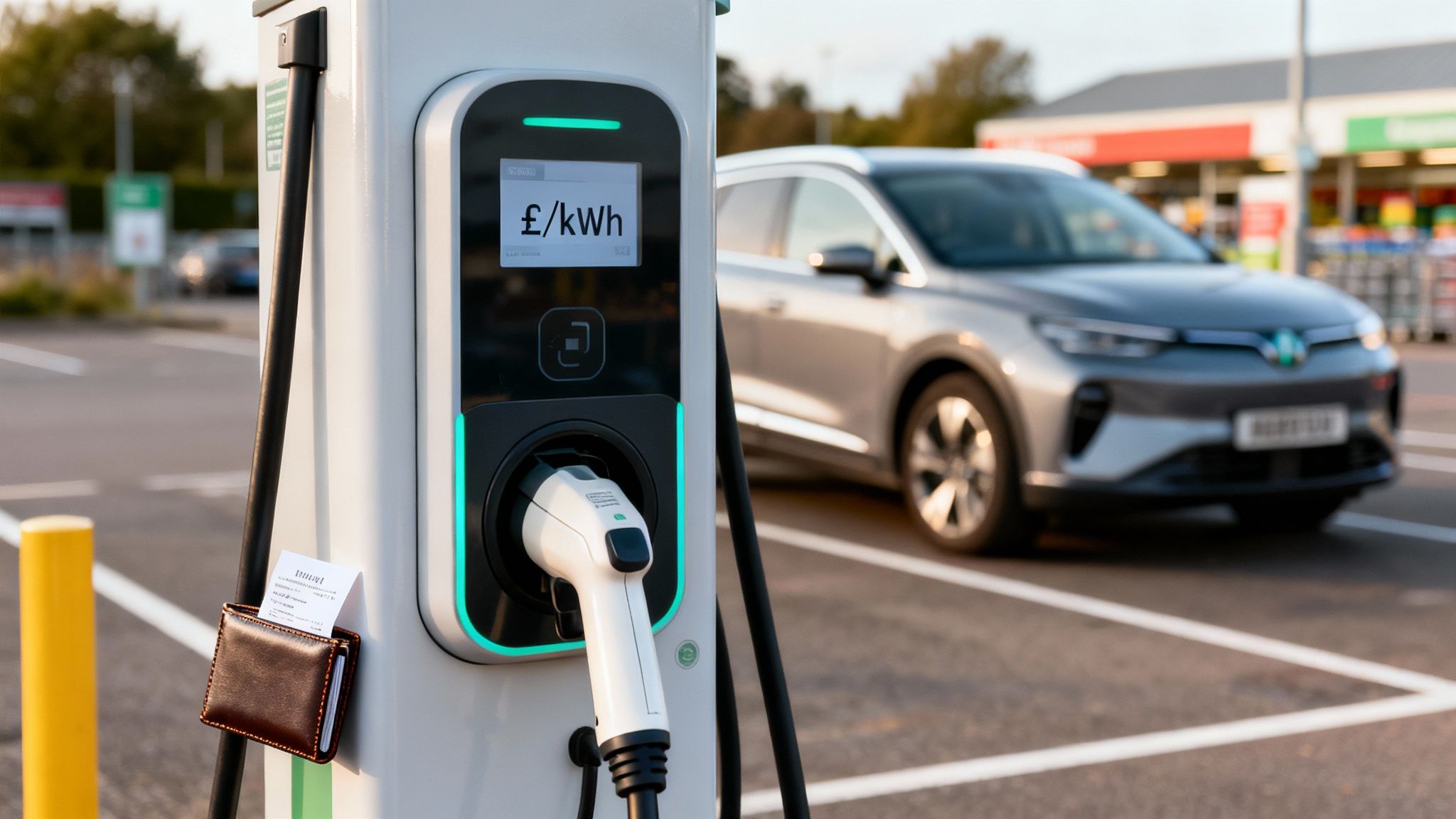
The promise of cheap overnight electricity is absolutely true—if you have a driveway and a home charger. For the millions of us living in flats or terraced houses without off-street parking, the reality is a grim dance with the UK's public charging network. The prices at motorway rapid chargers can be eye-watering, often costing more per mile than a reasonably efficient petrol car. Suddenly, that smug EV grin starts to look a bit strained.
And it’s not just about the electricity. Have you tried getting an insurance quote for some of these high-performance electric SUVs? The combination of blistering acceleration and expensive-to-repair battery packs can send premiums into the stratosphere. Insurers are still figuring out the risk, and you’re the one paying for their uncertainty.
The Hidden Financial Traps
It's crucial to look beyond the cost of a single charge. The total cost of ownership is a far more complicated beast, filled with financial gremlins you might not expect.
- Public Charging Pain: Relying solely on public chargers can easily double or triple your running costs compared to charging at home. A full "tank" at a service station can set you back £50 or more.
- Insurance Shocks: Models like the Tesla Model Y, with their neck-snapping performance, can attract surprisingly high insurance quotes, sometimes wiping out any fuel savings you might have made.
- The Looming Road Tax: Let's not forget the elephant in the room. From 2025 , new electric cars will no longer be exempt from Vehicle Excise Duty (VED), adding another annual cost to the pile.
The narrative of "cheap EV motoring" is dangerously oversimplified. The real cost depends entirely on your lifestyle, your postcode, and whether you have the luxury of a private driveway. For a detailed breakdown of what you can expect to pay, check out our sceptic's guide to not getting fleeced on electric car charging costs in the UK.
The Depreciation Dilemma
So, you’ve forked out £50,000 for your shiny new electric SUV. Is it going to be worth less than a half-eaten pasty in three years? This used to be a major concern, with early EVs depreciating faster than a politician's apology. However, the tide is turning.
The second-hand market for EVs is no longer a graveyard of G-Wizes and Nissan Leafs with knackered batteries. In fact, the UK's used electric vehicle market is booming, with battery electric vehicle sales soaring by an impressive 44.4% in the third quarter of 2025 alone. This surge reflects growing affordability and surprisingly strong value retention.
Data now shows that a used Tesla Model 3 or Model Y can retain around 70% of its value after three years, compared to just 50% for many of its petrol-powered rivals. This resilience makes the total cost of ownership for some of the best electric SUV UK models highly competitive, even with their higher initial price tags.
Ultimately, a car like a Tesla holds its value remarkably well due to its brand appeal and access to the Supercharger network. In contrast, rivals from legacy manufacturers, while excellent cars, often face steeper depreciation curves. It's the financial advice your bank manager is probably too polite to give you: sometimes, the badge on the front makes all the difference to your wallet in the long run.
Our Final Verdict and a Very Reluctant Recommendation
Right, after all that number-crunching and thinly veiled mockery, we’ve reached the point where we’re supposed to pick a winner. But let’s be honest, crowning a single best electric SUV UK drivers should buy is a fool's errand. The 'best' is always a deeply personal compromise.
Are you the sort of person who’d sacrifice build quality for a flawless charging network? Or trade scintillating performance for a boot that can actually hold a Labrador without it needing therapy afterwards?
So, instead of a single, gleaming trophy, we’re handing out a few reluctant, slightly sarcastic awards. Consider this our final judgement on a deeply flawed but occasionally brilliant bunch of cars.
The Unofficial Awards Ceremony
First up, the awards nobody asked for but everyone deserves to hear. These are the real-world titles that matter far more than whatever gong these cars pick up at a stuffy industry dinner.
- Most Likely to Annoy You With Software Updates: It has to be the Tesla Model Y . You’ll wake up one morning to find it has a new ‘Light Show’ feature you’ll use precisely once, but the button for the glovebox will have mysteriously moved for the seventh time.
- Best Car for Pretending You’re Environmentally Conscious: The enormous Kia EV9 . Nothing screams ‘I care about the planet’ quite like a three-tonne, seven-seat behemoth that consumes electricity with the voracity of a small village. A truly magnificent piece of greenwashing on wheels.
- Most Sensible Car in a Silly Hat: Step forward, Skoda Enyaq . It’s the automotive equivalent of your dad wearing trainers with his suit—practical, comfortable, and trying very hard to be cool but not quite pulling it off.
Our Grudging Overall Winner
After much deliberation and several strong coffees, our reluctant recommendation for the best all-rounder has to go to the Skoda Enyaq . We know, we know. It’s a deeply unsexy choice. It won’t set your pulse racing, and your neighbours won't be green with envy.
But here’s the thing: it just works. The Enyaq delivers on its promises with a quiet, unassuming competence. It offers a fantastic real-world range, a genuinely practical and spacious interior, and solid build quality, all for a price that doesn’t feel like daylight robbery.
It neatly avoids the infuriating tech-bro minimalism of the Tesla and the sheer, unwieldy bulk of the Kia.
For most UK families who just need a reliable, spacious, and efficient electric car to handle the grim reality of daily life, the Skoda Enyaq is, quite frankly, the least worst option. It’s the sensible, logical choice, and for that, it grudgingly gets our vote.
Your Electric SUV Questions, Answered
Got a few nagging questions about making the switch to an electric SUV? We hear you. Here are the straight-talking answers to the queries you're probably too polite to ask your neighbour who won't stop talking about their new EV.
Is Public Charging In The UK Still A Nightmare?
Honestly? It can be. The network is getting bigger and better every month, with new rapid chargers popping up all the time. But let's not pretend it's perfect. The biggest frustration isn't a lack of chargers, it's their reliability.
Pulling up to a charger only to find it's out of order, already in use, or demands you download another app is a genuine headache. It's a real mixed bag out there.
The public charging experience swings from brilliantly seamless to utterly infuriating. My best advice is to always have a backup plan. Use an app like Zap-Map to check if a charger is actually working before you get there – it’ll save you a world of pain.
Will An Electric SUV Actually Save Me Money?
This is the big one, and the answer is a classic "it depends". If you can plug in at home overnight on a cheap EV tariff, then yes, absolutely. Your running costs will plummet, and you’ll save a packet compared to petrol or diesel.
However, if you're relying solely on public rapid chargers, especially the ones at motorway services, those savings can evaporate pretty quickly. In some cases, you might even pay more per mile than you would in an efficient petrol car. You also need to factor in that insurance can sometimes be a bit higher for EVs.
The game-changer for many is a salary sacrifice scheme, which can knock 30-50% off the cost of the car itself. That single factor often makes the financial argument for going electric a total no-brainer.
What Is The Real-World Range In A Bleak British Winter?
Whatever the manufacturer claims on the box, take it with a pinch of salt – especially in winter. A cold, wet January day is the ultimate test for an EV battery. The cold saps its efficiency, and running the heater, wipers, and lights all drain power much faster.
A good rule of thumb is to knock 20-30% off the official summer range figure. So, if your SUV is supposed to do 300 miles in perfect conditions, you should realistically plan for around 210-240 miles on a frosty motorway journey. Always err on the side of caution with those official numbers.
At VoltsMonster , we cut through the hype to give you the honest truth about electric vehicles. For more brutally frank reviews, guides, and news, visit us at https://www.voltsmonster.com.
VoltsMonster Electric Vehicle Blog