Is a Portable Electric Car Battery Charger Actually Worth It?
Right then. Let's talk about the dreaded flat battery – the electric car driver's equivalent of finding out the pub has run out of crisps. A portable electric car battery charger is pitched as the ultimate lifeline for these moments. It's a gadget designed to give your car just enough juice to get you out of a sticky situation, not a magical, instant refuel from the gods of electricity.
What on Earth Is a Portable EV Charger?
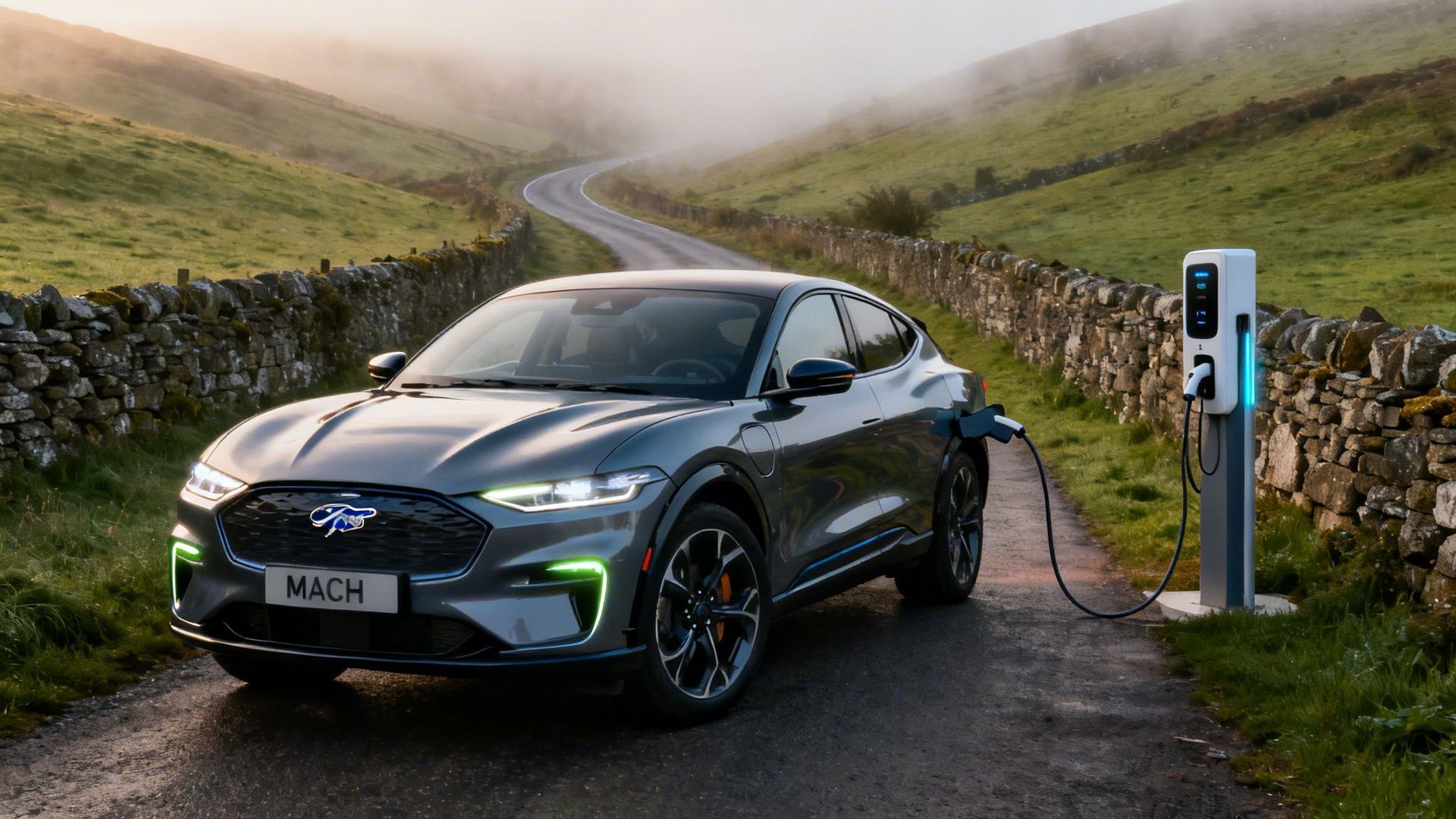
Picture this: you’re stranded in the middle of nowhere, miles from the nearest charging station. Your state-of-the-art electric car, a supposed marvel of modern engineering, now has all the practical utility of a very expensive, very heavy paperweight. This is precisely the nightmare scenario a portable electric car battery charger is meant to solve.
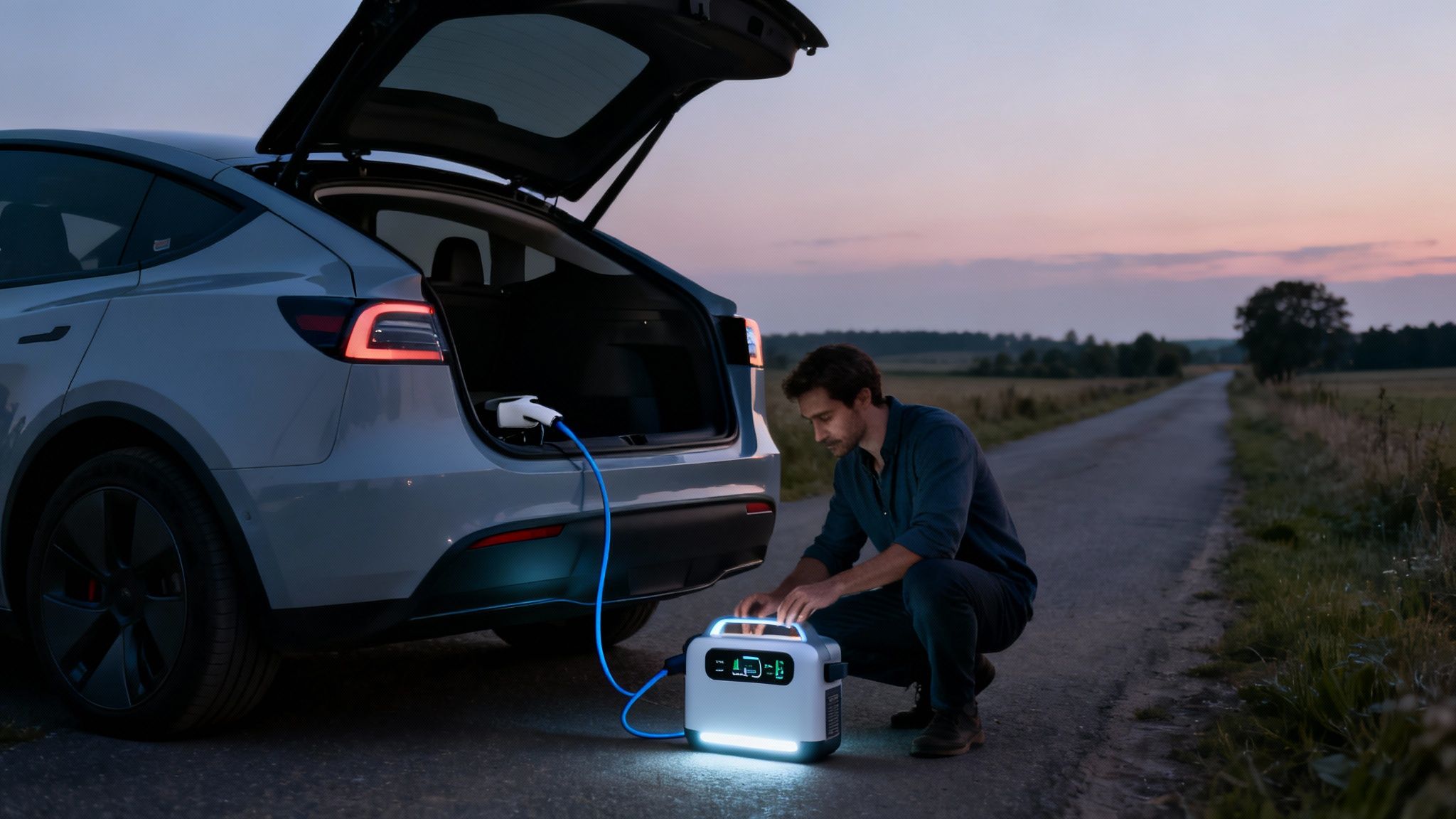
But let's cut through the marketing waffle. It's not a jerry can full of lightning. A better way to think about it is with a simple, slightly depressing analogy. Charging your EV is like filling a swimming pool:
- A public rapid charger is the fire brigade's hose, blasting water in at an incredible rate.
- Your home wallbox is a decent garden hose, steady and reliable for an overnight fill.
- A portable charger is a bucket. It's slow, tedious, and you wouldn't want to fill the whole pool with it, but it'll give you enough to get out of trouble.
Not a Jump Starter, Not Even Close
It's crucial to understand what this gadget isn't. Hordes of people confuse a portable EV charger with a traditional 12V jump starter pack, and they are fundamentally different beasts. A jump starter gives a quick jolt to the car's small 12V battery, the one that powers the lights and radio. It does absolutely sod all for the enormous traction battery that actually moves the car.
A portable electric car battery charger, on the other hand, is designed specifically to top up that main, high-voltage battery. It’s a tool for adding miles of range, not for waking up a dead dashboard.
Think of it this way: a jump starter is like giving a footballer a smelling salt to get them back on their feet. A portable charger is like giving them an energy gel to help them run another mile.
The Real-World Use Case
So, when is this device actually useful? It’s an emergency tool, plain and simple.
It’s for those heart-in-mouth moments when you’ve misjudged your range or found a public charger is, predictably, out of order. It provides just enough power—slowly—to limp to a proper charging point. It is not a replacement for a home wallbox or a convenient way to charge daily.
This is your get-out-of-jail-free card, not a season ticket. Understanding this distinction is the key to avoiding bitter disappointment and using it for its intended, life-saving purpose.
So, How Do These Things Actually Work?
Ever looked at a portable charger and wondered how that little box of tricks gets power from a normal wall socket into your car's massive battery? It’s not magic, although when you’re watching the percentage crawl up, it can certainly feel like a slow-burn miracle.
Let's demystify it. The process is really just a bit of electrical translation. The electricity in your home is Alternating Current (AC) , where the electrical charge zips back and forth. Your car's battery, on the other hand, is a bit more particular; it only accepts Direct Current (DC) , which is a steady, one-way flow.
Your portable charger acts as the interpreter in this conversation. It takes the AC power from your standard three-pin plug, straightens it out, and turns it into the smooth DC your car's battery can digest. Think of it less as a simple 'charger' and more as a sophisticated power converter, making sure your car and your house get along without any electrical arguments.
Meet the 'Granny Charger': Slow and Steady Wins the Race
Most portable chargers you'll come across are what drivers affectionately (or sometimes, frustratingly) call 'granny chargers'. The nickname gives you a pretty good idea of what to expect: they're reliable and get the job done without any drama, but they're not exactly in a hurry. In the industry, this is known as Level 1 charging.
- The Plug: It connects to a standard UK 230V, 13-amp, three-pin socket – the same one you use for your kettle.
- The Power: It sips power very gently, typically delivering around 2.3kW .
- The Speed: This translates to adding roughly 4-8 miles of range for every hour it's plugged in. It’s perfect for an overnight top-up but not much use if you’re trying to get somewhere quickly.
This leisurely pace is precisely why they are best thought of as backup or emergency tools. Trying to fully charge a modern EV with a large battery from empty would take well over a day, maybe even an entire long weekend.
This isn't a fault of the charger. The real bottleneck is your household wiring. A standard socket simply isn't designed to handle the massive power dump of a dedicated charging station. The 'granny charger' is smart enough to know this and deliberately restricts the power draw to avoid tripping your fuses or, worse, starting a bonfire.
This deliberate slowness is also a key feature of the wider public network. In the UK, slower chargers (3-8kW) account for 54% of the 82,002 public charging devices. This makes a portable charger a genuinely useful bit of kit for destination charging when you’ve got time on your hands. You can dig into the latest stats on the UK's charging infrastructure on GOV.UK.
The Heavyweights: Portable DC Chargers
Now we enter a completely different league. If the granny charger is like filling a swimming pool with a garden hose, a portable DC charger is like calling in the fire brigade. These are the special forces of the charging world—incredibly powerful, incredibly effective, and, you guessed it, incredibly expensive.
They work by bypassing your car's onboard AC-to-DC converter altogether and pumping high-voltage DC power straight into the battery. The result is dramatically faster charging, but they need a seriously beefy power source to work. This is why you’ll only find them used by commercial outfits like roadside assistance fleets. You definitely won't see one on the shelves at Halfords.
For the average EV driver, the trusty, slow-and-steady granny charger is the only portable option that makes any real practical or financial sense.
How to Choose a Charger Without Getting Fleeced
Diving into the market for a portable EV charger can feel like navigating a minefield of tech jargon, dodgy claims, and suspiciously cheap gadgets that look like they'd burst into flames if you looked at them funny. Think of this section as your survival guide – a cynical mate whispering in your ear to stop you from wasting your cash on a glorified paperweight.
Choosing the right device isn't about finding the cheapest one on Amazon. It's about finding one that won't turn your very expensive EV into a very large, immobile sculpture. You need to scrutinise the specs as if your car's warranty depends on it, because, well, it probably does.
And this is more important than ever. The UK market for these gadgets was valued at a whopping USD 58.22 million in 2024 and is set to grow at a blistering 21.8% each year. With that much money sloshing around, the cowboys are bound to ride into town. If you want to dig into the numbers, you can learn more about the UK's portable EV charger growth on cognitivemarketresearch.com.
Portable EV Charger Spec Sheet Smackdown
Forget the flashy marketing nonsense for a moment. There are only a handful of specifications that truly matter when you’re trying to separate the contenders from the con artists. These are the non-negotiables that determine whether you’ve bought a useful tool or an expensive mistake.
The table below cuts through the noise and tells you exactly what to look for, what it actually means, and what should send you running for the hills.
| Feature | What to Look For | Why It Matters (No Jargon) | Red Flag to Avoid |
|---|---|---|---|
| Power Output (kW) | Around 2.3kW from a standard 3-pin plug. Adjustable settings are a bonus. | This is the maximum speed you'll get from a normal wall socket. It's slow and steady, adding about 8-10 miles of range per hour. | Wild claims of "fast charging" (e.g., 7kW) from a standard 3-pin plug. It's physically impossible and a flat-out lie. |
| Connector Type | Type 2 connector for the car end. No exceptions. | This is the universal standard for virtually every modern EV in the UK and Europe. The wrong plug makes the charger a useless brick. | Anything other than a Type 2 connector, like a Type 1, unless you have a very specific, older EV like an early Nissan Leaf. |
| Cable Length | A minimum of 5 metres . | A short cable is a nightmare. You'll be forced into precision parking just to reach the socket. 5 metres gives you practical flexibility. | Cables under 4 metres. It might seem like a small difference, but in a tight spot, it's everything. |
| Safety Marks | CE and UKCA markings clearly visible on the product and packaging. | These are your proof that the device has been tested and won't set your car (or your house) on fire. They are non-negotiable. | A complete absence of any safety certifications. It's a huge gamble on a product that handles a lot of electricity. |
| IP Rating | At least IP55 . Ideally, IP65 or higher. | This number tells you how well it stands up to dust and water. Given our lovely British weather, a higher number means less worry. | No IP rating listed, or anything below IP44. You don't want rain to be a death sentence for your charger. |
Ultimately, getting these five things right means you're buying a safe, effective tool that will do the job when you need it most. Getting them wrong is just asking for trouble.
A Quick Visual on How It All Works
Before we dive deeper into safety, here’s a simple visualisation of the process you're investing in. It's just a simple chain from your wall socket, through the charger, and into your car.
The portable charger is the crucial middleman here, taking standard household electricity and safely converting it into a format your EV’s battery can accept. Your choice of device determines how safely and efficiently this all happens.
Why Safety Certifications Are Not Optional
Right, let's talk about the bit that stops your car from becoming a bonfire. A legitimate portable charger will be plastered with safety certifications. If it's missing these, avoid it like you'd avoid a warm pint.
Buying an uncertified charger is like hiring a dodgy electrician who learned their trade from a YouTube video. It might work for a bit, but the ending is likely to be smoky, expensive, and involve the fire brigade.
Seriously, don't skimp on this. Look for these critical marks:
- CE Mark: This is the European standard for health, safety, and environmental protection. It's a fundamental sign of a properly manufactured product.
- UKCA Mark: This is the UK's post-Brexit equivalent of the CE mark. Any new electrical product sold in Great Britain should have this. If it doesn’t, it’s a big warning sign.
- IP Rating: This stands for 'Ingress Protection' and tells you how resistant the device is to dust and water. Given the famously predictable British weather, you should look for a minimum of IP55 (dust protected and can withstand low-pressure water jets), but IP65 or IP67 is much better, offering robust protection against our relentless drizzle.
Spending a little extra on a reputable brand with these badges isn't an upsell; it's a very sensible investment in not having to explain a melted charging port to your insurance company.
The Reality of Using a Portable Charger in Britain
So, you’ve taken the plunge and bought one. It’s unboxed, feels reassuringly solid, and is now tucked away in your boot, ready for whatever the road throws at you. Congratulations, you're now part of the prepared drivers' club. But what’s it really like using a portable electric car battery charger out in the wild, often damp, landscape of Great Britain?
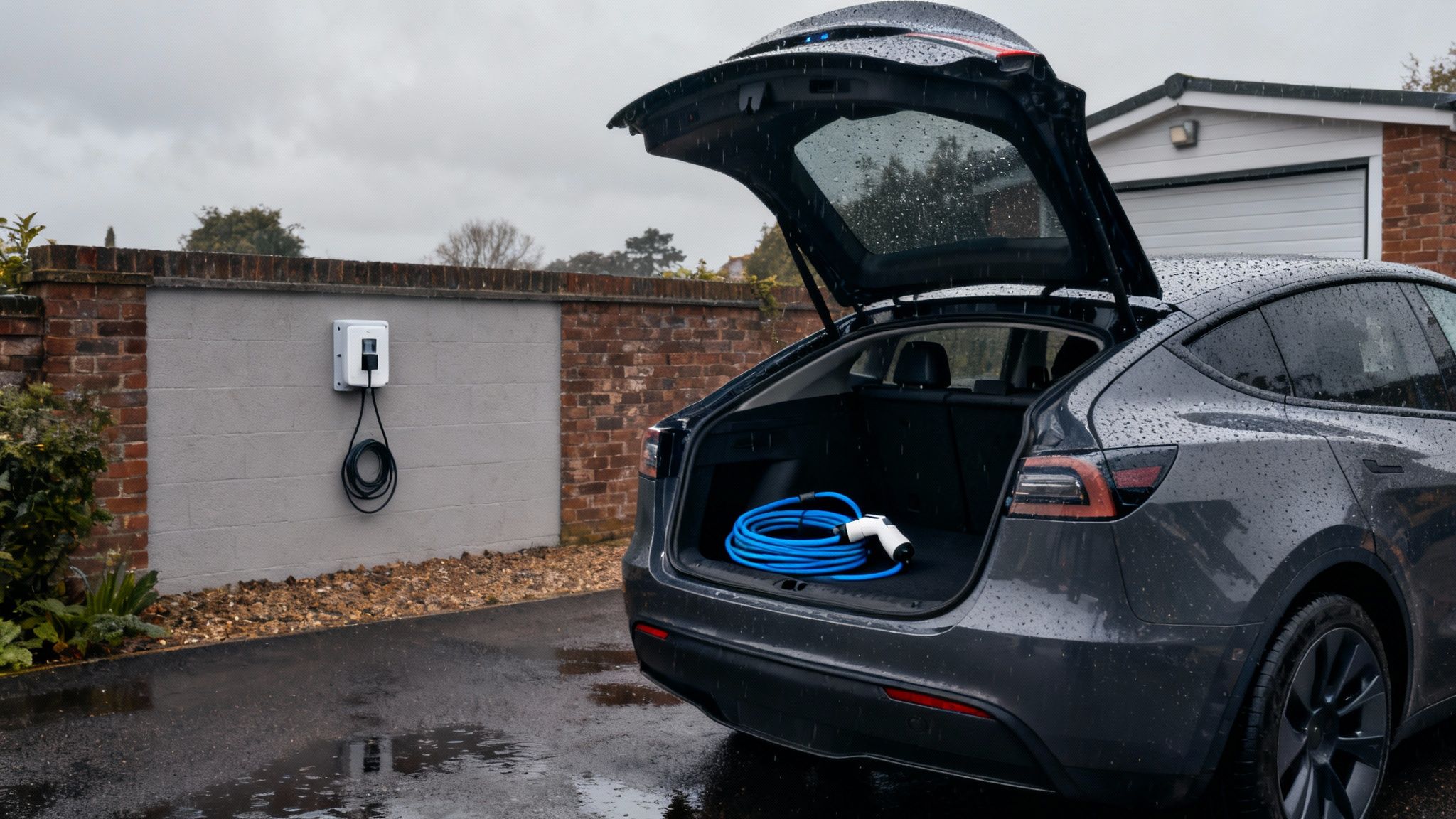
Think of this as the brutally honest user manual the manufacturer was too optimistic to include. Let's kick off with your first, and often trickiest, challenge: the great British socket hunt. Finding a usable outdoor socket can feel a bit like searching for a politician who gives a straight answer—you know they exist in theory, but finding one when you actually need it is another matter entirely.
This leads us to a crucial bit of etiquette. Before you even think about plugging into your mate’s garage or that conveniently placed socket on the side of a pub, you absolutely must ask permission. Silently siphoning off their electricity is a fast track to being struck off the Christmas card list for good.
Charging Speeds: The Cold, Hard Truth
Alright, let's tackle the elephant in the room: charging time. Manufacturers love to advertise impressive-sounding figures, but the reality of topping up from a standard UK three-pin socket is, to put it mildly, a leisurely affair. This isn't a quick splash-and-dash; it's more like a slow, overnight brew.
To save you from a wave of crushing disappointment later, let's manage those expectations right now.
- Average Gain: You can realistically expect to add somewhere between 4 to 8 miles of range per hour .
- Best-Case Scenario: On a good day, with a tailwind and a very efficient car, you might just nudge 10 miles per hour .
- The Big Picture: To get enough juice for a 50-mile trip, you’re looking at a commitment of at least 5-6 hours.
This glacial pace really cements the portable charger's role as a tool for emergencies. It’s there to get you just enough power to escape a sticky situation, not for a full recharge before a long journey up the M1.
Think of it as a first-aid kit for your EV's battery. It’s designed to stabilise the patient and get them safely to a proper hospital (a fast charger), not to perform open-heart surgery on the hard shoulder.
Safety in Our Damp Climate
Using any high-power electrical device outdoors in Britain calls for a healthy dose of common sense. As we all know, electricity and our national obsession with drizzle are not the best of friends. Your charger's IP rating is your guide here; an IP65 rating means it can shrug off a bit of rain, but that’s not an invitation to leave it sitting in a puddle.
Always do your best to keep the charger unit and the plug connection as sheltered and dry as you can. And please, never use a standard indoor extension lead. They simply aren't built for the sustained power draw or the damp conditions. If you absolutely must use an extension, make sure it’s a heavy-duty, outdoor-rated cable designed for the job.
Taming the Cable Python
Finally, a word on storage. If you just chuck the cable into your boot after you're done, it will magically transform itself into a python’s nest of knots by the next time you need it. Learning to coil it properly is a simple skill that will save you a world of frustration.
Follow these simple steps to keep your cable from becoming a tangled beast:
- Start at the Charger: Hold the main charger unit in one hand.
- Create Loops: With your other hand, create loose, even loops of the cable, about the size of a dinner plate.
- Alternate Direction: This is the secret trick. To stop it from twisting, coil one loop over your hand and the next one under.
- Secure It: Use the Velcro strap it came with (or just buy one) to tie the coiled cable together neatly.
This simple routine turns a potential mess into a compact, manageable tool that’s ready to go the moment disaster strikes. Welcome to the practical, and yes, slightly damp, reality of owning a portable EV charger.
When You Need One Versus When a Wallbox Is Better
Let's get one thing straight from the outset. A portable electric car battery charger is not a replacement for a proper home wallbox. Thinking it is, is like bringing a Swiss Army knife to a construction site and expecting to build a house. They're different tools for entirely different jobs.
This little gadget is a specialist, a master of awkward situations where a proper charger is either impossible to install or simply isn't there. It's the flexible friend you call on when your main plan falls through. A wallbox, on the other hand, is the bedrock of daily EV ownership—the powerful, reliable workhorse you depend on.
This section is all about drawing a clear line in the sand. We'll show you exactly when a portable charger is an absolute godsend, and when you’d be mad not to invest in a dedicated wallbox.
The Portable Charger: Your Get-Out-of-Jail-Free Card
Think of a portable charger as your trump card for those tricky moments. It shines brightest when permanence and high-speed charging are off the table.
Here are the scenarios where it’s a real lifesaver:
- You're a Renter: Your landlord isn’t exactly thrilled about you drilling into their pristine wall for a permanent charging point. A portable charger lets you top up from a standard three-pin socket with zero installation drama.
- Visiting the In-Laws in the Sticks: You’re heading to a remote cottage where the most advanced tech is a toaster. With a portable charger, you can trickle-charge overnight from their garage socket, making sure you have enough juice to make a quick getaway... I mean, leave the next day.
- The Emergency Backup: Your fancy home wallbox has thrown a wobbly and is on the fritz. The portable charger you cleverly stashed in the boot becomes your temporary lifeline, keeping your EV topped up while you wait for the electrician.
- Occasional Topping Up: Maybe you have a plug-in hybrid with a small battery, or you only use your full EV for short local trips. In this case, the slow overnight charge from a portable unit might be all you really need.
In essence, the portable charger is for filling the gaps. It’s for the ‘what if’ moments and the situations where a permanent fixture just isn’t an option. It gives you freedom and flexibility, but what you trade for that convenience is speed and smart features.
The Wallbox: The Undisputed Heavyweight Champion
Now, let's talk about the proper tool for the job. If you own your home and have a driveway or garage, a professionally installed wallbox isn't a luxury; it's a fundamental part of EV ownership. It's better than a portable charger in almost every meaningful way for daily use.
First and foremost is speed . A typical 7kW wallbox will charge your car at least three times faster than a portable charger plugged into a domestic socket. That’s the difference between getting a full charge comfortably overnight versus it taking well over 24 hours.
Then there's safety and convenience . A wallbox is a dedicated, weatherproof, professionally installed circuit. You’re not left worrying about overloading your home's wiring, and there are no cables trailing awkwardly out of a window. It’s a robust, permanent solution designed for one thing: charging your car safely and efficiently.
Finally, you get the smart features . Modern wallboxes are clever bits of kit. They can:
- Schedule Charging: Set it to charge only during off-peak hours (like the middle of the night) when electricity is cheapest, which can save you a serious amount of money over a year.
- Track Usage: Many have companion apps that monitor exactly how much electricity you're using. This is perfect for company car drivers who need to expense their charging costs.
- Integrate with Solar: Some advanced units can even link up to your home solar panels, letting you charge your car with genuinely free, green energy from the sun.
The UK's charging market highlights this dynamic. While valued at an enormous USD 745.87 million in 2025, the growth in public infrastructure shows how different charging speeds serve different needs. In 2025 alone, 6,220 new slow chargers (under 8kW) were added across the country. These often complement home charging, providing more opportunities where a portable charger could be useful at a destination. You can find more details in this report on the UK's EV charging market growth on researchandmarkets.com.
To make it crystal clear, here's a simple breakdown of which tool to use and when.
Charger Showdown: Portable Brick vs. Wallbox Titan
This table breaks down the ideal use-case for each type of charger. It’s all about picking the right tool for the right job to avoid frustration.
| Scenario | Portable Charger (The Flexible Friend) | Home Wallbox (The Powerhouse) |
|---|---|---|
| Daily Commuting | Not ideal. Too slow for a full daily top-up. | Perfect. Fast, reliable overnight charging. |
| Renting a Property | Winner. No installation needed, just a plug socket. | Not practical without landlord's permission. |
| Visiting Friends/Family | Winner. Take it with you for an overnight trickle charge. | Not an option unless they also own an EV. |
| Emergency Backup | Essential. A great safety net if your main charger fails. | This is your main charger. |
| Cost Savings | Cheaper upfront, but can't use smart off-peak tariffs. | More expensive to install, but smart scheduling saves money long-term. |
| Charging Speed | Very slow ( ~2.3kW ). Think 15-30 hours for a full charge. | Much faster ( 7kW+ ). A full charge overnight is standard. |
| Safety & Convenience | Requires care with extension leads and weather. | Dedicated, weatherproof circuit. Plug in and forget. |
Ultimately, the choice is simple. The wallbox is your day-to-day strategy for a hassle-free EV life. The portable charger is your brilliant backup plan.
Your Portable EV Charger Questions Answered
Right, you’ve waded through the technical specs, the practical realities, and the sheer choice of chargers out there. But a few nagging questions are probably still bouncing around your brain. Let's tackle them head-on.
This is your rapid-fire FAQ session – the final debrief before you part with your hard-earned cash. Think of it as a dose of realism to make sure you know exactly what you’re getting into.
Can I Use a Portable EV Charger in the Rain?
Honestly, you'd have to be a bit brave to try it without first checking the IP rating. That little code is your only real defence against our nation's perpetually damp climate.
While some chargers are designed to be weatherproof ( look for IP65 or higher ), remember that electricity and water are not, and never will be, the best of mates. It is always, always safer to find a sheltered spot for the main unit and the plug socket. Don't be the person who fuses the entire street just to get 10 miles of range during a downpour.
Will a Portable Charger Damage My Car's Battery?
Not if you buy a reputable one that meets UK safety standards. This is completely non-negotiable. Look for the CE and UKCA marks of approval; they are your assurance that the device isn't a ticking time bomb built in a shed.
A properly certified portable charger 'talks' to your car's battery management system. It negotiates the power delivery to ensure everything is done safely, protecting your expensive battery from any harm.
The real danger comes from the cheap, uncertified tat you find on sketchy websites. Your EV's battery costs more than a small hatchback; don't risk turning it into a very large paperweight just to save £50 on a charger.
How Many Miles Do I Actually Get Per Hour of Charging?
Forget the ridiculously optimistic numbers you might have seen in the marketing blurb. In the real world, hooked up to a standard UK 3-pin socket, you're looking at a gain of about 4 to 8 miles of range for every hour of charging .
Yes, it’s painfully slow. But that's the point. It’s designed for two specific scenarios: a slow overnight top-up or getting just enough charge to limp to a proper fast charger. It is absolutely not intended for a quick splash-and-dash before a long journey. Patience is a virtue, especially when you’re at the mercy of a ‘granny charger’.
Can I Just Plug It Into Any Old Extension Lead?
Absolutely not. Please don't do this. A standard, flimsy indoor extension lead is not designed to handle the sustained high-power draw needed to charge a car, even at a slow rate.
Using one is a significant fire risk. The cable can overheat, melt, and potentially cause a very serious incident. If you absolutely must use an extension, it needs to be a heavy-duty, outdoor-rated one specifically designed for high-current applications. Even then, it's far from ideal.
Is It Legal to Run a Cable Across the Pavement?
This is a massive grey area and a potential legal minefield. Technically, creating a trip hazard on a public pavement could land you in hot water with your local council. More importantly, it could leave you liable if someone takes a tumble over your cable.
If you have to do it as a last resort, you are obliged to use a proper, heavy-duty cable protector or ramp to cover it safely. Even then, it’s generally frowned upon and should be seen as a solution for a genuine emergency, not your go-to daily charging plan.
Will It Send My Electricity Bill Through the Roof?
Well, it’s not free. Charging your car at home will, of course, increase your electricity bill. However, because a portable charger uses a standard plug, you’ll be paying your normal domestic rate for every kilowatt-hour you use.
Compared to the often eye-watering prices of public rapid chargers, a slow overnight top-up at home is almost always the cheaper option. Just don't expect it to be quick.
At VoltsMonster , we cut through the noise to give you the real story on all things EV. For more brutally honest reviews, guides, and industry commentary, check out our latest content at https://www.voltsmonster.com.
VoltsMonster Electric Vehicle Blog