Electric Car Real World Range: The Unvarnished Truth
Let's be honest, the advertised range of an electric car is a bit like a politician's promise—brilliant in theory, but often a damp squib in reality. The electric car real world range is almost always lower than the official figure, sometimes dramatically so, but the good news is that for most UK drivers, it's still more than enough for a typical week's pottering about. This is your no-nonsense guide to what you’ll actually get.
The Great British Range Robbery
Let’s cut through the marketing fluff. The range figure plastered all over a shiny new EV is about as realistic as a dating profile picture from ten years ago. It’s an idealised, airbrushed version of the truth, achieved in a sterile lab where the sun is always shining, the road is perfectly flat, and traffic jams simply don't exist. This utopian number is called the WLTP figure, and we'll dissect that beast later.
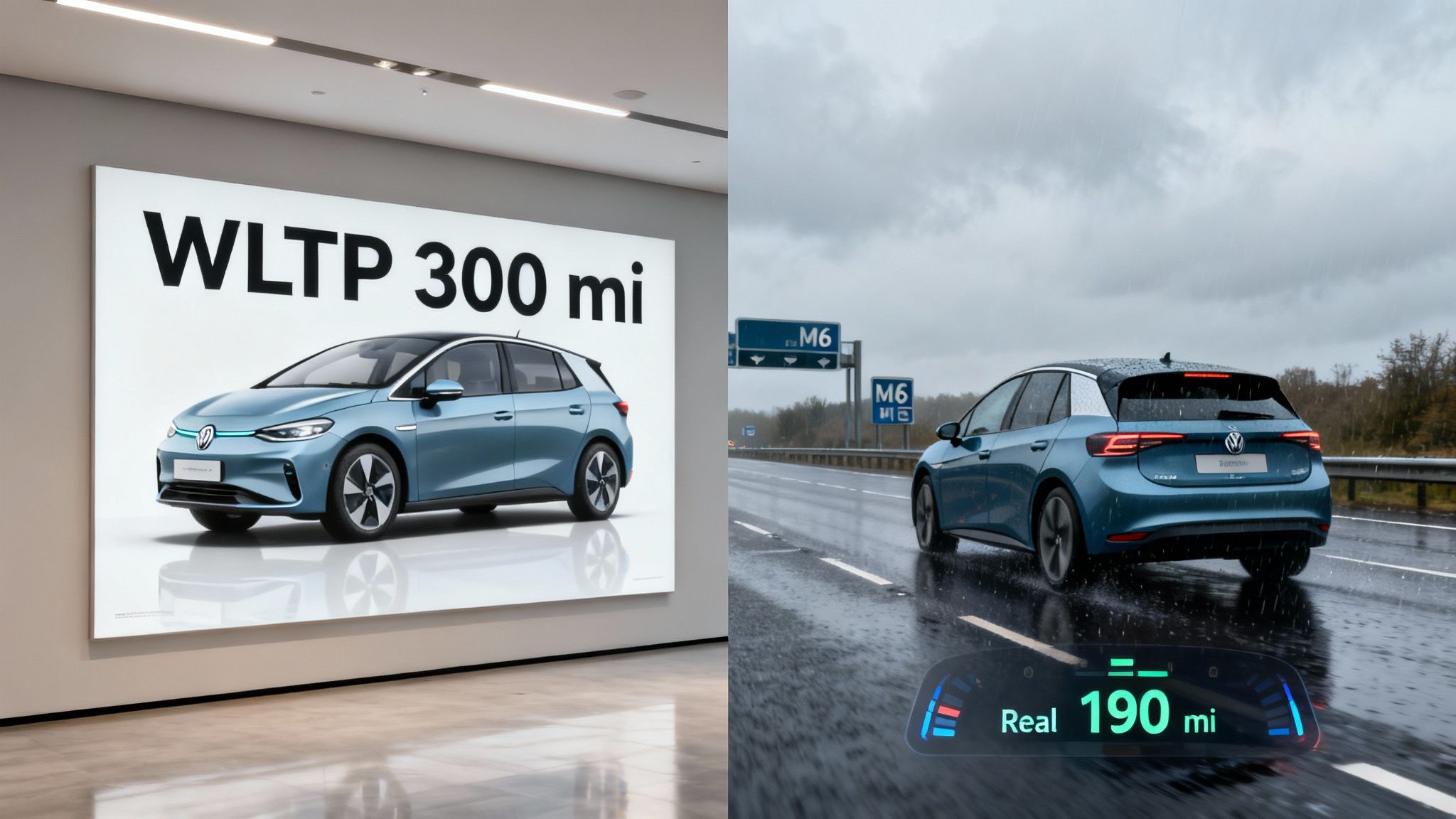
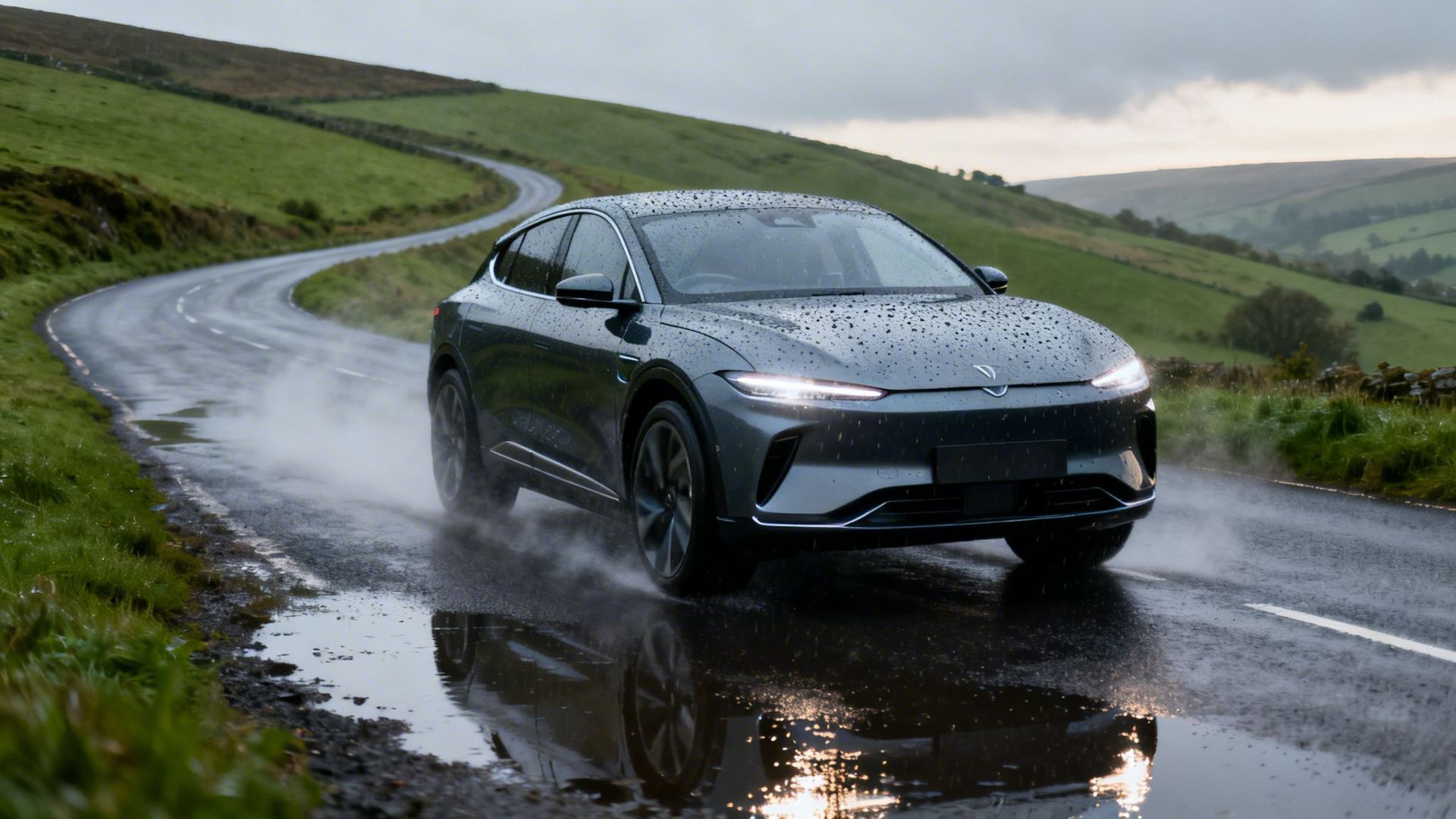
The reality, of course, is a miserable Tuesday morning schlep up the M6 in February. It's bucketing down, you've got the heater on full blast to demist the windscreen, and the battery gauge is dropping faster than your will to live. This is the chasm between the brochure and the B-road, the gap between the promise and the grim reality of British driving conditions.
Why The Big Difference Then?
So, what's behind this great discrepancy? Simply put, real life gets in the way. Unlike the meticulously controlled environment of a test lab, your daily drive is a chaotic mess of variables, each one nibbling away at your precious miles.
- The Glorious British Weather: Cold temperatures are the arch-nemesis of an EV battery. They slow down the chemical reactions inside, while also forcing you to crank up the cabin heating, which is a massive power drain.
- Your Right Foot: Driving like you're trying to qualify for the British Grand Prix will decimate your range. Smooth and steady wins the efficiency race.
- The Terrain: That scenic, hilly route through the Peak District? Your car’s battery hates it. Climbing hills requires a colossal amount of energy.
- The Clutter: Hauling around the entire family, the dog, and half of IKEA's flat-pack furniture adds weight, which in turn demands more energy to move.
The core takeaway is this: advertised range is a benchmark, not a guarantee. Think of it as the absolute best-case scenario , which you'll probably never encounter outside of a perfect summer's day with a tailwind.
But before you throw your hands up in despair and run back to the petrol station, here's the crucial bit. Even with all these range-sapping factors, the actual distance most modern EVs can cover is still more than sufficient.
The average Brit drives just 127 miles per week . A car with a 'real' winter range of 180 miles will handle that with laughable ease, needing just one top-up. The key isn't to fixate on the mythical WLTP number, but to understand your own driving needs and the real-world performance of the car you're eyeing up.
Decoding WLTP: Why Official Range Figures Are A Fantasy
Let's get one thing straight about the official range figures you see advertised for electric cars. They're optimistic. Wildly optimistic. The number you see is the WLTP figure, and understanding what it really means is the first step to becoming a savvy EV owner.
WLTP stands for Worldwide Harmonised Light Vehicle Test Procedure . It’s a standardised laboratory test designed to make comparing different EVs fair and simple. Think of it as a car’s GCSEs – everyone sits the same exam under the same controlled conditions.
The trouble is, those conditions are a bit like a perfect summer’s day that never actually happens in Britain. The test is a huge improvement on the old, even more fanciful NEDC standard, but it still doesn't come close to replicating a typical journey from, say, Manchester to Leeds on a wet Tuesday morning.
At its core, the WLTP test puts a car on a rolling road in a climate-controlled room. It then runs through a very specific cycle of gentle acceleration and braking. There’s no headwind, no steep hills, no surprise traffic jam on the M6, and certainly no need to crank up the heater to demist the windscreen.
The Perfect Lab vs Gritty UK Roads
The WLTP test is designed to simulate a mix of driving situations, but the numbers tell the real story. The entire test lasts just 30 minutes , with an average speed of only 28.8 mph . It’s a gentle, predictable drive that bears little resemblance to the stop-start chaos of a real British commute.
This is precisely why your electric car's real-world range often feels like a letdown. On UK roads, it's common for an EV to achieve 10-20% less than its official WLTP range. The Society of Motor Manufacturers and Traders (SMMT) notes that while the average new EV has a WLTP range of 236 miles , most owners see something closer to 189-212 miles once you factor in our grim winters and motorway speeds. For more on this, the RAC has some excellent real-world findings.
To really see the difference, it helps to put the lab test head-to-head with a typical day on UK roads. The gap between the lab coat and the raincoat is telling.
WLTP Test vs UK Driving Reality: A Stark Contrast
This table breaks down exactly why those official figures don't quite stack up when you hit the tarmac.
| Factor | WLTP Test Conditions | Typical UK Real World Conditions |
|---|---|---|
| Temperature | A lovely 23°C (and sometimes 14°C ) | Anything from a frosty -5°C to a sweltering 30°C during that one week in July. |
| Terrain | A perfectly flat rolling road | Potholed A-roads, steep inclines in the Peak District, and endless motorway drags. |
| Vehicle Load | Just the driver (or an equivalent weight) | A family of four, the dog, and a boot packed with the weekly shop. |
| Climate Control | Switched off completely | Air-con on full blast or the heater working overtime to keep you from freezing. |
| Driving Style | Smooth, pre-planned acceleration and braking | Punchy acceleration to merge; sharp braking for someone who's just pulled out. |
| Tyres | Special low-resistance tyres at perfect pressure | Standard tyres, often a bit under-inflated, gripping a wet, greasy road surface. |
As you can see, the lab is a utopia for battery performance. Our roads are anything but.
The WLTP figure is a tool for comparison, not a crystal ball for prediction. Use it to judge one EV against another, but never, ever treat it as a promise of what you’ll actually achieve.
So, while the WLTP number provides a vital benchmark for comparing models, you need to take it with a massive pinch of salt. It represents the absolute best-case scenario. Now, let’s look at the real-world factors that are constantly trying to drain your battery.
The Usual Suspects: How to Lose Miles Without Trying
So, you've realised the official range figure on the sticker is about as reliable as a weather forecast for a bank holiday weekend. Good. Now, let’s meet the crew of culprits responsible for pilfering your precious miles. These aren't mysterious gremlins in the wiring; they're the everyday factors that can turn a comfortable journey into a nail-biting hunt for the nearest charging point.
Getting to grips with what drains your battery is the first step to mastering your EV. Once you understand their game, you can start to fight back.
The Winter Vampire
First up is the most notorious range-killer of them all: the cold. Winter is the arch-nemesis of an electric car battery, and it attacks on two fronts. Neither is good for your mileage.
For a start, the lithium-ion battery itself just doesn't like the cold. Low temperatures slow down the chemical reactions inside, making it sluggish and less efficient at delivering power. At a biting -15°C , some research suggests an EV can lose almost half of its range, dropping to just 54% of what you'd see on a warm summer's day.
But the bigger drain often comes from you. In a petrol or diesel car, the engine produces huge amounts of waste heat, which is simply piped into the cabin to keep you warm. An EV has no such luxury. Every bit of warmth—from the cabin heater to your toasty seat and steering wheel—is drawn directly from the main battery. Blasting the heater can pull between 3,000 and 5,000 watts , a colossal drain that sacrifices miles for comfort.
Captain Leadfoot
We all have a bit of Captain Leadfoot in us. It’s that urge to plant your foot at a green light, enjoying that instant electric torque. But giving in to your inner speed demon is a sure-fire way to decimate your range.
Conventional engines are at their least efficient in town, but electric motors are the complete opposite; they excel in stop-start traffic. It's on the motorway where they really have to work hard. The energy needed to overcome air resistance increases exponentially with speed, so pushing a two-tonne car through the air at 70 mph takes a monumental effort.
Just increasing your speed from 60 mph to 70 mph can increase energy consumption by over 20% . The best defence is a smooth driving style. Look ahead, anticipate traffic, and lift off the accelerator early to let the regenerative braking do its work, rather than relying on the brake pedal.
The Heavy Packer
Next up is the well-intentioned family member who packs for a weekend away as if preparing for a polar expedition. Three suitcases, the dog, the cool box, and that bit of furniture you promised to drop off at your sister's—it all adds up.
It’s simple physics: the more weight your car has to move, the more energy it needs. A few bags of shopping won't make a difference you'd notice, but loading the car to the roof for a family holiday certainly will.
The rule of thumb is straightforward: more weight equals less range. Before a long trip, it’s worth having a ruthless clear-out. That old box of books you’ve been meaning to take to the charity shop? It’s costing you miles every day it sits in the boot.
Each of these factors might only shave off a few miles on its own, but when they team up, the effect can be dramatic. The Winter Vampire, Captain Leadfoot, and The Heavy Packer are a formidable trio.
The Supporting Cast of Criminals
The rogues' gallery doesn’t stop there. A few other culprits are always lurking, ready to chip away at your battery.
- The Hill Dweller: Driving up steep hills is the automotive equivalent of running up stairs. It takes a huge burst of energy. You’ll get some of it back through regenerative braking on the way down, but it’s never a 100% return.
- The Tyre Tyrant: This is a silent but costly villain. Under-inflated tyres increase rolling resistance, meaning the motor has to work harder just to keep the car moving at a steady speed. Checking your pressures once a month is one of the easiest wins for maximising range.
- The Climate Criminal: We've covered heating, but the same goes for cooling. As soon as the sun makes a rare appearance, blasting the air conditioning puts another significant demand on the battery. On a properly hot day, the AC can easily reduce your range by 10-15% .
By understanding how these factors work, you can start to minimise their impact. You can't change the weather or flatten hills, but you can change your driving habits. A lighter foot, properly inflated tyres, and a sensible approach to the climate control will turn you from a victim of range anxiety into a master of EV efficiency.
Real-World Range for Real British Roads
Right, let's move on from the lab tests and get down to what really matters: how far can you actually go on a single charge on British roads? Forget the glossy brochures for a moment. This is what you can genuinely expect from some of the UK’s most popular electric cars, warts and all.
We've picked a few models you'll see everywhere and put their numbers under the microscope. For each one, we’ll compare the official WLTP figure with a realistic summer range and, crucially, what to expect during a bleak British winter.
The Family Favourite: Tesla Model Y
The Model Y is a common sight on our roads for good reason. It’s hugely practical, crammed with clever tech, and boasts a fantastic official range. But how does it really stack up day-to-day?
- Official WLTP Range: 331 miles
- Realistic Summer Range: Around 270-290 miles . That’s more than enough for a family trip to the seaside without any range anxiety.
- Grim Winter Range: This is where it bites, dropping to about 210-230 miles . Still plenty for the weekly shop and school run, but that long drive to see relatives might need a planned stop.
In stop-start city traffic, the Model Y is brilliant; its regenerative braking constantly tops up the battery. It's out on the motorway where you’ll see the range tumble, especially when it's cold. It's a superb all-rounder, but even a Tesla can't beat physics.
The Sensible Choice: Kia Niro EV
The Kia Niro EV feels like the comfortable, reliable hatchback you've always known, just with a battery. It's not trying to be flashy—it just gets the job done exceptionally well.
- Official WLTP Range: 285 miles
- Realistic Summer Range: A very respectable 240-250 miles . This comfortably covers almost any daily or weekly driving routine.
- Grim Winter Range: Expect this to fall to around 180-200 miles . The drop is noticeable, but for the price, it remains a seriously capable car.
This car truly comes into its own on A and B-roads, where its efficiency really shines. It's less at home cruising at 70 mph for hours, where its boxier shape means the battery drains faster than a sleeker car like the Tesla. For the typical UK driver, though, its real-world range is spot on.
The Plucky Brit: Vauxhall Corsa Electric
A familiar face with a new electric heart. The Corsa Electric is a fantastic first step into the world of EVs. Its smaller battery means you need to be a bit more conscious of range, but its real-world figures are refreshingly honest.
- Official WLTP Range: 222 miles
- Realistic Summer Range: You’ll get about 180-190 miles in good weather. Perfect for zipping around town and handling the daily commute.
- Grim Winter Range: Dips to 130-140 miles . This is when you'll need to think ahead, but for local journeys, it’s perfectly fine.
The Corsa is in its element on city streets. It's nimble, easy to park, and barely uses any electricity in traffic. A long motorway trek in the middle of winter, however, will definitely require some careful planning around charging stops.
This infographic neatly sums up the main things that chip away at your car's range.
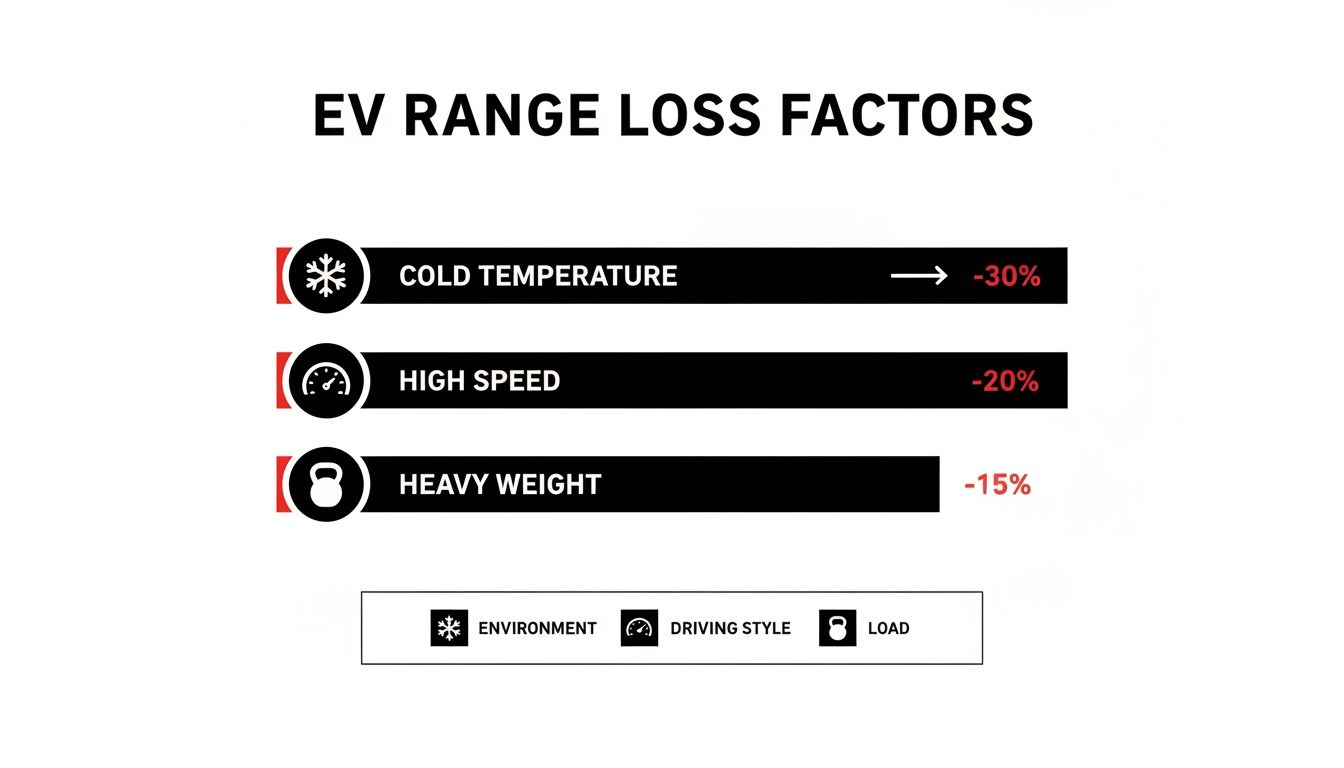
As you can see, cold weather is the biggest villain by far, but speed and weight are two major factors that are much more in your control.
The crucial thing to remember is that even the 'worst-case' winter range of these cars is often more than enough for the average driver. They are designed for the typical short trips that make up most of our driving lives.
In fact, the average UK driver covers just 127 miles a week, which fits easily within these real-world capabilities. With newer EVs now averaging a real-world range of 232-261 miles , it's clear there's plenty of breathing room for our nation's short-trip culture. Considering the average supermarket run is 11 miles and a family visit is just 22, a single charge can easily last you days. You can discover more insights about EV usage on Autotrader.co.uk to see how the numbers stack up.
How to Become a Range-Extending Guru
Right, enough of the doom and gloom. We’ve unmasked the villains trying to steal your precious miles, but now it’s time to fight back. Mastering your electric car's real-world range isn't about becoming a hypermiling hermit or crawling along at 40 mph. It’s about learning a few simple tricks that make a genuine, noticeable difference.
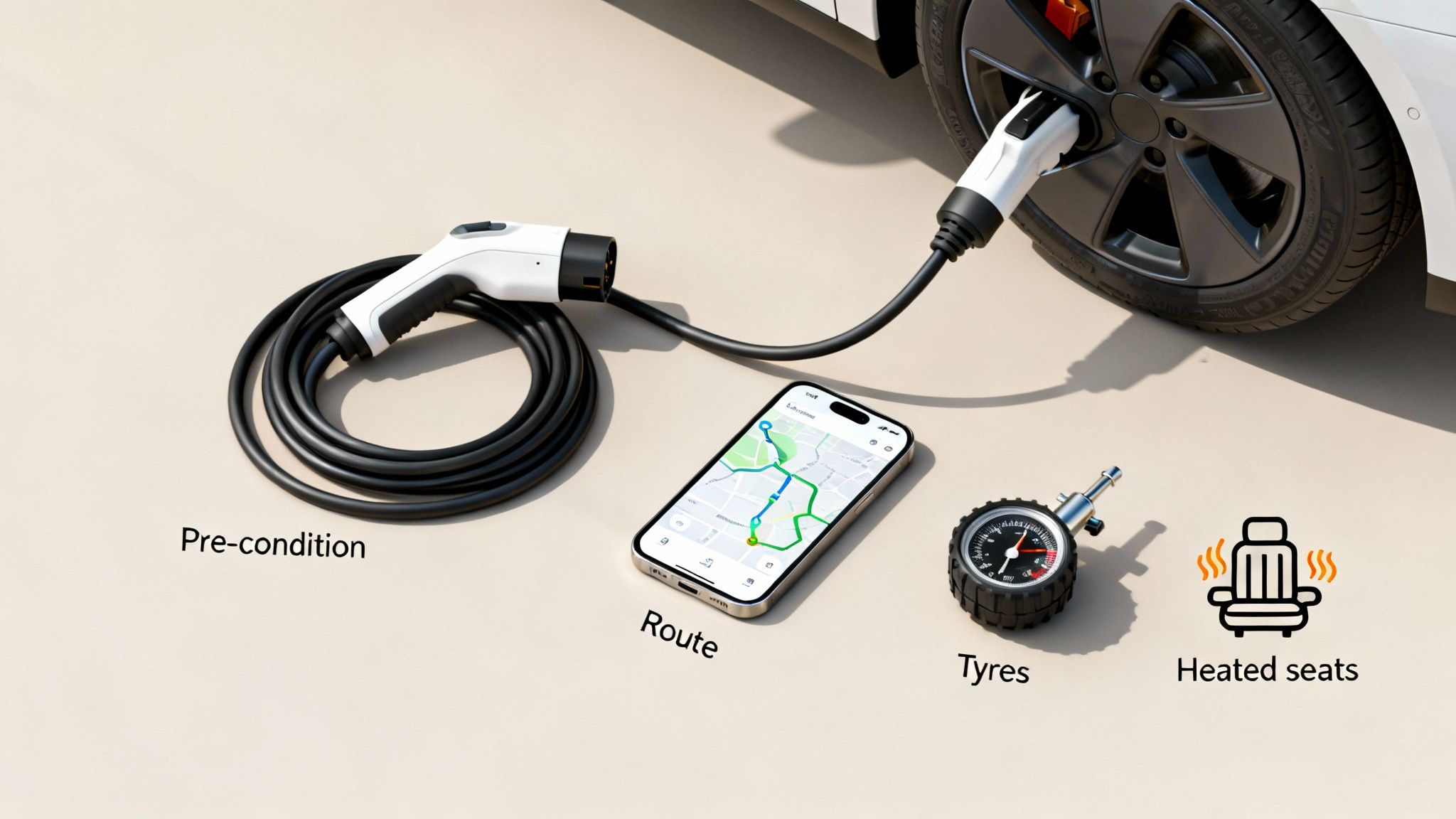
Think of it less like a science exam and more like discovering the cheat codes for your car. Once you know them, you’ll wonder how you ever managed without.
Master the Art of Pre-Conditioning
This is the single biggest win for winter driving, and honestly, it feels like magic. Pre-conditioning is just a fancy way of saying you warm (or cool) the car's cabin and battery while it's still plugged into the charger.
By doing this, you're drawing power from the grid, not your car's precious battery reserves. You get to slide into a perfectly toasty car on a frosty morning and set off with 100% of your range intact. Forgetting to do this and blasting the heater from a cold start can instantly wipe 10-20 miles off your predicted range, so this is an absolute game-changer.
Embrace the Heated Seat
Here’s a fun fact for you: heating all the air inside your car is ridiculously inefficient. It’s like trying to warm a cathedral with a single candle. A far smarter way to stay warm is to use your heated seats and, if you have one, a heated steering wheel.
These features use a tiny fraction of the energy compared to the main cabin heater—we're talking around 75 watts versus a whopping 3,000-5,000 watts . They transfer heat directly to you, making you feel just as cosy while preserving a huge chunk of your range.
Become One with Regenerative Braking
Every EV has regenerative braking, a clever system that turns the electric motor into a generator the moment you lift off the accelerator. It recaptures energy that would otherwise be lost as heat during braking and sends it straight back to the battery.
To make the most of it, you need to adjust your driving style a little. Instead of racing towards the next red light and slamming on the brakes, look ahead and anticipate the stop. Lift off the accelerator early and let the car slow itself down smoothly. The more you can avoid touching the actual brake pedal, the more energy you’re clawing back. It effectively turns every traffic jam into a mini-charging session.
Think of the accelerator as a single pedal for both going and slowing. A smooth foot means a happy battery and more miles in the bank. It's the closest you'll get to creating your own fuel.
A few more simple habits can make a surprising difference and keep you well away from the dreaded "limp home" mode.
- Check Your Tyres: Under-inflated tyres increase rolling resistance, forcing the motor to work harder. Check the pressures monthly—it takes five minutes and is one of the easiest ways to gain a few extra miles.
- Plan Your Journey: Modern EVs have brilliant navigation systems that will plan your route, including necessary charging stops. Trust the tech. A 20-minute rapid charge while you grab a coffee is far less stressful than sweating over the last 5% of your battery.
- Lighten the Load: Are you still hauling that box of junk to the tip from three months ago? Get rid of it. Every bit of extra weight requires extra energy to move.
Finally, try not to fret about finding a top-up. The UK's public charging network has exploded in recent years, growing by over 400% since 2020 , with nearly 87,000 public chargepoints now available. This robust infrastructure means there's roughly one charger for every four miles of road, making day-to-day EV use entirely practical, even with range fluctuations. Discover more stats about the UK's impressive EV market on Zapmap.
So, What's the Bottom Line?
After all the talk of lab tests, real-world driving, and the long list of things that can drain your battery, it’s easy to feel a bit lost. But the main takeaway is surprisingly simple: that big range number you see in the brochure is just a starting point, not the final word. And honestly, that's perfectly okay.
The truth is, the electric car real world range you'll actually get is almost certainly more than enough for your day-to-day life.
Let's cut to the chase. Range anxiety is mostly a fear of the unknown. Once you get a feel for how your EV responds to different conditions—a cold morning, a motorway sprint, a car full of passengers—you're no longer just a spectator. You’re in the driver's seat, literally and figuratively. You learn to adapt and suddenly, that long trip doesn’t seem so daunting.
Think about it: the average UK driver clocks up just 127 miles a week . Even a smaller EV, with its range slightly clipped by a chilly British winter, can manage that on a single charge with juice to spare. All while petrol prices continue to do their thing.
Don't get hung up on chasing a mythical maximum range figure. The real win is understanding your car and how your driving habits influence the distance you can cover.
Ultimately, knowledge is the best antidote to range anxiety. With the insights from this guide, you can pick the right EV and drive it with confidence, knowing exactly what to expect on British roads. It’s not about the number on the tin; it’s about making that number work for you. Welcome to smarter, calmer, electric driving.
A Few Lingering Questions?
Got a couple of questions still buzzing around? It’s completely normal. Let's tackle some of the most common ones we hear about an EV's real-world range.
Does Rapid Charging Wreck the Battery?
Using a rapid charger every now and then is absolutely fine – that’s what they’re there for. But, if you make it a daily ritual, you will likely see the battery degrade a bit faster over the long run compared to slower AC charging at home.
Think of it like this: a big Sunday roast is a wonderful treat, but you probably wouldn't have one every single day. For your typical commute and daily pottering about, slower home charging is the best way to look after your battery. Save the ultra-rapid chargers for those long hauls up the M6 when you need a quick top-up and a coffee break.
Should I Really Avoid Charging to 100%?
For everyday use, yes. Constantly pushing the battery to its absolute limit puts a strain on the cells. To keep your battery in top condition for as long as possible, the golden rule is to set a daily charging limit of around 80% or 90% .
The only time you should really charge to 100% is immediately before you set off on a long journey where you know you'll need every single mile. It's a simple habit that can make a huge difference to your battery's lifespan.
How Much Range Will I Actually Lose Towing a Caravan?
Right, brace yourself for this one: you'll lose a massive amount. Towing is the ultimate range-killer. It forces your efficient EV to work incredibly hard, and the hit to your range can be eye-watering.
Depending on the weight and, frankly, the terrible aerodynamics of the caravan you're pulling, you can realistically expect your range to be slashed by anywhere from 40% to an astonishing 60% . If towing is a big part of your plans, your journey planning needs a total overhaul – you'll be getting very well acquainted with the UK's charging network.
At VoltsMonster , we cut through the marketing fluff to give you the honest truth about electric cars. For more no-nonsense reviews, guides, and entertaining EV content that tells it like it is, check out our full site.
VoltsMonster Electric Vehicle Blog