UK EV Charger Reviews: The Brutally Honest Guide
Right, so you’ve got a shiny new electric car parked on the drive. Good on you. Now for the next hurdle: figuring out the best way to charge it without getting tangled in a mess of cables and confusing tech. That's where we come in. Our brutally honest EV charger reviews are designed to help you tell the game-changing kit from the glorified, and very expensive, wall ornaments.
Decoding the Baffling World of EV Chargers
Welcome to the wild west of EV chargers. It's a landscape more baffling than a government U-turn on climate policy. You'd think plugging in a car would be straightforward, but you'd be wrong. The market is drowning in jargon, acronyms, and marketing guff that’s often about as useful as a chocolate teapot.
Consider this guide your personal Sherpa, here to hack through the jungle of technical specs and sales fluff. We'll give you the straight-talking truth on what actually matters when you're picking a charger. Whether it's a home unit that won't blow your fuses every five minutes or a public one that isn't permanently out of order, we’ve got you covered.
Home vs Public Charging: A Quick Reality Check
The first big decision comes down to where you'll do most of your charging. For the vast majority of EV drivers, a home charger is the bread and butter. Public chargers are more for topping up on long journeys or for those occasional "oh dear, I'm nearly empty" moments.
Here’s a simple breakdown of what you’re really looking at:
| Feature | Home Chargers (AC) | Public Rapid Chargers (DC) |
|---|---|---|
| Speed | Slow and steady ( 3-22kW ). Perfect for an overnight top-up. | Blisteringly fast ( 50-350kW ). Think of it as a quick splash-and-dash. |
| Cost | Much cheaper electricity, especially if you get a smart off-peak tariff. | Significantly pricier. We're talking motorway service station petrol prices here. |
| Convenience | The absolute ultimate. Wake up every morning to a fully charged car. | Can be a bit of a lottery. You might have to queue, or worse, find it broken. |
| Technology | Alternating Current (AC) is converted to DC by your car's onboard charger. | Direct Current (DC) bypasses your car's converter to charge the battery directly. |
Getting your head around this is the first step. Home chargers give you slow, cheap, and dependable power, making them the go-to for daily driving. Public chargers, especially the rapid DC ones, are all about speed when you absolutely need it, getting you back on the road in a hurry.
Think of it like this: a home charger is your kitchen tap—steady, reliable, and always there when you need it. A public rapid charger is a fire hose. It's incredibly powerful and useful in an emergency, but you wouldn’t use it to fill a glass of water.
We're here to cut through the noise, telling you what to look for and, just as importantly, what to run a mile from. This sets the stage for our deep-dive reviews, where we get into the nitty-gritty of specific models and networks. Let the battle of the plugs commence.
Home EV Charger Reviews: The Good, The Bad, and The Useless
Right, let’s talk about the box you’ll be bolting to your wall. Choosing a home charger can feel like a ridiculously big commitment, can't it? This is a piece of tech that will sit there for years, silently judging your parking and, more importantly, dictating how smoothly your EV life actually runs.
Get it right, and it’s a seamless dream. Get it wrong, and you're in for a world of app-based rage and charging failures in the pouring rain. This isn’t about just listing specs from a brochure. We’re getting into the real-world nitty-gritty. How much of a racket does it make at 2 am? Is the app a work of genius or something cobbled together during a disastrous team-building exercise?
With the UK market for EV chargers set to balloon from £620 million in 2024 to a projected £9.68 billion by 2030, the number of options is frankly overwhelming. It's a gold rush out there, and not all that glitters is a well-designed, reliable piece of kit. Let’s separate the contenders from the pretenders.
The Big Three Contenders
In the UK, a few names constantly bubble to the surface: Zaptec, Hypervolt, and the veteran, Pod Point. Each has its disciples and its detractors. Think of them as the EV charger equivalent of a playground argument over whether the SEGA Mega Drive or the Super Nintendo was better.
We're going to slice them open and see what’s really inside, looking beyond the slick marketing photos to focus on what actually matters when you're fumbling with a cable on a dark, wet Tuesday night.
First, though, let's figure out where you fit in. This decision tree helps map out whether a home or public charger should be your primary focus.
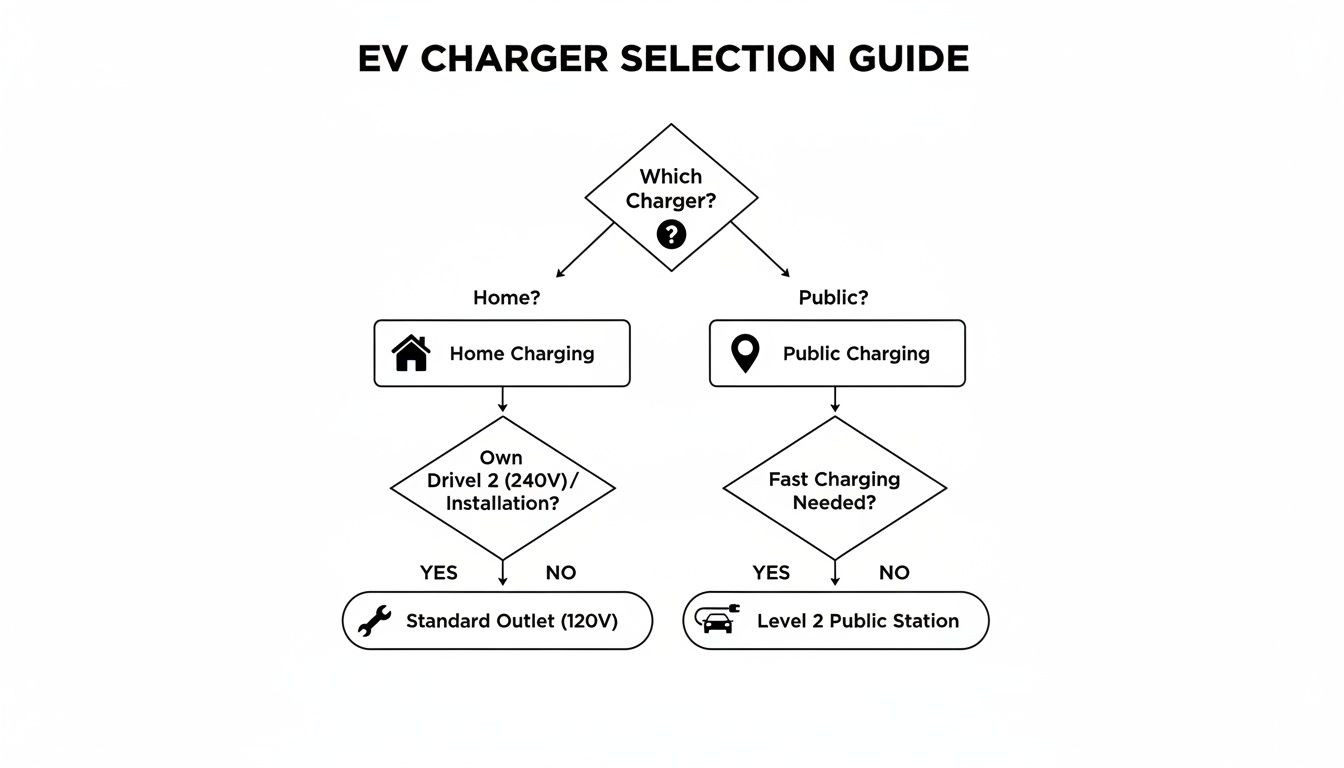
As the flowchart makes clear, for most daily drivers, a dedicated home unit is the logical first step. This makes public charging a useful backup rather than an essential lifeline.
Home EV Charger Showdown: Key Features at a Glance
We've boiled down the marketing guff to bring you a no-nonsense comparison of what really matters. Forget the fluff; this is about how these chargers actually perform day-to-day.
| Charger Model | Max Power (kW) | Smart Features and App Usability | Tethered or Untethered | Our Sarcastic Verdict |
|---|---|---|---|---|
| Pod Point Solo 3 | 7.4kW | Simple, reliable app. Schedules charges easily but lacks deep data. Basic but it works. | Both | The trusty Vauxhall Astra of chargers. Won't win beauty contests, but it'll get you there. |
| Hypervolt Home 3 Pro | 7kW | Feature-packed app with brilliant solar integration and cost tracking. A bit of a learning curve. | Tethered only | The show-off. Looks great, does everything, and has flashy lights to prove it. |
| Zaptec Go | 7.4kW | Elegant, intuitive app. Superb dynamic load balancing. Feels very clever without being complicated. | Untethered only | The minimalist Scandinavian architect. Incredibly smart, stylish, and smaller than you'd believe. |
In short, there's no single "best" charger, just the one that's best for you. Pod Point is for the "set-and-forget" crowd, Hypervolt is for the tech-savvy solar owner, and Zaptec is for those who value smart power management and minimalist design.
The App Experience: Where Sanity Goes to Die
A modern EV charger is only as good as its app. This is your command centre, your gateway to those juicy, cheap overnight electricity tariffs. If the app is rubbish, you'll curse the day you bought the thing.
- Pod Point: The app is famously simple, almost to a fault. It’s clean, it schedules charges, and it generally just works. But if you’re a data nerd who wants to track every last watt, you’ll find it disappointingly basic. It’s the reliable but slightly dull friend you can always count on.
- Hypervolt Home 3 Pro: Now we’re talking. The Hypervolt app is packed with features, from detailed analytics to solar integration and cost tracking. It’s slick and responsive, but this complexity can be a double-edged sword; there’s a steeper learning curve and more that could potentially go haywire after a software update.
- Zaptec Go: This app strikes a fantastic balance. It offers powerful features like dynamic load balancing (which stops you from blowing the main fuse when the kettle's on) and a clean, intuitive interface. It feels very... Scandinavian. Efficient, clever, and not overly shouty about it.
A truly smart charger isn't just about a remote start/stop button. It's about intelligently integrating with your energy tariff, your solar panels, and your home's overall power consumption to charge your car in the cheapest, most efficient way possible—without you having to think about it.
Build Quality and Aesthetics
Let's be honest, you have to look at this thing every single day. Does it look like a sleek piece of modern technology or a rejected prop from a 1980s sci-fi film?
Hypervolt often wins on aesthetics. Its units are stylish, come with customisable LED light rings, and generally look the business. The build quality feels solid and premium.
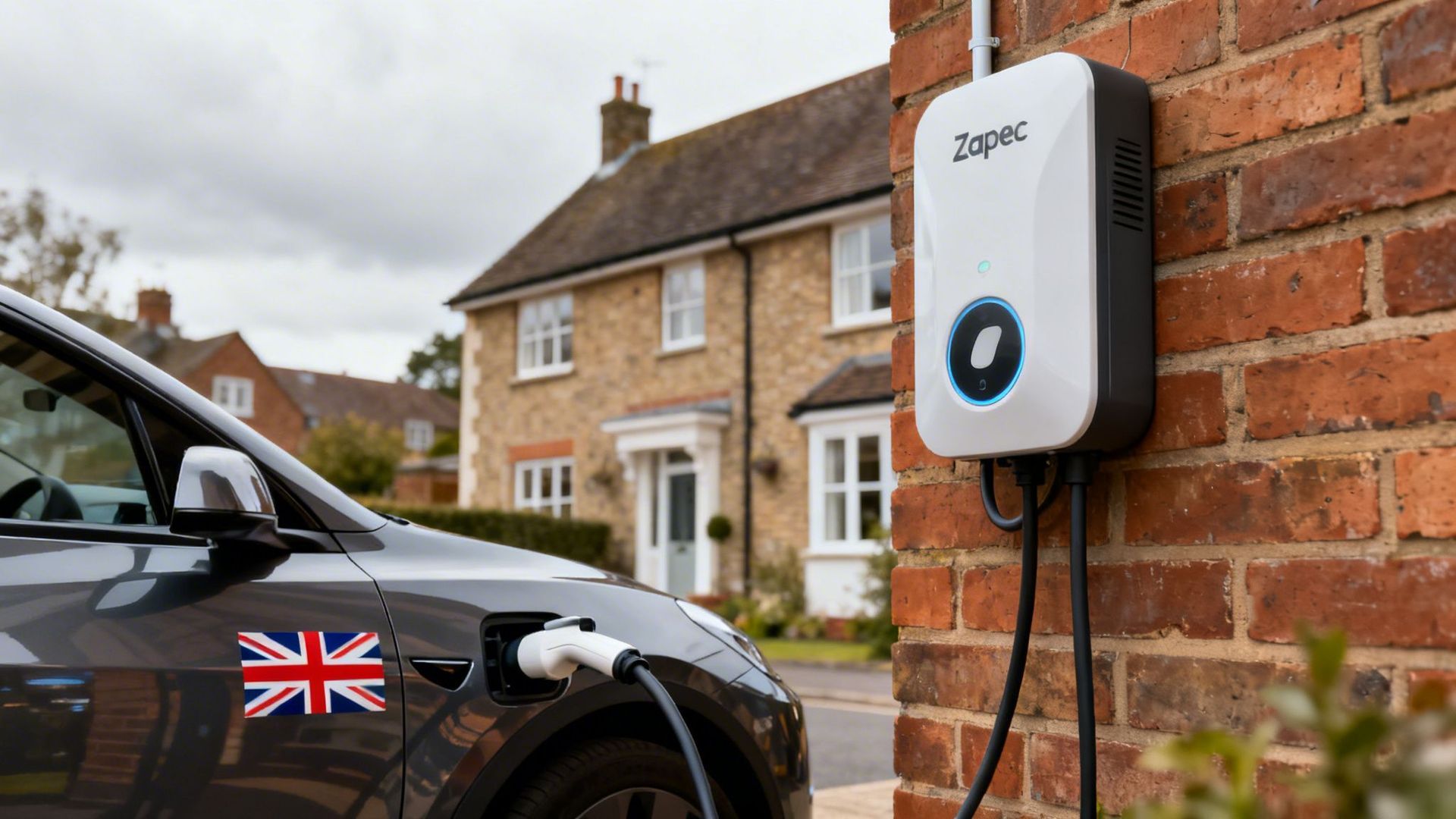
The Zaptec Go is unbelievably small and minimalist. Seriously, it’s about the size of a tablet and comes in six different colours, designed to blend in rather than stand out. It feels incredibly robust despite its tiny footprint.
Pod Point chargers are... functional. They are a common sight across the UK for a reason—they are the workhorses of the industry. But they won’t be winning any design awards any time soon, and the plastic casing feels a bit less premium than its rivals.
Getting a reliable home unit is becoming more critical than ever. While the UK has 87,168 public EV charging devices, a staggering 55% of them are slow chargers under 8kW. This reliance on a slow public network is a source of frustration in many driver reviews and underscores why the 809,181 home chargers in the country are doing the real heavy lifting. You can explore more about the current state of UK charging infrastructure on Uswitch.com.
Smart Charging and Saving Money
This is where the real magic is supposed to happen. A good smart charger automatically starts juicing up your car when electricity is cheapest, typically in the middle of the night.
All three contenders offer this, but their execution varies.
- Pod Point's scheduling is basic but effective. You set the times you want it to charge, and it does. Simple.
- Hypervolt goes a step further, integrating directly with specific energy tariffs to automatically hunt down the cheapest slots. Its solar integration is also excellent, allowing you to divert excess solar power straight into your car battery for free.
- Zaptec uses its sophisticated load balancing to ensure it never draws too much power, making it ideal for homes with high electrical loads or older wiring. It smartly and safely adjusts the charging rate in real-time.
Ultimately, the choice comes down to your priorities. Are you a set-and-forget type, a tech enthusiast who wants all the data, or someone who needs the smartest possible power management for a busy household? Your answer will point you to one of these three—each a titan in its own right, yet each with its own distinct personality.
Navigating Britain's Public Charging Safari
Right then, you’ve got your home charger sorted. But what happens when you need to venture beyond the comfort of your own driveway? Welcome to the wild, and sometimes frustrating, world of public EV charging in the UK. It’s a real mix out there – a patchwork of gleaming, ultra-rapid hubs and the sad, broken husks of forgotten chargers lurking in grim supermarket car parks.
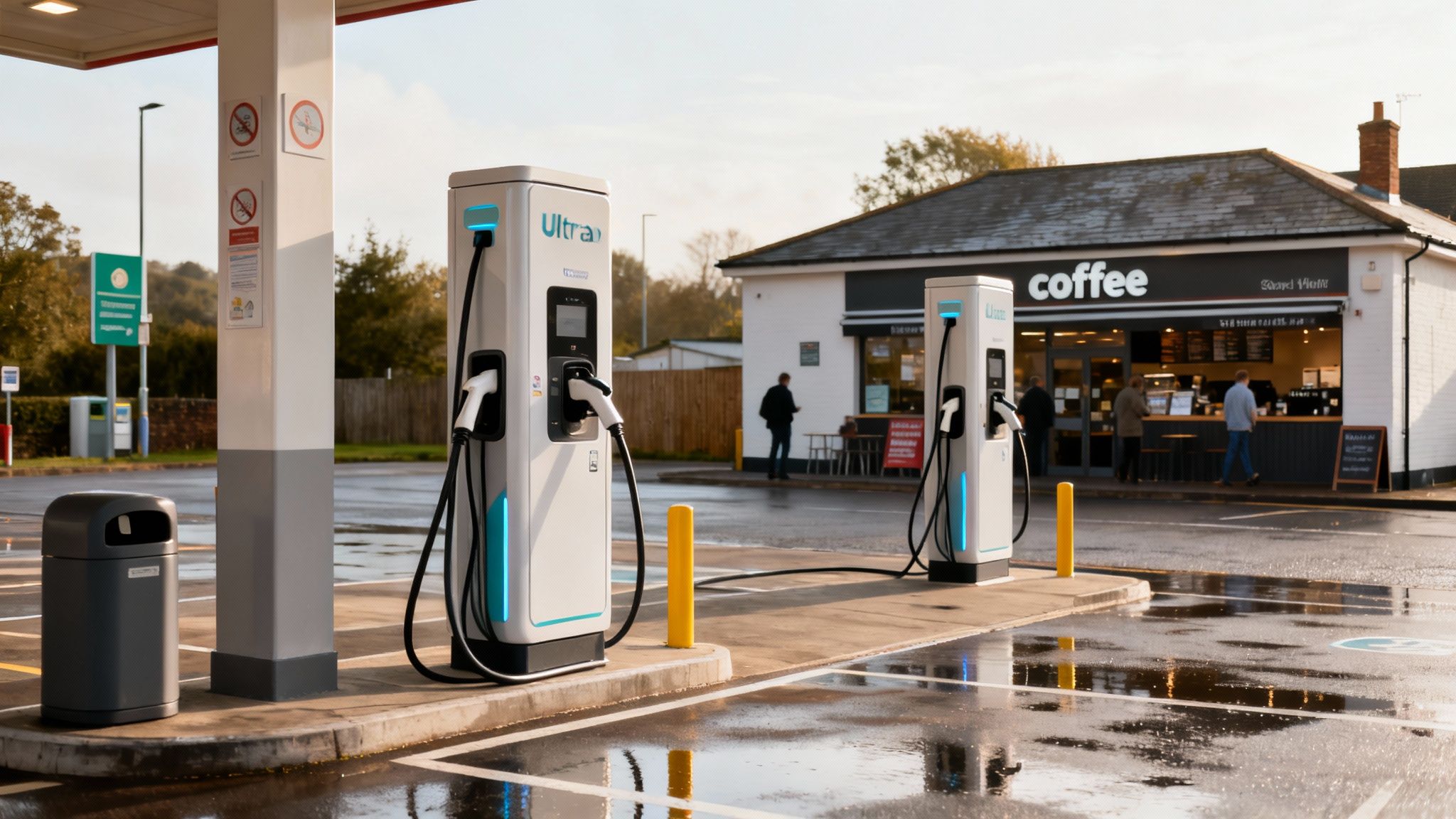
The network is certainly growing, but is it actually getting any better? This is where the real adventure begins. We’re diving into the major public networks you’ll actually encounter: InstaVolt, Osprey, Gridserve, and the ever-present Tesla Superchargers. We'll cut through the marketing fluff and judge them on what truly matters on the road.
The Big Four Public Networks
When you're out and about, one thing matters more than anything else: reliability . A charger that doesn't work is just an expensive, useless piece of street furniture. After that comes pricing , which can swing from "fair enough" to "daylight robbery". And finally, there's the overall experience – are you near a decent coffee shop, or are you spending 25 minutes staring at a forlorn-looking bin?
Let's break down the main players you’ll find dotted across the UK's A-roads and motorways.
- InstaVolt: Often hailed as the gold standard for reliability. Their chargers just tend to work, a refreshingly low bar that many rivals struggle to clear. They were also pioneers of simple contactless payment, saving you the faff of downloading yet another app.
- Osprey: Another strong contender on the reliability front. Osprey has been aggressively expanding its network with high-quality hardware, often in well-lit, accessible spots like pub car parks. Their distinctive purple branding makes them easy to spot.
- Gridserve Electric Highway: Famous for its ambitious Electric Forecourts, which are basically service stations of the future. While the Forecourts are brilliant, their older motorway chargers (inherited from Ecotricity) have a historically ropey reputation that they're still working hard to shake off.
- Tesla Superchargers: The original and, for a long time, the undisputed champion. The network is vast, incredibly reliable, and brilliantly integrated with Tesla cars. Now, with many sites opening to non-Tesla EVs, they are a formidable option for everyone, though often at a premium price.
This expansion is happening at a blistering pace. In the first half of 2025 alone, the UK's public EV charging infrastructure saw a 27% year-on-year growth, adding a staggering 8,670 new charge points. This surge is largely driven by high-powered charging hubs, which are becoming genuine game-changers for long-distance drivers. You can read more about these EV infrastructure growth findings.
The Great App Plague
Before contactless payment became common, public charging was a special kind of hell that involved downloading a different app for every single network. Your phone's home screen would look like a chaotic mosaic of charging logos, each demanding its own login and pre-loaded payment details.
Thankfully, things are getting better. Most new rapid chargers now legally require a contactless payment option. However, the apps can still be useful, offering live availability status, session tracking, and sometimes slightly lower pricing.
Our survival tip for the uninitiated: Download the Zap-Map and PlugShare apps. They pull together data from most networks, showing you what's available, what's broken, and what other drivers are saying. They are absolutely essential tools for navigating the network.
Pricing: A Costly Convenience
Let's not beat around the bush: public rapid charging is expensive. You're paying for speed and convenience, and the networks know it. Prices are usually quoted per kilowatt-hour (kWh) and can be significantly higher than what you pay at home – often three or four times as much.
Here’s a rough idea of what to expect, though prices can change faster than a politician’s promise:
| Network | Typical Price per kWh (Contactless) | Subscription Option? | Our Take |
|---|---|---|---|
| InstaVolt | 75p - 85p | No | Consistently reliable, but you pay a premium for it. Simple and straightforward. |
| Osprey | 79p - 89p | Yes (offers discount) | Pricey, but their subscription can make it more palatable for frequent users. A solid network. |
| Gridserve | 69p - 79p | No | More competitively priced, especially on the motorways. The Forecourts are excellent. |
| Tesla | ~67p (Non-Tesla) | Yes (offers discount) | The best experience, but non-Tesla drivers pay a steep price without a subscription. |
The User Experience: Grim or Grand?
The location of a charger can make or break the experience. A 30-minute charge can feel like an eternity if you’re stuck in a dark, unlit corner of a car park with no facilities.
Gridserve's Electric Forecourts are the pinnacle here, offering coffee shops, lounges, and even meeting pods. They understand that charging time is dwell time. Similarly, Osprey and InstaVolt often partner with brands like Costa Coffee or McDonald's, ensuring you can at least grab a brew and use a proper loo.
The worst offenders are often the lone chargers installed as an afterthought. You'll find them in deserted retail parks or supermarket car parks where the main store closes at 4 pm on a Sunday, leaving you stranded in a desolate wasteland. Always check your app for recent user comments—they often provide the grim, real-world details the official maps leave out. The public charging safari is improving, but it still requires a bit of planning and a healthy dose of patience.
The Hidden Costs: What You'll Actually Pay for Installation and Running
So, you’ve found a charger you like, and the price on the website looks reasonable. Hold on a moment. That price tag is just the beginning of the story, and the glossy brochures often conveniently skip the next few chapters. Let’s pull back the curtain on the real cost of getting an EV charger installed and running it day-to-day.
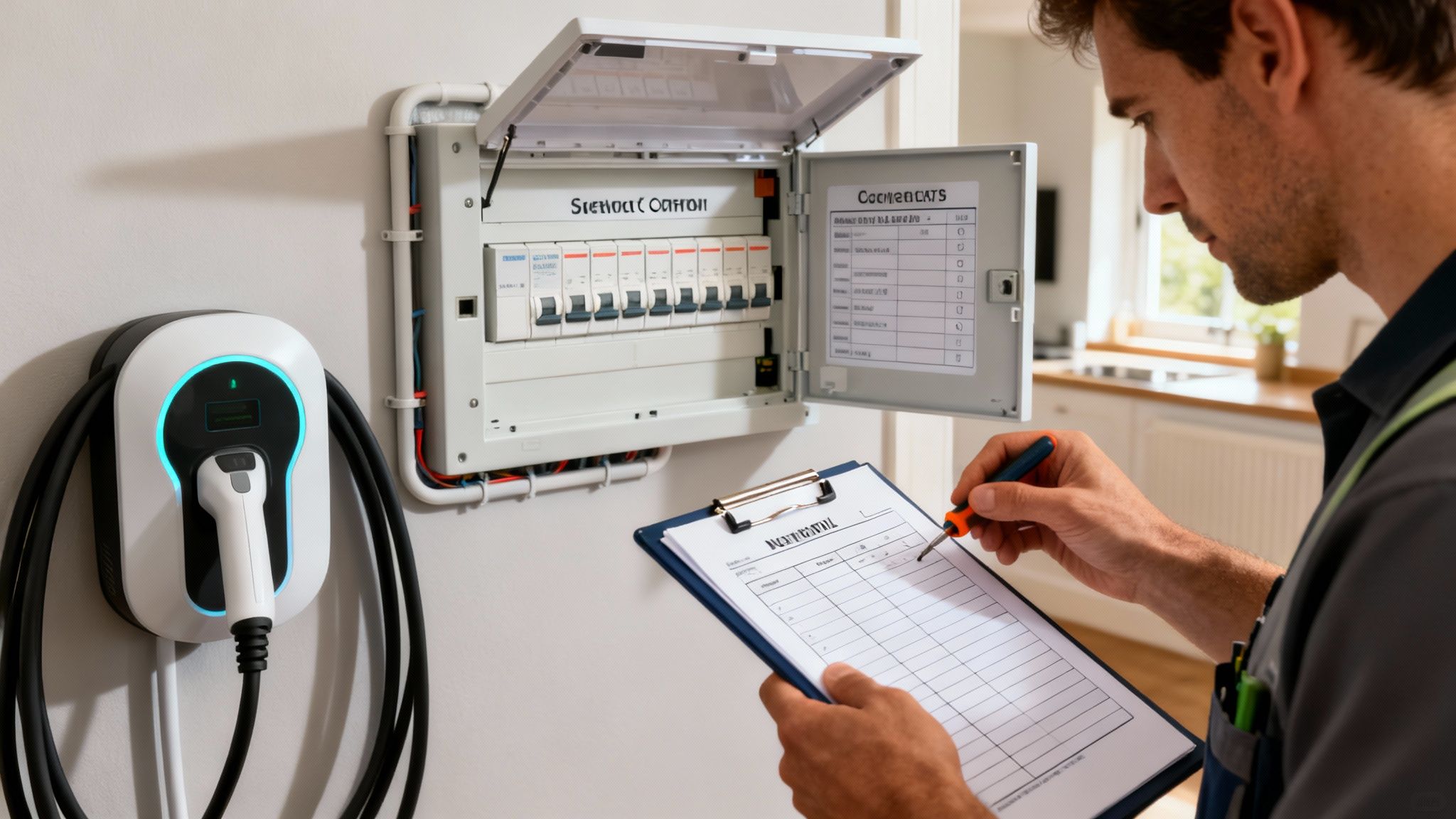
The first hurdle is the installation, and this is where costs can vary wildly. The key difference comes down to whether your property qualifies for a ‘standard’ or a ‘non-standard’ installation.
A 'standard' installation is basically the dream scenario for an installer. Your fuse box (or consumer unit) is modern, has spare capacity, and is located close to where you want the charger. The cable run is short and simple, with no complex drilling through reinforced walls. If you tick all these boxes, you can expect to pay somewhere between £800 and £1,100 , which includes the charger itself.
When a 'Standard' Job Isn't So Standard
Of course, life is rarely that simple. Many of us live in UK homes with wiring that has seen better days, and that’s where the costs start to creep up.
A non-standard installation can throw up all sorts of unexpected expenses. Here are a few common ones I see all the time:
- Long Cable Runs: If your charger needs to be at the far end of a long driveway, the extra armoured cable and labour will add to the bill.
- Outdated Consumer Units: Does your fuse box look like it belongs in a museum? It'll likely need a full replacement to meet modern safety regulations, which is a significant extra cost.
- The Dreaded Earth Rod: Some installations require a copper earth rod to be hammered into the ground for safety. If this has to go through pristine block paving or concrete, be prepared for some disruptive and pricey groundwork.
Getting a detailed, fixed-price quote before any work begins is non-negotiable. A reputable installer will always carry out a proper survey—either in person or virtually—and break down every single cost. Don’t let anyone touch a screwdriver until you have that piece of paper.
Keeping Your Electricity Bill in Check
Once your shiny new charger is on the wall, the next mission is to use it without giving your electricity meter a heart attack. Just plugging your car in the moment you get home from work is a classic rookie mistake.
The secret to cheap EV motoring is smart charging, which means pairing your charger with a specialist EV energy tariff. These tariffs offer incredibly cheap electricity rates for a few hours overnight, often as low as 7-10p per kilowatt-hour (kWh) . Compare that to a typical daytime peak rate of over 30p/kWh , and you can see the savings.
A good smart charger and its app handle all of this for you. You just set when you need your car by, and the charger waits for the cheap overnight window to start drawing power. Honestly, this is the single most important feature to look for. It’s what makes an EV a genuinely cheap-to-run car rather than just an expensive gadget.
Without a smart tariff, you’re stuck paying peak prices, and the cost-per-mile saving over a petrol car quickly disappears. To put it in perspective, a full charge on a cheap overnight rate could cost you just £5-£7 . That same charge at a peak daytime rate could easily hit £20-£25 . The difference over a year is staggering.
Our Final Verdict on the Best EV Chargers
Right, after all that talk of kilowatts and connectors, it's time to get down to brass tacks. We’ve sifted through the marketing fluff, wrestled with clunky apps, and spent more time than we’d like to admit in rain-swept car parks to figure out what’s what.
But here’s the thing: crowning one single "best" charger is a fool's game. The perfect charger for your neighbour with a massive solar array might be completely wrong for you. Your ideal match really depends on your car, your home, and how you drive.
So, instead of giving you a lazy, one-size-fits-all answer, we're handing out awards based on what drivers actually need. This is where our in-depth EV charger reviews come together to give you some straight-up, practical advice.
Our Top Picks for Every Driver
We’ve carved up the market into categories that really matter, giving you the definitive choice for each situation.
-
Best Budget Smart Charger: The Pod Point Solo 3 . Think of it as the reliable workhorse of the EV charging world. The app is basic and the design won't win any art awards, but it nails the important stuff. It just works, delivering smart charging without any fuss. It’s the perfect no-nonsense choice if you just want to plug in and forget.
-
Best for Tech and Solar Geeks: The Hypervolt Home 3 Pro . If you're the kind of person who wants to track every last watt, perfectly sync your charging with your solar panels, and maybe show off with a cool LED light display, this is your charger. The app is absolutely packed with features, giving you incredible control over your energy.
-
Best for Slick Design and Power Management: The Zaptec Go . This thing is seriously tiny, looks fantastic, and is remarkably clever. Its dynamic load balancing is a cut above the rest, which makes it ideal for homes with a lot of high-draw appliances or slightly older wiring. It’s the smart, minimalist pick for anyone who cares as much about form as they do about function.
For public charging, the choice is a bit more straightforward. When it comes to pure reliability and dead-simple ease of use, InstaVolt is the clear winner. You might pay a little more per kWh, but the peace of mind you get from a charger that actually works first time is worth every penny.
And the 'Most Disappointing' Award Goes To...
Now for the award no one wants to win. This year, the 'Most Disappointing Charger' trophy goes to the sad, forgotten fleet of slow and often broken chargers marooned in supermarket car parks.
They promise convenience while you do your weekly shop but almost always deliver a dose of frustration and a mad scramble for a plan B. They’re a stark reminder to always, always check an app like Zap-Map before you set off. Avoid them if you can.
Your EV Charger Questions Answered
Got questions? We’ve got answers. We've spent countless hours scrolling through forums and comment sections, so we know exactly what's on your mind. Here, we tackle the most common queries, from the practical to the slightly paranoid, to give you the clarity you need before you part with your cash.
Let's face it, diving into the technical jargon can feel like trying to decipher a really bad instruction manual. So, let's cut through the noise and get straight to the point.
Do I Actually Need a Smart EV Charger in the UK?
In a word, yes. It's not just a nice-to-have anymore; since 2022, it's been a legal requirement for all new home charger installations. But even if it weren't, you'd still want one.
A smart charger is your ticket to cheap electricity. It automatically schedules your charging sessions for off-peak hours when energy is at its cheapest, saving you a significant chunk of money on your bills. Unless you enjoy setting an alarm for 2 a.m. to manually plug in your car, a smart charger is the only sensible choice.
What’s the Difference Between Tethered and Untethered?
This really boils down to convenience versus a cleaner look. A tethered charger comes with the cable permanently attached, just like the hose at a petrol station. It's incredibly convenient – you just pull up, grab the cable, and plug in. The downside? It can look a bit untidy, with a thick cable coiled up on your wall.
An untethered charger , on the other hand, is just a socket. You’ll need to use the portable cable that came with your car, which means getting it out of the boot every time you want to charge. It looks much neater on your wall, but it adds an extra, slightly tedious step to your routine.
Think of it this way: tethered is for the "grab-and-go" driver who prioritises speed. Untethered is for the minimalist who doesn’t mind a little extra effort for a tidier finish.
How Much Does a Standard Home EV Charger Installation Cost?
This is the big one, isn't it? A typical 'standard' installation, including the charger itself, usually costs between £800 and £1,100 .
However, that word 'standard' is doing a lot of work. This price assumes your consumer unit (or fuse box) is up-to-date, located in a convenient spot, and that the cable doesn't need to be run halfway around your house. If your setup is more complex – for example, if your fuse box is ancient or on the other side of the property – be prepared for that cost to rise. Always, always get a fully itemised quote before agreeing to any work.
Ready to dive deeper into the world of electric vehicles? At VoltsMonster , we provide brutally honest reviews, vlogs, and podcasts to cut through the noise. Find your next EV insight at https://www.voltsmonster.com.
VoltsMonster Electric Vehicle Blog