A Practical Guide to Workplace EV Charging Installation
Let's be honest, your company car park probably isn't ready for the electric vehicle revolution. A proper workplace EV charging installation is no longer a 'nice-to-have' for the green-minded folks in marketing; it's a fundamental upgrade your business needs to stay competitive. This isn't just about polishing your corporate image, it’s about making a smart move that affects everything from attracting top talent to streamlining your daily operations. And frankly, if you get it wrong, you’ll look like a proper wally.
Why Bother with Workplace EV Charging?
Thinking of this as just another expense is missing the point entirely. It's an investment, and a surprisingly tactical one. The automotive world is hurtling towards an electric future, and businesses that drag their heels will quickly look as outdated as a dial-up modem. This is about staying relevant and, frankly, avoiding the headache of being left behind.
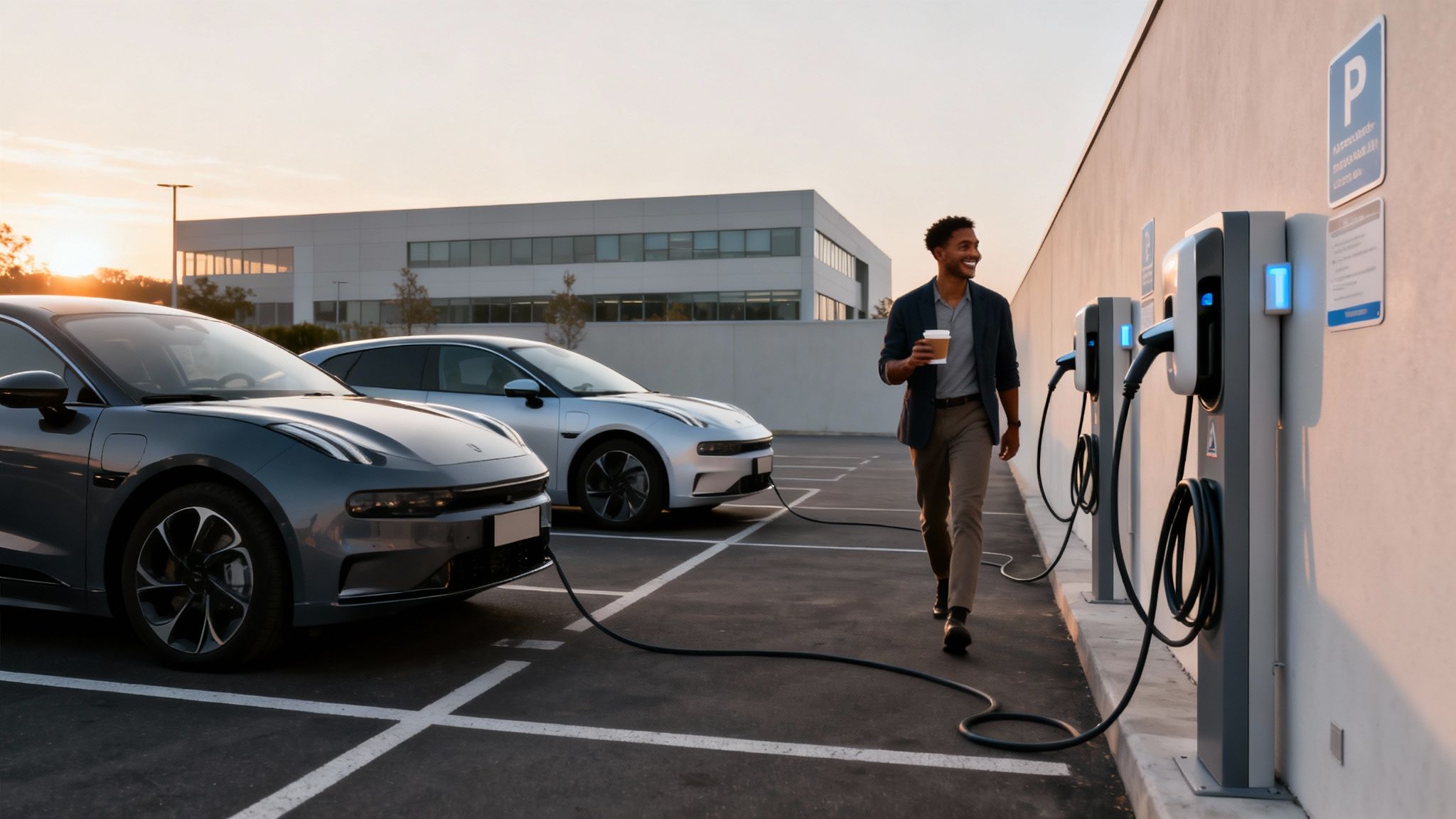
The benefits go far beyond simply providing a plug. It’s a powerful statement about your company's values and its commitment to both its employees and the environment. Consider it a massive, flashing sign that says, "We're forward-thinking, not stuck in the dark ages."
The Unspoken Perks for Your Business
Sure, you're doing your bit for the planet, but let's talk brass tacks. Installing chargers is a magnet for talent. A 2024 survey found that 42% of EV drivers consider workplace charging a key factor in their job satisfaction. In a tight job market, that simple convenience can be the perk that convinces a star candidate to choose you over a rival.
It also keeps your current team happy. No one enjoys the post-work detour to a supermarket car park, crossing their fingers that a public charger is free and actually working. Allowing them to charge while they work removes a huge point of stress, especially for those who can't install a charger at home. It’s a bit of a no-brainer.
"Since most people commute to work, parking their cars for hours each day, workplaces are excellent locations to charge, opening doors for anyone thinking about driving electric, especially those who cannot charge at home."
Future-Proofing and Financial Sense
Beyond the people-focused benefits, there's a strong commercial case to be made. As more company fleets switch to electric, having on-site charging isn't a luxury—it's a logistical necessity. You simply can't run a modern fleet with extension leads dangling out of the first-floor windows. That would be monumentally stupid.
A well-planned workplace EV charging installation also lets you manage energy costs intelligently. Smart chargers can be set to operate during off-peak hours, taking advantage of cheaper electricity tariffs and reducing the strain on your building's supply. It's a proactive step that will save you money and operational chaos down the line. Putting this off is just kicking a very expensive can down the road.
Let's be honest, the initial cost of installing EV chargers can be a bit eye-watering. The good news? You don't have to foot the entire bill yourself. The UK government, in a rare moment of clarity, is actively encouraging businesses to make the switch, and they're putting their money where their mouth is with some very helpful grant schemes.
Figuring out which grants you qualify for, however, can feel like a full-time job. It’s a maze of acronyms, strict eligibility rules, and deadlines that seem to sneak up on you. But don't worry, we'll cut through the red tape and get straight to what you need to know.
Getting to Grips with the Main Grants
For most businesses, the go-to option is the Workplace Charging Scheme (WCS) . Think of it as the government’s flagship programme to get chargers into commercial car parks across the country. It's not a blank cheque, but it provides a significant discount on the upfront cost of both the hardware and the installation.
The WCS operates on a voucher system. You apply before any work starts, and if you’re approved, you get a voucher to hand to your installer, who then claims the grant amount back from the government. Simple, right?
A word of warning: you absolutely must use an OZEV(Office for Zero Emission Vehicles) authorised installer . Getting your usual electrician to do the job, even if they're brilliant, will make you ineligible for the funding. No exceptions. Don't be a muppet.
So, Who Actually Gets the Money?
This is where people often get stuck. The criteria are quite specific. In general, any registered business, charity, or public sector organisation can apply, provided you meet a few key conditions:
- You need your own parking. The spaces must be dedicated, off-street parking for your staff or fleet. Kerbside parking on a public road just won't do.
- You must be in the UK. The scheme covers England, Wales, Scotland, and Northern Ireland.
- You need a reason. You have to declare a need for EV charging now or an intention to encourage staff to switch in the future. This is usually the easiest part.
The Workplace Charging Scheme has been a real game-changer since it started back in 2016. It can cover up to 75% of the purchase and installation costs , up to a cap of £350 per socket . As of early 2024, the scheme had already supported the installation of over 65,000 sockets . You can see the latest figures for the EV charging grant scheme on GOV.UK.
The application itself is done online. It seems straightforward, but small mistakes can lead to big delays. Make sure every detail, from your Companies House number to the site postcode, is spot on.
Once you get the green light, a voucher code will land in your inbox. This is your golden ticket. It's valid for 180 days , and that’s a firm deadline. Let it expire, and you're back to square one. My advice? Get your installer lined up and ready to go before you even apply, so you can hit the ground running once that voucher arrives.
UK Workplace Charging Grants At-a-Glance
To make things a bit clearer, here’s a quick rundown of the main funding streams available for UK businesses. While the WCS is the most common, it's worth knowing about the others, especially if you manage a fleet or are in a more specialised sector.
| Grant Scheme | Who Can Apply | What It Covers | Key Takeaway |
|---|---|---|---|
| Workplace Charging Scheme (WCS) | Any registered business, charity, or public sector body with dedicated off-street parking. | Up to 75% of the cost of buying and installing charge points, capped at £350 per socket , for up to 40 sockets . | The most popular and accessible grant for general workplace charging. |
| EV Infrastructure Grant for Staff and Fleets | Small-to-medium-sized businesses with fleets or staff who need to charge at work. | Up to 75% of the cost of wider infrastructure work, like wiring and posts. Capped at £15,000 per grant . | Focuses on preparing your site for large-scale charging, not just the chargers themselves. Great for future-proofing. |
| On-Street Residential Chargepoint Scheme (ORCS) | Local Authorities. | Covers part of the capital costs of installing on-street charge points for residents who lack off-street parking. | Not a direct business grant, but important if you're partnering with your local council on a community charging project. |
These schemes can and do change, so always check the latest guidance on the GOV.UK website before you start planning. Getting expert advice from your installer is also invaluable here—they deal with these applications day in, day out and know all the common pitfalls to avoid.
Choosing the Right Chargers for the Job
So, you’ve got a handle on the grants. Now for the bit that can feel like wandering through a Currys megastore during the January sales: picking the actual hardware. Dive in without a plan, and you’ll either end up with something woefully underpowered or so over-the-top that your finance director starts having sleepless nights.
Let's be clear: a workplace EV charging setup isn't about buying the shiniest, fastest box on the market. It’s about matching the technology to how your staff actually work and drive. Most people aren't nipping out for a 20-minute rapid charge in the middle of a spreadsheet marathon; their cars will be sat in the car park for a solid eight hours.
This is exactly why slower AC (Alternating Current) chargers are so often the perfect fit. As of October 2025, the UK had over 86,000 public charging devices, and a whopping 56% of them were low-power units, typically between 3kW and 8kW. They're ideal for a full day's top-up and are significantly cheaper to install and run. You can dig into the data in this EV Charging Index report.
Dumb Chargers vs The Smart Revolution
Your first big decision is whether to go for a 'dumb' charger or a smart one. Think of a dumb charger as a plug on a stick. It does one thing and one thing only: provide electricity. There’s no connectivity, no app, and absolutely no way to track who’s using it or how much power they’ve guzzled.
They might seem temptingly cheap, but this is a classic false economy. For any business, they are an administrative nightmare just waiting to happen. How do you bill employees for their usage? How do you stop Dave from accounts leaving his car plugged in all week? Simple: you can't.
Smart chargers, on the other hand, are the brains of the operation. They connect to the internet, giving you a management platform (often called a CPMS - Charge Point Management System) where you can really take control.
- Set user groups and pricing: You could charge staff one rate, visitors another, or even make it free for certain teams.
- Monitor usage in real-time: See exactly which chargers are in use, who’s plugged in, and for how long.
- Manage power distribution: This is a big one. Load balancing prevents your building’s electrical system from tripping when everyone plugs in at 9 AM.
- Generate reports: Get hard data on energy consumption for your sustainability reports or to simplify accounting.
Honestly, the extra upfront cost for smart functionality pays for itself almost immediately in saved hassle and much better energy management. Unless you're installing a single, dedicated charger for one specific company vehicle, don't even consider the dumb option.
Understanding Speeds and Sockets
Charger speeds can be baffling at first, but for a typical workplace, you're really only looking at two main categories.
| Charger Type | Power Output | Best For | Typical Charge Time (for ~100 miles) |
|---|---|---|---|
| AC Fast Charger | 7kW - 22kW | All-day staff parking, overnight fleet charging. | 4-6 hours |
| DC Rapid Charger | 50kW+ | Quick top-ups for fleet vehicles or visitors, not for all-day parking. | 20-40 minutes |
For most businesses, 7kW AC chargers are the absolute sweet spot. They provide a decent top-up over a standard working day without requiring a heroic—and very costly—grid upgrade. A 22kW charger sounds better on paper, but many EVs can't even accept AC power that fast. More importantly, your site might not have the three-phase supply needed to run them at full chat anyway.
DC rapid chargers are a different beast entirely. They're expensive, incredibly power-hungry, and generally overkill unless you're running a high-turnover fleet of vans that need to get back on the road ASAP.
A small detail that often gets overlooked is whether to choose tethered (cable attached) or untethered (socket only) units. Tethered is certainly more convenient for users, but those cables are the first thing to get damaged and can look messy. Untethered is neater and more robust, but it relies on employees bringing their own cables—which, trust me, they will inevitably forget.
Laying the Groundwork: Power, Surveys, and Civil Works
So, you’ve chosen your charging points. Fantastic. Now comes the part where the glossy brochures meet the reality of mud, concrete, and electrical switchboards. A successful workplace EV charging installation has less to do with the chargers themselves and everything to do with what happens beforehand.
Getting this stage wrong is a recipe for disaster. We’re not just talking about a few delays; we're talking about a budget that spirals out of control. It's time to swap sales pitches for hard hats.
The All-Important Load Assessment
First things first, let's talk power. Before anyone even thinks about digging, a qualified electrician needs to perform a load assessment. The big question is: can your building's current electrical supply actually handle the extra demand of multiple EVs charging at once?
Think about it. Most commercial buildings, especially older ones, were never designed for this kind of high, sustained power draw. Your supply might be fine for the daily grind of PCs, lights, and air conditioning, but adding several 7kW chargers is a completely different beast. It's the equivalent of asking your system to run a dozen high-powered ovens for hours on end.
The assessment will scrutinise your Maximum Import Capacity (MIC) , which is the total amount of power your site is contractually allowed to pull from the grid. If the new chargers push you over this limit, you have a serious and expensive problem to solve.
A grid connection upgrade is the number one budget-killer for workplace charging projects. It involves applying to your Distribution Network Operator (DNO) and can easily add thousands of pounds and many months to your timeline. This is precisely why a professional site survey isn't a 'nice-to-have'—it's absolutely essential.
Planning the Civil Works: More Than Just Digging
Once you're confident the building won't plunge into darkness, you need a plan to get that power from the switchboard to the parking bays. This is where the 'civil works' begin, and it’s rarely straightforward.
An experienced installer will map out the most efficient cable routes, which involves some critical detective work:
- Underground Service Detection: What lies beneath your car park? Gas mains, water pipes, and fibre optic cables are common obstacles. Striking any of these is a costly and dangerous mistake that a proper survey will prevent.
- Cable Runs and Voltage Drop: The further the chargers are from your main supply, the thicker and more expensive the armoured cabling needs to be. This is to counteract 'voltage drop' and ensure the chargers perform as they should.
- Trenching and Reinstatement: This involves digging trenches for the cables, laying protective ducting, and then putting everything back as it was. The cost of resurfacing tarmac, re-laying block paving, or repairing landscaped gardens can be a surprisingly large part of the total project cost.
This is a great overview of the key decisions you'll face when choosing the right hardware for your site.
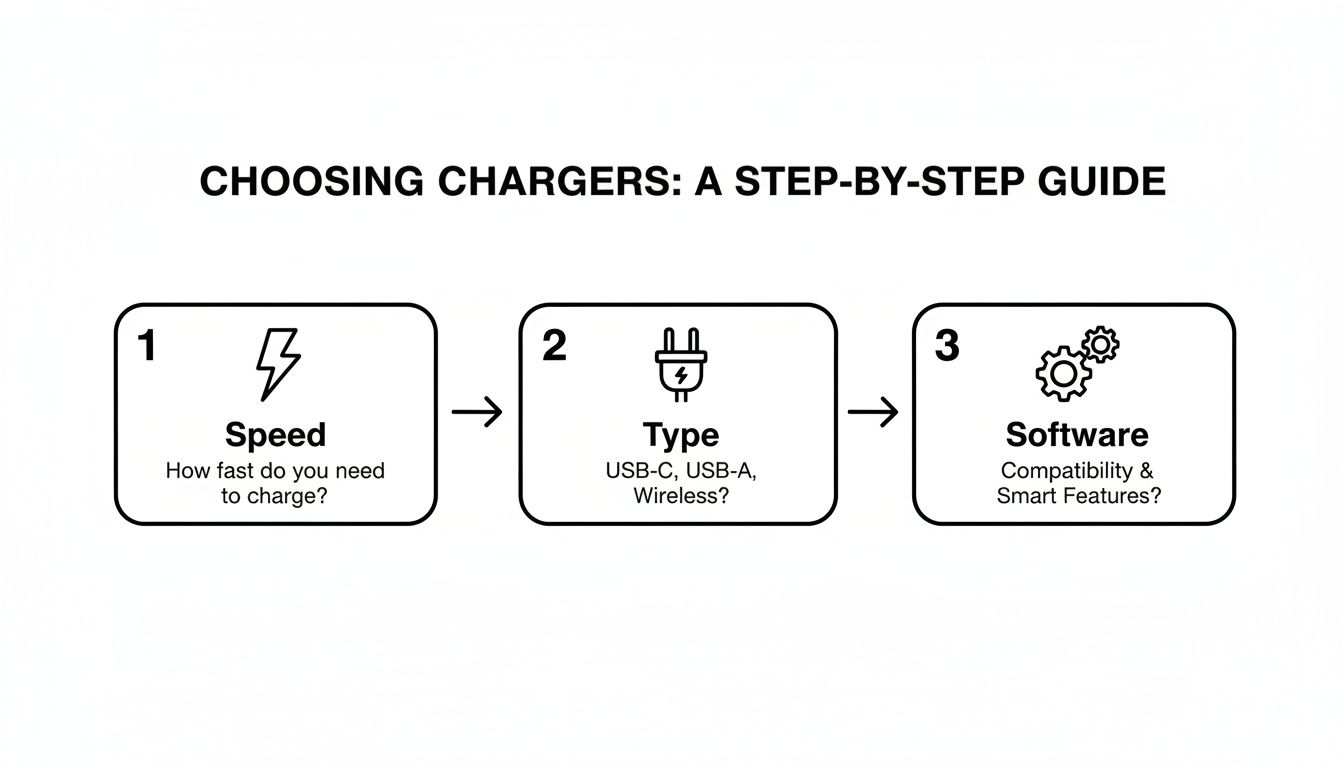
As you can see, finding the right balance between charging speed, connector types, and smart management software is key to getting it right.
Getting the Paperwork in Order
You can't just start excavating your car park and wiring things into the national grid. A compliant installation requires a paper trail, and skipping this step can cause major headaches with your local council and the DNO.
The most critical piece of admin is the DNO notification. Your installer is legally required to inform the local DNO about any new charger installation. For larger schemes, you’ll need to formally apply for a connection before any work can begin.
On top of that, significant civil works could stray into planning permission territory. While most charger installations are considered 'permitted development', it's always worth checking with your local authority. This is especially true if your building is listed or located in a conservation area. Don't take the gamble—the survey and planning phase is your opportunity to uncover these potential nightmares before they become expensive realities.
Managing Installation and Daily Operations
The dust has settled, the installers have packed up their drills, and you’re now the proud owner of several shiny new EV chargers. Marvellous. But don't pop the champagne just yet; the real work of managing your workplace EV charging installation is only just beginning.
Getting the hardware on the wall is one thing, but turning it into a seamless, argument-free workplace perk is a completely different challenge.
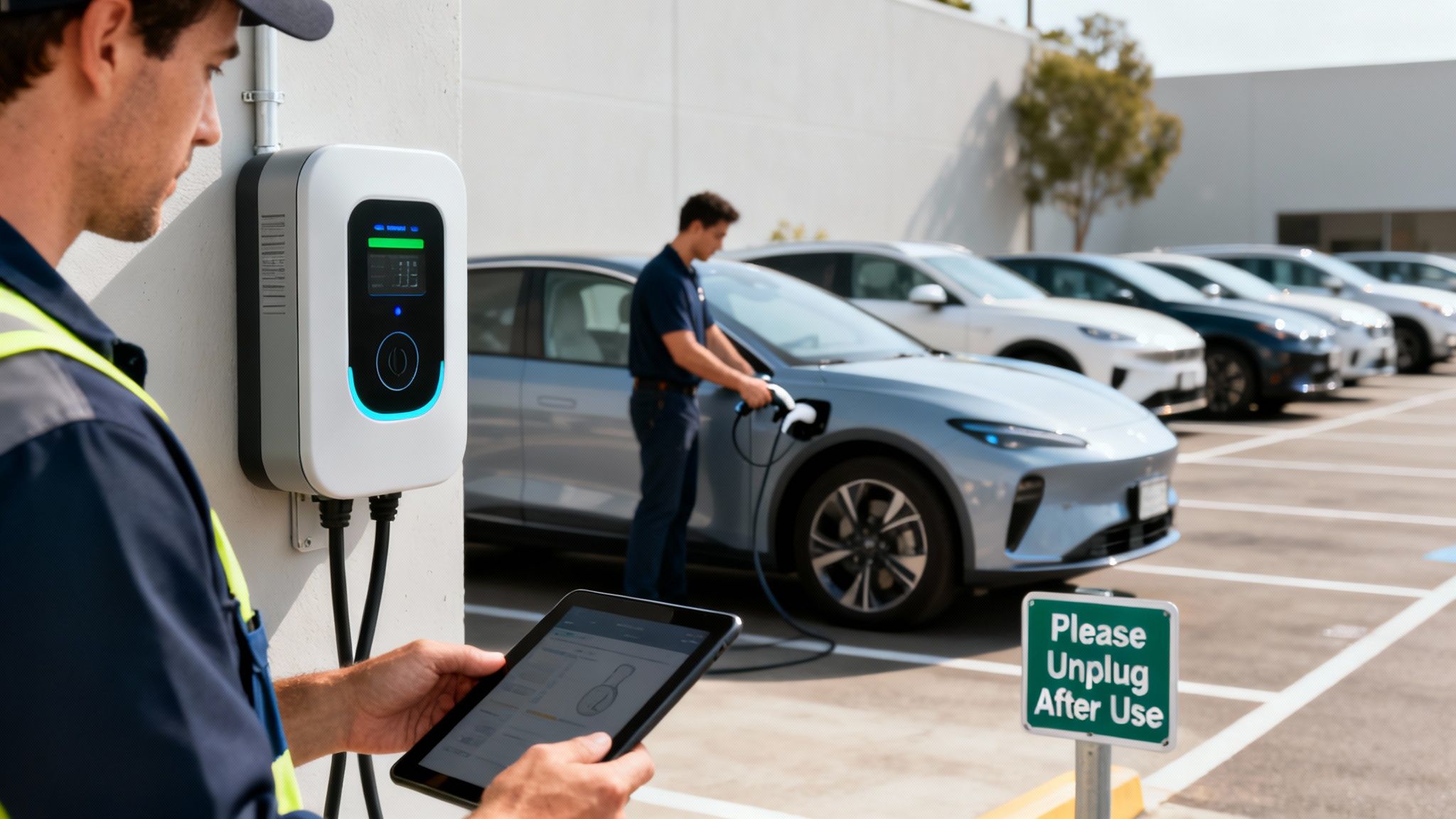
The final, crucial step of the installation is the commissioning process . This isn't just a flick of a switch. It’s where your installer meticulously tests everything—every charger, every connection, every bit of software—to ensure it’s all working as it should and, more importantly, safely. They’ll sign everything off and hand you the keys to your new electric kingdom.
Now it’s over to you.
Keeping the Electrons Flowing
Chargers, like any piece of tech, can throw a wobbly. A screen might freeze, a connection could fail, or it might just decide it doesn't fancy talking to the app today. This is where a solid Operations & Maintenance (O&M) contract becomes your best friend. Skimping on this is a classic rookie error.
A decent O&M package should be more than just a helpline number you call in a panic. It needs to cover both reactive and proactive support.
- Reactive Maintenance: This is your emergency call-out service. When a charger dies, you need a guaranteed response time to get an engineer on-site to fix it. A broken charger is worse than no charger at all; it’s a monument to unfulfilled promises.
- Proactive Maintenance: This involves regular check-ups, software updates, and physical inspections to catch problems before they happen. Think of it as an MOT for your charging network.
Don't just tick the box on the cheapest maintenance plan. Scrutinise the Service Level Agreement (SLA). What are the guaranteed fix times? Does it cover the cost of replacement parts? A vague contract isn't worth the paper it’s printed on when half your car park is fuming over a dead plug.
The Human Element: Policies and Politics
Now for the really tricky part: managing the people. Without clear rules, your pristine charging bays will descend into a lawless free-for-all, sparking more office drama than a leaked salary spreadsheet. You need a fair usage policy, and you need it from day one.
The reality is that while 77% of EV drivers mainly charge at home, they still rely on other locations for a significant top-up. The growth in public infrastructure, with Zapmap reporting 13,469 new public points added in 2025 alone, hasn't curbed the demand for reliable workplace charging. You can explore more about the rise of EV charging in the UK. This reliance makes your workplace chargers a valuable, and potentially contentious, resource.
Your policy needs to answer some key questions to prevent what’s affectionately known as 'charger hogging'.
Preventing Charger Hogging and Setting Prices
What happens when someone plugs in at 8 AM and leaves their fully charged car blocking the bay until 6 PM? This is the number one cause of EV-related conflict. Your smart charging software is the solution here.
Here are some tools at your disposal:
- Charging Time Limits: Set a maximum session duration, say four hours. After that, the user gets a notification to move their motor.
- Idle Fees: This is the real deterrent. Once the car is fully charged, the system can start billing the user a per-minute fee for occupying the bay. It’s amazing how quickly people move when their wallet is on the line.
- Pricing Strategy: Are you going to offer charging for free, at cost, or for a small profit? Charging a nominal fee (e.g., per kWh) is often the fairest approach. It covers your electricity and maintenance costs and subtly discourages people from plugging in when they don’t really need to.
Ultimately, your goal is to make the system fair, transparent, and self-policing. A clear policy, backed by the features of your smart charging system, will turn your installation from a potential headache into a genuinely useful asset that everyone can benefit from.
Your No-Nonsense Installation Checklist
Right, enough theory. Let’s boil this whole process down to a straightforward list of actions. This isn’t some vague corporate plan; it’s a practical checklist to keep your workplace EV charging installation on track and out of trouble.
Pin this to the wall in the project room. Refer back to it when an installer starts talking in acronyms. Use it to show the finance director that you do, in fact, have a concrete plan.
Project Installation Checklist
Think of this table as your project's essential roadmap, guiding you from a vague idea to the first happy employee plugging in their car. Following this sequence is often what separates a smooth, on-budget installation from a drawn-out, costly nightmare.
| Phase | Action Item | Key Consideration |
|---|---|---|
| 1. Discovery & Planning | Conduct a site survey and electrical load assessment. | This is non-negotiable. It tells you exactly how much power you have to play with and uncovers potential horrors like a required grid upgrade. |
| Research and apply for relevant UK grants (e.g., WCS). | Get your application in before you commit to any installation work. The grant voucher has a strict 180-day expiry period. | |
| 2. Procurement | Select OZEV-approved chargers and an authorised installer. | Choosing a non-approved installer will instantly disqualify you from receiving any grant funding. Always check their credentials on the government list. |
| 3. Execution | Finalise charger locations and agree on the civil works plan. | The goal here is to minimise costly trenching. The shorter your cable runs, the kinder it will be to your budget. |
| 4. Go-Live & Management | Commission the chargers and configure the management software. | This is where you set up user accounts, payment details, and those all-important idle fees to discourage people from hogging the bays. |
| Draft and circulate a clear employee usage policy. | Do this from day one to avoid arguments and confusion. Clearly outline the rules, costs, and what happens if someone blocks a bay. |
Following these steps in order will help you anticipate challenges and make sure nothing critical gets missed. It provides a clear structure for everyone involved, from the electrical contractor right through to your internal team.
Got a Few More Questions?
It's completely normal to have a few lingering questions. Setting up workplace charging is a big project, and the devil is often in the detail. Here are some of the most common queries we come across from businesses just like yours.
So, How Long Does This All Actually Take?
Ah, the classic "how long is a piece of string?" question. The honest answer is: it really depends on the complexity of your site.
If you're just putting a couple of wall-mounted units near your main fuse board, a good installer could have you up and running in a few days. But if you’re looking at a larger project that involves digging trenches across your car park or, crucially, needing an upgraded connection from your local Distribution Network Operator (DNO), you should brace yourself for a much longer timescale – often several months from the initial survey to the final switch-on. The site survey is what will give you the real picture.
Can We Let Visitors and the Public Use Them?
You absolutely can. In fact, offering public charging can be a nice little earner for the business.
This is where smart chargers and their management software really shine. You can easily set up different pricing for different people. For example, you might give your staff a subsidised rate, charge visitors a standard rate, and open it up to the general public at a premium price. It’s a great way to monetise the hardware, but do a quick check on any local planning rules about public use first.
One thing businesses often overlook is the ongoing running cost. It's not just the price of the electricity. You need to budget for the monthly software subscription for your charge point management system, any annual maintenance contracts, and payment processing fees if you're taking money from users. These can add up.
How Do We Stop People Leaving Their Cars Plugged in All Day?
The number one cause of EV-related office tension: the dreaded charger hog. Someone plugs their car in at 9 am and leaves it there until 5 pm, long after it's finished charging. Thankfully, this is easily managed with good policy and the right tech.
Most smart charging platforms let you introduce rules to keep things fair:
- Set time limits: You could cap charging sessions to a four-hour maximum, which is plenty for most people to get a significant top-up.
- Introduce idle fees: This is the real game-changer. Once a car is fully charged but remains plugged in, the system can start charging the user a per-minute fee for blocking the bay. You’ll be amazed how quickly that parking space becomes free when there’s a cost involved.
Will We Need Planning Permission?
For most simple installations, the answer is no. In the UK, putting up wall-mounted chargers usually falls under 'permitted development', so you don't need to go through the whole planning process.
However, don't assume you're in the clear. The situation changes if you're installing multiple chargers on posts that need proper foundations, or if your building is listed or sits within a conservation area. In these cases, you absolutely must speak to your local planning authority before starting any work. A five-minute phone call can save you a massive headache down the line.
For brutally honest car reviews, charging guides, and a refreshing take on the electric vehicle world, check out the latest content from VoltsMonster . Dive into our blogs and podcasts at https://www.voltsmonster.com.
VoltsMonster Electric Vehicle Blog