UK EV Car Charger Reviews You Can Actually Trust (Unlike Your Mate's Opinion)
Trying to make sense of EV car charger reviews can feel like learning a new language invented by a committee of mad scientists. Ultimately, though, the right choice usually comes down to a few key things. The best chargers give you a good mix of smart, money-saving features and a power level that works for your home's wiring – which, for most of us in the UK, is a perfectly adequate 7kW . Get this balance right, and you'll avoid paying for fancy extras you simply don't need.
Decoding The UK EV Charger Market
Welcome to the wild west of EV charging. It's a crowded market where every manufacturer claims their little plastic box is the best thing since sliced bread. Before we dive into comparing specific brands, let's set some ground rules. Think of this as your guide to reading EV car charger reviews without getting suckered in by clever marketing babble.
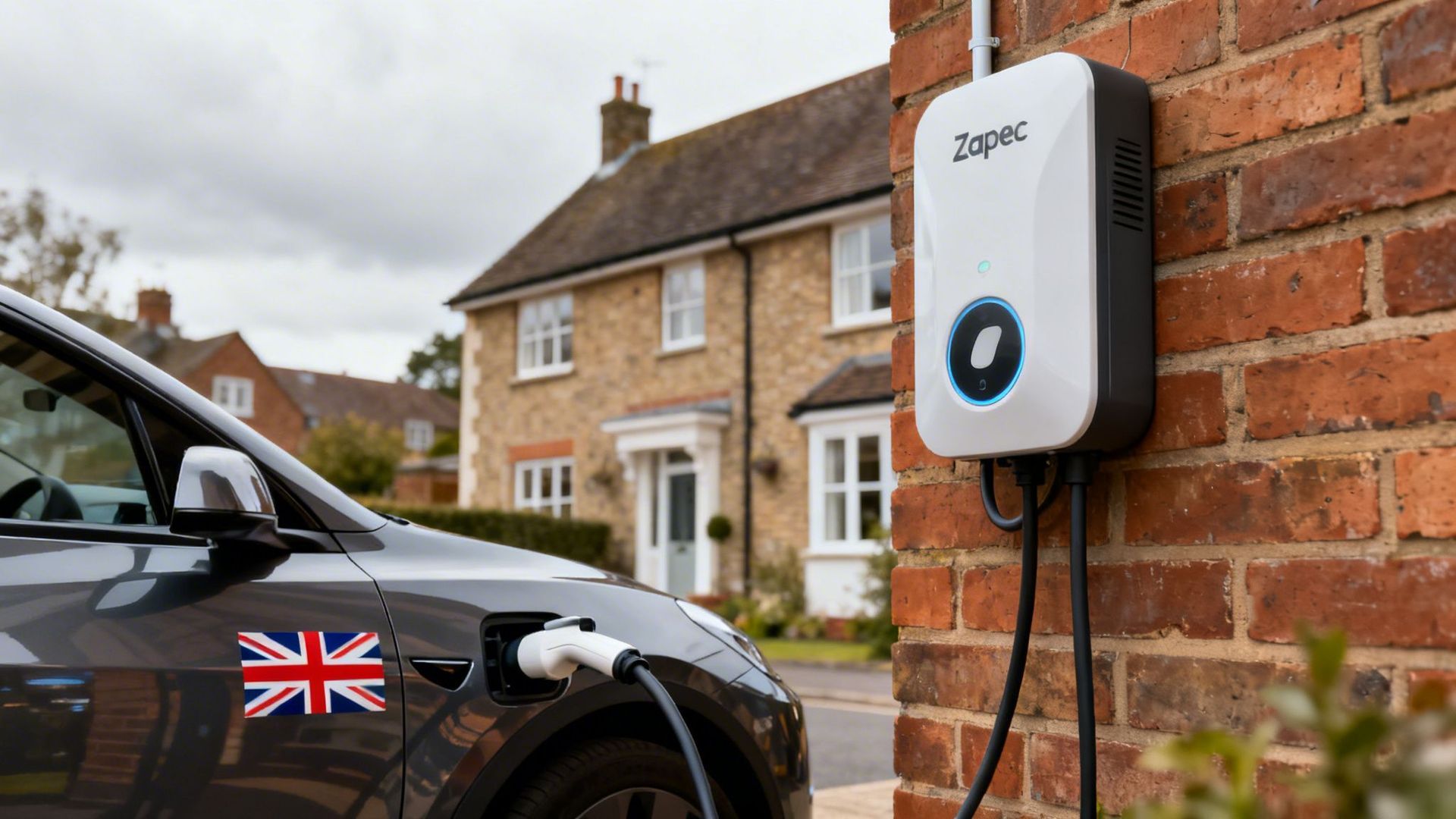
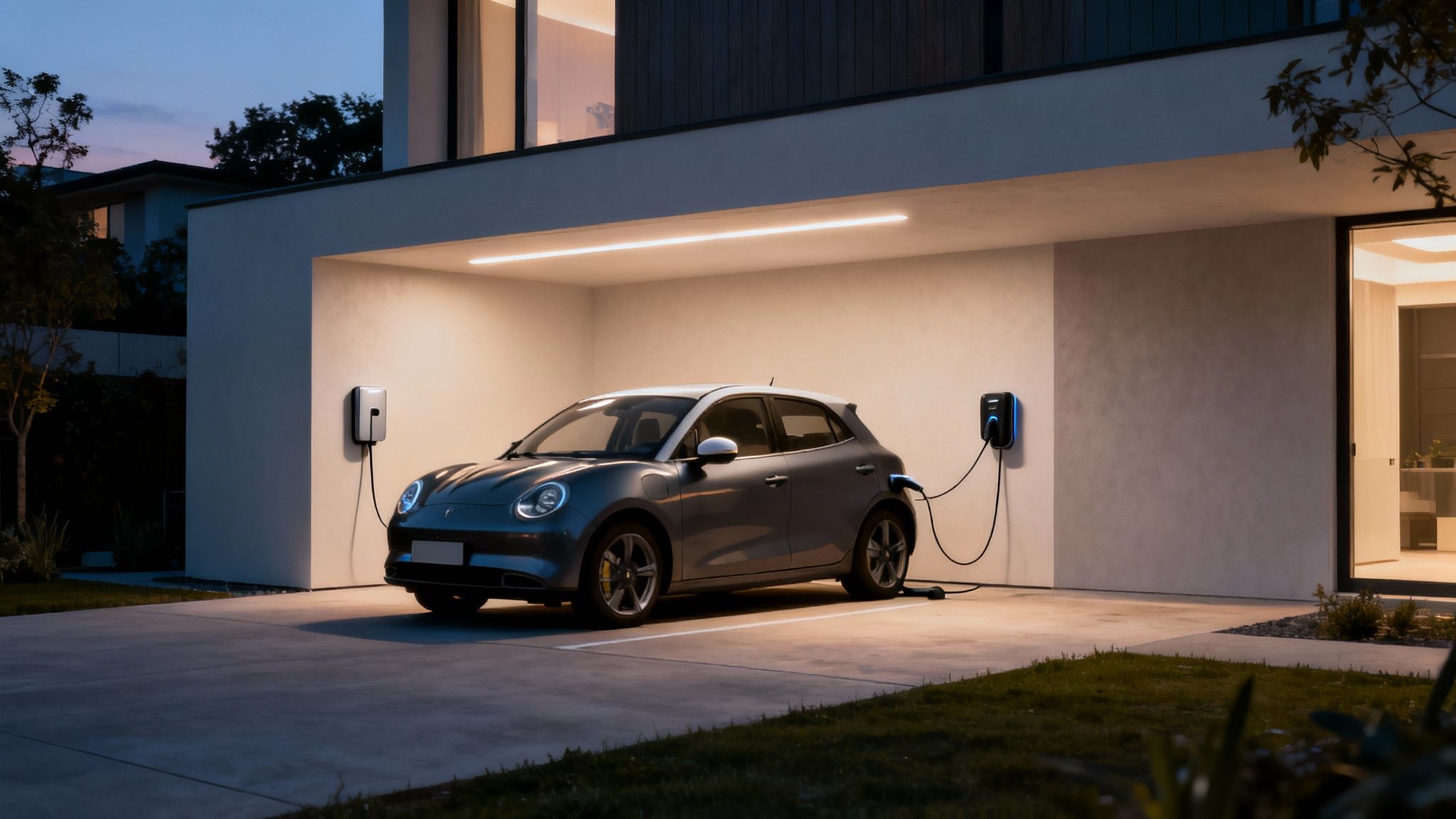
First, the jargon. The great "tethered vs. untethered" debate isn't really about which tech is superior; it's about what fits your life. A tethered charger has the cable permanently attached. It's incredibly convenient – just grab and plug – but can look a bit untidy, like a snake having a nap on your wall. An untethered unit is just a neat little socket, but it means you have to get the cable out of your boot every single time. Trust me, that's no fun in the middle of a downpour.
Power, Smarts, and Other Myths
Next up: power output. You'll see 22kW chargers advertised with promises of super-fast charging that'll have your car ready before you've finished a cup of tea. The reality check? Almost no home in the UK has the three-phase electrical supply needed to run one. For 99% of us , a standard 7kW charger is as fast as you can go, and it’s perfectly capable of giving you a full battery overnight.
Your decision really hinges on balancing convenience, features, and your actual power needs, as this flowchart breaks down.
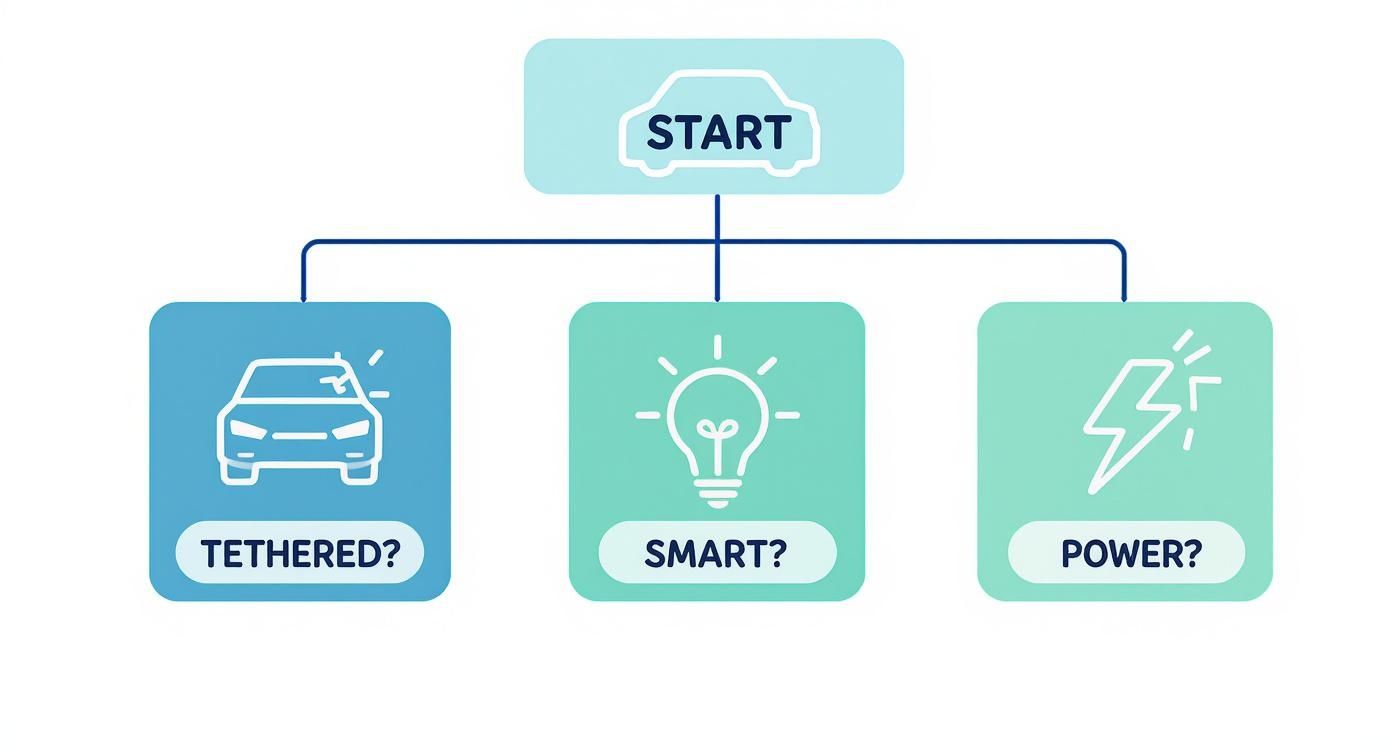
The main takeaway here is that your big three choices—cable type, smart features, and power—will directly shape how easy the charger is to use day-to-day and how much it costs you in the long run.
Then you have the word ' smart '. Back in 2022, new regulations made it mandatory for all new home chargers installed in the UK to be smart. This isn't just about another app cluttering up your phone; it's about real, tangible savings.
A proper smart charger lets you schedule charging to happen during off-peak hours when electricity is dirt cheap. That feature alone can save you hundreds of pounds a year, turning your charger from a simple appliance into a genuine money-saving tool.
So, when you're wading through reviews, ignore the guff about "revolutionary design". Focus on the practical stuff. Does the app actually work without crashing? Is it easy to set a schedule? And is the unit built to survive a miserable British winter? These are the questions that truly matter. Consider yourself armed and ready for the charger arena.
The Best Home EV Chargers: A UK Showdown
Right, let's get down to brass tacks. We’re putting the top home EV chargers available in the UK against each other to see which one truly comes out on top. This isn't just about reciting specs from a brochure; it’s a real-world look at what it's like to live with these things day in, day out.
Forget the glossy marketing and the suspiciously perfect five-star reviews for a moment. We're more interested in how these chargers handle a miserable Tuesday in November when you just need your car ready for the morning commute. We’ll be looking at everything from the hassle of installation to how good the app is (and whether it crashes more than a learner driver), right through to build quality and that all-important value for money.
The Contenders: A Quick Introduction
In one corner, we have the sleek, minimalist darling, the Ohme Home Pro . It’s the charger that looks like a piece of modern art and is beloved by techies for its incredibly clever integration with energy tariffs.
In the opposite corner is the rugged workhorse, the Hypervolt Home 3 Pro . This one is less about looking pretty and more about getting the job done, packing a mountain of features like built-in solar integration and a customisable LED light show. Because, why not?
And finally, there's the popular kid that everyone knows: the Pod Point Solo 3 . It’s the safe, sensible choice you’d introduce to your parents, focusing on pure simplicity over a dizzying array of settings. Let the battle commence.
Installation and First Impressions
The installation process is your first real interaction with your new charger, and it can set the tone for your entire ownership experience. A smooth setup feels like a good omen, whereas a day of drilling, head-scratching, and endless cups of tea for the electrician can sour things from the start.
-
Ohme Home Pro: Installation is generally straightforward for any qualified electrician. Its compact size is a real plus, meaning it doesn’t look like an industrial substation bolted to the side of your house. First impressions are of a premium, albeit slightly plasticky, product.
-
Hypervolt Home 3 Pro: This unit is a bit of a beast, physically larger and heavier than its rivals. Installation is often a two-person job, but once it's on the wall, it feels incredibly solid. It screams 'built to last', which is definitely reassuring.
-
Pod Point Solo 3: Known for its widespread network of installers, getting a Pod Point fitted is often a doddle. The unit itself is famously minimalist—a feature some love and others find a bit bland.
If you're still navigating the maze of options, our team has put together a comprehensive look at the best EV home charger UK models to help you avoid getting ripped off. Think of it as a sceptic's guide, just how we like it.
The App Experience: The Digital Battleground
A modern EV charger is only as good as its app. This is where you’ll be scheduling charges, tracking costs, and occasionally cursing the developers when it refuses to connect. A clunky app can turn a great piece of hardware into a very expensive paperweight.
The Ohme Home Pro's app is its superpower. It truly excels at finding the cheapest and greenest times to charge by linking directly to your energy provider's tariff. For anyone on a variable rate tariff like Octopus Agile, it's an absolute game-changer.
The ability to automatically charge when electricity prices plummet overnight isn't just a gimmick; it's the single most effective way to slash your EV running costs. This is what 'smart charging' is actually for.
Hypervolt’s app, on the other hand, is feature-packed but can feel a little cluttered at first. It does everything you could possibly want—solar integration, scheduled charging, cost tracking—but finding the right setting can sometimes feel like a treasure hunt. Still, it's powerful and reliable once you get the hang of it.
Pod Point's approach is all about simplicity. Its app is clean, basic, and does the essentials extremely well. If you just want to plug in and have it charge during your off-peak window without any fuss, it’s brilliant. If you’re a data nerd who wants to dive deep into stats, you might feel a bit short-changed.
UK Home Charger Head-to-Head Comparison
To make sense of it all, let’s put the key details side-by-side. This table cuts through the marketing waffle to show you what really matters for the average British driver.
| Charger Model | Power Output (kW) | Cable Type | Key Smart Features | Typical Installed Cost (£) | Real-World Usability Score (/10) |
|---|---|---|---|---|---|
| Ohme Home Pro | 7.4 | Tethered | Agile tariff integration, cost tracking | £950 - £1,100 | 9 |
| Hypervolt Home 3 Pro | 7 | Tethered | Solar integration, load balancing | £900 - £1,050 | 8 |
| Pod Point Solo 3 | 7 | Tethered/Untethered | Simple scheduling, auto-power balancing | £850 - £1,000 | 7 |
As you can see, while they all offer the standard 7kW charging speed that’s perfect for overnight top-ups, the real differences lie in their smart features and who they're designed for. The Ohme is for the savvy cost-cutter, the Hypervolt is for the eco-conscious tech enthusiast, and the Pod Point is for the driver who values simplicity above all else.
A Survival Guide to Public Charging Networks
Stepping into the world of public EV charging can feel a bit like a lottery. Will the charger work? Will it be blocked by a fully charged Nissan Leaf whose owner is currently enjoying a leisurely three-course meal? Think of this as your survival guide to the charging jungle.
We’re taking a close look at the main UK networks, from the motorway service station giants to the contenders in the supermarket car park. It’s time to get to grips with the maddening patchwork of different apps, payment methods, and baffling membership schemes. More importantly, we’ll tackle the grim reality of pulling up to a broken charger with only 10% battery left.
This isn't just another EV charger review; it's a practical guide to planning your journey without falling victim to 'charger anxiety' – a very real and tedious modern affliction.
The Big Players on the Motorway
When you’re making a long trip up the M6, you need chargers that are fast, reliable, and available. These are the networks you’ll find dominating the service stations, for better or for worse.
- Gridserve Electric Highway: The new king of the motorway. After taking over Ecotricity's ancient network, Gridserve has been on a mission, swapping out old, unreliable units for shiny new ones that actually work. They offer both CCS and CHAdeMO connectors and, thankfully, support simple contactless payment.
- IONITY: This is the premium option, especially if you have deep pockets. IONITY offers some of the fastest charging speeds out there ( up to 350kW ), but you definitely pay for the privilege. Their network is smaller but well-placed on major routes, making them a solid, if pricey, choice for a quick boost.
Supermarket and Destination Charging
For a convenient top-up while you're doing the weekly shop, these networks have you covered. They are usually a bit slower but are often cheaper or sometimes even free.
- Pod Point: A familiar sight at places like Tesco and Lidl. Pod Point chargers are generally dependable, though you might have to wrestle with their app to get started. The 7kW and 22kW chargers are perfect for adding a decent amount of range while you browse the biscuit aisle.
- InstaVolt: Known for its brilliant reliability and simple contactless payment system. You’ll find them at locations like McDonald's and Costa Coffee. They aren't the cheapest, but you can almost always count on them to be working, which is worth its weight in gold.
Juggling this mix of providers often means having a smartphone loaded with apps. For a more detailed look at the tools available, you might find our guide on how to find EV charging stations near you with top UK apps useful.
The Agony of Charger Anxiety
Let’s be honest: the biggest challenge isn't always the number of chargers. It’s the nagging fear that the one you’re heading to won't be working when you arrive. This 'charger anxiety' can quickly turn a pleasant road trip into a stressful, range-watching nightmare.
Research confirms this isn't just anecdotal. The Great EV Charging Report found that while most drivers were generally satisfied, a significant minority still felt anxious, particularly on longer journeys. This highlights the gap between the infrastructure that exists on paper and the real-world experience of using it. You can explore the full findings in the 2023 report from EVA England .
The true measure of a public charging network isn't its top speed or its fancy app. It’s reliability. A slightly slower charger that works every single time is infinitely better than an ultra-rapid one that’s perpetually out of order.
So, what's the best strategy? Always have a Plan B, and probably a Plan C, too. Use apps like Zap-Map or PlugShare to check a charger's recent user comments before you even set off. If multiple people have reported issues, it's best to steer clear. A good rule of thumb is to not let your battery dip into the red before looking for a charge, and always assume the first charger you visit might be a dud. It sounds cynical, but it’s a mindset that will save you a lot of stress.
The Real State of UK Charging Infrastructure
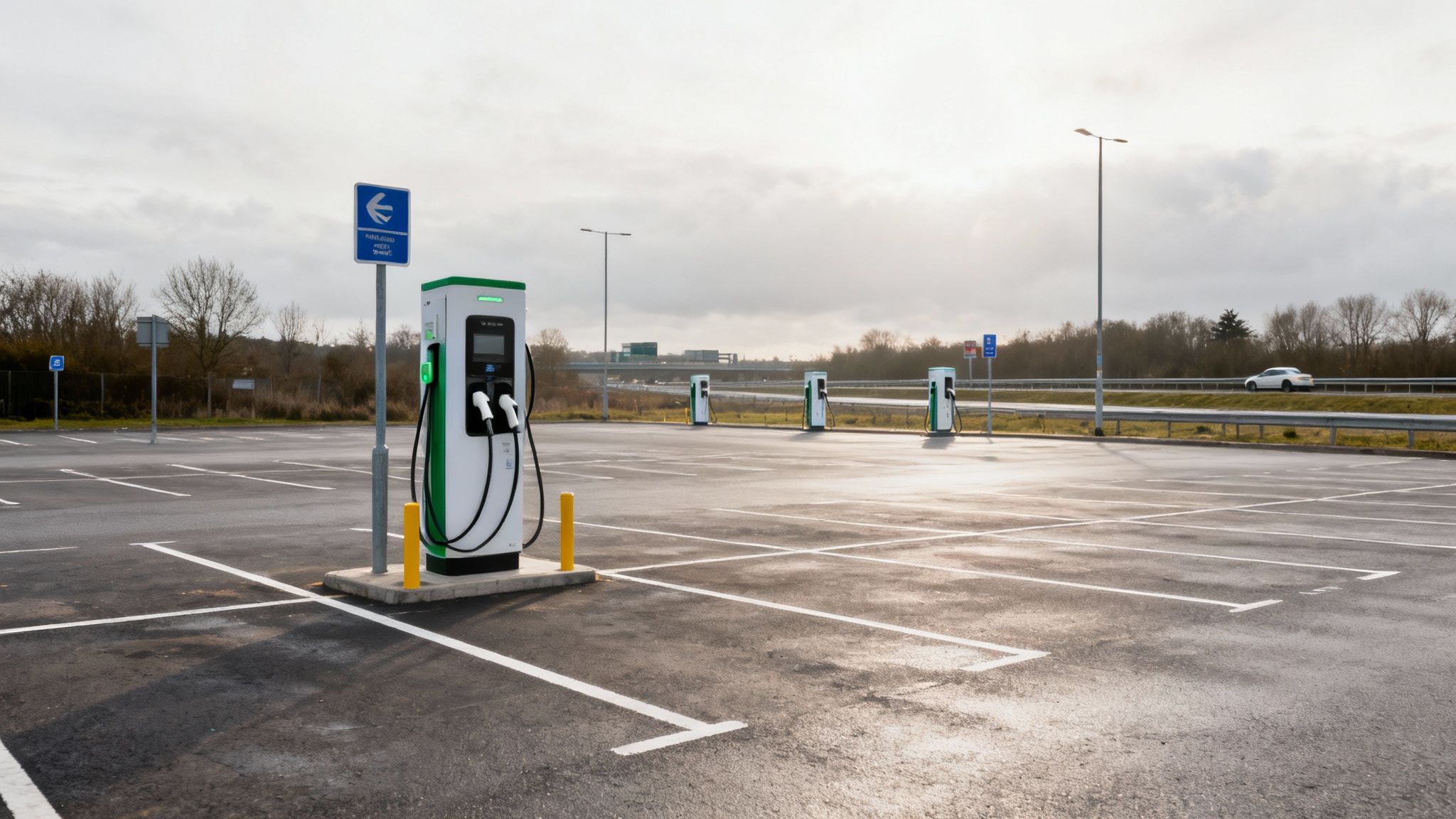
We’ve all heard the soundbites. Politicians and press releases paint a rosy picture of the UK as an EV paradise, with charging points popping up on every corner. But if you're an EV driver, you know the reality on the ground can feel quite different.
So, let's cut through the noise and look at the actual numbers. The government is pushing hard to expand the network, but are they putting the right chargers in the right places? Understanding this is key to figuring out if the infrastructure can truly support your switch to electric, or if it’s more political window dressing.
After all, it’s not just about the total count. A slow trickle charger at a supermarket is next to useless when you’re desperate for a quick boost on the M6.
A Numbers Game: Destination vs. En Route
The government loves to tout the growing total number of public chargers. According to the official figures, as of October 2025, there were 86,021 public electric vehicle charging devices in the UK. On the face of it, that sounds pretty healthy.
But as is often the case, the devil is in the detail. Let’s break that number down.
A whopping 41,390 (48%) of those are 'destination' chargers—the kind you find at hotels or shopping centres. Another 32,981 (38%) are slower 'on-street' units. That leaves just 8,096 (9.4%) as the high-power 'en route' chargers you genuinely need for a long journey.
This inconvenient truth tells a clear story: our public network is currently built for leisurely top-ups, not for the kind of rapid, cross-country travel that replaces a five-minute fuel stop.
The Great Regional Divide
It’s not just about the type of charger, but also where you can find one. The distribution of charging points across the UK is a real postcode lottery, and the experience can vary dramatically from one county to the next.
- London: Unsurprisingly, the capital is saturated with chargers, boasting the highest density in the country by a long shot.
- Scotland: Has made impressive progress, particularly with its ChargePlace Scotland network, which provides solid coverage even in some surprisingly remote areas.
- Wales and Northern Ireland: Are lagging noticeably behind. This has created 'charging deserts' in certain areas, making long-distance EV travel feel like a bit of a gamble.
This means a trip through central London is a breeze, but a journey across rural Wales requires almost military-grade planning.
The core issue with the UK's charging infrastructure isn't just the raw number of chargers. It's their strategic placement and speed. Having thousands of slow chargers in city centres does very little for a family trying to get to their holiday cottage in Cornwall on a bank holiday weekend.
We’ve taken a much deeper look into the specific challenges drivers face in our guide to the EV charging landscape in the UK.
So, is the infrastructure ready? For daily commutes and local driving, it's absolutely getting there. But for replacing the convenience of a petrol station on a spontaneous long road trip? Not quite. For now, planning remains the EV driver's best friend.
Our Final Verdict on the Best EV Chargers
Right, we've waded through the technical specs, sidestepped the marketing spin, and put the leading chargers through their paces. Now it's time to cut through the noise and give you a straight answer on which ones are actually worth your money.
Choosing an EV charger is a bigger decision than you might think. It’s not just about raw power; it’s about finding a reliable workhorse for your daily life. You need something that won’t let you down on a freezing winter morning when you absolutely must get to work. So, let’s get to it and pick some winners.
The Best All-Rounder Home Charger
For the best all-round home charging experience, the Ohme Home Pro is our top pick. Its real genius is how it single-mindedly focuses on saving you money. The app’s clever integration with agile energy tariffs, allowing it to charge only when electricity is at its rock-bottom price, is a game-changer.
This isn't some niche feature you'll never use. It can genuinely trim hundreds of pounds from your annual electricity bill, meaning the charger effectively pays for itself over a couple of years. For the savvy EV driver who wants smart tech that delivers real-world savings, it's a no-brainer.
The Best Budget-Friendly Option
If you're balking at the idea of spending nearly a grand on a glorified wall socket, don't worry. The Pod Point Solo 3 is our recommendation for anyone wanting proven reliability without the hefty price tag. Think of it as the Ford Focus of EV chargers: it’s dependable, you see them everywhere, and it gets the job done with no fuss.
Pod Point's strength is its simplicity. The app handles the essentials brilliantly without trying to be a supercomputer. It just works, and in a world full of flaky tech, that simple reliability is priceless.
What you get is a solid piece of kit from a company with one of the UK’s largest installation networks, all for a very sensible price. It’s the perfect, fuss-free choice for drivers who just want to plug their car in and get on with their lives. It might not have the clever tariff-tracking of the Ohme, but its straightforward, dependable nature is a massive selling point.
The Most Reliable Public Network
When you're miles from home and your battery gauge is dipping into the red, you don't care about fancy apps or loyalty schemes – you just want a charger that works. For that reason, InstaVolt stands out as our champion of public charging.
Their approach to success is beautifully simple, and it’s something many rivals still haven't figured out:
- Install high-quality, reliable charging units.
- Keep them well-maintained and operational.
- Make payment dead simple with contactless card readers.
They may not always be the absolute cheapest option per kWh, but the peace of mind you get from pulling up to an InstaVolt station is worth every penny. In all our testing and EV car charger reviews, reliability is the one thing that matters most on the road, and InstaVolt delivers time and time again. They’re a safe bet in the often-unpredictable world of public charging.
Common EV Charger Questions Answered
After wading through the murky waters of EV charger reviews, you're probably left with a few nagging questions. These are the ones you might feel a bit daft asking, but don't worry, we’ve heard them all. So, let’s have a quick-fire round to clear up any confusion before you part with your hard-earned cash.
This is your final briefing, a chance to get some straight, fluff-free answers. Think of it as the FAQ section, but with a bit more real-world experience and a lot less corporate waffle.
Do I Really Need a Smart EV Charger?
In a word, yes. It's not just a nice-to-have; since mid-2022, it's been the law for all new home charger installations in Great Britain. But let's set the red tape aside for a moment and focus on your wallet. A smart charger is your secret weapon against eye-watering electricity bills.
It lets you schedule charging for the dead of night, when electricity tariffs can be incredibly cheap. Without that simple feature, you’re just plugging in whenever you get home, most likely paying peak rates like an absolute rookie. That’s like deliberately choosing the priciest petrol station on the motorway every single time.
Some of the more advanced chargers can even sync up with your home solar panels, letting you fill your car's battery with pure, unadulterated sunshine. So, while the word "smart" gets thrown around a lot, in this context, it genuinely means "saves you a pile of money". Don't even think about getting a charger without it.
What Is the Difference Between 7kW and 22kW Home Chargers?
The simple answer is speed, but the real-world answer is a bit more complicated and, for most UK homeowners, a bit of a non-starter. A 7kW charger is the standard for British homes and is more than capable of charging any EV from empty to full overnight. It runs on a single-phase electricity supply, which is what virtually every house in the country has.
A 22kW charger, on the other hand, is three times faster. That sounds fantastic until you hit the massive snag: it needs a three-phase electricity supply. Most residential properties simply don't have this, and getting it installed can cost thousands of pounds, often involving digging up your garden and a whole load of paperwork.
On top of the costly supply upgrade, not all electric cars can even accept a 22kW charge from an AC source. You could spend a fortune on a super-fast charger only to find your car can't use the extra power anyway.
So, unless you happen to live in a converted factory or a brand-new mansion with all the bells and whistles, a 22kW charger is an expensive and utterly pointless ornament for your wall. Stick with 7kW ; it’s all you need.
Should I Get a Tethered or Untethered Charger?
Welcome to the great philosophical debate of the EV world. A tethered charger has the cable permanently attached, and its convenience is undeniable. You just pull up, grab the cable, and plug in. There's zero faffing about with a muddy cable you've had to drag out of the boot.
The downside is that you’re stuck with that specific cable type (usually a Type 2 connector) and its length. It can also look a bit messy, with the cable coiled up on the wall like a dormant python.
An untethered charger is just a neat little socket. It looks much tidier and gives you the flexibility to use different cables if you need to. The big drawback, of course, is the daily ritual of wrestling with the cable from your car, which is especially miserable when it's chucking it down with rain. For sheer, unadulterated ease of use, tethered wins every single time. But if you’re a minimalist who values a clean look above all else, go untethered.
How Much Does Home EV Charger Installation Cost?
Ah, the classic 'how long is a piece of string' question. The price you see advertised for a charger is almost never the final bill. The total cost depends entirely on the quirks of your property.
A "standard installation," which is often bundled into the advertised price, makes a lot of assumptions. It presumes your consumer unit (or fuse box) is modern, compliant with current regulations, and located conveniently close to where you want the charger.
If your home's wiring dates back to the dark ages, or the cable needs to be routed under a pristine driveway and through three solid brick walls, the costs can rocket. You could easily see a bill climb from £900 to well over £1,500 .
- Get a Survey: Always insist on a proper survey before you agree to anything.
- Send Photos: A reputable installer will ask for detailed photos or a video call to assess the job properly.
- Get a Firm Quote: Never, ever proceed without a fixed, written quote that covers all the work.
Be deeply suspicious of any deal that seems too good to be true. A cheap installation often means cut corners, which is the last thing you want when dealing with high-power electronics attached to your house.
At VoltsMonster , we cut through the jargon to give you honest, entertaining, and genuinely useful advice on navigating the world of electric vehicles. Check out our latest reviews and guides at https://www.voltsmonster.com.
VoltsMonster Electric Vehicle Blog