EV Car Reviews UK: A Brutally Honest Guide to Going Electric
Let's be honest, you're EV-curious. The fantasy of silent cruising, neck-snapping acceleration, and waving a final, two-fingered salute to the petrol station is a powerful one. But then you hear the whispers from the front line: horror stories of drivers stranded at broken chargers in the pissing rain, range that evaporates in winter, and home electricity bills that could make a grown man weep.
Is Going Electric a Genius Move or a Monumental Cock-Up?
The shift to electric cars in the UK is no longer the preserve of eco-warriors and tech evangelists; it's a full-blown mainstream invasion. The numbers are genuinely bonkers. Just a few years back, pure electric vehicles made up a piddling 1.4% of new car sales. Flash forward to today, and there are over 1.7 million of them infesting UK roads, a proper part of the automotive landscape.
This boom suggests going electric is a no-brainer. Who wouldn’t want to glide past petrol stations with a smug grin plastered across their face? The promise is one of pennies-per-mile motoring, zero tailpipe emissions, and the kind of instant shove that makes pulling away from the traffic lights a genuine event. It all sounds bloody brilliant on paper, doesn't it?
The Reality Check You Didn't Know You Needed
But it's not quite that simple. Making the leap from a familiar petrol or diesel motor to a battery-powered one is a big step, and it comes with its own unique set of headaches. Suddenly you're drowning in a sea of new acronyms (WLTP, kWh, SoC), dragged into debates about charging etiquette, and gripped by the ever-present fear of 'range anxiety'—a modern affliction that can turn a simple schlep up the M1 into a nerve-shredding game of guess-the-miles.
The slick marketing brochures paint a picture of a seamless, utopian future. The reality can sometimes involve wrestling with a frozen charging cable in a badly lit car park while an app on your phone repeatedly tells you an "unknown error has occurred".
Before you get swept away by the hype, it's crucial to understand what you're really signing up for. The true ownership experience is a mix of brilliant highs and genuinely infuriating lows. We explore this in much more detail in our guide on the realities of electric vehicle ownership in the UK .
Key Considerations Before You Take the Plunge
Think of this guide as your brutally honest co-pilot. We're slicing through the marketing guff to give you a clear-eyed view of what it’s really like to live with an EV in Britain today. We’ll be comparing some of the most popular models on the market, not just by their brochure stats, but on the things that actually matter day-to-day.
| Consideration | Petrol/Diesel Car | Electric Vehicle |
|---|---|---|
| Refuelling | 5 minutes at any smelly petrol station. | 30 mins (if you're lucky) to 12+ hours. |
| Running Costs | Predictably painful. | Wildly variable (cheap as chips at home, eye-watering on the road). |
| Driving Feel | Familiar rumble and agricultural gear changes. | Silent, smooth, and startlingly quick. |
| Maintenance | Regular oil changes and other wallet-draining rituals. | Fewer moving parts, but tyres wear faster than a politician's principles. |
The Head-to-Head: A Proper UK EV Showdown
Right, let's get down to brass tacks. Comparing electric cars using the official brochures is a bit like choosing a holiday based on the CGI renders – you're setting yourself up for disappointment. It’s time to pit the main players against each other in a proper, real-world scrap on Britain's potholed roads.
Forget the fantasy figures published by manufacturers. This is all about performance on a wet Tuesday in Stoke.
We've lined up three of the UK's most popular contenders: the tech-darling Tesla Model Y , the pragmatic and stylish Kia EV6 , and the disruptive, cheap-as-chips MG4 . Each one represents a different philosophy, a different price point, and a different answer to the big question: "Is this EV thing really for me?" This is what our ev car reviews uk series is all about – no-nonsense, real-world data.
The UK's appetite for electric cars is growing faster than a weed in a heatwave, as this chart clearly shows.
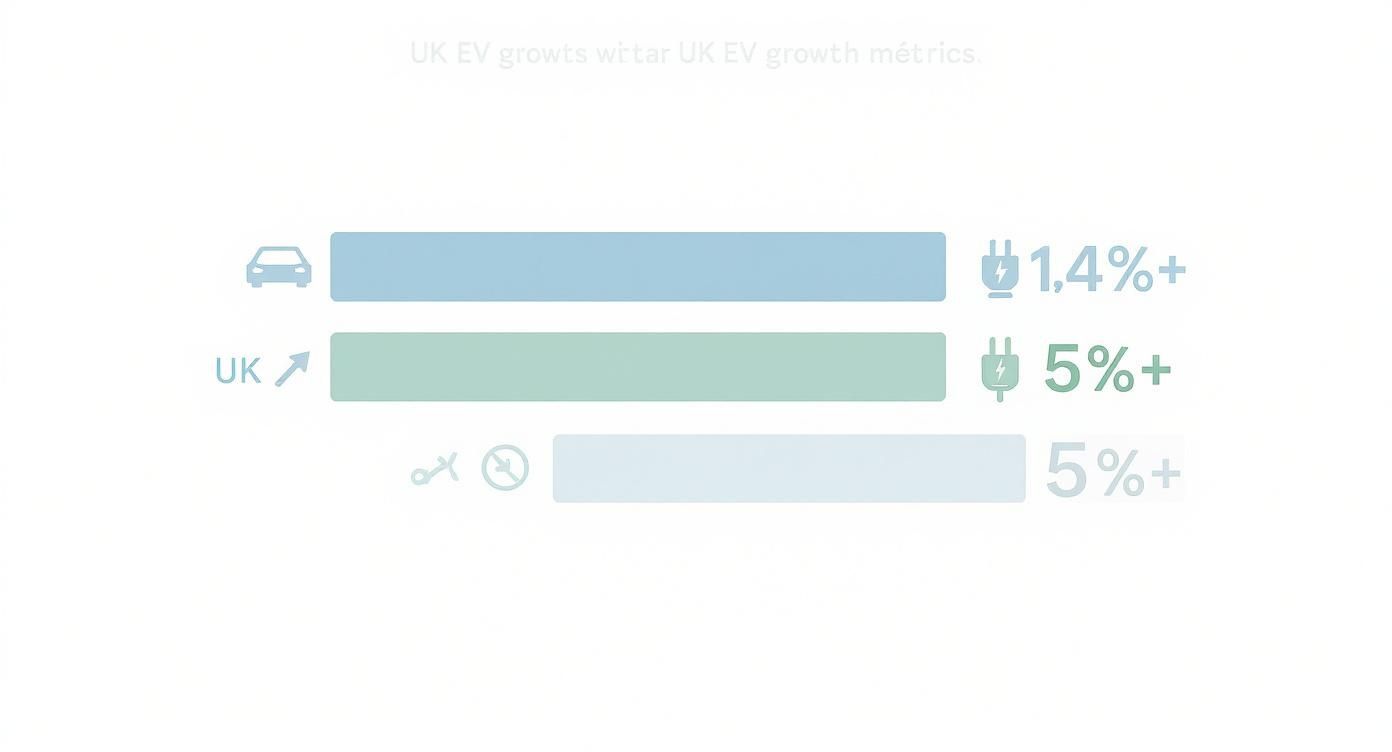
This jump from a niche market at 1.4% to a significant segment of over 5% of cars on the road highlights just how quickly things are changing.
The Contestants: Our Unholy Trinity
First in the ring is the Tesla Model Y . It’s the EV everyone thinks of first, the automotive equivalent of an iPhone. It's minimalist to a fault, ludicrously quick, and grants you access to the smugly superior Supercharger network. But is living with its screen-only philosophy a joy or a massive pain in the arse?
Next, we have the Kia EV6 . With its sci-fi styling and a brilliant 7-year warranty, it’s the sensible choice that doesn’t feel sensible at all. It boasts an ultra-fast 800-volt charging architecture, which sounds impressive, but what does that actually mean at a Gridserve station on the M40?
And finally, the challenger: the MG4 . This is the car that made the entire industry sit up and spill its tea. Offering proper EV performance and range for the price of a mid-spec hatchback, it almost seems too good to be true. We’ll find out exactly where the corners have been cut.
The M1 Winter Range Test
Let's be clear: official range figures are works of fiction, penned by optimists in a warm laboratory. To get to the truth, we subjected each car to the ultimate British test—a freezing January commute up the M1 with the heating on full blast, wipers flapping, and the radio blaring to drown out the misery.
- Tesla Model Y Long Range (Official Range 331 miles): The Tesla held up surprisingly well, managing a real-world 255 miles . Its sophisticated heat pump system clearly earns its keep, but that’s still a hefty 23% drop from the official number.
- Kia EV6 RWD (Official Range 328 miles): The Kia was hot on its heels, delivering 240 miles . A respectable performance, but a slightly steeper drop of 27% , proving that even the best are battered by the cold.
- MG4 Long Range (Official Range 281 miles): The budget hero put in a valiant effort, achieving 205 miles . That's a 27% reduction, matching the Kia's percentage drop, which is seriously impressive for a car in this price bracket.
The big takeaway here is that winter will mercilessly slash your range by at least a quarter. Anyone who tells you otherwise is either lying or lives in a heated garage. Plan your long journeys accordingly, or prepare to become intimately familiar with service station coffee.
For a deeper dive into the lies and half-truths of official figures, check out our electric car range comparison for the UK.
The Rapid Charger Reality Check
A car’s maximum charging speed is another figure ripe for misinterpretation. To see what you can really expect, we timed how long it took each car to charge from 10% to 80% on a standard 150kW public rapid charger—the kind you’ll actually find out in the wild.
The numbers below give a snapshot of what these cars are really like to live with day-to-day.
At-a-Glance Real-World Performance Metrics
| Real-World Metric | EV Model 1 (e.g., Tesla Model Y) | EV Model 2 (e.g., Kia EV6) | EV Model 3 (e.g., MG4) |
|---|---|---|---|
| Winter M1 Range | 255 miles | 240 miles | 205 miles |
| 10-80% Charge Time (150kW) | 27 mins | 18 mins | 35 mins |
| Infotainment Irritation Level | High (screen-only chaos) | Medium (mostly logical) | Low (simple but effective) |
The results were revealing. The Kia EV6 , with its superior 800V system, was the undisputed champion, taking just 18 minutes . The Tesla’s famed Supercharger access doesn't help it here; on a generic charger, it took a respectable 27 minutes . The MG4 , while the slowest at 35 minutes , is hardly a disaster and perfectly acceptable for a long-journey pit stop.
As these results show, the choice for UK drivers has never been better, and it’s a trend reflected in the market. Sales of new and used EVs are surging, with models like these becoming a common sight as manufacturers rush to meet demand.
The Daily Grind of Living with an Electric Car
So, you’ve navigated the slick showroom, signed on the dotted line, and your shiny new electric car is sitting on the drive. Congratulations. You've officially swapped the familiar smell of petrol for the silent, smug superiority of electric power. But let's be honest, buying the car is the easy part. Now you have to actually live with the thing.
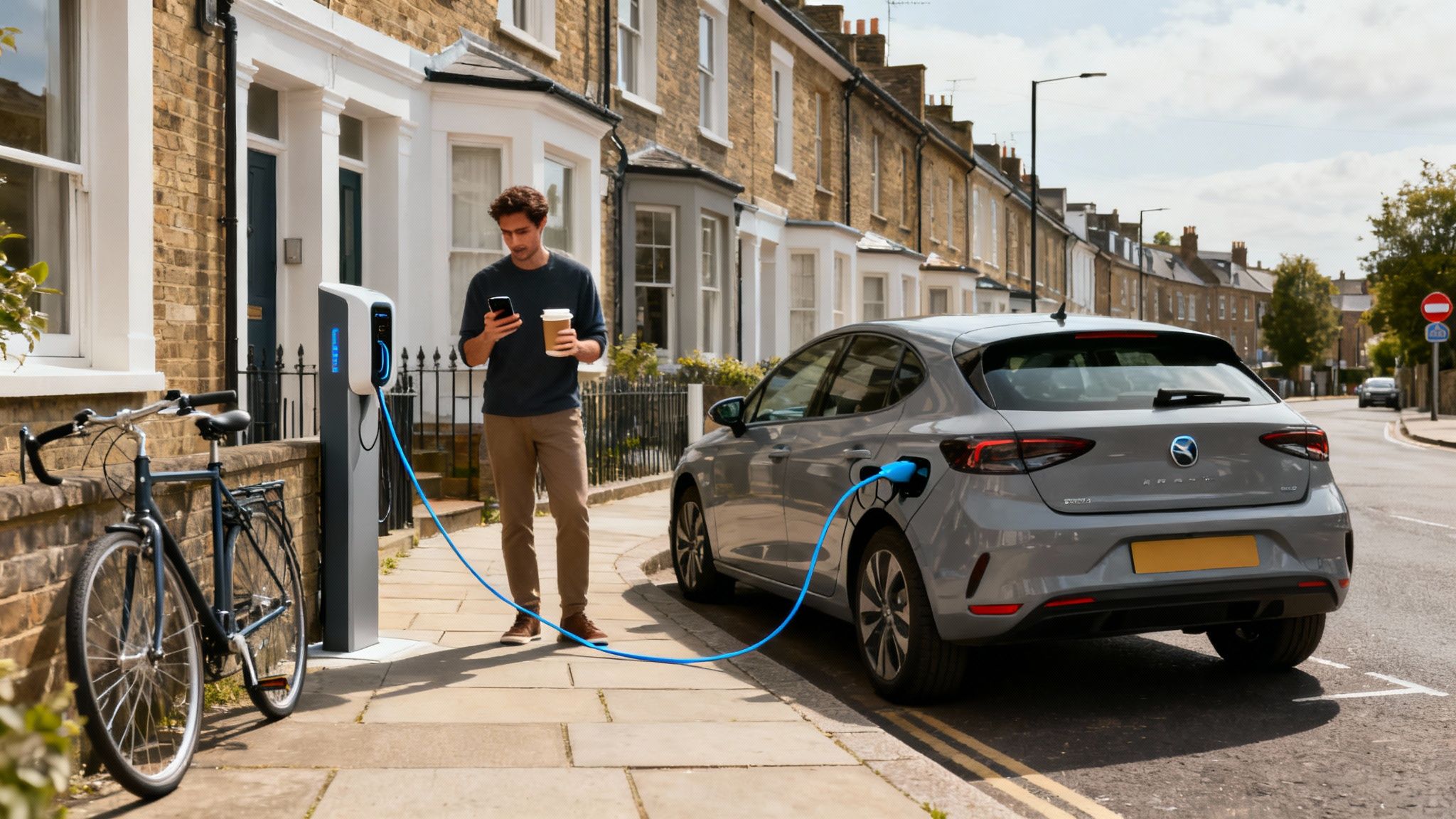
Here’s your no-nonsense guide to the daily reality of EV ownership in Britain—a world where your driveway, or lack thereof, dictates your sanity. Let's get straight to the biggest hurdle.
The Driveway Dictatorship
Is it really practical to own an EV in the UK without off-street parking? In short, yes, but you’d better have the patience of a saint and an exceptionally high tolerance for faff. Relying entirely on the public charging network is like playing Russian roulette with your daily schedule.
Having a home charger is the holy grail. It’s where the promised land of "pennies per mile" actually exists, letting you plug in overnight on a cheap electricity tariff. Without that convenience, you're at the mercy of public charging prices, which can often be more expensive than filling up a reasonably efficient petrol car.
If you’re one of the millions living in a flat or a terraced house, your options are limited. You'll either be trailing cables across the pavement (a trip hazard lawsuit waiting to happen) or becoming a weekly regular at the local supermarket, praying the charger isn't occupied or, more likely, just plain broken.
The Public Charging Circus
Welcome to the chaotic, often maddening world of public charging. It’s a baffling ecosystem of competing companies, each one demanding you download their specific app, register your life story, and occasionally offer up a blood sample just to get a few kilowatts of juice.
You'll quickly find your phone cluttered with apps—Pod Point, Gridserve, Ionity, Shell Recharge... the list goes on. You'll also need a wallet stuffed with various RFID cards for the inevitable moment an app refuses to connect. It’s a fragmented, infuriating system that makes the simple act of paying at a petrol pump seem like a masterclass in user-friendly design.
Forget range anxiety; the real fear is charger anxiety. It’s that sinking feeling you get when pulling into a motorway service station with 10% battery, only to find all four rapid chargers are out of order. It's a uniquely modern form of torture.
The Hidden Costs They Don't Mention
Beyond the charging palaver, a few other financial gremlins are lurking in the shadows of EV ownership. These are the details often glossed over in glowing ev car reviews uk that focus purely on the drive itself.
- Eye-Watering Insurance: Insurers are still a bit twitchy about EVs. The high purchase price, specialist repair costs, and lingering fears over battery replacement mean premiums can be shockingly high. Brace yourself for a quote that might make your eyebrows launch into orbit.
- Tyre Torture: Electric cars are heavy. All that battery weight puts immense strain on the rubber, meaning they chew through tyres far more quickly than their petrol-powered cousins. Expect to be replacing them much more frequently, especially if you enjoy that instant electric acceleration.
- Software Shenanigans: Modern cars are essentially computers on wheels, and we all know how reliable computers can be. From infotainment screens freezing up to keyless entry systems having a tantrum, be prepared for the occasional software glitch that can only be fixed by the classic "turn it off and on again" method.
Living with an EV in the UK is very much a game of two halves. On a good day, it’s brilliant—silent, cheap to run, and satisfyingly futuristic. But on a bad day, it’s a masterclass in frustration management. Your experience will depend almost entirely on your access to a home charger and your ability to keep your cool when an app tells you "payment failed" for the seventh time in a row.
Getting to Grips with the Real Cost of Owning an EV in the UK
We’re all familiar with the story: electric cars are meant to be incredibly cheap to run. "Pennies per mile!" is the common refrain as they glide silently past another petrol station. But with home electricity prices not quite the bargain they used to be, is that still the whole truth?
Let's look beyond the simplistic "leccy vs. petrol" headlines. It’s time for a proper financial deep dive that many EV reviews tend to skim over. We're going to build a realistic three-year cost of ownership model, putting our featured EVs up against a familiar face on British roads: the petrol-powered Volkswagen Golf.

This isn’t just about fuel. We'll be factoring in everything from the initial purchase price and the soul-crushing impact of depreciation to insurance, servicing, and tax. Some of the numbers might surprise you.
The Elephant in the Room: Depreciation
The single biggest cost of running any new car isn't what you put in the tank (or plug into the wall); it's depreciation. This is the silent killer of your car budget. For a while, EVs seemed to defy gravity, holding their value with surprising strength, but the market is shifting. A flood of new models and changing incentives means resale values have started to fall back to earth.
A new petrol Golf might lose around 40% of its value over three years. While some premium EVs have historically done better, many mainstream models are now expected to shed 50-55% or more in the same timeframe. That initial drop in value can easily wipe out any potential fuel savings before you’ve even finished your first cup of coffee on the M25.
Fuelling the Debate: Electricity vs. Petrol
This is where things get tricky. How much you save on running an EV comes down to one simple thing: where you charge it.
- Home Charging: Got a driveway? Brilliant. If you can get on a cheap overnight electricity tariff (think around 7.5p per kWh ), you're in the money. This works out to a ridiculously low cost of about 2-3p per mile .
- Public Charging: If you're relying entirely on the public network, the picture changes dramatically. Rapid chargers can easily cost 79p per kWh or more, pushing your running costs up to 20-25p per mile . Suddenly, that petrol Golf doesn't look so expensive to run.
For our comparison, we'll assume a sensible real-world mix of home and public top-ups. For a more granular look, check out our guide on the real cost of owning an EV compared to petrol cars .
Dealing with the Tax Man: VED and Company Cars
For now, pure EVs have a huge perk: they pay £0 in Vehicle Excise Duty (VED), or road tax. A petrol Golf, meanwhile, lands you with a standard rate bill every year. But don’t get too comfortable – this tax-free party is scheduled to end in 2025, which will level the playing field quite a bit.
Where EVs still hold an almost unbeatable advantage is company car tax. With a Benefit-in-Kind (BiK) rate of just 2% , an EV can save a higher-rate taxpayer thousands of pounds a year. A comparable petrol car could easily sit in a 30%+ tax bracket. For company car drivers, this single factor often makes the decision for them.
The choice to go electric isn't a simple calculation; it’s a complex equation based on your specific circumstances. For a high-mileage company car driver with a home charger, it’s a financial slam dunk. For a low-mileage private buyer in a city-centre flat, it could be a costly mistake.
The Final Tally: A Three-Year Breakdown
So, let's pull all these threads together. The table below gives a simplified but realistic projection of what it costs to own these cars over 36 months. We've included the purchase price, estimated depreciation, fuel/energy costs (based on 10,000 miles a year), insurance estimates, standard servicing, and VED.
Three-Year Ownership Cost: A Financial Reality Check
This detailed financial breakdown compares our featured EVs against each other and a petrol equivalent over a typical ownership period.
| Cost Factor | Tesla Model Y | Kia EV6 | VW Golf (Petrol) |
|---|---|---|---|
| Purchase Price (OTR) | ~£44,990 | ~£45,275 | ~£30,000 |
| Est. Depreciation | - £20,250 | - £24,000 | - £12,000 |
| Energy/Fuel Cost | ~£900 | ~£950 | ~£4,500 |
| Insurance (Estimate) | ~£2,400 | ~£2,100 | ~£1,500 |
| Servicing | ~£600 | ~£450 | ~£750 |
| VED (Road Tax) | £0 | £0 | ~£555 |
| Total 3-Year Cost | £24,150 | £27,500 | £19,305 |
Once the dust settles, the numbers speak for themselves. For a private cash buyer, the humble petrol Golf actually works out cheaper over three years. Why? It's almost entirely down to its lower purchase price and slower depreciation. While you save a fortune at the "pump" with an EV, the huge initial outlay and the value it loses can be too much to overcome in the short term. The verdict is clear: do your own sums before you sign on the dotted line.
The Verdict: Who Should Buy Which EV?
Right, the spreadsheets have been crunched, the charging cables wrestled with, and our patience thoroughly tested. After all the real-world driving and financial deep dives, it's time to deliver the final verdict. But we're not just going to crown a single "winner" and call it a day—that's the sort of lazy conclusion you'd find in other EV car reviews UK .
The truth is, the "best" EV is a bit like the "best" biscuit for your tea: it all depends on the situation. Are you after a quick dunk with a Rich Tea or are you settling in for a proper session with a Hobnob? In the same way, your perfect electric car hinges entirely on your life, your budget, and frankly, how much hassle you're prepared to put up with.
So, let's get specific and match the right car to the right person.
For the High-Mileage Motorway Warrior
You’re a sales rep, a consultant, or maybe you just spend more time on the M6 than in your own living room. Your needs are crystal clear: maximum range, a comfortable cruise, and a charging network that won't send your blood pressure soaring.
For you, the Tesla Model Y is almost impossible to look past. Yes, the minimalist interior can feel a bit sparse and the ride is on the firm side, but its real-world range is dependable, and its trump card is undeniable: the Supercharger network. It's the one public charging system that just works , a priceless advantage when you need to get from Bristol to Newcastle for a meeting on time.
The Kia EV6 runs it a close second, offering a plusher ride and a far more conventional, premium-feeling interior. But for anyone whose livelihood depends on being on the move, the sheer reliability of the Tesla network gives it the edge.
For the Urban Family Haulier
You're a master of the school run, a veteran of supermarket car park battles, and you occasionally escape for a weekend trip to the coast. You need practicality, a decent amount of space, and running costs that don’t require a second mortgage. You also want a car that doesn't feel like a soulless box on wheels.
This is where the Kia EV6 truly shines. It strikes a fantastic balance. The real-world range is genuinely useful for those longer journeys, and its lightning-fast charging is a godsend when you need a quick top-up with the kids in the back. It also has more than enough space for shopping, school bags, and the dog. Crucially, its interior feels special, and it’s a more comfortable and engaging car to drive around town than the Tesla.
The MG4 is a tempting budget alternative for family duties, but the Kia's superior build quality, faster charging, and seven-year warranty provide a long-term peace of mind that's worth the extra cash. It's the grown-up, sensible choice that still manages to feel exciting.
For the Savvy Company Car Driver
Let’s be honest, your main motivation here is financial. It's all about slashing that Benefit-in-Kind (BiK) tax bill. You want the cheapest route into a brand-new car, and the 2% BiK rate on EVs is an opportunity that’s too good to ignore.
In this scenario, the MG4 is the undisputed champion. This is a decision made by your head, talking directly to your wallet. For a monthly lease cost that embarrasses its rivals, you get a car with a perfectly usable real-world range, decent tech, and running costs that will make your finance director smile. It delivers 80% of the full EV experience for what feels like 60% of the price.
Sure, some of the interior plastics are a bit scratchy and it isn't the most refined car on the motorway, but who really cares? You'll be saving hundreds, if not thousands, of pounds a year in tax. It’s a complete no-brainer.
And Who Should Stick with Petrol for Now?
Let's be brutally honest for a moment. If you live in a city-centre flat with no access to off-street parking and would rely solely on the public charging network, you should probably steer clear of an EV for another year or two. The stress of hunting for a working charger and the eye-watering cost of public rapid charging will quickly sour the ownership experience.
You’d simply be swapping petrol station forecourts for windswept, poorly-lit service station car parks, and that’s not an upgrade in anyone's book.
Your EV Questions Answered
Still on the fence about making the switch? You're not the only one. The electric car world is swimming with jargon, confusing stats, and plenty of myths. Let's cut through the noise and tackle the questions we hear all the time, with the kind of straight answers you won't get from a salesman.
Is the UK Charging Network Actually Any Good?
In a word: patchy. If you live in a big city or spend your life on the motorway network, you’ll find the infrastructure is getting much better. There are now plenty of shiny, multi-stall charging hubs that, for the most part, just work.
But head out into the countryside, and it’s a different story. You can quickly find yourself hunting for a single, temperamental 7kW post tucked away behind a village hall. The real issue isn't just the number of chargers, though; it's their reliability. Every EV driver has a horror story about arriving at a charger with a near-flat battery, only to find it's out of order. It’s a uniquely modern kind of frustration.
Let's be blunt: for a stress-free life, you really need a home charger. Relying purely on the public network is an adventure best left to the very brave or those with a lot of time on their hands.
What’s a Realistic Battery Range in a British Winter?
Expect to see a serious drop. Those official WLTP range figures are a bit of a fantasy, achieved in perfect lab conditions. They don't account for a cold, wet Tuesday in January, with the heating on full, wipers flapping, and your headlights on.
A solid rule of thumb is to knock 25-30% off the official range as soon as the temperature dips into single digits. So, if a car is advertised with a 300-mile range, think of it as having around 210-220 miles of usable range in the real world. Always look at the battery size in kWh and seek out real-world winter tests over the headline figure.
Are EVs Still Cheaper to Run with Electricity Prices So High?
This one comes down to a simple question: can you charge at home? The answer creates two completely different scenarios.
- Charging at home: If you can get onto a smart overnight EV tariff, you could be paying as little as 7-10p per kWh . That works out to a fantastically cheap 2-3p per mile .
- Public rapid charging: If you live in a flat and have to use public rapid chargers all the time, it's a different story entirely. Paying 70-85p per kWh is common, pushing your cost per mile up to 20-25p . Suddenly, that efficient modern diesel doesn't look so expensive to run.
The huge savings you hear about are almost exclusively for those with a driveway. Without one, the financial case for going electric becomes much less compelling.
How Long Do EV Batteries Really Last?
Let's put this myth to bed. Modern EV batteries are built to last the life of the car, not fizzle out like an old smartphone battery after a couple of years. Total, catastrophic failure is incredibly rare.
Most manufacturers back this up with an 8-year or 100,000-mile warranty , which typically guarantees the battery will hold at least 70% of its original capacity. Real-world data suggests the average battery only loses about 1.8% of its capacity per year.
While a full battery replacement out of warranty would be eye-wateringly expensive, it's a highly unlikely event. It's far more probable that a single module within the pack might fail, which is a much more manageable repair. Frankly, your car's engine is far more likely to give up the ghost than its battery pack is.
At VoltsMonster , we cut through the hype to give you the real-world insights you need. From brutally honest reviews to practical guides on living with an EV in the UK, we've got you covered. Check out more of our content at https://www.voltsmonster.com.
VoltsMonster Electric Vehicle Blog