A Driver's Guide to the Tesla Supercharger Network in the UK
So, you’ve taken the plunge and bought a shiny new Tesla. Congratulations. Now you’re probably wondering how to keep it juiced up without spending half your life tethered to a dodgy lamppost charger that demands three different apps and a blood sacrifice to get started. This is where the Tesla Supercharger network comes in – the undisputed king of rapid charging in the UK and the main reason most Tesla drivers have never heard of 'range anxiety'.
What Is the Tesla Supercharger Network Anyway?
Let’s be clear: the Tesla Supercharger network isn't just a random collection of plugs. Think of it more like a private, high-speed motorway for your car's battery, built exclusively to make your life easier. It's a vast system of powerful chargers, placed exactly where you need them – motorway services, major A-roads, and city hubs. Forget hunting for a single, broken charger in a dimly lit corner of a supermarket car park.
This network was designed from the ground up with one goal: to make long-distance electric travel not just possible, but genuinely effortless. It’s the gold standard that turns a drive from London to Edinburgh from a logistical puzzle into a simple cruise with a couple of civilised pit stops. The secret sauce is the seamless integration between car and charger. Your Tesla knows where the chargers are, if they’re free, and even preconditions its own battery on the way to make sure it charges as fast as humanly possible.
The Unstoppable Growth in Britain
The scale of this operation here in the UK is genuinely impressive. It started with just a handful of sites and has exploded into a sprawling web that blankets the country. You can cruise up the M1 or the A1(M) without a second thought about running out of power, and that reality is down to the network's relentless growth.
As of late 2025, Tesla has over 2,154 Supercharger charge points live in the UK. This makes it the second-largest rapid charging network in the country, hot on the heels of Instavolt. That isn't just a number; it's a lifeline for the 100,000+ Tesla vehicles now on British roads. If you're interested in the details, you can explore the latest UK Tesla data and statistics. This rapid expansion has completely changed the game, turning "where will I charge?" into a question of choice, not a panicked prayer.
Why It Just Works
The reason the Tesla Supercharger network inspires such loyalty comes down to a simple, almost boringly reliable principle: it just works. There are no fobs to lose, no payment cards to juggle, and no clunky apps that crash halfway through. You simply park, plug in, and the car and charger handle the rest. This elegant simplicity is what truly sets it apart.
It’s the difference between using an iPhone and trying to assemble a flat-pack wardrobe with instructions written in ancient Sumerian. One is intuitive and stress-free; the other will probably end in tears and a call for professional help.
This fundamental reliability is the network’s core strength. While other providers are still wrestling with broken units and confusing payment systems, Tesla has built an ecosystem where the car and the charger are in perfect harmony. It’s this foundation of dependability that means for many drivers, the Supercharger network isn't just a nice feature—it's the main event.
Understanding Supercharger Speeds: V2, V3, and V4
Right, let's get one thing straight: not all Superchargers are created equal. Rocking up to a charging station is a bit like arriving at a pub – some serve a proper pint in seconds, while others leave you waiting. Knowing the difference between the charger versions scattered across the UK can turn a tedious stop into a brilliantly efficient pit stop.
This handy diagram shows the simple hierarchy of the Tesla network, from the overall system down to the individual chargers and the vehicles they power.
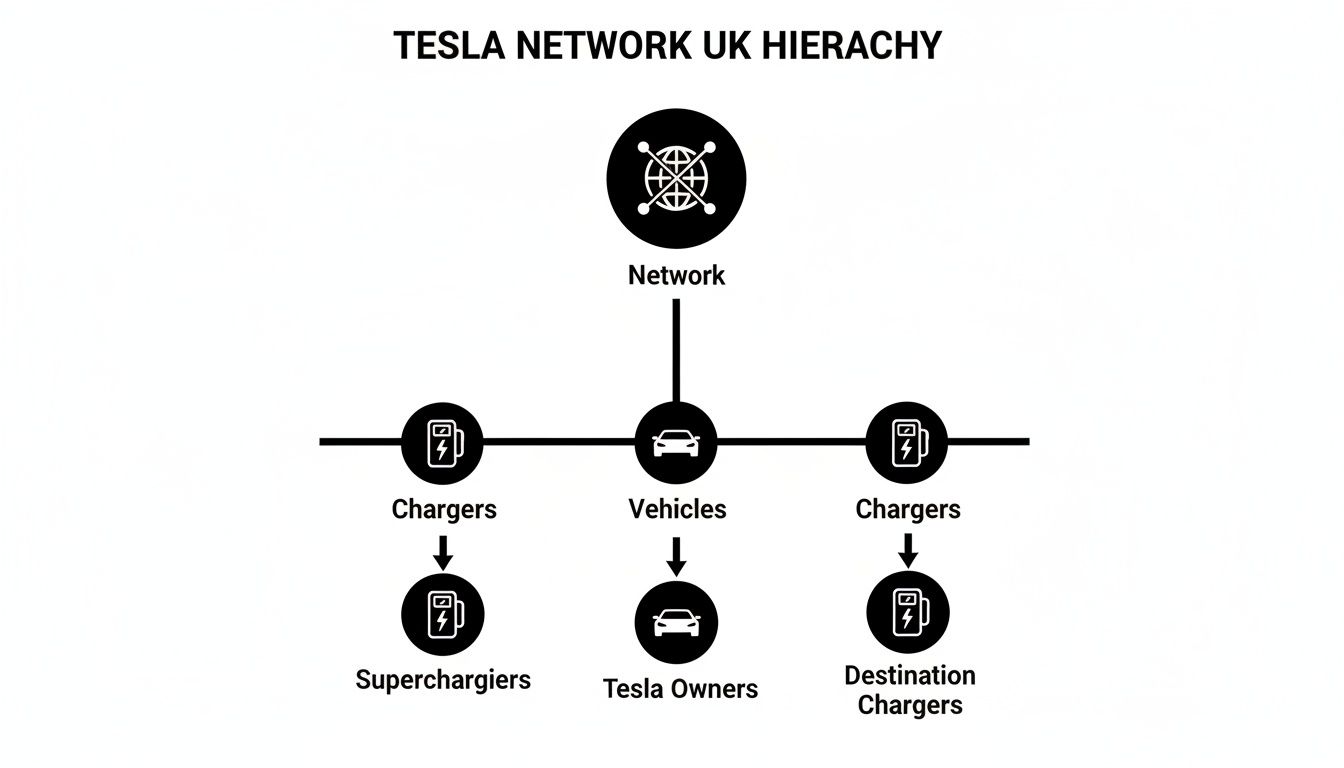
It really highlights how the entire ecosystem is built around a seamless link between the infrastructure and the car, a design that makes the whole process ridiculously simple for the driver. Now, let’s break down the actual hardware you’ll be plugging into.
The Old Guard: V2 Chargers
Think of V2 Superchargers as the dependable old Land Rover Defenders of the network. They’re not the fastest things on the road anymore, but they’re rugged, widespread, and they get the job done. Capped at a respectable 150kW , these were the workhorses that built Tesla's reputation in the UK.
The key quirk with V2s is power sharing. The stalls usually come in pairs, labelled A and B (like 1A, 1B, 2A, 2B). If you pull into stall 1B while someone is already charging in 1A, you'll split the 150kW between you. It's a bit like sharing a single bar tap – the first person gets a full pour, but when the second person orders, both taps slow down. The lesson? If you have a choice, always pick a stall with a different number to the car next to you.
The Current Champion: V3 Chargers
This is where things get serious. V3 Superchargers are the backbone of the modern network, offering a mighty 250kW punch. Crucially, unlike their V2 predecessors, they don't share power. Every V3 stall has its own dedicated line to the good stuff, so you get the full whack regardless of who parks next to you.
Charging at a V3 is like having your own personal bartender pulling a perfect, uninterrupted pint. You get the maximum flow, every single time, without having to share with the bloke next to you.
This speed makes a massive difference on long journeys. A 15-minute stop at a V3 can add well over 150 miles of range, which is just enough time to grab a questionable motorway coffee and complain about the price of it. They are the reason Tesla drivers are often so smugly relaxed about cross-country trips.
The Future Arrives: V4 Chargers
Finally, we have the new kids on the block: the V4 chargers. These are the future of the network, designed not just for Teslas but for everyone. They boast a much longer charging cable, making it far easier for non-Tesla EVs with awkwardly placed charge ports to plug in without performing a 12-point turn.
While currently delivering similar speeds to V3s, V4 hardware is built for the future and is capable of much higher outputs. Recent data shows the UK is a key focus for V4 upgrades, with the network aiming for 500kW peaks which could cut charging stop times by 20% . This rapid evolution is part of a global push that saw the network deliver 4.8 TWh of clean energy in just nine months of 2025, with the UK’s share helping to cut 150,000 tonnes of CO2 compared to petrol cars. You can read more about these impressive growth figures and what they mean for UK drivers.
A Quick Guide to Tesla Supercharger Versions
Here's a straightforward comparison of the Supercharger types you'll find, from the reliable old guard to the latest speed demons.
| Supercharger Version | Maximum Charging Speed | Key Feature | Best Analogy |
|---|---|---|---|
| V2 | 150kW | Paired stalls that share power. | Two people sharing one pub tap. |
| V3 | 250kW | Every stall gets dedicated, full power. | Your own personal, high-speed bartender. |
| V4 | 250kW+ | Longer cable & future-proofed for speed. | The ultra-modern bar with room for everyone. |
Knowing which charger you're pulling up to can help you manage your time and expectations, turning a necessary stop into a quick and easy break.
How to Use a Supercharger and Basic Etiquette
Right, let’s get to the practical bit. Your first time using a Tesla Supercharger is one of those moments that makes you feel like you’re living in the future. It’s so absurdly simple it’s almost suspicious. Forget juggling different apps, fumbling with payment cards, or phoning a helpline in the pouring rain. This is charging as it was meant to be.
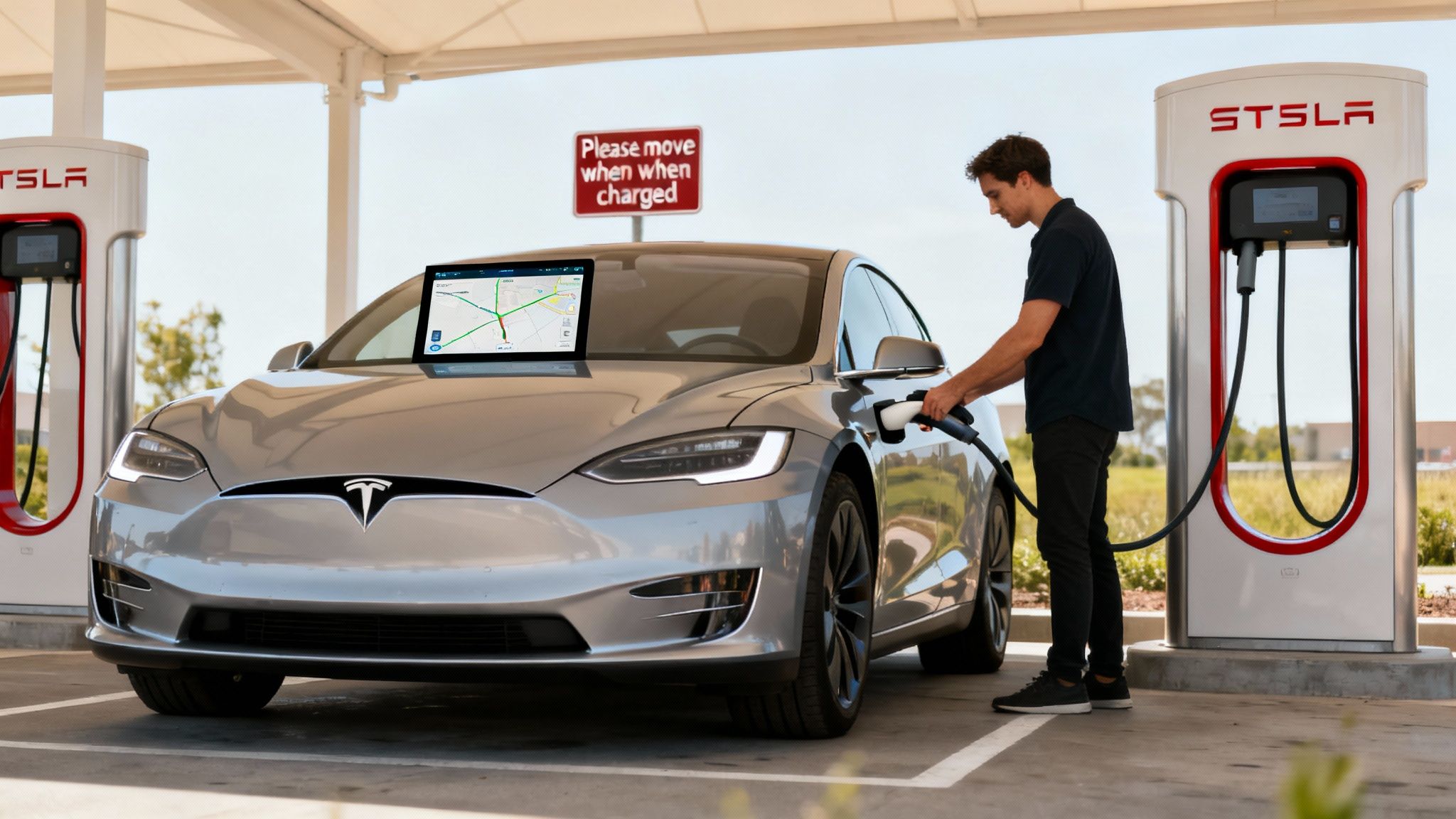
Here's a step-by-step guide to your first brilliantly uneventful charging session.
Finding and Navigating to a Charger
First things first, you need to find one. Don’t bother with third-party apps unless you’re in a real bind. Your Tesla’s built-in navigation is your best mate here and is absolutely central to the whole seamless experience.
Just tap the screen, pick a Supercharger on the map, and set it as your destination. This is where the magic starts. Your car will automatically begin preconditioning the battery on the way. Think of it as the car doing warm-up stretches before a sprint; by heating the battery to the optimal temperature, it guarantees you’ll get the fastest possible speeds the second you plug in. Arriving with a cold battery is the number one reason for slow charging, and Tesla has completely automated the solution.
The car even tells you how many stalls are free at your destination, so there are no nasty surprises when you arrive. If you do want a broader overview of charging points beyond Tesla's network, you can learn more about how to find EV charging stations near you with top UK apps.
The Plug and Play Experience
Once you arrive, the process is laughably easy. There’s no complex song and dance.
- Park Up: Reverse into the bay. The charging cables aren’t massively long, so reversing is usually the best approach to get your charge port close enough.
- Unlock the Port: Press the button on the top of the Supercharger handle. This sends a little signal to your car, which then opens its charge port flap for you. It’s a small detail, but it feels incredibly slick.
- Plug In: Push the connector firmly into the port. You'll see the light around it turn from white to a pulsing blue, then solid green, to show that charging has started successfully.
- Go and Grab a Coffee: That's it. Seriously. No cards to tap, no apps to open, no PINs to remember. The charger talks directly to your car, identifies your Tesla account, and bills the card on file.
It's the charging equivalent of contactless payment. You just show up, plug in, and walk away. The system handles all the tedious admin behind the scenes, leaving you to focus on more important things, like whether to get a flapjack or a brownie.
The Unwritten Rules of the Road
Using the network is a doddle, but like any shared resource, there are a few unspoken rules of etiquette. Following them ensures the Tesla Supercharger network remains a pleasant and efficient experience for everyone. Don't be that person.
- Don't Park If You're Not Charging: A Supercharger bay is for charging, not for parking. Using it as your personal spot while you pop to the shops is the ultimate EV sin.
- Move On When You're Done: Your Tesla app will ping you when charging is nearly complete. As soon as you have enough range, move your car. Don’t hog a spot by charging to 100% unless you absolutely have to. That last 20% is painfully slow anyway.
- Keep It Tidy: Wind the cable back neatly when you’re finished. Don't just drop it on the ground for the next person to trip over.
To give this a gentle push, Tesla introduced idle fees . If you leave your car plugged in after it’s finished charging and the station is busy, you’ll be charged for every minute you overstay. It’s a clever, automated nudge to remind people to be considerate.
Decoding the Costs and Non-Tesla Access
Right then, let's talk brass tacks. For all its seamless glory, the Tesla Supercharger network isn't a charity. So, how much does this convenience actually set you back?
The answer, much like a British weather forecast, is "it depends". The cost isn't a flat rate; it's a dynamic beast that changes based on location and, crucially, time of day.
Peak vs Off-Peak: Timing is Everything
At most of its UK sites, Tesla operates a peak and off-peak pricing structure. Charging during the day, when everyone and their dog is on the road, will cost you more per kilowatt-hour (kWh). But if you’re a night owl or an early bird, plugging in during the quieter off-peak hours can slash your costs significantly.
It’s a simple system designed to manage demand, much like train tickets or economy 7 electricity tariffs. Your car's navigation system handily displays the current price at any given Supercharger, so you’re never flying blind. Strategic charging—planning your stops for off-peak times—is the easiest way to keep your running costs down on a long trip.
Letting the Riff-Raff In: Non-Tesla Access
For years, the Supercharger network was a walled garden, an exclusive club for Tesla owners. But in a move that shook up the entire industry, Tesla has started opening its gates to drivers of other electric car brands. This is arguably the biggest change to the network since its inception.
Drivers of Fords, Audis, Polestars, and more can now access selected Supercharger sites using the official Tesla app. The process is a little less slick than the native Tesla experience—it requires an app and manual payment setup—but it gives other EV drivers a taste of what they've been missing. You simply find a participating site in the app, select your stall, and begin charging.
This rollout is happening gradually across the UK, so not every site is open to all just yet. The V4 chargers, with their longer cables, are specifically designed to make this easier for cars with awkwardly placed charge ports, signalling a clear commitment to this more open future.
The Two-Tier Price of Admission
Naturally, this access comes with a catch. Tesla has implemented a two-tier pricing system. Tesla owners continue to pay the standard rate, which is automatically billed to their account. Guest users, however, pay a higher price per kWh for the privilege of using the UK's most reliable charging network.
Think of it as paying a day-pass fee to use a swanky private gym. You get access to all the best equipment, but you pay a premium for not being a full member.
For non-Tesla drivers who make frequent use of the network, there is an optional monthly subscription available in the app. This subscription reduces the cost per kWh to the same rate that Tesla owners pay, making it a savvy choice for regular users.
Is the premium for non-Tesla users worth it? When you consider the alternative—arriving at a rival charger to find it broken, occupied, or just plain slow—many would argue it's a small price to pay for guaranteed performance and peace of mind.
Reliability is king here. The network boasts 98% uptime versus the UK's public average of a rather pathetic 85% , meaning fewer 'out of service' headaches during peak holiday rushes. This dependability is why 92% of Tesla UK owners rate it 'excellent' in polls, as it’s the gold standard in the battle against range anxiety. You can find out more about why Tesla's network is often crowned the best in the UK.
Of course, to truly understand the costs, you should also read our deep dive into UK electric car charging costs and how to avoid getting fleeced.
How Does the Tesla Network Stack Up Against Its UK Rivals?
So, let's get down to brass tacks. The Tesla Supercharger network is undoubtedly impressive, but is it truly the king of UK public charging, or just a very slick, exclusive club? To figure that out, we need to compare it to the other major players you'll find on British motorways: Gridserve, Ionity, and the ubiquitous BP Pulse.
This isn't just about comparing stats on a spreadsheet. It's about the real-world experience of being low on battery on a drizzly bank holiday Monday, with the kids getting restless in the back.
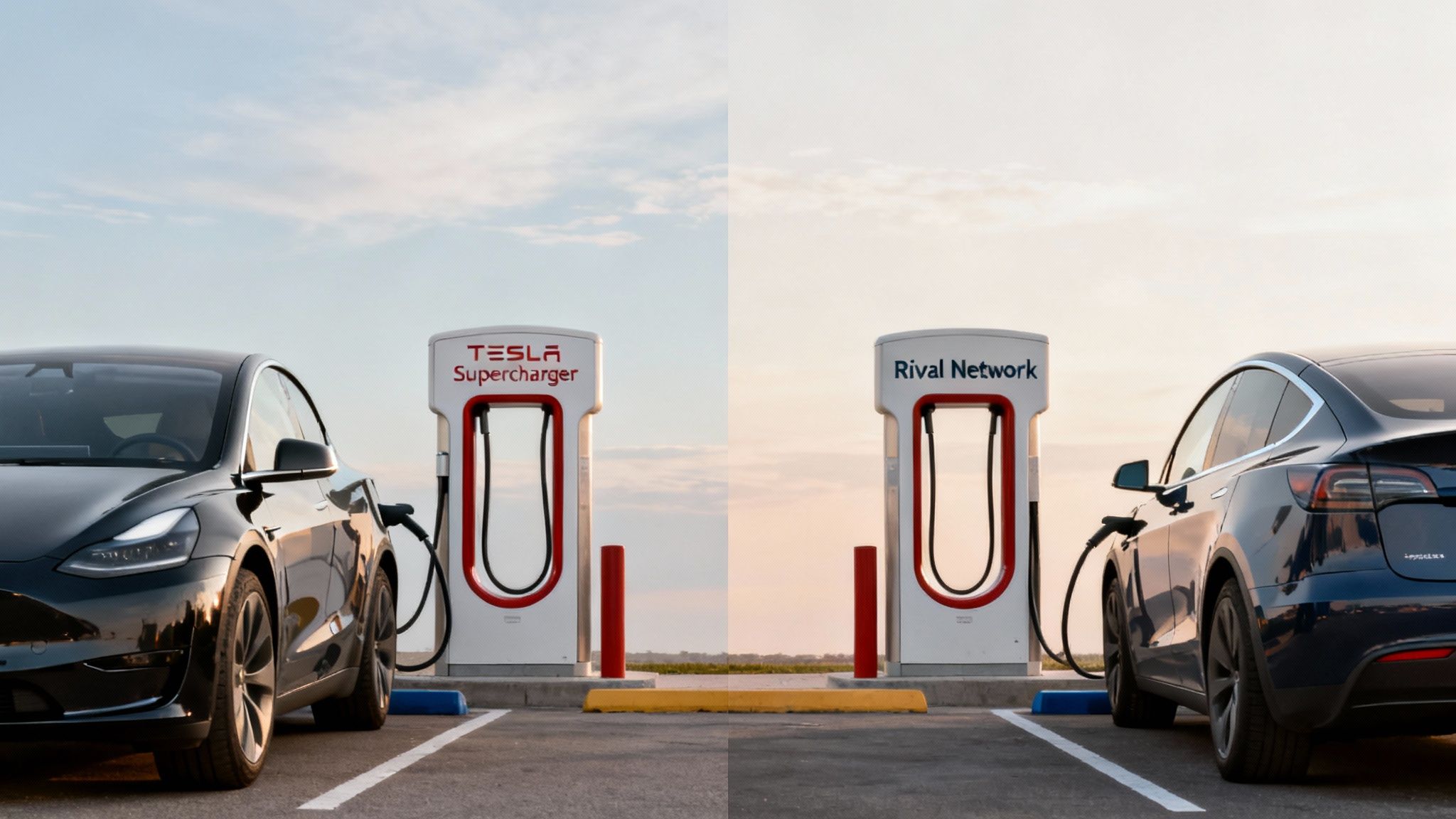
Picture a classic UK road trip – maybe London to the Lake District. In a Tesla, the car's navigation plans the whole thing, telling you exactly where and for how long to stop. You pull into the Supercharger bay, plug in, and walk off for a coffee. It just works. The process is so seamless it's almost forgettable.
Now, imagine that same journey in a non-Tesla EV. You’re likely juggling a few different apps, hoping the one rapid charger shown at the next service station isn't broken, blocked by a diesel car, or already has a queue. That, right there, is the fundamental difference.
The Reliability Rumble
When it comes to pure dependability, Tesla isn't just winning; it feels like they’re playing a completely different game. The Supercharger network consistently boasts an uptime of over 98% . In simple terms, this means if your satnav directs you to a Supercharger, you can be almost certain it'll be working when you arrive.
Contrast that with the bit of a lottery you sometimes find on other public networks. While things are definitely getting better, tales of broken chargers, failed card payments, or units delivering a fraction of their advertised speed are still all too common. Gridserve's Electric Forecourts are a brilliant leap forward, but they're still not on every corner.
Choosing a public charger in the UK can feel like a game of Russian roulette. With Tesla, you know every chamber is empty. With some rivals, you're just crossing your fingers that today isn't your unlucky day.
This reliability is the unspoken benefit of the Tesla ecosystem. It’s the peace of mind that your long journey won’t be derailed by faulty infrastructure. You can get a much fuller picture by reading our guide to the EV charging landscape in the UK.
Speed, Coverage, and Cost: The Showdown
If we're talking about a pure drag race of charging speeds, rivals like Ionity can often match or even beat Tesla's V3 units with their 350kW chargers. They are breathtakingly fast. The catch? The Ionity network is much smaller and more sparsely located, often making them a welcome surprise rather than something you can build an entire journey around.
Coverage is where the Tesla Supercharger network still has the edge. Its sites are strategically peppered along the UK's motorways and A-roads – exactly where you need them for long-distance travel. Competitors like BP Pulse might have more individual charge points on the map, but a huge number of these are slower 7-22kW destination chargers, not the rapid chargers you need for a quick top-up on the move.
And then there's the price. Tesla is rarely the cheapest, especially if you're charging at peak times. You can almost always find a lower price per kWh from a rival network, but that saving often comes with a gamble on reliability and ease of use. Is saving £3-4 on a charge worth the stress of a charger that won't start? For most drivers, the answer is a firm no.
UK Rapid Charging Network Showdown
To put it all into perspective, here's a head-to-head comparison of the major UK rapid charging networks, focusing on the key factors that impact your journey.
| Network | Reliability Score | Typical Cost (p/kWh) | User Experience | Best For |
|---|---|---|---|---|
| Tesla Supercharger | 9.5/10 | 55p - 75p | Seamless plug-and-charge for Teslas; simple app use for others. Consistently excellent. | Long-distance, hassle-free travel and drivers who value reliability. |
| Gridserve Electric Highway | 8/10 | 65p - 79p | Modern, multi-charger hubs. Contactless payment is easy. Can get busy. | Motorway service station top-ups and access to multiple connectors. |
| Ionity | 7.5/10 | 74p | Very fast 350kW speeds but a smaller network. App/contactless can be hit-and-miss. | Drivers of cars with 800V architecture (e.g., Porsche, Kia, Hyundai). |
| BP Pulse | 6/10 | 69p - 79p | Huge network, but reliability is inconsistent. Mix of old and new hardware. | Finding a charger in an urban area, but always have a backup plan. |
Ultimately, while other networks are catching up fast, Tesla’s perfectly integrated system of car, navigation, and charger remains the benchmark for stress-free EV travel in the UK.
The Verdict: Is It Really a Big Deal?
So, what's the final word on the Supercharger network? Is it just a nice extra, or is it the main reason people flock to Tesla?
Let’s be honest: for a huge number of UK drivers, it’s the single biggest reason they put a Tesla on their driveway.
This is the ecosystem that flips the script on electric car ownership. It takes it from being a slightly compromised, sometimes stressful affair to something that’s genuinely easier than running a petrol or diesel car. Forget juggling multiple apps, pulling up to find a broken charger, or calling a support line while getting soaked. It’s the sheer, almost boring, reliability that gives drivers a peace of mind other networks are still desperately trying to match.
The network is Tesla’s ace in the hole. It’s like Apple controlling both the iPhone and the App Store—a completely joined-up experience that makes rivals look like they’re still fumbling with the instructions.
Of course, the competition is getting better. Gridserve’s Electric Forecourts are a brilliant step in the right direction, for example. But they still don't have that perfect, elegant dance between the car, the sat-nav, and the charger itself. Tesla’s ability to warm up the battery on the way to a charger and handle billing without you lifting a finger isn’t a gimmick; it’s a core advantage that saves real time and faff on every long trip.
Still the One to Beat
At the end of the day, the network’s power is built on a simple foundation: trust. Drivers trust the car to find a working charger, trust a space will be free when they get there, and trust they'll get the charging speed they were promised. This completely removes the 'what if?' mental gymnastics that can still dog so many other EV journeys across the UK.
For now, and for the foreseeable future, the Tesla Supercharger network is the gold standard. It’s the benchmark all other charging networks are judged against, and rightly so. It was never just about having the most chargers; it’s about having the smartest and most dependable system out there.
A Few Lingering Questions
Still got a couple of things you're not sure about? It's a common feeling. Let's tackle some of the most frequent questions we hear about the Tesla Supercharger network .
Can I Just Rock Up and Charge Any EV?
Not quite yet, but we're getting there. While Tesla is gradually opening its network to everyone, access for non-Tesla EVs is still limited to specific sites in the UK. Think of it like a members' club that's started offering guest passes, but only at certain locations.
Your best bet is to use the 'Charge Your Non-Tesla' filter within the official Tesla app. This is the only way to know for sure which sites are open to all. The rollout is constantly expanding, so it's essential to check the app before you set off to avoid a frustrating trip and a very empty battery.
Is It Cheaper to Charge at Home or Use a Supercharger?
Without a shadow of a doubt, charging at home is dramatically cheaper. If you're on a decent overnight electricity tariff, you could be paying a third (or even less!) per kWh compared to a Supercharger. It's the difference between making a coffee at home versus buying one from a fancy café in central London.
Superchargers are all about convenience on a long journey, or for those who can't charge at home. You're paying a premium for the speed and the prime locations, not for your day-to-day commute. Their purpose is to get you back on the road fast, not to be the cheapest fill-up.
What’s the Deal with Idle Fees?
Idle fees are Tesla's clever way of saying, "Your car is full, please move it!" They are small, per-minute charges that kick in after your car has finished charging, but only if the station is busy.
This simple system ensures drivers don't just leave their cars blocking a charger for hours. You’ll get a notification from the Tesla app when your battery is nearly full, and another once it's done. That gives you a fair warning to wander back, unplug, and let someone else have a turn.
Is the Supercharger Network Really That Reliable?
Honestly, yes. It’s not even a fair fight. Independent studies and real-world driver data consistently put the Tesla network's uptime at over 98% . For comparison, some other public rapid networks struggle to hit figures that aren't frankly a bit embarrassing.
This legendary reliability is the network's superpower. It removes the charging lottery from long-distance EV travel, giving you a level of confidence that turns range anxiety into something other people worry about.
At VoltsMonster , we're obsessed with giving you the real story on EVs, cutting through the jargon with honest, practical advice. From deep-dive reviews to handy guides, we've got your back. Explore our latest articles and join the electric revolution.
VoltsMonster Electric Vehicle Blog