The Real Volkswagen ID Buzz Range: A No-Nonsense UK Guide
On paper, the Volkswagen ID. Buzz proudly claims an official WLTP range of around 258 miles from a full battery. But let's be honest – especially in the UK – you're more likely to see that number settle somewhere between 220-240 miles in summer and a much chillier 180-200 miles in the depths of a miserable British winter.
The Official ID. Buzz Range Versus Grim Reality
It’s an open secret among EV drivers that the official range figures from manufacturers should be taken with a bucketload of salt. They’re achieved in perfect lab conditions – no hills, no headwinds, no freezing November mornings, and definitely no catastrophic traffic jams on the M25.
This standardised test, the Worldwide Harmonised Light Vehicle Test Procedure (WLTP), provides a useful yardstick for comparison, but it just doesn't reflect the beautiful chaos of real-world driving.
Think of the WLTP figure as a professional athlete's peak performance inside a climate-controlled stadium. Your daily commute, however, is more like trying to set a new personal best while lugging the weekly shop through a muddy field in the pouring rain. A whole host of factors are queued up, ready and waiting to chip away at those precious miles.
What The Numbers Really Mean
At the heart of the Volkswagen ID. Buzz is a 77-kWh battery pack, which is a solid, competitive size for this type of premium electric people carrier. But while the glossy brochure might shout about that 258-mile range, a healthy dose of cynicism is essential.
For an honest look at how carmakers' claims often stack up against reality, you might want to check out our broader electric car range comparison for the UK and other lies.
Let's break down how those official figures compare to what you can actually expect.
Official vs Reality: A Quick Look at the ID. Buzz Range
This table gives a clearer picture, contrasting the advertised range with more realistic estimates for typical UK driving conditions.
| Model / Condition | Official WLTP Range (Claimed) | Estimated Real-World Range (Summer) | Estimated Real-World Range (Winter) |
|---|---|---|---|
| VW ID. Buzz (77 kWh) | 258 miles | 220 - 240 miles | 180 - 200 miles |
As you can see, the drop-off, particularly in winter, is significant. This isn’t a fault of the ID. Buzz; it's just the physics of electric vehicles in a country known for its "bracing" weather.
This chart really drives the point home, showing the stark difference between the lab-tested range and what you'll likely get on a typical British summer or winter day.
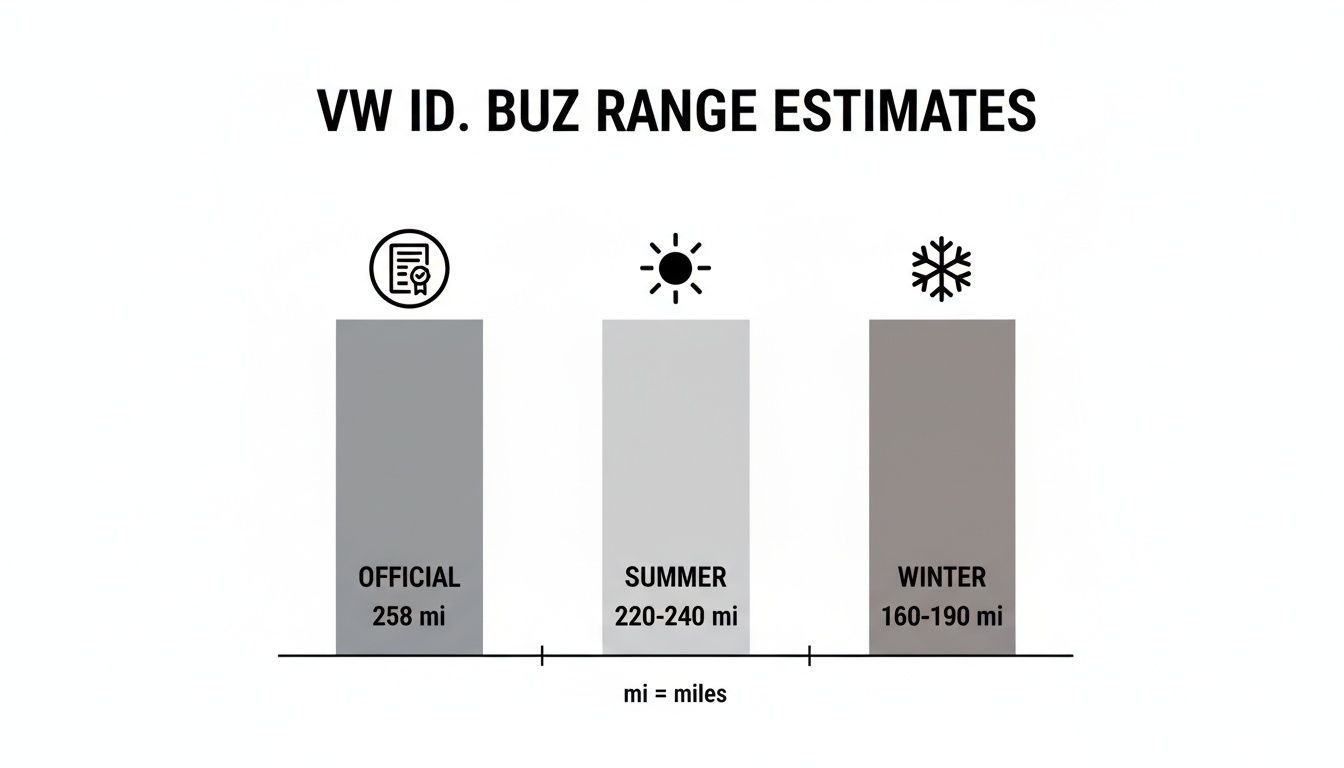
The key takeaway? Cold weather is the arch-nemesis of your battery, potentially slashing your range by a quarter or even more.
Key Factors Slashing Your Mileage
So, what are these range-robbing villains? It's a familiar cast of characters for any EV driver in the UK.
- Temperature: Cold batteries are unhappy and less efficient. On top of that, you'll be running the heater and demister, which draw a surprising amount of power.
- Driving Style: A heavy right foot is the quickest way to drain your battery. Aggressive acceleration and hard braking drink electricity faster than a stag do on a Saturday night.
- Speed: Cruising at 70 mph on the motorway creates far more aerodynamic drag than pootling around town at 30 mph . This dramatically reduces your efficiency and eats into your range.
- Terrain & Load: Constantly driving uphill or loading the Buzz to the rafters with family, dogs, and luggage forces the motor to work much harder, consuming more energy with every mile.
How Different ID Buzz Models Affect Range
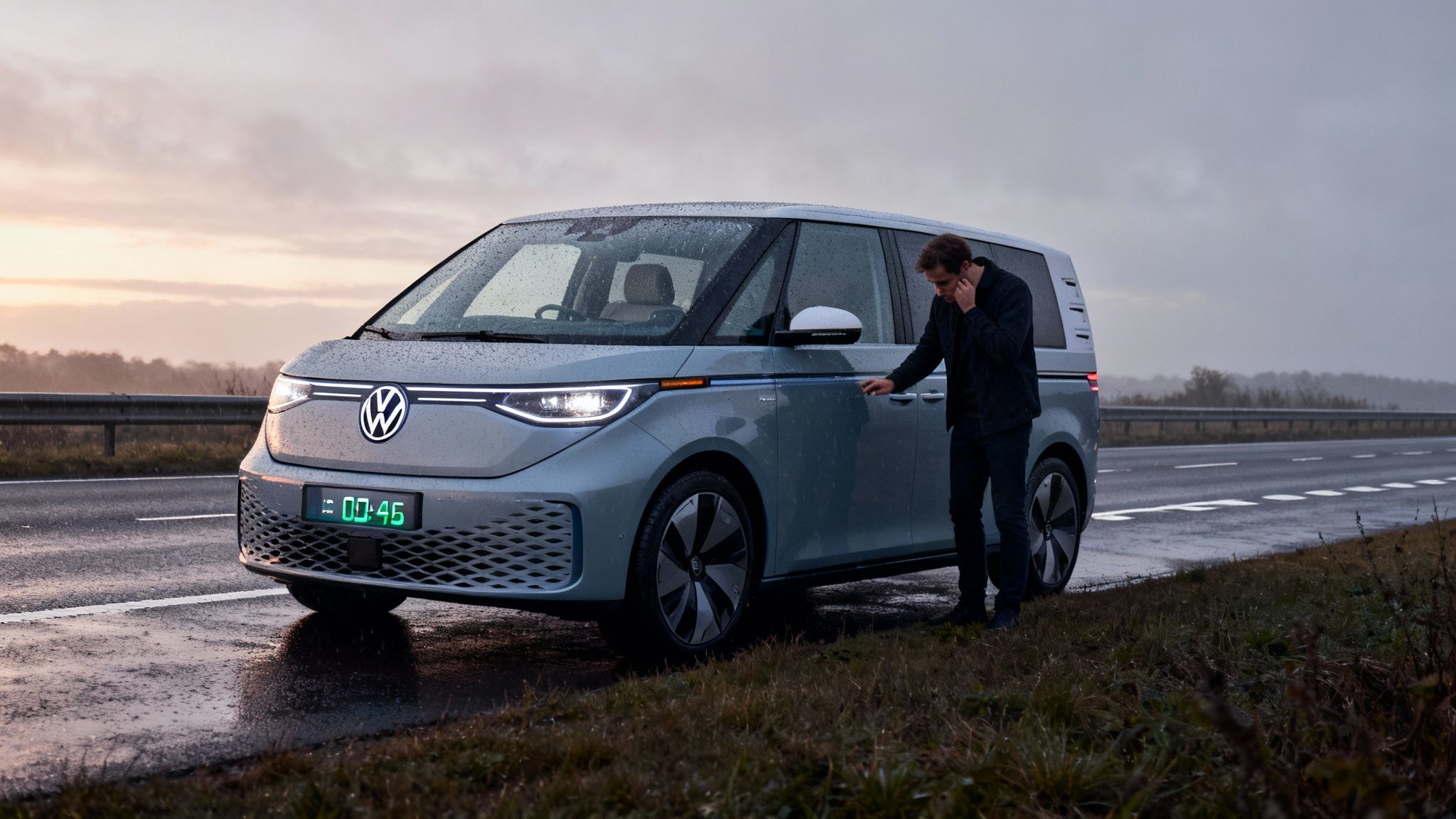
You might think an ID. Buzz is an ID. Buzz, but that’s a bit like saying all biscuits are the same. The model you choose has a direct, and sometimes surprising, impact on your real-world ID Buzz range . That spec sheet isn’t just for pub bragging rights; it's a menu of compromises between practicality and how far you'll get on a single charge.
The most obvious split in the current UK line-up is between the people-carrying ‘Pro’ model and the panel-sided ‘Cargo’ van. Logic suggests the lighter commercial version would go further, right? Well, not always. The Cargo’s boxy, windowless rear can disrupt airflow, and it's built to handle heavy loads—the kryptonite of any EV battery.
Ultimately, it's often the passenger version, with its slightly sleeker profile and focus on comfort over pure utility, that ekes out a few more precious miles from the battery.
The Trade-Off Between Space and Stamina
Volkswagen, never one to miss a trick, is expanding the family with long-wheelbase (LWB) versions and bigger battery options. More space for the kids or your surfing gear sounds brilliant, but physics is a cruel mistress. A longer, heavier vehicle simply needs more energy to get going and keep moving.
It really boils down to two simple truths:
- More Weight: Every extra kilogram of vehicle, passenger, or luggage demands more work from the motor, which chips away at your range.
- Bigger Batteries: While a larger battery pack offers a higher headline range, it also adds a lot of weight. You reach a point of diminishing returns where some of the extra capacity is spent just lugging itself around.
Expect the upcoming LWB seven-seater and all-wheel-drive GTX models to offer more versatility and punch, but don't be surprised if their official range figures are slightly less impressive than the original, lighter models. It’s the classic trade-off: you can have more performance or more range, but rarely both at the same time.
Future Models and The Range Equation
As more variants arrive, choosing the right ID. Buzz becomes a strategic decision. The sporty, dual-motor GTX will undoubtedly be quicker off the line, but it'll chew through its battery at a faster rate, especially if you enjoy its performance.
Likewise, the forthcoming long-wheelbase models will be a godsend for larger families, but that extra length and weight will inevitably trim the maximum distance you can travel. Understanding this relationship between the spec and its real-world efficiency is key to picking the right model and avoiding disappointment later on.
The Great British Range Robbery
So, you’ve got your eye on a new ID. Buzz. You’ve seen the official range figures, probably pinned them to the fridge, and you're already planning those long, silent, emission-free road trips. Fantastic. Now, allow me to introduce you to a uniquely British conspiracy that’s hell-bent on ruining your day. Your van’s impressive ID. Buzz range is under constant, merciless attack from the very fabric of this green and pleasant land.
It’s a multi-pronged assault. The first wave hits on a damp November morning, where the battery-sapping chill forces you to blast the heater and demister just to see where you're going. Then comes the soul-crushing crawl of a city commute; that stop-start shuffle is the electric equivalent of death by a thousand papercuts for your battery percentage.
And what about the great British getaway? Strapping a roof box on for that glorious schlep down to Cornwall is an act of aerodynamic vandalism. Your sleek, retro-futuristic van suddenly has the drag coefficient of a garden shed, and you can practically watch the miles disappear from the display with every gust of motorway wind.
The Real-World British Penalty
It’s not just about the weather and traffic; it's a perfect storm of range-robbing realities that VW’s salespeople tend to skim over. Anecdotal evidence from UK owners paints a painfully clear picture: a fully loaded van, heading into a stiff headwind on the M6 with the heating on full, will deliver a range that's a pale imitation of the brochure’s promise.
This isn't a fault; it's a feature of EV ownership in the UK. The advertised range is the starting point. Your job is to grimly accept how much of it will be stolen by rain, hills, traffic, and your desperate need for a warm cabin.
This constant battle for miles is happening even as the ID. Buzz helps cement VW's place at the top. Interestingly, the van was crucial in keeping Volkswagen as the UK's best-selling automotive brand. Yet, with electric vehicles making up just 33,605 of their sales in a recent year, over 80% of their cars sold still had combustion engines. It just goes to show how much of this electric transition is still to come. You can dig into more of VW's UK sales figures on Cars UK.
Ultimately, understanding the ID. Buzz range in Britain is less about hard science and more about managing expectations. Prepare for the worst, hope for a tailwind, and never, ever trust the guess-o-meter when you’re still 50 miles from home.
Charging Your ID. Buzz Without Losing Your Mind
A decent range is one thing, but it’s pretty useless if you can't top it up without having a meltdown at a motorway service station. Getting to grips with charging your ID. Buzz is key, and it's a completely different ball game to splashing a bit of petrol in a tank. Consider this your essential guide to plugging in without pulling your hair out.
The biggest difference you'll encounter is between charging at home and using the public network. At home, you're looking at a slow, steady overnight charge using a dedicated wall box. It’s cheap, incredibly convenient, and means you wake up every morning with a full "tank". Honestly, this is the best way to live with an EV. For anyone taking the plunge, it's well worth exploring the best home EV chargers UK drivers recommend to avoid a costly misstep.
Public charging, on the other hand, can feel a bit like the Wild West. It’s much faster, far more expensive, and, from time to time, completely out of order.
Decoding Charging Speeds
When you pull into a service station on a long journey, you’ll be hunting for a rapid charger. The ID. Buzz can, in theory, handle a charging speed of up to 170 kW from a DC fast charger. That’s a seriously impressive figure, promising a 10-80% top-up in about 30 minutes – just enough time to queue for a deeply average, overpriced coffee.
However, that little phrase "up to" is doing a lot of heavy lifting here.
Just like the official range figures, that maximum charging speed is a best-case scenario. The reality depends on the charger's actual output, your battery's current level, and crucially, its temperature. A cold battery on a frosty morning will deliberately charge much slower to protect its long-term health.
Think of it like pouring a pint. You can go full tilt at the beginning, but you have to ease off as you get closer to the top to avoid it turning into a frothy disaster. An EV's charging curve works in a similar way, slowing right down after 80% to preserve the battery. That’s precisely why waiting around at a public charger for that last 20% is often a massive waste of both time and money.
ID Buzz Charging Speeds & Times
So, what does this all mean in the real world? This table breaks down what you can realistically expect from the common types of chargers you’ll find across the UK. It gives you a practical idea of how long you'll be waiting and a rough guide to what it might cost.
| Charger Type | Power Output | Estimated Time (10-80%) | Cost per kWh (Approx.) |
|---|---|---|---|
| Home Wallbox | 7 kW | 7-8 hours | 15p - 30p |
| Public AC Charger | 22 kW | 5-6 hours | 45p - 65p |
| Rapid DC Charger | 50 kW | ~60 minutes | 65p - 85p |
| Ultra-Rapid DC Charger | 150-170 kW | ~30 minutes | 75p - 90p |
As you can see, the convenience of home charging is hard to beat for cost, while the ultra-rapid chargers are your best friend on a long-haul trip – provided you can find one that’s working and doesn't have a queue.
How To Squeeze Every Last Mile From Your ID Buzz
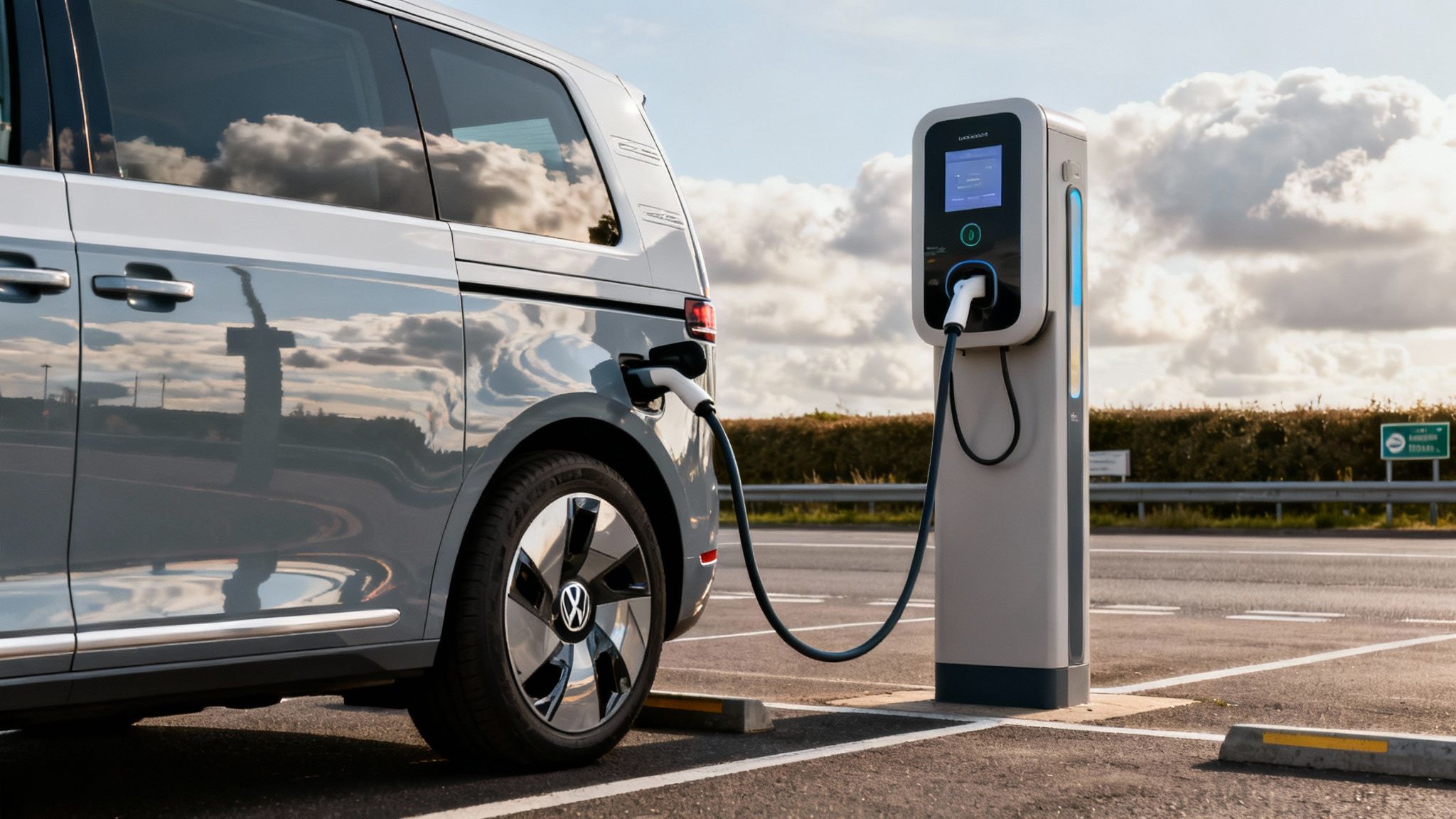
Alright, enough with the doom and gloom. Now that we’ve established your ID. Buzz’s range is under constant assault from the British weather and your lead-lined right foot, let's talk about how to fight back. Forget the patronising "drive slower" advice; these are the proper, actionable tips that turn you from a range-anxious mess into a hypermiling hero.
First up is the dark art of regenerative braking . The ID. Buzz gives you two main modes to play with: the standard ‘D’ (Drive) and the more aggressive ‘B’ (Brake) mode. In ‘D’, the van coasts like a normal automatic when you lift off the accelerator. Switch to ‘B’ mode, however, and it decelerates sharply, mimicking the effect of engine braking in a petrol car.
This aggressive deceleration isn’t just for show. It’s actively converting the van's kinetic energy back into electricity and feeding it straight into the battery. For city driving, with its endless stopping and starting, leaving it in ‘B’ mode is a no-brainer. You’ll be clawing back precious miles at every traffic light and roundabout.
Master Your Climate and Pre-Conditioning
One of the biggest culprits for a disappearing ID Buzz range is our obsession with staying toasty warm. Blasting the heater on a frosty morning can siphon off a surprising amount of power, as it’s essentially a giant, energy-hungry electric fire. This is where pre-conditioning becomes your secret weapon.
If your Buzz is plugged in at home, you can use the app to pre-heat (or cool) the cabin before you even unplug. This draws power from the mains, not your battery, meaning you start your journey with a full charge and a comfortable cabin. It’s the single easiest win for preserving range on a cold day.
Think of it like boiling the kettle with electricity from the grid versus using a battery-powered camping kettle for your morning brew. One is sensible and efficient; the other is a desperate act that drains your most valuable resource.
The Small Tweaks That Make a Big Difference
Beyond the big wins, a few small habits can add up to a significant range boost over time. These are the details that separate the pros from the amateurs who end up stranded on the hard shoulder.
- Tyre Pressures: This is boring but crucial. Under-inflated tyres create more rolling resistance, forcing the motor to work harder. Check them once a month; it’s a two-minute job that genuinely saves energy.
- Use Heated Seats & Steering Wheel: These are far more efficient at warming you up than the main cabin heater is at warming up all the air inside the van. Get them on and turn the main climate control down a few degrees.
- Be Smooth: Avoid stamping on the accelerator or slamming on the brakes. Gentle, progressive inputs are the key to efficiency. Drive like your nan is in the back holding a full trifle.
It seems plenty of people are getting the message about practical EVs. The ID. Buzz saw its deliveries skyrocket by a massive 377% between 2022 and 2023, showing just how many UK buyers are now looking for a usable electric van. You can read more about Volkswagen's impressive commercial vehicle results and see the growing demand for yourself.
Is The ID. Buzz Worth The Money?
So, we've talked range, charging, and how to eke out every last mile. Now for the million-dollar question—or rather, the sixty-thousand-pound one: is the ID. Buzz actually worth your hard-earned cash?
Let's not beat about the bush. The ID. Buzz is not a budget-friendly option. Its head-turning retro looks and modern tech come with a price tag that’s more than a little eye-watering.
You're definitely paying a significant "cool tax" for that iconic design. A factory-fresh ID. Buzz Life starts at over £59,000 , while the top-tier Style trim will see you sailing past the £63,000 mark. That’s a serious investment, especially for a vehicle that, as we’ve discussed, might need a top-up on a chilly winter drive from London to Manchester.
Before you start raiding the savings account, though, it's vital to look at the bigger picture. Understanding the real cost of owning an EV compared to petrol cars is key. The savings on fuel, tax, and maintenance can make that initial price feel a lot less intimidating over a few years.
The VoltsMonster Verdict: Deal Of The Week
After a thorough trawl of the UK market, it’s clear the smartest buys aren't in the brand-new showroom. The real value is lurking in the nearly-new and leasing markets.
Dealerships are currently brimming with ex-demonstrators and pre-registered models that have barely seen a road. Picking up one of these can easily save you £5,000-£7,000 off the list price, letting the first owner absorb that hefty initial depreciation. It’s a no-brainer.
But our top tip for the savviest buyers? Look at a Personal Contract Hire (PCH) or leasing deal. We’re seeing offers for the ID. Buzz Life trim for around £550 per month with a reasonable initial payment. This route neatly sidesteps any concerns about long-term battery health or what the resale value might be in five years' time.
Leasing lets you enjoy all the charm and practicality of the Buzz without the hefty financial baggage or the worry of being left with an expensive, outdated battery down the line. It's the most sensible way to drive one of the coolest EVs on the road without risking it all.
ID. Buzz Range: Your Questions Answered
Still got a few things on your mind? That’s perfectly normal. When you’re thinking about spending this much on a new vehicle, especially an electric one, a bit of healthy scepticism is a good thing. Let’s tackle some of the most common questions we get about the real-world ID. Buzz range .
Do Bigger Wheels Really Reduce the ID. Buzz Range?
They absolutely do. Swapping the standard wheels for a set of big, flashy alloys might look fantastic, but it’s a classic case of style over substance. The simple physics are that heavier wheels with wider tyres increase rolling resistance, meaning the motors have to work harder just to get things moving.
You can realistically expect a range penalty of around 3-5% . That might not sound like a lot, but it could easily be a crucial 8-10 miles, which is often the difference between reaching that next charger or having an awkward phone call to a recovery service.
How Much Range Will I Lose When Towing?
Towing is the biggest range-killer for any EV, and the ID. Buzz is no exception. Hooking up a caravan or a substantial trailer will absolutely hammer your battery, slashing your available mileage by a sobering 30-50% .
Let’s be blunt: if you plan on towing a family caravan down to Cornwall for the summer, you should assume your range will be halved. This doesn't make it impossible, but it does mean you’ll need to plan your charging stops with almost military precision.
Think of it this way: every mile you tow, you're not just moving the van; you're dragging a small, brick-shaped house through the air behind it. The battery will drain at an alarming rate, so be prepared and don't get caught out.
Is the ID. Buzz Range Better Than Its Main Rivals?
Honestly, it’s competitive, but it doesn't blow the competition away. The ID. Buzz stacks up pretty well against rivals like the Mercedes-Benz EQV in ideal conditions. However, it’s not always the top dog, particularly when the temperature plummets and its efficiency takes a noticeable hit.
The real selling points for the ID. Buzz have always been its incredible design, brilliant practicality, and that undeniable charm. It wins on character, not necessarily on having the biggest number on the spec sheet.
Can Software Updates Actually Improve the Range?
Yes, they genuinely can. Volkswagen regularly pushes out over-the-air (OTA) software updates, which are essentially digital tune-ups for the van's complex electronic systems.
These updates often include smarter algorithms for battery management and more efficient power delivery from the motors. You won't wake up to a sudden 50-mile boost, but these small, incremental tweaks add up over time, leading to real, noticeable gains in how far you can go on a single charge.
Ready to dive deeper into the world of EVs? At VoltsMonster , we've got the honest reviews, guides, and tips you need to navigate the electric revolution. Check out more at https://www.voltsmonster.com.
VoltsMonster Electric Vehicle Blog