Honest Hyundai Ioniq Reviews: A Sceptic's Guide for UK Drivers
Let’s be honest, you’re probably looking up Hyundai Ioniq reviews because you want an electric car that just works. You're not after the Silicon Valley hype, a ludicrous price tag, or a car that talks to you like a needy Alexa. Good news: you’ve come to the right place. The Ioniq family is essentially the sensible jumper of the EV world—not exactly a fashion statement, but reliable, comfortable, and bloody effective.
So, What Is This Hyundai Ioniq Family, Then?
Right, let’s clear one thing up from the off. "Ioniq" isn't just one car; it's Hyundai's not-so-secret codeword for a whole family of electric and electrified vehicles. Think of it as their EV sub-brand, a bit like what Polestar is to Volvo, but with less Scandi-minimalism and more common sense. It’s the nameplate they stick on everything from a frugal hatchback to a design-award-hoarding spaceship.
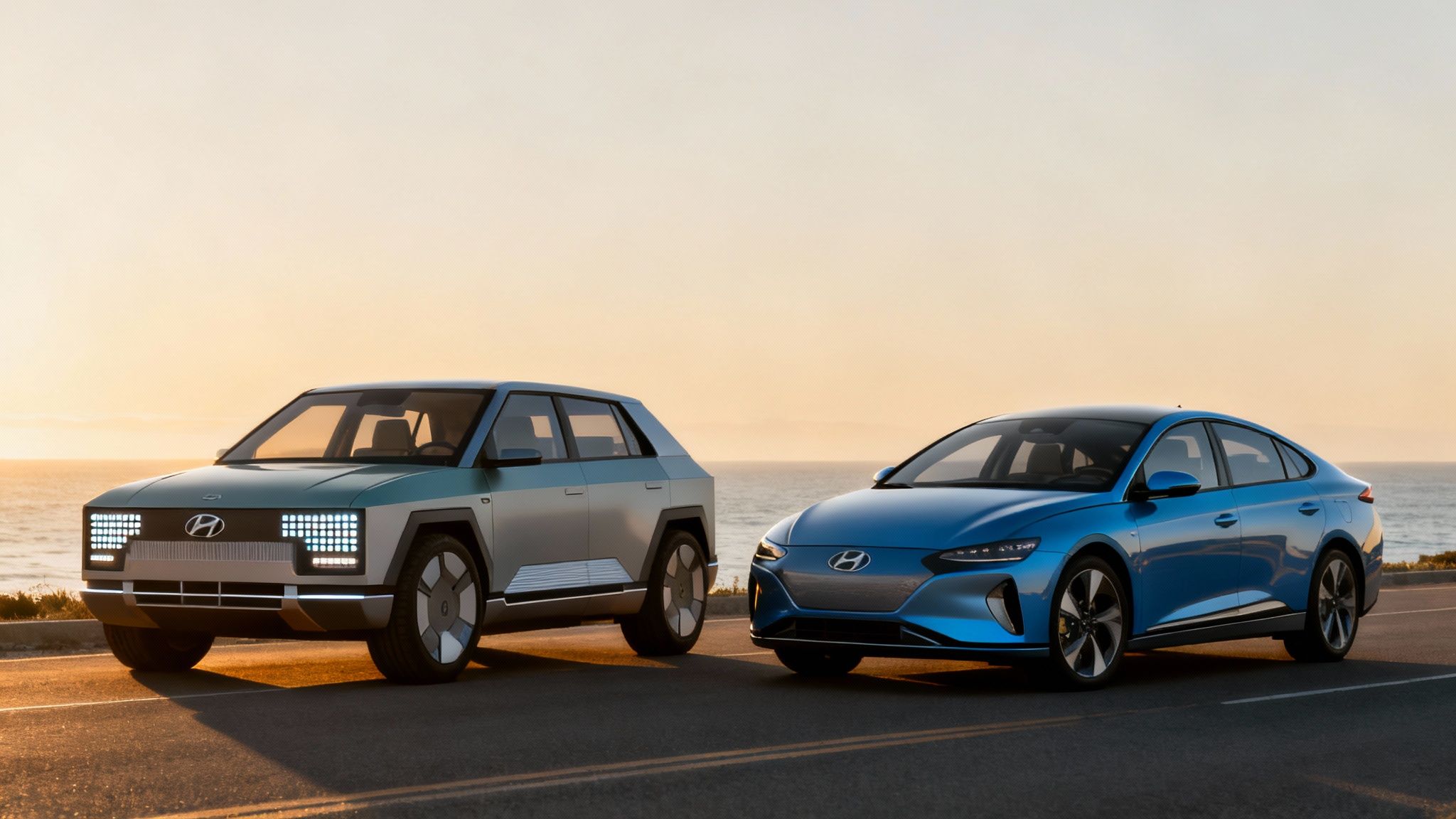
For the average UK buyer, this can be a bit of a muddle. You've got the original Ioniq, the one that looks like a proper car, and then you have its wilder, more ambitious offspring, the Ioniq 5 and Ioniq 6. They’re all part of the same clan but are built for entirely different people with entirely different ideas about what a car should be.
- The Original Ioniq Electric: This is the unsung hero. A straightforward hatchback that’s about as exciting as a Tuesday afternoon but as cheap to run as a kettle. It’s the smart-money choice for escaping the tyranny of the petrol station for good.
- The Ioniq 5: This is the one that looks like a retro-futuristic concept car escaped the motor show. It's a family-sized SUV with a ridiculously spacious, lounge-like interior and charging speeds that make most rivals look like they’re still using dial-up internet.
- The Ioniq 6: Dubbed the ‘electrified streamliner’, this one’s a slippery, saloon-shaped beast designed to slice through the air with maximum efficiency. It's the long-distance champion of the family, built for munching motorway miles without a fuss.
From Sensible Beginnings To Global Contender
The whole Ioniq saga kicked off in the UK back in late 2016 with the original trio of hybrid, plug-in, and full-electric models. It wasn't a flashy launch, but it quietly built a reputation for being brilliantly efficient.
By early 2021, the series had sold over 325,000 units globally, with a huge chunk landing in Europe. In fact, nearly half of all Ioniq Electrics sold worldwide ended up with European customers, a testament to how well-suited they were to our roads. That momentum has only grown, helping Hyundai become a major player in the UK car market. You can explore more on the Ioniq's sales history here.
This visual below breaks down the Ioniq family tree into its three main branches.
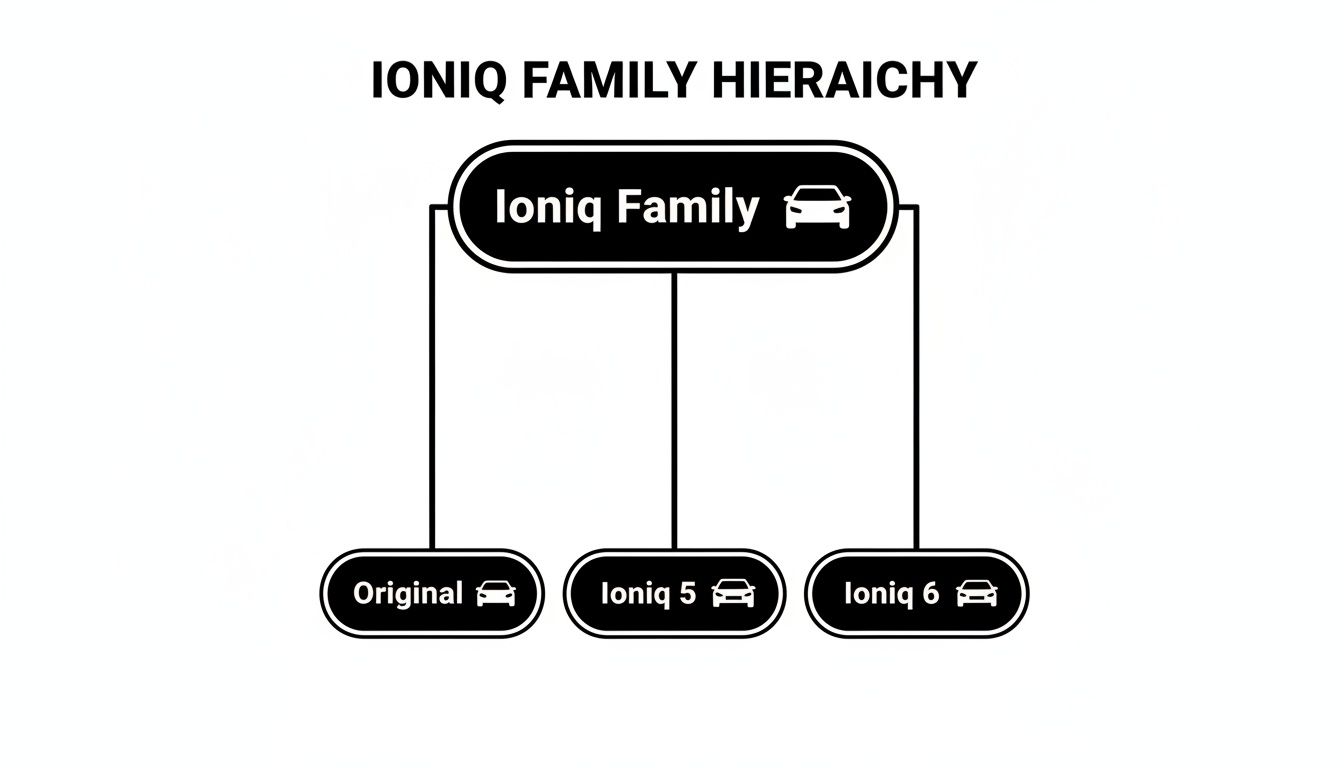
This simple hierarchy shows the evolution from the practical original hatchback to the more design-led SUV and saloon models that followed.
Put simply, the Ioniq name represents a journey from pure, unadulterated pragmatism to ambitious, futuristic design. It offers a clear choice: do you want the most pence-per-mile possible, or are you willing to pay a bit more for head-turning style and cutting-edge tech? This review will help you decide.
The Ioniq Family At a Glance
Here’s a quick, no-nonsense comparison of the key Ioniq models you'll find clogging up UK roads.
| Model | Best For | Typical UK Price (Used) | Real-World Range |
|---|---|---|---|
| Ioniq Electric (28kWh) | Maximum value, city driving | £8k - £12k | 110 - 130 miles |
| Ioniq Electric (38kWh) | Balanced efficiency & range | £12k - £16k | 150 - 180 miles |
| Ioniq 5 (58kWh) | Stylish family transport | £22k - £28k | 190 - 220 miles |
| Ioniq 5 (77kWh) | Long-range cruising, tech lovers | £28k - £40k+ | 250 - 290 miles |
| Ioniq 6 (77kWh) | Motorway warriors, ultimate range | £30k - £42k+ | 280 - 330 miles |
This table should give you a decent idea of where each model sits in the pecking order, both in terms of price and how far it’ll get you on a single charge. Now, let’s dig into the details.
Reviewing The Original Ioniq Electric Hatchback
Right, let's talk about the unsung hero of the Ioniq family. While the Ioniq 5 and 6 are off winning awards and looking flash on Instagram, the original Ioniq Electric hatchback (2016-2022) has been quietly getting on with the job. It's the sensible one, the car that proved you didn't need to be an eco-warrior or a tech millionaire to drive electric. This is the EV for people who've actually done the maths.
This car was never designed to turn heads. Its styling is deliberately, almost stubbornly, normal. It doesn’t scream "I'm saving the planet!" at everyone it passes; it just looks like a perfectly decent five-door hatchback. Forget the marketing guff – we care about how it handles a rainy Tuesday commute in Reading, or if you can cram a week's shopping from Lidl in the boot without a degree in spatial engineering.
Two Flavours Of Frugality
The original Ioniq Electric came in two main versions, really defined by the size of the battery pack. Think of it as choosing between a regular or a large portion of chips – one is spot-on for most journeys, the other just gives you a bit more breathing room.
- The 28kWh Model (2016-2019): This was the first one out of the gate. Its smaller battery makes it a fantastic choice for city driving, the school run, and predictable daily commutes.
- The 38.3kWh Model (2019-2022): The facelifted model got a very welcome battery bump, turning it into a much more capable all-rounder for those who find themselves on the motorway more often.
The key difference, of course, is the range. But whatever you do, don't believe the official manufacturer figures. Those numbers were achieved in a lab, probably by a scientist on a rolling road in a temperature-controlled paradise. Here in the UK, where it’s usually a bit damp and chilly, reality bites.
To get a real sense of this car, you have to ignore the brochure. A 28kWh model will reliably give you 110-130 miles in mixed driving. The bigger 38.3kWh version will see you clear 150-180 miles . In the depths of a British winter, you'll want to knock about 20% off those figures.
An Interior Built For Purpose, Not Posing
Step inside, and that theme of profound common sense continues. The dashboard isn't going to blow you away with gigantic screens or fancy materials. It's a sea of hard-wearing plastics and buttons that are exactly where you expect them to be. You get the feeling the designers spent more time making sure the heated seat button was easy to jab on a cold morning than they did on choosing the ambient lighting colours.
And you know what? It’s brilliant. Everything just works. The infotainment is surprisingly responsive, with Apple CarPlay and Android Auto included as standard on most trims. It's a functional, comfortable space built to handle the rigours of family life, not to impress the neighbours. Boot space is decent, too, easily swallowing the weekly shop or a couple of suitcases for a weekend away.
Its Secret Weapon: Efficiency
Here's the Ioniq Electric's party trick: it is astonishingly, almost ridiculously, efficient. This thing sips electricity like a connoisseur savouring a fine wine. While bigger, heavier EVs need colossal batteries to get a decent range, the Ioniq’s slippery, aerodynamic shape and clever engineering mean it extracts more miles from every single kilowatt-hour.
This incredible efficiency is the core of its appeal. It translates directly into seriously low running costs. If you can charge up at home on a cheap overnight tariff, you’re looking at just a few pence per mile. It makes even the most frugal diesel look like a gas-guzzling monster. This car is a masterclass in making every electron count. For those keen on tinkering, there are even ways to unlock more data from the car's systems; you can learn more about how a Hyundai Ioniq was hacked by its owner in our detailed article.
The table below breaks down the key specs for the two versions you’ll find on the UK used market.
| Specification | Ioniq Electric (28kWh) | Ioniq Electric (38.3kWh) |
|---|---|---|
| Years Available | 2016 - 2019 | 2019 - 2022 |
| Real-World Range | 110 - 130 miles | 150 - 180 miles |
| Peak Charging Speed | ~70kW | ~50kW |
| 0-60 mph | 9.9 seconds | 9.7 seconds |
| Best For | City use, maximum value | All-round daily driving |
Ultimately, the original Ioniq Electric is a triumph of clever engineering over flashy marketing. It might not set your pulse racing, but its sheer competence and penny-pinching efficiency make it one of the smartest used EV buys in Britain today.
Ioniq Running Costs And Charging In The UK
Right, let’s get down to brass tacks. A car’s fancy tech and sleek lines are all well and good, but the real question is, how much is this thing going to cost to actually run ? For anyone dipping their toes into electric motoring for the first time, this is often the make-or-break moment.
Fortunately for the Ioniq, this is where it properly shines, leaving its petrol-powered cousins choking on its (non-existent) dust.
The headline figure is, of course, fuel. Or rather, the glorious lack of it. Swapping eye-watering trips to the petrol station for plugging in at home is the single biggest financial win of owning an EV. The Ioniq’s trump card here, as we’ve mentioned, is its almost comical efficiency.
This isn’t just some abstract number on a spreadsheet; it translates directly into pounds and pence in your pocket. In fact, Hyundai Motor UK recently revealed that alternative-fuel vehicles now make up a staggering 58% of its UK sales, a shift driven almost entirely by this cost-saving appeal. Real-world UK road tests consistently show the original Ioniq Electric hitting 4 to 4.5 miles per kilowatt-hour (mi/kWh) . For home chargers on a cheap overnight tariff, that works out to a measly 2–3p per mile .
That kind of figure makes even the most frugal diesel look ruinously expensive. You can see more on this trend in Hyundai's strong UK market performance report.
Home Charging Versus The Wild West
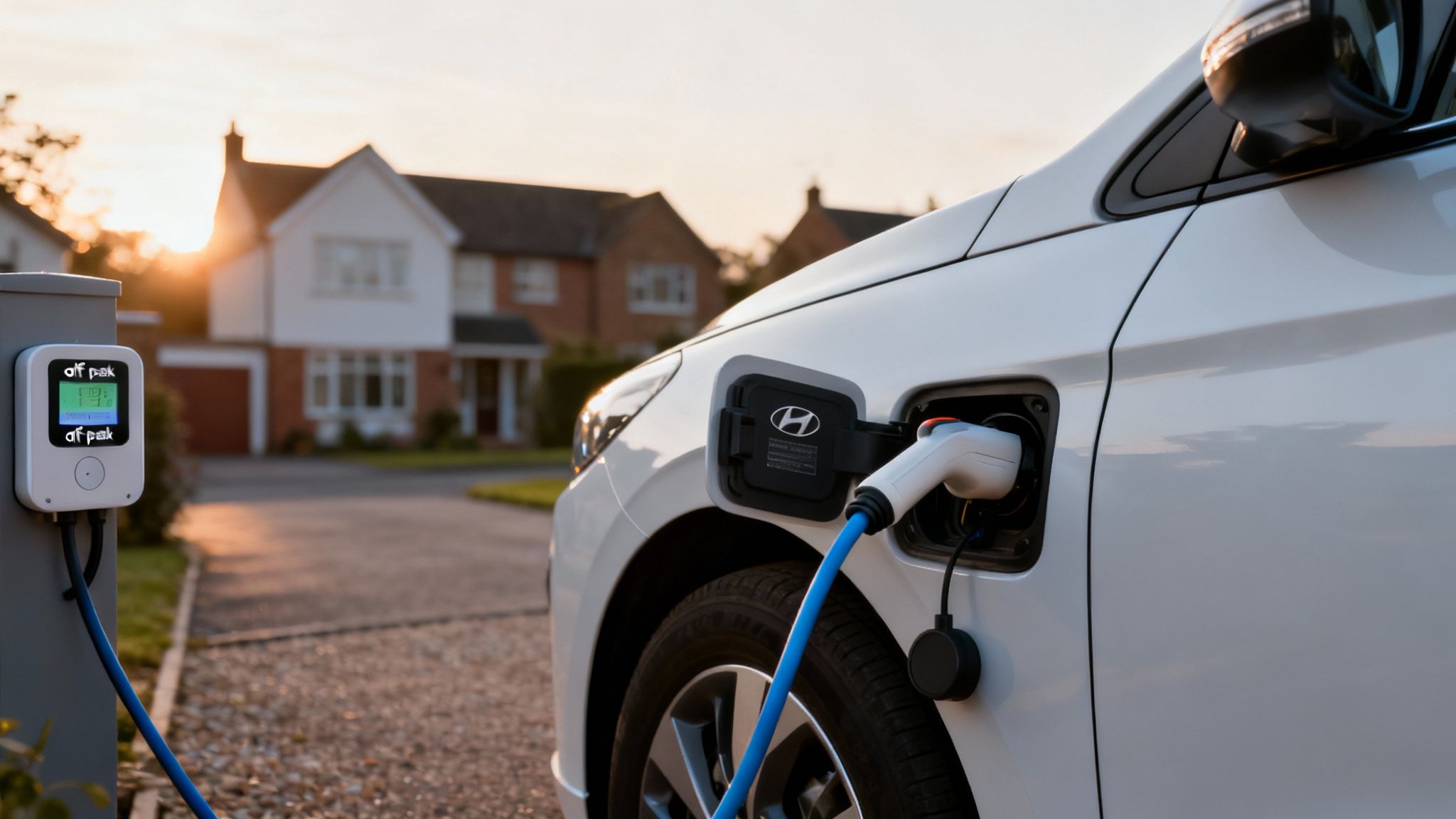
To get these ridiculously low running costs, you absolutely must be able to charge at home. Seriously, this is non-negotiable. Plugging into your own wallbox overnight on a cheap dual-rate electricity tariff is the key to unlocking the Ioniq’s superpower.
- Home Charging (The Dream): On a tariff like Octopus Go, you could be paying as little as 7.5p per kWh for your overnight juice. A full charge for the 38kWh Ioniq would set you back less than £3. That’s enough for 150-odd miles of driving for the price of a posh coffee.
- Public Charging (The Gamble): Venture into the wild west of public charging, and the picture changes dramatically. Rapid chargers on the motorway can cost anywhere from 69p to 85p per kWh . That same full charge could now sting you for over £32, pushing your pence-per-mile cost well into double digits.
The lesson is simple: public rapid chargers are for emergencies and the occasional long trip, not for daily use. Relying on them exclusively would be like doing your weekly food shop at a motorway service station—convenient, but financially insane. For a deeper dive, check out our sceptic’s guide to UK electric car charging costs.
Other Ownership Costs
Beyond ‘fuel’, the Ioniq continues to be delightfully cheap. Its other running costs are a breath of fresh air compared to a complex internal combustion engine car.
Vehicle Excise Duty (VED)
This one’s easy. For pure electric cars like the Ioniq Electric, VED (or road tax, as we all call it) is currently £0 per year
. That’s a lovely, round number we can all get behind and a saving that adds up year after year.
Servicing and Maintenance
Servicing an EV is a much simpler affair. There’s no oil to change, no filters to replace, no exhaust systems to rust through, and no clutch to wear out. Servicing schedules are typically every 10,000 miles or once a year, and the bills are refreshingly low – often well under £100 for a basic check-up. The main consumables are tyres, brakes (which last ages thanks to regenerative braking), and windscreen washer fluid.
Insurance Groups
The original Ioniq Electric sits in a very reasonable insurance group, typically between 16E and 22E
, depending on the specific trim level. This makes it comparable to many mid-sized family hatchbacks like a Ford Focus or VW Golf, so you shouldn’t get any nasty surprises when it comes to getting a quote.
How To Buy A Used Hyundai Ioniq In The UK
Right, you’ve chewed over the numbers, weighed up the running costs, and decided the sensible EV life is for you. Excellent choice. Now for the fun bit: navigating the UK’s used car market to find a good Ioniq without being taken for an absolute ride.
Buying a used electric car isn’t quite the same as kicking the tyres on an old Ford Fiesta. You’ve got a different set of worries, and chief among them is that big, expensive battery pack hiding underneath. Get this wrong, and your bargain EV could quickly become a very large, very stationary garden ornament.
But don’t panic. Armed with a bit of knowledge, you can absolutely snag a gem. In fact, the original Ioniq Electric is a fantastic candidate for a savvy used purchase, mainly because so many of them started life as fleet cars.
Why Ex-Fleet Cars Are Your Friend
Normally, the words "ex-company car" might conjure up images of something that's been hammered down the M1, its cabin filled with the ghosts of a thousand lukewarm service station coffees. With the Ioniq, it’s often the complete opposite.
- Impeccable Service History: Fleet operators are beyond meticulous with maintenance. These cars will have been serviced on the dot, every time, usually by a main dealer.
- The Right Kind of Miles: Most will have racked up consistent motorway mileage, which is far kinder to a car's components (especially an EV's) than the endless grind of stop-start city driving.
- Depreciation is Your Ally: Here’s the big win. Fleet cars suffer brutal initial depreciation. The first owner—the company—has taken that massive financial hit for you, leaving you to swoop in and grab a well-maintained, three-year-old car for a fraction of its original price.
This depreciation curve is precisely where the opportunity lies. On the UK used market, a recent Hyundai Ioniq averages around £14,020 , with 2019 examples hovering at about £11,215 after dropping in price by roughly 17% over the last year. Crucially, many of these 2017–2019 models still have years left on their 8-year/100,000-mile battery warranty , offering a safety net that many rivals just can't match. You can get more details on Hyundai Ioniq price trends from CarGurus.co.uk.
The Essential Used Ioniq Checklist
When you go to view an Ioniq, your priorities need to shift slightly from what you’d look for in a petrol or diesel car. It’s time to channel your inner detective and focus on the electric bits.
We’ve put together a quick checklist to help you focus on what really matters when you’re kicking the tyres (and checking the battery).
Used Ioniq UK Buyer's Checklist
| Check Area | What to Look For | Why It Matters |
|---|---|---|
| Battery Health (SoH) | Ask to see the car fully charged. Better yet, use an OBD2 dongle and an app like 'EV Watchdog' to get a direct State of Health (SoH) reading. Aim for 90% or higher. | This is the car's lifeblood. A tired battery means poor range, turning your commuter car into a local runabout that's terrified of motorways. |
| Warranty Status | Check the service book for a full, unbroken main dealer history. Every stamp should be present and on time. | Hyundai’s 8-year battery warranty is a massive perk, but it’s often conditional on a perfect service record. Gaps could mean the warranty is void. |
| Charging Gear | Ensure all charging cables (Type 2 and the 3-pin 'granny' charger) are present and in good condition. Check the charging port for damage. | Replacing these can be surprisingly expensive. A missing cable is an easy way for a seller to claw back a few hundred quid at your expense. |
| The 12V Battery | Don't forget the little battery! A failing 12V battery can cause all sorts of bizarre electrical gremlins and non-start situations, even if the main battery is full. | It's a cheap and easy fix, but if it's on its way out, it can make the car seem unreliable. Factor in the cost of a replacement if it seems sluggish. |
This isn't an exhaustive list, of course, but it covers the big-ticket items specific to the Ioniq. A bit of due diligence here will pay massive dividends down the road.
The single most important aspect of any used EV is the health of its high-voltage battery. A tired battery means reduced range, turning your dependable commuter into a car that struggles to reach the next town over. This is non-negotiable.
The battery's "State of Health" (SoH) is simply a measure of its degradation. A brand-new car has 100% SoH . Over time and with use, this percentage drops. Thankfully, Ioniq batteries are known for being impressively robust, but you absolutely must check. Anything above 90% SoH is a great result for a car that’s a few years old.
Hyundai’s 8-year/100,000-mile battery warranty is a huge selling point, covering it against total failure and excessive degradation (usually defined as dropping below 70% SoH ). But, as mentioned, you need that full main dealer service history to keep it valid. No service book, no deal. Simple as that.
Finally, while the Ioniq is generally solid, check that the little 12V battery is healthy, as a failing one can cause all sorts of weird electronic gremlins. For a more detailed guide, check out our article on the https://www.voltsmonster.com/top-5-things-to-look-for-when-inspecting-a-used-ev. Finding a well-cared-for example is the key to a happy and cheap-to-run ownership experience.
Reviewing The Ioniq 5 And Ioniq 6
Just when we all had Hyundai filed away as the sensible, value-driven brand that made the brilliantly dull original Ioniq, they threw the script out of the window. The Ioniq 5 and Ioniq 6 are what happened next – cars that look less like they came from a factory and more like they escaped from a sci-fi film set.
It was a proper handbrake turn for the brand. Hyundai went from producing a car designed to blend in, to creating two that are physically incapable of it. The humble ‘Ioniq’ name, once a byword for no-nonsense efficiency, was suddenly slapped on the back of some of the boldest designs on the road.
This is where our Hyundai Ioniq review moves on from the smart-money hatchback and into the realm of the statement piece. It's where Hyundai started having fun, and the results are fascinating.
The Ioniq 5: A Retro-Futuristic Family Hauler
First to land was the Ioniq 5, a car that gleefully defies easy labels. Is it a massive hatchback? A crossover? An SUV? Honestly, who cares? It looks like an 8-bit video game character made real – a fantastic homage to 1970s concept cars, but stuffed with tomorrow's tech. It's big, unapologetically boxy, and has incredible road presence.
The real magic, though, is on the inside. Thanks to the completely flat floor of its all-electric skateboard platform, the interior is simply vast. It genuinely feels less like a car and more like a minimalist Scandi lounge on wheels. The front seats can recline almost flat, and the whole centre console slides backwards and forwards. It’s a wonderfully calm and spacious place to spend time.
But the Ioniq 5’s real party trick is its charging. It was one of the very first mainstream EVs to pack an 800-volt electrical architecture .
In plain English, this means it can charge at a properly bonkers speed. Find a potent 350kW public charger and you can theoretically zap the battery from 10% to 80% in just 18 minutes . That’s just enough time to grab a truly awful service station coffee before you’re ready to hit the road again.
The Ioniq 6: The Electrified Streamliner
If the Ioniq 5 is a masterclass in retro-futurism, the Ioniq 6 is a pure lesson in aerodynamics. Hyundai calls it an "electrified streamliner," which is just a very cool way of saying it’s shaped like a smoothed-over pebble to slice through the air. It’s long, low, and incredibly slippery, designed with one primary goal: to wring every last mile from its battery.
It’s built on the same brilliant 800-volt platform as the Ioniq 5, so all that rapid-charging goodness is still present and correct. But where the 5 prioritises outright space and practicality, the 6 knowingly sacrifices a bit of rear headroom for ultimate efficiency. That swooping roofline and Porsche-esque tail are all in service of range.
This makes the Ioniq 6 the undisputed long-distance champion of the Ioniq family. With the larger 77.4kWh battery , it claims an official range of up to 338 miles . Even in the real world, it’s a car that can tackle long motorway slogs without inducing a constant state of range-based panic.
A Tale Of Two Philosophies
Putting these two alongside the original Ioniq Electric is like comparing a well-made wooden spoon to a laser-guided food replicator. The original was built to a price, engineered for maximum pence-per-mile thriftiness above all else. It was a tool, and a very good one at that.
The Ioniq 5 and 6 signal a complete change of mindset. These are design-led, tech-forward cars that compete on desirability and style, not just on spreadsheets.
Here’s a quick rundown of how they stack up for a typical UK buyer:
| Feature | Ioniq 5 | Ioniq 6 | The Original Ioniq |
|---|---|---|---|
| Primary Focus | Style, space, family life | Range, efficiency, design | Pure value for money |
| Best For | The school run, IKEA trips | Motorway marathons | Sensible daily commuting |
| Charging Speed | Ultra-fast (800V) | Ultra-fast (800V) | Decent, but not a leader |
| Interior Vibe | Mobile lounge | Cockpit-like cocoon | Functional and durable |
| Used UK Price | £22k+ | £30k+ | £8k - £16k |
The evolution is crystal clear. Hyundai used the original Ioniq to prove it could build a competent and incredibly efficient EV. With the 5 and 6, it proved it could build EVs that people would genuinely want. This pivot transformed the brand from a value-focused contender into a true design and technology leader in the electric car space.
Our Final Verdict On The Hyundai Ioniq Range
Right then, the big question: should a Hyundai Ioniq be on your shopping list? Let's cut through the noise. The Ioniq family isn't a single car; it's more of a sliding scale from sensible to spectacular. It’s a genuinely brilliant, if slightly split-personality, lineup with a model for just about everyone.
Your choice really boils down to one simple, honest question: what do you actually need from your car? Forget what you want for a second and be ruthless with your answer.
Which Ioniq Is For You?
If you’re a high-mileage warrior just looking to obliterate your monthly petrol bill, the original Ioniq Electric (38kWh) is, quite frankly, one of the smartest used EV buys in the UK right now. It's the undisputed king of common sense – a masterclass in efficiency that puts your bank balance far ahead of any playground bragging rights.
Need to haul the family around, crave a car that turns heads, and want the absolute latest charging gadgetry? You’ll need to find the extra cash for an Ioniq 5 . That spacious, lounge-like interior and blisteringly fast charging make it a phenomenal family wagon that just so happens to look like a concept car.
Or perhaps you’re a motorway rep who measures life in service station coffees? The Ioniq 6 is your steed. It gives up a little practicality for its wind-cheating shape, making it the undeniable long-distance champion of the Ioniq family.
Think of it like this: the original Ioniq is a purchase you make with your head. The Ioniq 5 and 6 are cars you buy with your heart – but your head can still absolutely justify them. All three are fantastic at what they were designed to do.
VoltsMonster’s Deal Of The Week
Talk is cheap, so let's put our money where our mouth is. After a good trawl through the UK's classifieds this week, we’ve found an absolute corker.
- The Car: 2020 Hyundai Ioniq Electric Premium SE (38.3kWh)
- Location: Hyundai Main Dealer, Midlands
- Mileage: 31,000 miles
- Price: £13,995
- Why it’s a deal: This is the top-spec, facelifted model with the bigger battery, full leather, and every toy Hyundai could throw at it. The killer detail? It has a perfect main dealer service history, which means the 8-year/100,000-mile battery warranty is fully intact , with about four years of cover remaining. For less than a new petrol supermini, you’re getting a ridiculously cheap-to-run daily driver with massive peace of mind.
On the test drive, check this: Make sure the heated steering wheel gets properly toasty – they can be a weak spot. More importantly, find a rapid charger and plug it in. You want to see it accepting a healthy charge rate of around 45kW to confirm all is well. This is as good as it gets for maximum EV motoring on a minimal budget.
Got Questions About The Ioniq? We've Got Answers
Right, you've done the hard graft. You've read the reviews, stared at the specs, and you're this close to taking the plunge. But a few little questions are probably still bouncing around your head. Let's clear them up.
Think of this as the final once-over before you hit the classifieds. No fluff, just straight-up answers to the stuff we get asked all the time.
Is The Hyundai Ioniq Reliable?
In a word: yes. The original Ioniq Electric, in particular, is a bit of a workhorse. It’s mechanically simple, and because there are far fewer moving parts than in a petrol car, there’s just less to break.
The batteries have also proven to be tough as old boots, with owners reporting impressively low levels of degradation even after years of service. It’s a car that was clearly built to last, not just to look good in the showroom.
How Long Does The Ioniq Battery Last?
This is the big one, isn't it? Hyundai backs the high-voltage battery on all Ioniq models with a solid 8-year/100,000-mile warranty . This protects you against total failure and serious capacity loss (typically if it drops below 70% of its original state of health).
In the real world, data from high-mileage cars shows that most Ioniq batteries are still holding well over 90% of their charge after years on the road. With a bit of sensible care, the battery should easily outlive the rest of the vehicle.
The bottom line is that total battery failure is incredibly rare. For anyone buying a used Ioniq in the UK, that long warranty provides a brilliant safety net and a level of reassurance you just don't get with some of its rivals.
Can You Tow With A Hyundai Ioniq?
This is where you need to pay attention, because it's a tale of two halves. The original Ioniq Electric hatchback was not type-approved for towing in the UK. So, if you were hoping to fit a tow bar to one of those, you're out of luck.
The Ioniq 5 and Ioniq 6, however, are a completely different kettle of fish. They’re surprisingly capable towers:
- Ioniq 5: Can pull a braked trailer of up to 1,600kg . That’s enough for a respectable family caravan.
- Ioniq 6: Is rated for up to 1,500kg (braked).
This makes the newer models genuinely practical choices for anyone with a trailer or a love for the great outdoors. If towing is a must-have, your decision is pretty much made for you.
At VoltsMonster , we cut through the noise to give you honest, irreverent EV advice. For more brutally honest reviews and guides, check out our latest articles at https://www.voltsmonster.com.
VoltsMonster Electric Vehicle Blog