A Bluffer's Guide to Nissan Leaf Charging Ports
Right, let's get one thing straight about Nissan Leaf charging ports. For most UK models, you're looking at two different sockets tucked away behind a flap on the car's nose: a Type 2 for your day-to-day home and public AC charging, and the now slightly quirky CHAdeMO port for the big, fast DC rapid chargers you find lurking at motorway services.
Think of them as the knife and fork of your EV charging experience—one for the slow and steady meal at home, the other for grabbing a quick, greasy bite on the road.
Cracking the Code of Nissan Leaf Charging Ports
Welcome to the occasionally baffling world of plugging in your Nissan Leaf. If you've ever found yourself staring at the front of the car feeling a bit like you're trying to decipher flat-pack furniture instructions, you're definitely not alone. Unlike your kettle with its one simple plug, the Leaf has historically featured this dual-port setup, a legacy of early EV design choices that still haunts the charging experience for owners today.
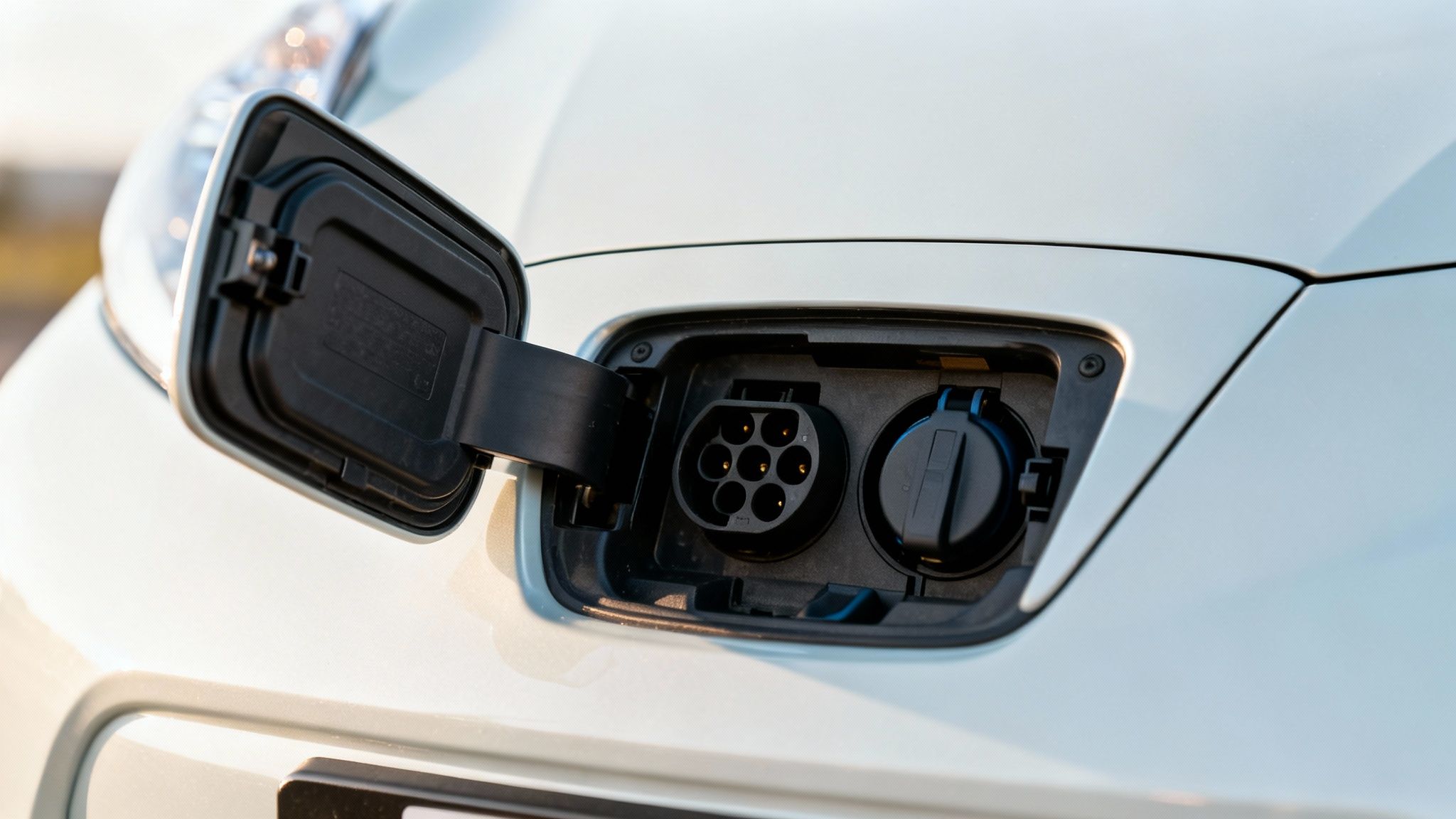
This guide is your decoder ring. We're going to slash through the jargon and explain exactly what those two ports are for, why there are two of them in the first place, and how they affect your life as a Leaf driver. This is all about practical, real-world knowledge that will stop you from looking like a lost tourist at a public charging station.
To make things crystal clear, here’s a quick-reference table showing which ports you can expect to find on UK models over the years.
Nissan Leaf Charging Port Quick Reference by UK Model Year
| Model Generation / Year Range (UK) | AC Charging Port (Slow/Fast) | DC Charging Port (Rapid) | Typical Onboard Charger Power (AC) |
|---|---|---|---|
| 1st Gen (2011-2017) | Type 1 | CHAdeMO | 3.3kW (6.6kW optional on later models) |
| 2nd Gen (2018-Present) 40kWh | Type 2 | CHAdeMO | 6.6kW |
| 2nd Gen (2019-Present) 62kWh "e+" | Type 2 | CHAdeMO | 6.6kW |
As you can see, the biggest change happened around 2018 when Nissan switched from the older Type 1 to the now-standard Type 2 connector for AC charging in the UK and Europe. The CHAdeMO port, however, has remained a constant, slightly stubborn feature for DC rapid charging across all generations.
Your Two Main Connectors Explained
The whole reason you have two different physical ports comes down to the two different types of electrical current your car can take. Getting your head around this simple distinction is the first real step to becoming a charging bore at the pub.
-
AC (Alternating Current) Charging: This is your slow-and-steady option, used for charging at home, work, or at many supermarket and car park chargers. For this, your Leaf uses its Type 1 (pre-2018) or Type 2 (2018 onwards) port. The car has to use its own internal 'onboard charger' to convert this AC power from the grid into DC power that the battery can actually store.
-
DC (Direct Current) Charging: This is the fast stuff. It's the 'rapid' charging that gets you back on the motorway in under an hour. The Leaf uses its CHAdeMO port for this, which cleverly bypasses the car's slower onboard converter and shoves high-voltage DC power straight into the battery pack.
Think of it like this: AC charging is like filling a swimming pool with a garden hose—it takes a while but it gets the job done reliably overnight. DC charging is like calling the fire brigade to fill it up; it’s incredibly fast, a bit more dramatic, and really for when you're in a massive hurry on a long trip.
Understanding this fundamental difference is the key. One port is for your daily top-ups and patient overnight fills, while the other is your lifeline on long journeys. Master the purpose of each, and you've won half the battle.
The Great Plug Debate: CHAdeMO vs The World
Right then, let's get straight to the elephant in the room. Why, in a world that’s quickly settling on the slick, all-in-one CCS plug, is your beloved Nissan Leaf still sporting a CHAdeMO port?
It can feel a bit like turning up to a smartphone party proudly rocking a Nokia 3310. It works, it’s reliable, but you can’t help but notice it’s becoming a bit of a relic.
The story behind the CHAdeMO plug is a classic tale of being first to the dance but wearing the wrong outfit for the new theme. It was developed in Japan by a group including Nissan and Mitsubishi, and its name is a clever contraction of "CHArge de MOve," or "charge for moving." For a good while, it was the only DC rapid charging standard out there.
This early lead is exactly why every Leaf you see on UK roads, from the original 24kWh models right up to the latest ones, has that distinctively large, round CHAdeMO socket. Nissan backed its horse early, and for over a decade, it seemed like a solid bet.
The Rise of a Rival
But while Japan was perfecting its standard, Europe was brewing its own solution. The result was the Combined Charging System, or CCS .
The real genius of CCS, and the main reason it ultimately won the format war, was its elegant simplicity. It cleverly combines the everyday AC charging pins with two hefty DC pins into one neat package, using the same physical port for both slow and rapid charging.
This meant carmakers could design cars with just one charging flap, not the Leaf’s slightly fussy two-port setup in the nose. It was simply a tidier, more integrated solution, and the European car industry—along with most of the world—piled in behind it.
You can think of it as the Betamax versus VHS of the electric car world. CHAdeMO was technically brilliant and got there first, but CCS was the format that achieved mass-market adoption, leaving CHAdeMO-equipped cars like the Leaf in a slightly awkward spot.
So, where does that leave you as a UK Leaf driver today? Are you doomed to wander the charging deserts, desperately searching for a mythical CHAdeMO unit while smug Tesla and VW drivers zip past? Well, not quite.
Is Owning a CHAdeMO Car a Massive Pain in the Arse?
Let's be brutally honest: owning a CHAdeMO car in an increasingly CCS world is becoming more of an inconvenience, but it's not a catastrophe just yet.
The UK’s early charging network was built around the Leaf, so there are still thousands of CHAdeMO connectors dotted across the country. You'll find them on most older 50kW rapid chargers.
However, the tide has well and truly turned. The modern charging hubs being installed by networks like Gridserve and InstaVolt are overwhelmingly CCS-focused. A new site might feature a dozen gleaming 350kW CCS chargers and, if you're lucky, one or two lonely CHAdeMO plugs tucked away in a corner. The future is clear: CHAdeMO is being phased out of new installations.
This presents a few practical challenges for Leaf drivers:
- Competition: With fewer plugs to go around, you might find yourself queueing behind another Leaf or a Mitsubishi Outlander PHEV.
- Power Limits: Most CHAdeMO chargers in the UK top out at 50kW . While newer CCS chargers can deliver power at two or three times that speed, your car is limited by the plug's capability.
- Adapter Frustration: The golden question everyone asks is, "Can I just buy an adapter?" For public chargers, the short answer is a resounding "no." A simple, widely available CCS-to-CHAdeMO adapter for public rapid charging remains frustratingly elusive for UK drivers. To get a better handle on the complexities, you can read our deep dive into CCS to CHAdeMO adapter options for UK drivers .
The Ariya and the End of an Era
The final nail in the coffin for Nissan’s loyalty to the standard is its own flagship EV, the Ariya. It launched with a CCS port—a crystal-clear signal that the company has finally waved the white flag in the format war.
Even the upcoming third-generation Leaf, expected around 2026, is confirmed to be ditching CHAdeMO for good.
This means that while your current Leaf will be supported for years to come, it represents the end of a technological branch. It doesn't make it a bad car—far from it. It just means you need to be a little more strategic when planning those longer journeys.
For now, the CHAdeMO plug is a quirk, a charmingly stubborn piece of EV history that still gets the job done. Just don't expect it to be the headline act at the charging station of tomorrow.
Real-World Charging Speeds and Times
Let's cut to the chase. The charging times you see in glossy Nissan brochures are cooked up under perfect lab conditions. They bear little resemblance to the reality of plugging in at a windswept, rainy service station on the M1 on a cold Tuesday night.
The truth is, how long you'll spend tethered to a charging point can vary wildly. Time is range, and it pays to understand what you're actually getting into, whether you're using a simple 3-pin plug at home or hunting down a rapid charger on a long trip.
The chart below gives a bit of context to the charging standards battle that shaped the Leaf's journey. It shows the historical tug-of-war between CHAdeMO and its main rival, CCS.
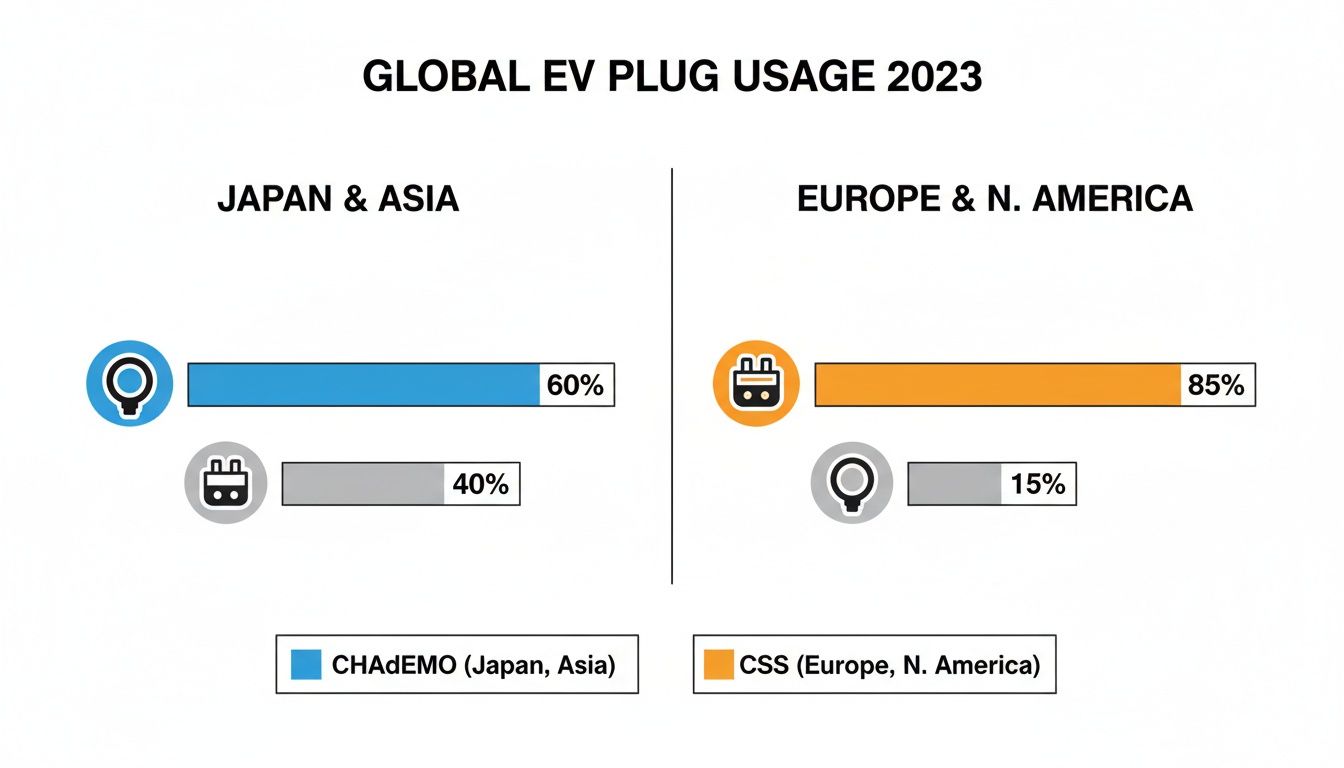
While CHAdeMO had a strong head start, particularly in Japan, you can see how CCS has become the dominant force across Europe and North America. This directly impacts the availability and future-proofing of the chargers you'll find across the UK today.
The Slow, The Steady, and The Sometimes-Rapid
Your Leaf's charging speed depends entirely on the power source you plug it into. In the UK, you'll generally encounter three main speeds, each with its own pros and cons.
-
The Glacial 3-Pin Socket (up to 3kW): Using the "granny cable" that came with the car is an exercise in extreme patience. Charging a 40kWh Leaf from nearly empty could take the best part of 15-20 hours . It’s fine for a small overnight top-up if you've only done a 30-mile commute, but for a big charge, it’s painfully slow.
-
The Sensible Home Wallbox (7kW AC): This is the sweet spot for most EV owners. A professionally installed 7kW wallbox, using your Type 2 port, will replenish a 40kWh Leaf from low to full in around 6-7 hours . It’s the perfect ‘plug in and forget’ solution for overnight charging, ensuring you wake up to a full battery every morning.
-
The Public Rapid Charger (50kW DC): When you're out on the open road, the CHAdeMO port is your best friend. A 50kW rapid charger can, in theory, take a 40kWh Leaf from 20% to 80% in about 40-60 minutes . I say in theory because real-world factors often have other ideas.
To make this a bit clearer, here are some realistic estimates for charging the most common Leaf batteries from 20% to 80% – the typical top-up you’d do on a journey.
Realistic UK Charging Times for Nissan Leaf Models
These are real-world estimates, not lab-condition fantasy figures. They account for the typical UK setup and the car's charging behaviour, giving you a much better idea of how long you'll actually be waiting.
| Leaf Model / Battery | 3-Pin Socket (3kW) | Home/Public Wallbox (7kW AC) | Public Rapid Charger (50kW DC) |
|---|---|---|---|
| Gen 1 (24kWh) | 5-6 hours | 2.5-3 hours | 20-25 minutes |
| Gen 1 / 2 (30kWh) | 6-7 hours | 3-4 hours | 25-30 minutes |
| Gen 2 (40kWh) | 8-9 hours | 4-5 hours | 40-60 minutes |
| Gen 2 e+ (62kWh) | 12-14 hours | 7-8 hours | 50-70 minutes |
As you can see, the method you choose makes a massive difference. While a home wallbox is more than enough for daily needs, you absolutely rely on the DC rapid network for any serious long-distance travel.
The Annoying Truth: Tapering and "Rapidgate"
Now for the quirks that the salesperson might have conveniently forgotten to mention. Charging an EV battery isn't like filling a petrol tank; the speed isn't constant. As the battery gets fuller, the car’s management system deliberately slows the charging rate to protect the cells. This is called tapering .
Tapering is the reason that last 20% of charge takes an absolute age. Zipping from 20% to 80% on a rapid charger might take 45 minutes, but going from 80% to 100% could easily take another 45. On a long journey, it's almost always faster to make two short 20-80% stops than one long stop to wait for a full battery.
This brings us to the infamous Rapidgate saga. Early 40kWh second-generation Leafs had a particularly nasty habit of overheating. Because the Leaf’s battery pack is passively air-cooled (unlike most rivals which have liquid cooling), doing several rapid charges in a single day would cause the battery temperature to soar.
To protect itself, the car would aggressively slash the charging speed. After your second or third rapid charge, you might find the car only accepting 20-25kW from a 50kW charger. This effectively doubles your waiting time and can turn a long drive into an epic odyssey of service station coffees.
Nissan did issue software updates to ease the worst of it, but the underlying hardware limitation remains. Thankfully, the larger 62kWh "e+" models handle heat much better. It's a critical point to be aware of if you’re looking at used 40kWh models. Even so, there is hope; you might be interested in our guide on what's involved in putting a new battery in an old Leaf .
Your UK Survival Guide for Home and Public Charging
Right, so you’ve got your head around the different charging ports on a Nissan Leaf. Now for the real-world bit: actually plugging it in. This is where the clean, green dream of EV ownership crashes into the messy reality of finding a working charger in the wild.
Charging your Leaf is really a tale of two very different experiences. First, there's the cosy, predictable sanctuary of your own driveway. Then there's the public charging network—a chaotic battlefield of competing companies, broken units, and unwritten rules of etiquette.
The Home Charging Dream
Let's start with the good news. Charging at home is, without a doubt, the single best thing about owning an electric car. It’s cheaper, it’s ridiculously convenient, and it means you wake up every single morning with a 'full tank'.
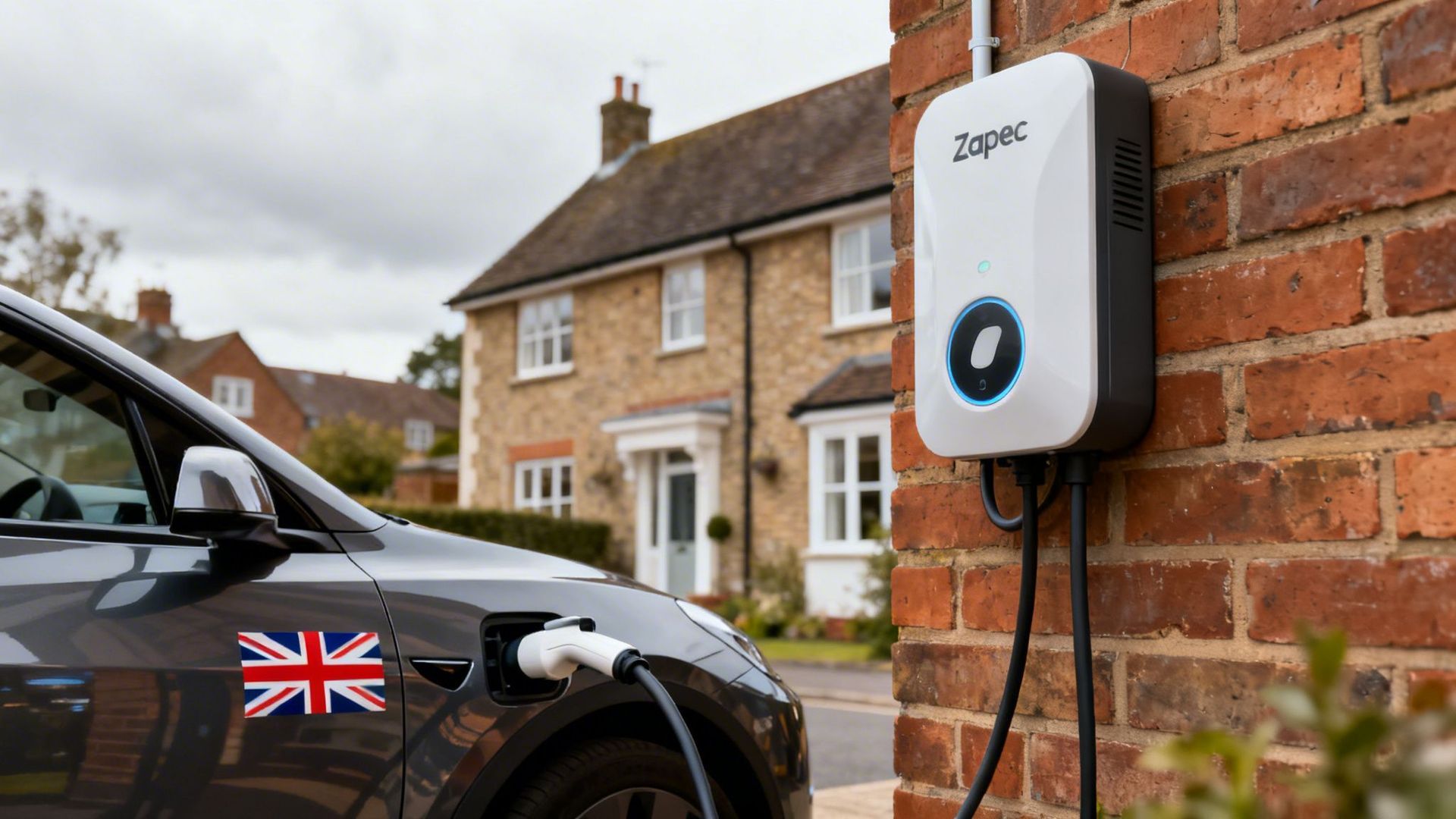
The smartest money you'll spend is on a dedicated 7kW home wallbox . Sure, you can use the 'granny cable' that plugs into a standard 3-pin socket, but it’s painfully slow. A proper wallbox will juice up your Leaf up to three times faster, turning an all-day slog into a simple overnight top-up.
When you're choosing one, you'll run straight into the great tethered vs. untethered debate. A tethered charger has the cable permanently attached, which is brilliantly easy—just grab and plug. An untethered unit is just a socket, so you have to lug your own cable out of the boot every time. It's a bit of a faff, but it looks neater and it’s more flexible if friends with different cars pop round. This is a big decision, so our guide on whether you should invest in a home charger or stick with public networks can help you weigh it all up.
Expect to pay anywhere from £800 to over £1,200 for the unit and professional installation. The government grants for homeowners in England are pretty much gone now, but if you're a renter or live in a flat, you might still get some help. It's always worth checking the latest official guidance.
Venturing into the Wild: The UK Public Network
Okay, time to leave the comfort of home. Welcome to the public charging arena. This is where your Leaf’s CHAdeMO port becomes both your best friend and, at times, your biggest source of frustration. The UK network is a patchwork quilt of providers like Gridserve, InstaVolt, and Pod Point, and each one has its own app, pricing structure, and level of reliability.
Your secret weapon in this fight is an app like Zap-Map . Honestly, it's non-negotiable for any EV driver. It gives you a live map of chargers, their supposed status, the connector types available, and, most importantly, comments from recent users. These comments are often a litany of despair that can save you a completely wasted journey.
As a Leaf driver, your main mission is to hunt down the increasingly rare CHAdeMO connector. You'll find one on most older 50kW rapid chargers. The problem is that the shiny new, ultra-fast hubs tend to prioritise the CCS standard, sometimes leaving just a single CHAdeMO plug to serve a growing queue of Leafs.
The Golden Rule of Public Charging: It’s simple, really: don’t be a plonker. Don’t hog a rapid charger to squeeze in that last 5% while other people are waiting. Get to 80%, unplug, and let someone else have a go.
The Reality of Finding a Plug
Don't just take our cynical word for it. Public chargers are absolutely vital. A UK government survey found that 74% of EV drivers use chargers in business car parks and 69% use them at service stations—exactly the sort of places you’ll still find a good number of CHAdeMO ports. Every week, 30% of EV drivers charge at work and 25% charge at service stations, which just goes to show how much we all rely on this infrastructure. You can dig into more insights from the full government report on EV driver habits .
Navigating this landscape takes patience and a bit of planning. Use your apps, always have a backup charger in mind, and just assume that any given unit might be out of order. It's a skill you'll learn—usually right after your first public meltdown at a remote, windswept charging bay.
Troubleshooting Common Charging Problems
It’s the moment every EV driver dreads. You’ve pulled into a dark, slightly menacing service station, plugged in your Leaf, and… nothing. Just a profound, soul-crushing silence. Before you start kicking the tyres and cursing the EV revolution, take a breath. Most charging failures aren't catastrophic; they're just fantastically annoying.
This is your troubleshooting bible for those all-too-common moments when the car decides to go on strike. We'll skip the technical waffle and get straight to the practical, what-do-I-do-right-now advice. From a simple communication glitch to a cable that’s decided to become a permanent fixture on your car, we’ve seen it all.
The Charger Refuses to Start
This is the most frequent complaint by a country mile. You’ve plugged in, waved your card or tapped the app, and the charger just stares back at you, completely unmoved. Don't panic; run through this checklist first. It sounds insultingly simple, but 90% of the time , one of these is the culprit.
-
The Emergency Stop Button: Scan the charging unit for a big, fat, red button. It's often been pressed by a previous user in a flap (or by a bored child). Try twisting or pulling it out to reset the unit.
-
Cable Seating: Push the charging handle firmly back into your car's port. Sometimes the connection isn't quite secure enough for the electronic 'handshake' to begin. Don’t be gentle; give it a proper shove.
-
The Classic Reboot: Just like your dodgy Wi-Fi router, try turning it off and on again. Stop the session in the app, unplug from your car, wait 30 seconds , and start the entire process from scratch.
If none of that works, the problem is almost certainly with the charger itself. Move to another unit if you can and make sure to report the faulty one on an app like Zap-Map to save another poor soul from the same fate.
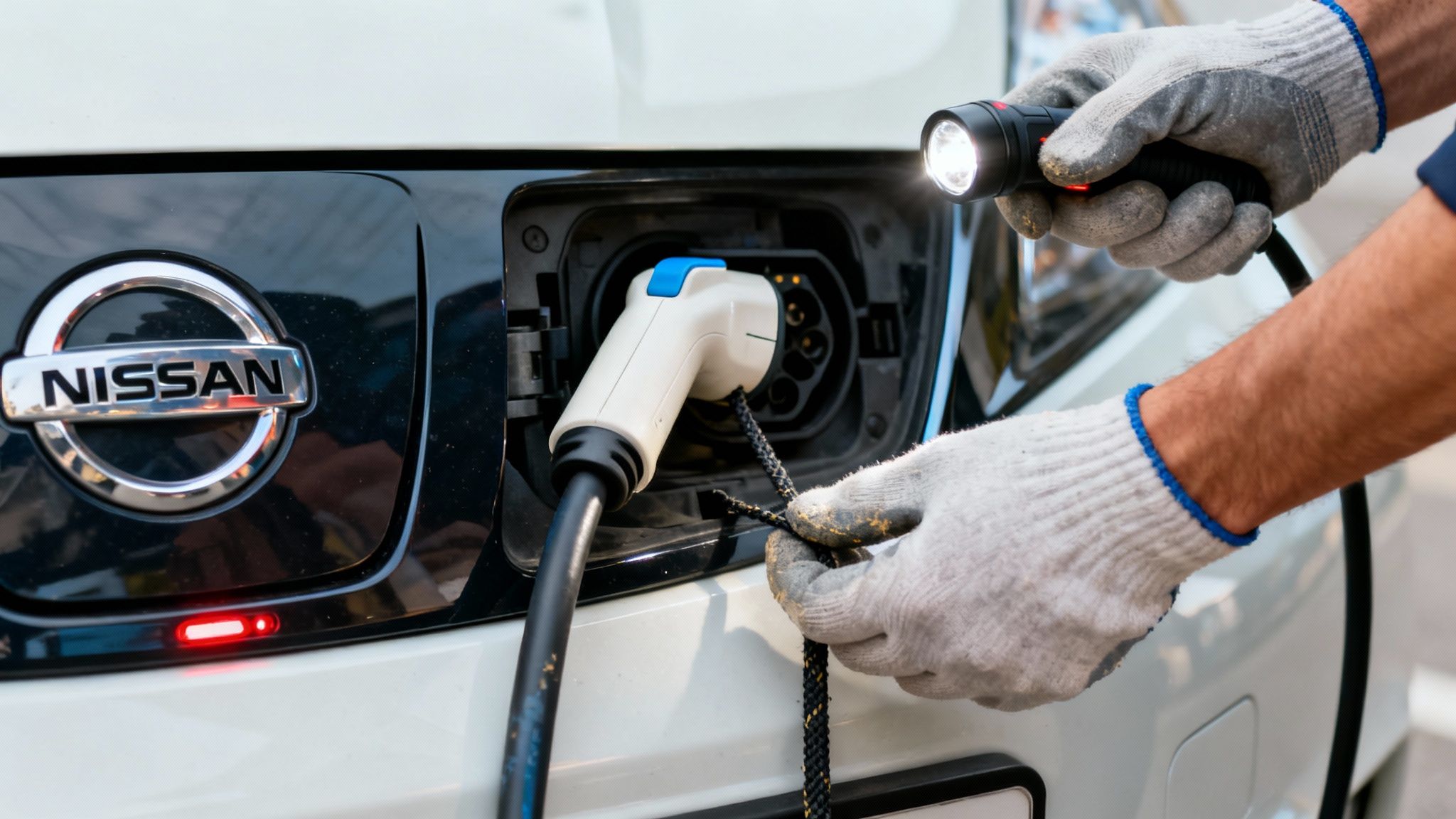
The Dreaded Stuck Cable Scenario
There are few things more anxiety-inducing than your car holding a public charging cable hostage. The locking pin is designed to prevent theft, but sometimes it gets a bit overzealous and refuses to let go.
First, make sure the car is fully unlocked. Press the unlock button on your key fob a couple of times—this often does the trick and releases the pin. Some older Leafs also have a manual release toggle inside the car, often located near the bonnet release, which can override the lock.
If you're truly stuck, there is a last-resort manual release. For the Type 2 port, you may need to access a pull-cord behind the trim in the boot. For the CHAdeMO , it’s often a more involved process. Your car's manual is your best friend here, but be warned, it might involve getting your hands dirty.
Diagnosing Blinking Lights and Error Messages
Your Leaf tries to tell you what's wrong via a set of three blue lights on the dashboard. Learning their language can save you a call to the AA.
- One Light Flashing: The car is ready to go, but the charge timer is set for later.
- Two Lights Flashing: The timer is active and overriding an immediate charge.
- Three Lights Flashing: This is the one to watch. It often signals a fault with the charger, the power supply, or a simple communication error between the car and the unit.
If you see three flashing lights, the best first step is to unplug and try the process again. If it persists, the charger or the local power grid is likely having a moment. It’s not usually a problem with your car, so don't fret. Just find another charger. The issue is rarely with your Nissan Leaf's charging ports themselves, but rather the fickle public infrastructure they have to deal with.
Right, you’ve made it this far, so you're either a proper Nissan Leaf nerd or you've taken a wrong turn on the information superhighway. Either way, let's tackle some of those lingering questions you might have about charging your Leaf.
Can I Use A Tesla Supercharger For My Nissan Leaf In The UK?
In a word? Nope. Don't even think about it.
Tesla's shiny Supercharger network is a bit of a private members' club, and unfortunately, your Leaf isn't on the list. While you might occasionally find one of their slower 'Destination Chargers' at a hotel or car park with a universal Type 2 plug that your Leaf can use for AC charging, their main rapid network is a closed shop.
For a proper rapid charge, you need to stick to public chargers that have a CHAdeMO connector.
Is It Bad For My Leaf's Battery To Only Use Rapid Chargers?
Constantly hitting your Leaf with DC rapid charges is a bit like living on a diet of takeaways. It’s brilliant when you need a quick fix, but it’s not the best for long-term health.
The main issue is heat. Rapid charging generates a lot of it, and heat is the biggest enemy of battery longevity. Relying on it too much will accelerate the natural degradation of your battery cells over time.
The best strategy is to use a slower AC home charger for your day-to-day topping up and save the CHAdeMO rapid charges for those longer trips when you absolutely need them.
Think of it like this: AC charging is your sensible, home-cooked meal. DC rapid charging is a greasy, late-night kebab – fantastic when you need it, but you'll live to regret it if you make it a daily habit.
Why Does My Leaf's Charging Slow Down After 80 Percent?
Ah, the dreaded charging slowdown. This is known as ‘tapering’, and it’s a deliberate safety feature, not a fault.
As your battery gets closer to full, the car's management system slows the charging speed right down to protect the cells from overheating and getting damaged. This is why charging from 80% to 100% on a rapid charger can feel like it takes forever.
On a long journey, it’s almost always quicker to stop twice and charge to 80% each time than it is to stop once and wait for that last 20% to trickle in.
Will CHAdeMO Chargers Disappear From The UK?
Disappear completely? Not for a while yet. There are still thousands of Leafs and other CHAdeMO-equipped cars on UK roads, so the charging networks won't just pull the plug overnight.
However, the tide has definitely turned. Almost all new rapid chargers being installed these days are heavily focused on the CCS standard. It's not uncommon to see a brand-new charging hub with a dozen CCS plugs and just one, lonely CHAdeMO unit tucked in a corner.
So, while you won't be left stranded anytime soon, the future is undeniably CCS.
At VoltsMonster , we cut through the jargon to give you the honest, unfiltered truth about electric vehicles. For more straight-talking reviews, guides, and industry chat, check out our latest articles at https://www.voltsmonster.com.
VoltsMonster Electric Vehicle Blog