What Is One-Pedal Driving and How Does It Actually Work?
Right then, let's get straight to it. One-pedal driving is a clever feature in electric cars that lets you speed up and slow down using only the accelerator pedal. Press down to go, ease off to slow down—often right to a complete stop. Think of it like the engine braking you get in a proper manual car, but dialled up to eleven and with the bonus of putting a bit of charge back into your battery.
The Lazy Sod’s Guide To One-Pedal Driving
So, what’s one-pedal driving all about, then? Remember those old Scalextric cars? You had one trigger: squeeze for more speed, release to slow down. That’s the basic idea. It’s a driving mode available in most modern EVs that makes the accelerator pedal do double duty.
When you lift your foot off the accelerator, the car doesn’t just coast freely like a typical petrol or diesel car would. Instead, it begins to brake automatically, using the electric motor in reverse. The more you lift off, the stronger the braking effect. This process is called regenerative braking —a nifty way of capturing the car's forward momentum and turning it back into electrical energy for the battery.
This isn't just a gimmick for people who find moving their foot a couple of inches to the left a chore. It genuinely changes how you connect with the car and read the road ahead.
So Why Bother With It?
The real magic of one-pedal driving shines in the dreary reality of British traffic. In the stop-start crawl of cities like London or Manchester, this feature can recover as much as 20-30% of kinetic energy that would otherwise be pissed away. In fact, UK-based EV trials have shown that drivers in urban environments can see their average range increase by 15% compared to using a traditional two-pedal method. You can find more insights about EV efficiency on the Dreamlease website.
It transforms the monotonous crawl of city commuting into a surprisingly smooth, efficient, and almost meditative experience. You start anticipating traffic flow not just to avoid braking, but to actively recapture energy.
At its core, one-pedal driving turns slowing down into a productive act. Instead of simply converting energy into wasted heat through your brake pads, every traffic light and roundabout becomes a chance to claw back a few more miles of range. It’s one of the keys to making city driving less of a soul-crushing chore and more of a strategic game.
How Regenerative Braking Makes It All Happen
So, how does this one-pedal driving witchcraft actually work? It’s not powered by some futuristic wizardry, but by a brilliantly simple piece of engineering called regenerative braking . This is the secret sauce, the clever bit of kit that makes the whole system tick.
In a standard petrol or diesel car, the engine's job is pretty one-dimensional: burn fuel to turn the wheels. But in an EV, the electric motor is a much smarter cookie. The second you lift your foot off the accelerator, it completely flips its script. It stops using power and starts creating it.
Essentially, the motor switches from being a motor to a generator. The car's own momentum—its kinetic energy—is used to spin the motor in reverse. This action creates resistance, which is what slows the car down, and in the process, it generates electricity that gets fed straight back into the battery. It’s the ultimate automotive recycling scheme.
From Wasted Heat to Free Miles
Think about how traditional brakes work. When you hit the brake pedal, you're just creating friction. Brake pads clamp down on discs, converting all that forward momentum into waste heat that just dissipates into the air. It’s like setting fire to a tenner just to warm your hands for a second.
Regenerative braking is a far more elegant solution.
It’s your car’s own personal power station, constantly scavenging for scraps of energy that would otherwise vanish. Every time you slow for a roundabout or lift off for a speed camera, you’re not just braking—you’re re-charging.
This diagram helps visualise what’s happening under the bonnet.
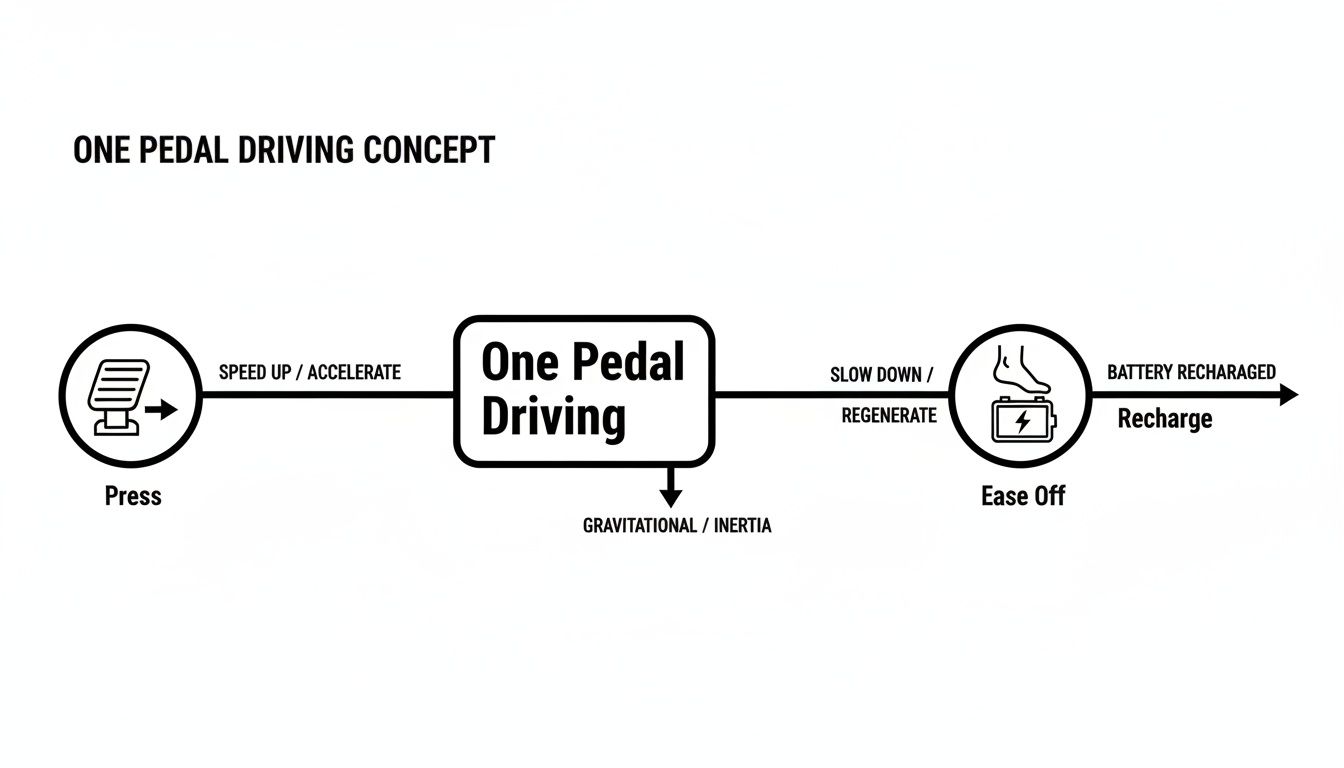
The whole process is seamless. Pressing the accelerator draws power from the battery, while easing off reverses that flow to send a little juice back home. It's this reversal that provides the braking force you feel.
Not All Regen Is Created Equal
Now, manufacturers get that not every driver wants to feel like they’ve just hit an invisible wall every time they lift off the accelerator. That’s why almost every EV lets you adjust the strength of the regenerative braking. You can usually tailor it to your liking right from the car’s main touchscreen.
- Low Setting: This feels very much like driving a conventional automatic car. You’ll get a whisper of braking effect, but the car will mostly coast freely when you lift off. It’s ideal for smooth motorway driving.
- Medium Setting: This is a nice middle-ground. It provides a noticeable slowing effect without feeling too abrupt, making it a great place to start if you’re new to the whole idea.
- High/Max Setting: This is the full-on one-pedal driving experience. Lifting your foot results in strong, confident deceleration, often enough to bring the car to a complete stop without you ever having to touch the brake pedal.
Of course, the idea of capturing braking energy isn't brand new. You can discover how hybrid cars actually work using similar principles in another one of our guides. But in a pure electric vehicle, the system is far more powerful and effective, turning your daily commute into a clever cycle of using and recovering energy.
How To Master One-Pedal Driving Without Looking Like a Prat
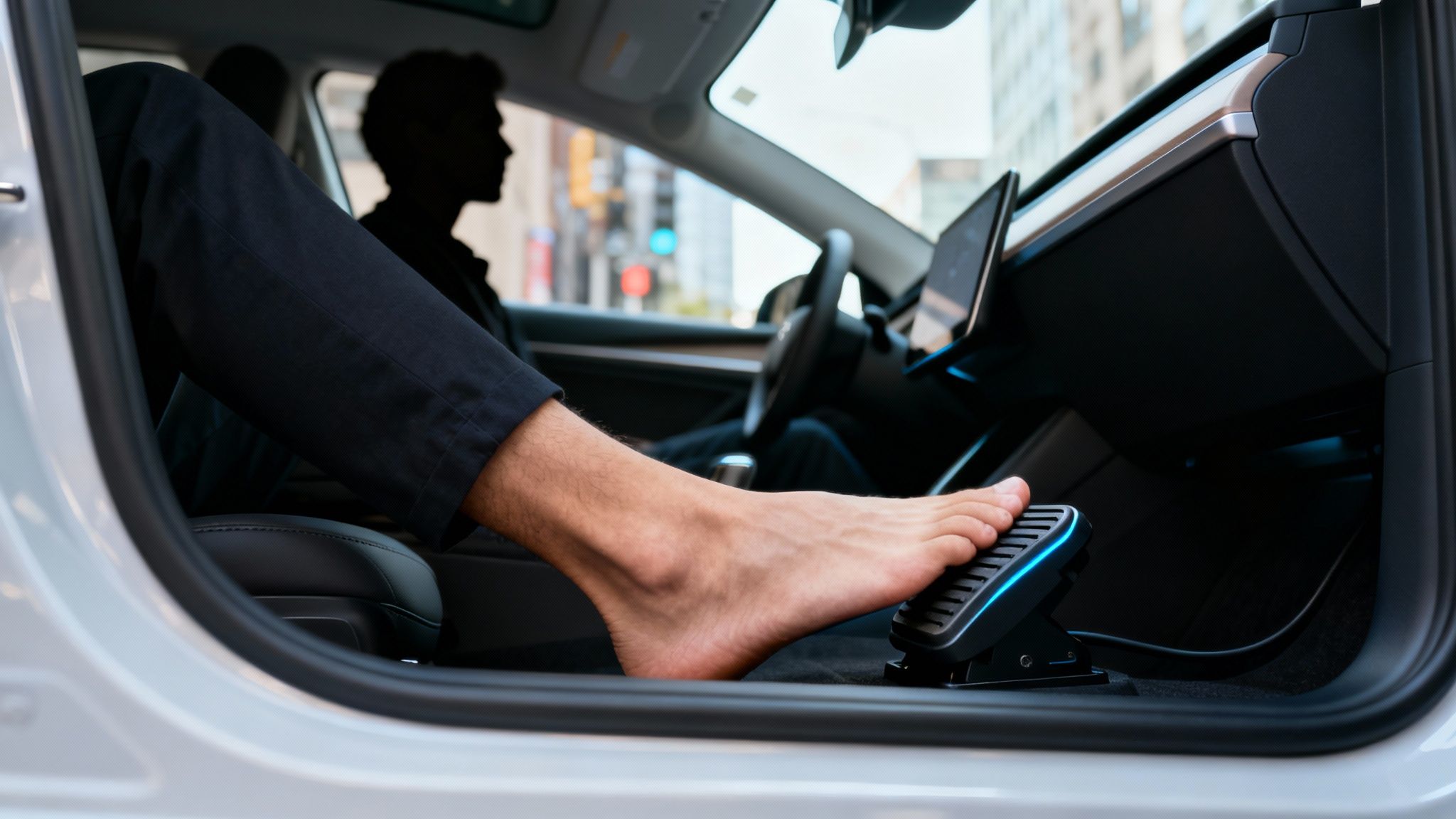
Right, let’s be honest. Your first go at one-pedal driving might feel less like a futuristic glide and more like a learner driver bunny-hopping through their first hill start. Your passengers' heads will nod, stomachs might churn, and any driving cool you thought you had will quickly evaporate.
But don't worry, mastering this art is simpler than it seems. The goal is to evolve from a jerky novice into a smooth operator, the kind of driver who makes passengers wonder if you’ve been moonlighting as a chauffeur. It's all about retraining your right foot from a clumsy on/off switch into a more delicate instrument.
Finding And Engaging The Beast
Before you can tame it, you have to find it. In their infinite wisdom, car manufacturers often hide this setting away. Don’t expect a big, friendly "ONE-PEDAL" button on the dash. You'll likely need to do a bit of digging.
Here's where to start your search:
- The Main Infotainment Screen: This is the most common place. Dive into menus like 'Vehicle Settings', 'Driving Modes', or 'EV'. You're looking for terms like 'Regenerative Braking', 'i-Pedal' (used by Hyundai/Kia), 'e-Pedal' (Nissan's term), or simply 'One-Pedal Drive'.
- Steering Wheel Paddles: Some cars, like the Kia EV6, cleverly use paddles behind the wheel to adjust regen levels on the fly. You can cycle through different strengths, from a gentle coast to a full, aggressive stop.
- A Physical Button: A rare but welcome sight. A few models might have a dedicated button on the centre console to activate the strongest braking mode directly.
Once you’ve found it, turn it up to the max. Go on, be brave. The only way to really learn is by jumping in at the deep end. Just make sure you do it in an empty car park, not on the M25 during rush hour.
Becoming A Smooth Operator
The real secret to graceful one-pedal driving is all about anticipation and modulation . Stamping on the accelerator and then lifting off completely will give everyone whiplash. The key is to be gentle and think much further ahead.
Think of the accelerator not as a button, but as a dimmer switch for your speed. The smoothness is found in the gradual release, not the abrupt lift.
Instead of braking at the last second, start easing off the accelerator much earlier than you would in a petrol or diesel car. Feather your foot, lifting it slowly and deliberately to control how quickly you slow down. Your aim is to glide to a perfect halt exactly where you intended, without ever touching that old-fashioned brake pedal.
Navigating a 20mph zone in Manchester or dealing with London's stop-start nonsense becomes a kind of game. How smoothly can you come to a stop? Can you judge the traffic flow well enough to avoid the brake pedal for your entire journey? When you get it right, it’s not just efficient—it’s immensely satisfying. You'll soon wonder how you ever put up with all that tedious pedal-swapping.
The Good, The Bad, and The Unexpected
Right, so one-pedal driving sounds pretty brilliant on paper. Smoother stops, a few extra miles for free, and that little spark of joy knowing you’re recycling energy. But before you relegate your brake pedal to a life of dusty retirement, let’s have an honest chat about the whole picture. It’s not all sunshine and battery percentage points.
Like most things worth having, it’s a mixed bag. You get some fantastic benefits, a few genuine annoyances, and some side effects you probably hadn’t even thought of.
The Good Bits: The Upsides
Let's kick off with the positives, because there are plenty. The most obvious win is efficiency , especially if your daily drive is a classic British crawl through traffic. Every time you lift off the accelerator to slow for a junction or a queue, you’re not just wasting momentum – you’re actively putting a little bit of energy back into the battery. This can genuinely add noticeable miles to your real-world range.
Then there’s the very welcome knock-on effect for your wallet. With regenerative braking handling most of the deceleration, your traditional brake pads and discs get a seriously easy ride. This means you’ll be visiting the garage for brake servicing far less often, leaving more cash in your pocket for, well, anything else.
And finally, there's the sheer comfort. Once you get over the initial learning curve, one-pedal driving is genuinely relaxing. It turns the frantic dance between accelerator and brake in stop-start traffic into a single, smooth action. It just makes for a less stressful, more flowing journey.
The Bad Bits: The Downsides
Now for the less glowing report. The biggest point of contention is safety . That strong, automatic deceleration can catch the driver behind you completely by surprise, particularly if they’re tailgating you. Modern EVs are designed to light up the brake lights when the regenerative braking is strong, but the suddenness of it can feel much sharper than a driver gently easing onto a brake pedal.
This isn't just theory. Insurance claim data from UK providers suggests EVs are more likely to be rear-ended, and this rapid slowing is often pointed to as a potential factor. It's a bit of an irony – while EVs often have fewer front-end collisions thanks to advanced emergency braking systems, the risk from behind is something to be aware of. You can read more about these EV fender bender findings on Green Car Reports.
One-pedal driving demands a new level of awareness, not just of the road ahead, but of the person driving six inches from your rear bumper.
There are also specific situations where it’s simply not the right tool for the job. On icy or very slippery roads, applying a strong braking force just to the driven wheels could potentially cause a loss of traction. Likewise, when you’re navigating a really steep hill, you might feel more comfortable with the precise, predictable control of the good old-fashioned friction brakes.
The Unexpected Side Effects
Beyond the clear pros and cons, a few other quirks pop up. One is the slightly strange issue of brake rust . Because your mechanical brakes get so little action, the discs can build up a thin layer of surface rust from rain and humidity. This can lead to a rather unpleasant grinding noise the first few times you properly use the brake pedal after a damp spell.
There’s also a risk of getting a bit too comfortable. Relying on one pedal 95% of the time can mean your reaction time to slam on the actual brake in an emergency might be a fraction of a second slower. It’s a tiny difference, but in a crisis, fractions of a second matter. It’s a fantastic driving style, but you must never forget that the brake pedal is, and always will be, your most important safety control.
Which EVs Have The Best One-Pedal Driving on UK Roads?
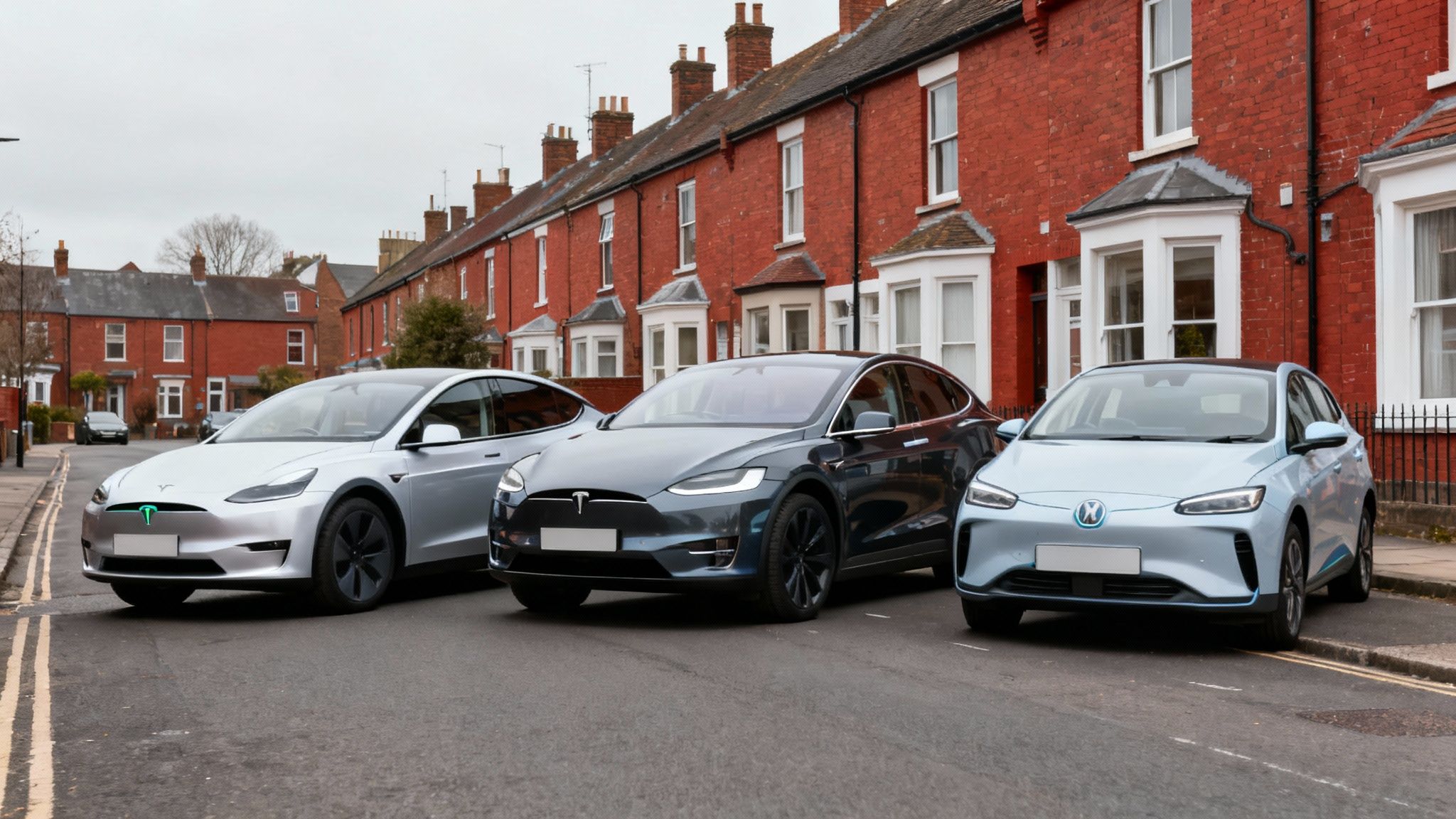
Here's a simple truth: not all one-pedal driving systems are created equal. Some carmakers have absolutely nailed it, delivering a system that feels so intuitive and smooth it's like the car is reading your mind. Others, well, their attempts can feel like you’ve handed the braking over to a learner driver, resulting in a jerky, unpredictable mess.
Getting this right is a massive deal, because a poorly tuned system can quickly turn a relaxing commute into a nauseating ordeal. If you’re shortlisting a few EVs, taking the time to understand how each brand approaches this feature is essential. Let’s dive into our breakdown of the best (and the rest) on UK roads.
The Good, The Bad, and The Baffling
The way an electric car slows down when you lift off the accelerator is a huge part of its personality. It’s not just a setting; it fundamentally defines the driving experience. Some manufacturers give you all the control you could want, while others adopt a "we know best" attitude that can be maddening.
Here’s how a few of the big names compare:
- Tesla (Model 3 & Y): Tesla's approach is famously opinionated. You get one mode: strong. It’s incredibly effective, bringing you to a firm, decisive stop every time. The catch? You can’t adjust it. If you don’t like it, tough luck.
- Hyundai & Kia (Ioniq 5 & EV6): These Korean siblings offer a masterclass in customisation. Their 'i-Pedal' system gives you multiple levels of regeneration, all adjustable via paddles on the steering wheel. You can go from gentle coasting to full one-pedal stopping on the fly, putting you in complete control.
- Polestar 2: Polestar serves up a beautifully calibrated system. It's strong and buttery-smooth, but like Tesla, it leans towards a 'one-size-fits-all' setup, though it does offer a couple of settings to tweak the feel.
- Nissan (Leaf): The original gangster of one-pedal driving with its 'e-Pedal'. It's a solid, dependable system that brings the car to a complete halt, though perhaps not as smoothly as its more modern rivals.
The real battleground for one-pedal driving isn't just about stopping power; it's about choice. The best systems are the ones that let the driver decide how the car should behave, not the other way around.
UK EV One-Pedal Driving Comparison
To make sense of it all, here's a quick head-to-head look at how different brands have tackled one-pedal driving. It’s amazing how varied the approaches can be.
| EV Model | System Name | Regen Strength | VoltsMonster Verdict |
|---|---|---|---|
| Tesla Model 3/Y | N/A (Standard) | Strong, Non-Adjustable | Incredibly effective and simple, but the lack of choice can be frustrating. |
| Hyundai Ioniq 5 | i-Pedal | Fully Adjustable (Paddles) | The gold standard. Offers complete control for all driving conditions. |
| Kia EV6 / Soul EV | i-Pedal | Fully Adjustable (Paddles) | Just like its sibling, it's a superb, intuitive system that puts the driver first. |
| Polestar 2 | One Pedal Drive | Adjustable (2 levels + Off) | Smooth and well-judged, but lacks the granular control of the Korean models. |
| Nissan Leaf | e-Pedal | On/Off | The trailblazer. Still very effective but feels a little less refined today. |
As you can see, the philosophy behind each system varies wildly, from Tesla’s set-and-forget approach to the total flexibility offered by Hyundai and Kia.
The VoltsMonster Verdict
So, who takes the crown? For pure, unadulterated customisation that perfectly suits the chaotic nature of British roads, it has to be the Hyundai and Kia models. The ability to flick through regen levels with a paddle is a genuine game-changer, letting you adapt instantly from a clear A-road to crawling city traffic.
While Tesla’s system is brutally effective, its lack of choice feels like a misstep in a market that increasingly values personalisation. The Kia implementation is particularly well-judged, a fact we noted in our brutally honest Kia Soul EV review where the intuitive controls really stood out.
Ultimately, the "best" system depends entirely on your driving style. If you want a simple, no-fuss experience, a Tesla will do the job perfectly. But for drivers who crave control and flexibility, the Korean contenders are currently leading the pack.
Our Top Pick For a One-Pedal Driving Bargain
Right then, let's talk brass tacks. We’ve been banging on about how great one-pedal driving is, but can you actually get a car with a decent system without taking out a second mortgage? The answer is a resounding yes. Our bargain hero of the week is the MG4 EV .
Forget any old-fashioned ideas you might have about the MG badge. The MG4 is a thoroughly modern EV, packing features that genuinely put some of its more expensive rivals to shame. Its real party piece is the highly adjustable one-pedal system. You can dial the regenerative braking up or down to suit your mood, from a light lift-off coast all the way to a full-on mode that brings you to a stop. It's an absolute game-changer in city traffic.
Why The MG4 Punches Well Above Its Weight
At its most assertive setting, the MG4’s one-pedal driving is impressively refined for a car at this price point. It smoothly brings you to a complete and gentle halt, turning the stop-start drudgery of the daily commute into something far less taxing. It might not have the premium badge appeal of a German saloon, but with brand-new prices often starting under £30k , its value proposition is impossible to ignore.
The MG4 proves that clever, efficient tech like one-pedal driving isn't just a luxury for the wealthy. It's a genuinely brilliant, budget-friendly gateway into smarter EV driving.
Keep an eye out for finance deals, which often make the monthly payments surprisingly palatable. And if you're looking to save even more, have a look at our guide on the best places to find second-hand electric cars in the UK. For the money, you simply won't find a better one-pedal driving experience.
A Few Lingering Questions About One-Pedal Driving
Right, you’ve made it this far, but I bet a few questions are still rattling around in your head. Let's tackle them head-on and clear up any lingering confusion. No waffle, just straight answers.
Does One-Pedal Driving Replace the Brake Pedal?
Absolutely not, and don’t let anyone tell you otherwise. The brake pedal is still your essential backup for emergencies, sudden stops, or when a pheasant decides to play chicken with your front bumper.
Think of one-pedal driving as handling about 90% of your routine slowing down. The brake pedal, however, remains your non-negotiable safety net for those moments when you need to stop right now.
Is It Difficult to Get Used To?
Honestly? There’s a bit of a learning curve. Your first few attempts might feel as smooth as a bag of spanners, with more lurching than a learner driver on a hill start.
But give it a day or two of gentle practice in a quiet car park or on familiar roads, and it quickly becomes second nature. Most drivers find that once they’ve cracked it, the experience is far more relaxing, especially in the stop-start misery of city traffic.
Do My Brake Lights Still Work?
Yes, they absolutely do. This is a critical safety feature mandated by UK and EU law, and car manufacturers take it very seriously.
Your brake lights will illuminate automatically when the car decelerates above a certain threshold. It doesn't matter if you’ve slammed on the brake pedal or simply lifted your foot off the accelerator in a strong one-pedal mode.
The car is smart enough to know when it’s slowing down sharply enough to warrant a warning. It will let the driver behind you know what's happening, so you won’t be the cause of a rear-end shunt because your lights weren’t on.
Can I Turn One-Pedal Driving Off?
In almost every EV on the market, yes. Manufacturers aren’t daft; they know this style of driving isn't for everyone or for every situation. You can typically adjust the level of regenerative braking right from the car’s infotainment screen or sometimes with paddles behind the steering wheel.
This means you can dial it right down to a gentle coasting mode for long motorway cruises or switch it off completely if you just prefer a more traditional driving feel. The choice is always yours.
At VoltsMonster , we cut through the jargon to give you honest, no-nonsense advice on the world of EVs. For more brutally honest reviews and guides, check out our other articles at https://www.voltsmonster.com.
VoltsMonster Electric Vehicle Blog