A Brit's Guide to the Zaptec EV Charger in 2026
Right, let's cut to the chase. You’ve probably seen the name Zaptec cropping up and are wondering if their EV chargers are worth the frankly eye-watering premium. This sleek bit of Norwegian hardware is certainly turning heads in the UK, partly for its minimalist look but mostly for the clever box of tricks packed inside.
Think of it like this: you can buy a mass-market cooking lager, or you can opt for a proper craft beer. Both get you tipsy, but one offers a whole lot more in terms of substance, quality, and style. That's the Zaptec in a nutshell.
Is a Zaptec EV Charger More Than Just a Pretty Box?
Fair question. With so many chargers on the market, it’s right to be sceptical. Is this Scandinavian import just a fancy shell with a price tag that’ll make your wallet weep, or is there something genuinely special going on under the bonnet?
Let’s be honest, in a sea of functional but deeply uninspiring white plastic boxes, a bit of design flair is a welcome change. But a Zaptec EV charger is designed to be more than just a good-looking accessory for your driveway. Its reputation is built on being properly smart. This isn't just about funnelling electricity into your car; it’s about managing that process with the cunning of a seasoned tax dodger. We're talking about a unit that thinks for itself, helping you swerve peak electricity tariffs and preparing you for future tech like selling power back to the grid.
Choosing a Zaptec isn't really like buying a simple appliance. It’s more like investing in your home's entire energy system. It’s built for those who realise the future of driving isn't just about being electric, it's about being smart.
And this isn't some flash-in-the-pan tech gadget from a Kickstarter campaign. The company's background is in developing heavy-duty, industrial charging systems, and that robust engineering and focus on safety is baked right into their home chargers. That’s a big part of why it's causing such a stir.
So, Who Is This For, Exactly?
If your only goal is to find the absolute cheapest way to get power into your EV, then a Zaptec probably isn't for you. There are plenty of budget-friendly chargers that will do the basic job perfectly well. For a rundown of all your options, our sceptic's guide to the best EV home chargers in the UK is the perfect place to start.
However, if you view your EV as part of a bigger, smarter picture, then you're in the right place. A Zaptec is for the homeowner who:
- Values good design: You've spent a fortune on your home and your car, so you don't want an unsightly plastic carbuncle bolted to the wall.
- Enjoys smart technology: You want a great app, clever features, and the ability to integrate your charger with things like a solar panel setup.
- Thinks about the long-term: You understand that crucial features like dynamic load balancing (which intelligently stops you from tripping your home's main fuse) and future-proof V2G (Vehicle-to-Grid) capabilities are major advantages, not just marketing guff.
Consider this your no-nonsense introduction. We’re about to dive deep into the specific models, the real-world costs, and all the clever gubbins that makes a Zaptec tick, giving you the full, unvarnished picture from a UK perspective.
Choosing Your Charger: Zaptec Go vs Zaptec Pro
Alright, let's get down to brass tacks: choosing the right Zaptec for your needs. It's easy to look at the Zaptec Go and the Zaptec Pro and think they're just two sides of the same coin. That’s a common mistake, a bit like thinking a family hatchback and a delivery van are interchangeable just because they both have four wheels. They’re built for entirely different jobs.
The real difference lies in who they’re designed for. The Zaptec Go is the perfect partner for the modern homeowner; it’s the sleek, discreet unit you’d install on the side of your house to keep your EV topped up. The Pro, on the other hand, is the heavy-duty workhorse built for much bigger tasks—think entire office car parks, new-build blocks of flats, or for the serious tech enthusiast wanting commercial-grade power at home.
The Everyday Hero: The Zaptec Go
Think of the Zaptec Go as the smart home gadget you’ll actually love using. It’s compact, beautifully designed, and has just the right amount of grunt for daily life in the UK. It’s a 7kW charger, which has become the gold standard for home installations. In practical terms, that means it adds about 25-30 miles of range for every hour it’s plugged in—more than enough to give you a full battery every morning.
It connects to your home Wi-Fi, which is how it communicates with the Zaptec app on your phone. This is where the magic happens, letting you schedule charges to take advantage of cheaper overnight electricity rates. For the vast majority of UK EV drivers, the Zaptec Go is, quite simply, all the charger you’ll ever need. It’s stylish, smart, and does its job without any fuss.
Its arrival was a big deal for Zaptec in the UK. The brand’s major push into our market kicked off in January 2023 with the launch of the 7kW Zaptec Go, a model specifically tailored to meet British electrical regulations. It paid off. By the first quarter of 2025, their UK revenue had soared by an incredible 54% to 14 million NOK . This growth helped them capture an 11% share of the home charger market across nine European countries. It also mirrored the UK’s wider EV boom, which saw public charge points jump 13% from 102,771 to 116,052 in 2025, a trend you can track in Zaptec's financial reports.
The Industrial Powerhouse: The Zaptec Pro
If the Go is the slick smartphone in your pocket, the Zaptec Pro is the rugged, industrial tool built for the most demanding environments. It’s primarily designed for situations where rock-solid reliability and shared power are critical.
The headline feature is its ability to deliver up to 22kW of power. But before you get too excited, there’s a catch. Most UK homes use a single-phase electricity supply, which caps out around 7.4kW. To unlock the full potential of a 22kW charger, you need a three-phase supply—something you’ll typically only find in commercial buildings or very large, modern properties.
So who is the Pro actually for?
- Large-Scale Deployments: It’s engineered for places like blocks of flats or offices where you need to run dozens of chargers from one central system.
- Uninterrupted Connectivity: Unlike the Go, the Pro has built-in 4G as a backup. If the Wi-Fi drops out, the charger stays online—essential for managing commercial payments and user access.
- Advanced Load Balancing: The Pro’s real genius is its ability to intelligently distribute power across a whole bank of chargers, preventing the building's main fuse from tripping when everyone plugs in at 9 a.m.
To help you visualise where you fit, this simple flowchart guides you through the decision. If aesthetics and smart technology are high on your list, you're on the right track.

The key takeaway is clear: if you value both aesthetic appeal and intelligent technology in your gadgets, a Zaptec EV charger is likely on your wavelength.
To make the comparison even clearer, here’s a quick look at how the two models stack up against each other.
Zaptec Go vs Zaptec Pro At a Glance
| Feature | Zaptec Go | Zaptec Pro |
|---|---|---|
| Max Power Output | 7.4kW (perfect for UK single-phase homes) | 22kW (requires a three-phase supply) |
| Ideal Use Case | Private homes, driveways, small residential settings | Blocks of flats, office car parks, commercial sites, multi-charger setups |
| Connectivity | Wi-Fi & Bluetooth | Wi-Fi, PLC (Powerline), and 4G LTE-M backup |
| Load Balancing | Can balance with up to 3 other Go chargers | Can balance with hundreds of chargers on the same circuit |
| Authentication | Zaptec App, RFID card/keyfob | Zaptec App, RFID card/keyfob, and OCPP payment systems |
| Key Advantage | Compact, stylish, and cost-effective for home use | Unbeatable scalability and mission-critical reliability |
Ultimately, the choice comes down to your specific needs. The Zaptec Pro is a phenomenal piece of commercial-grade engineering, but for a typical UK home, it's like using a sledgehammer to crack a nut. The Go offers all the essential smarts and style in a package that's perfectly suited for everyday domestic charging.
Understanding V2G and How Zaptec Makes You Money

Right, let’s get into the really clever stuff. Forget simply filling your car with electricity; what if your car could actually earn you a few quid? This isn’t some pie-in-the-sky fantasy. It’s called Vehicle-to-Grid, or V2G , and it’s the next big thing in home energy.
Think of your EV as a giant battery on wheels. With V2G, your charger becomes a two-way street. Not only can you pull power from the grid to charge your car, but you can also push power back from your car’s battery into the grid.
Suddenly, your car isn't just a money pit; it’s a potential side hustle. You can sell your stored electricity back to the grid during peak times—like the early evening when everyone’s putting the kettle on—when prices are eye-wateringly high. It's like having your own miniature power station parked on the drive.
The Dawn of Domestic Power Dealing
For years, V2G was a technology reserved for big commercial trials and fleets. Bringing it to the average UK home felt a long way off. That all changed when Zaptec decided to muscle its way into the market, transforming the Zaptec EV charger from a simple charging device into a smart energy hub.
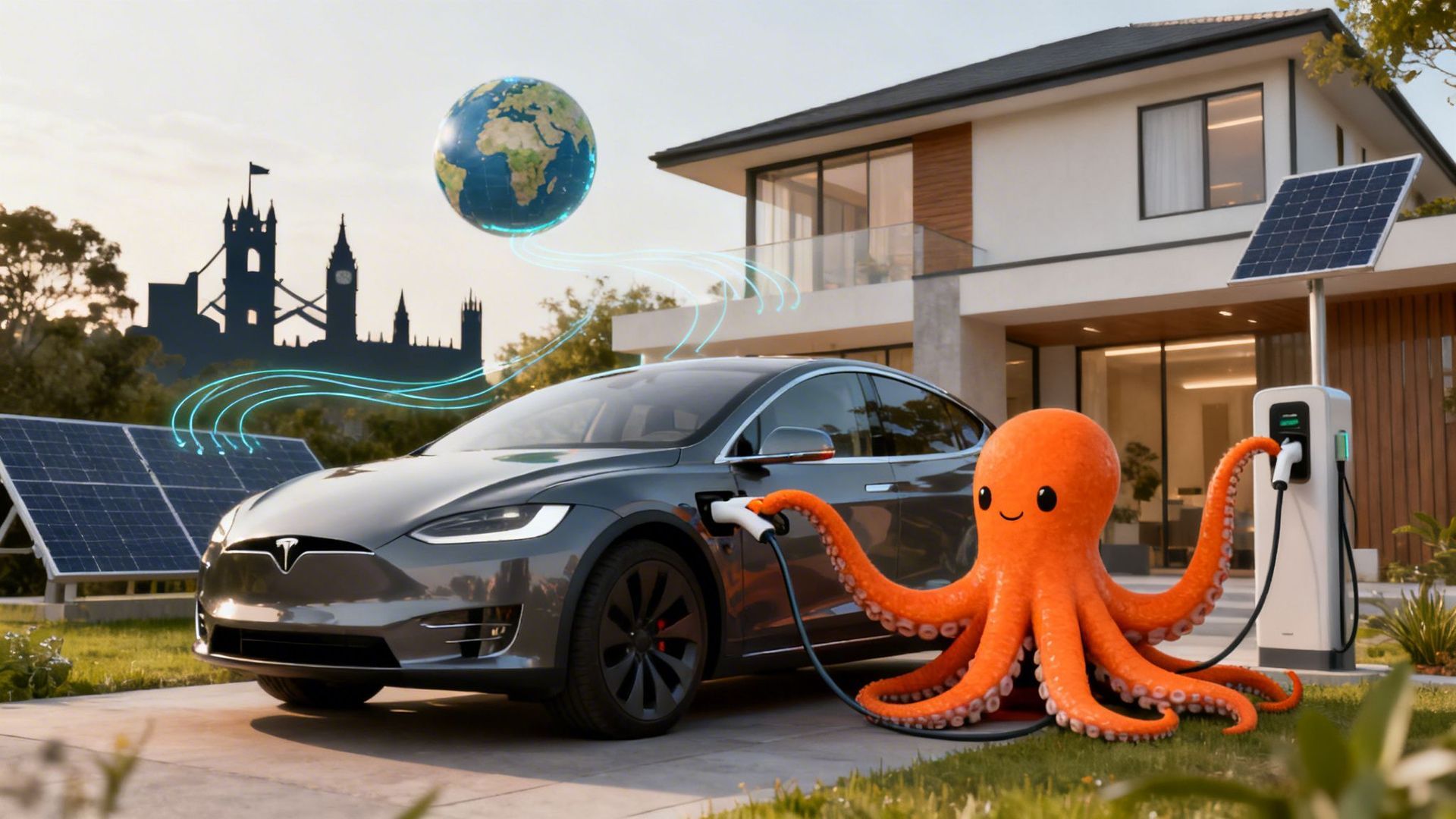
They made history in 2025 with the launch of the Zaptec Go 2 , the first V2G-ready charger available for both homes and businesses in the UK. Crucially, it came with MID certification, which is a fancy way of saying it can accurately bill for the energy it exports. Teaming up with Octopus Energy and EV manufacturer BYD, they launched the UK's first V2G bundle, a deal where drivers could essentially get paid to charge by selling power back during peak demand. You can delve into the details of this groundbreaking launch and discover more insights about Zaptec's V2G charger on evinfrastructurenews.com.
Vehicle-to-Grid turns your car into an energy asset. By charging when electricity is cheap and plentiful (like overnight or on a windy day) and selling back when it’s expensive and scarce, you play the energy market from your driveway.
This approach isn't just about lining your pockets. It also plays a massive role in stabilising the National Grid. With more renewable energy sources like wind and solar, the grid can become volatile. A network of home-based batteries (i.e., your cars) provides a buffer, smoothing out the peaks and troughs of supply and demand.
How Does This Actually Work in Practice?
Let’s be clear: you don’t have to sit there with a trader’s headset on, watching the energy market like a hawk. The whole process is automated through smart charging platforms.
A typical V2G setup with a Zaptec EV charger works a bit like this:
- You Set Your Needs: You tell the app what time you need your car and how much charge you'll need for your morning commute (e.g., "I need an 80% charge by 7 a.m.").
- The System Takes Over: The smart charging software then gets to work. It monitors wholesale energy prices and grid demand in real-time.
- Smart Charging & Discharging: It will automatically charge your car when prices are at their lowest, usually in the dead of night. Then, during the evening peak (typically 4 p.m. to 7 p.m. ), it will sell a small, pre-agreed amount of energy back to the grid for a profit.
- You Wake Up Richer: You wake up with the right amount of charge in your car and a slightly healthier bank balance. The system never lets your battery drop below your pre-set minimum, so you'll never be caught short.
This intelligent energy management is precisely what makes V2G a game-changer for homeowners. The financial benefits can be significant, and our complete guide explores many of the financial incentives for using home charging in more detail. Choosing a V2G-capable charger like the Zaptec Go 2 is the ultimate future-proofing move. It ensures that as these smart energy tariffs become more widespread, you’re already equipped to take full advantage.
Zaptec Installation Costs and Finding an Installer
Right, you’ve picked your weapon of choice from the Zaptec armoury. Now for the bit that makes your wallet twitch: getting the thing bolted to your wall and wired up. Let’s not beat around the bush; the cost of a Zaptec EV charger isn’t just the price on the box. The installation is where the numbers can get a bit... creative.
Think of it like buying a fancy new television. The price in the shop is one thing, but getting it mounted, hiding the cables, and hooking it up to your surround sound system is a different beast entirely. It’s the same with EV chargers. The total cost is a tale of two parts: the unit itself and the labour to fit it.
What’s the Damage for a Standard Installation?
Let’s talk figures. For a Zaptec Go, you can generally expect the unit and a ‘standard installation’ to set you back somewhere between £950 and £1,200 . This puts it squarely in the premium bracket, rubbing shoulders with rivals like the design-led Andersen A2 but a couple of hundred quid more than a functional workhorse like an Ohme ePod.
So, what does a "standard installation" actually get you? It's a term installers love, but it has more caveats than a budget airline ticket. Generally, it assumes:
- Your fuse box (consumer unit) is relatively modern, has spare capacity, and is happy to play nicely with a new high-power circuit.
- The charger is being fitted to your house wall, not a detached garage halfway down the garden.
- The cable run from your fuse box to the charger location is less than 10-15 metres .
- There's no need to start drilling through 2-foot-thick granite walls or digging up your prized rose bushes to lay armoured cable.
Anything outside this cosy little box is classed as a 'non-standard' job, and this is where costs can escalate faster than a politician’s expenses claim. You can get a head start by reading our full guide on what to expect during your home EV charger installation to avoid any nasty surprises.
Finding an Installer Who Isn’t a Cowboy
Finding a good installer is more important than finding a good pub. Get it wrong, and you’re in for a world of pain. A botched job won’t just give you a wonky-looking charger; it could invalidate your home insurance or, in a worst-case scenario, turn your expensive EV into a very large brick.
Your installer MUST be qualified and registered with a competent person scheme like NICEIC or NAPIT, with specific experience in EV charge point installation. When you're getting quotes, ask them these questions directly:
- Are you OZEV approved? This shows they meet government standards, even if you can't get the grant.
- Can you show me examples of previous Zaptec installations? A picture is worth a thousand words, especially if it shows neat cabling.
- Will you conduct a proper survey (either virtual or in-person)? Anyone offering a fixed price without seeing your setup is a massive red flag.
- What’s your process for load balancing and DNO notification? If they look at you blankly, run. This is a critical safety step to ensure you don't plunge your street into darkness every time you plug in.
Getting at least three detailed, itemised quotes is non-negotiable. It’s the only way to spot an outlier trying to pull a fast one. Don't just look at the final price; compare the breakdown of parts, labour, and any potential 'extras'.
Can You Still Get a Grant to Ease the Pain?
For homeowners with their own driveways, the glory days of the OZEV grant are long gone. However, there is still some help available. The EV Chargepoint Grant provides funding for renters and people living in flats. This grant can give you £350 off the cost of buying and installing a home charger.
This government incentive, along with others like the Workplace Charging Scheme, is helping drive the adoption that Zaptec is capitalising on. In Q1 2025, the company reported a remarkable 54% revenue growth in the UK, a success story that aligns with the rapid expansion of the UK's charging infrastructure, which is projected to hit 116,052 devices by the end of 2025. This highlights how home solutions like the Zaptec EV charger are crucial for managing grid demand. You can explore the full story behind Zaptec's impressive growth on investing.com.
So, while the initial outlay for a Zaptec installation is hefty, it’s an investment in top-tier technology. Just be sure to do your homework, vet your installer thoroughly, and get everything in writing.
Living With a Zaptec Day to Day

So, the installer has packed up their tools, you've handed them a well-earned cuppa for the road, and they’ve vanished into the sunset. Now you're left with a sleek, minimalist box on your wall. What’s it actually like to live with a Zaptec EV charger ? Beyond the shiny brochures, the reality of daily life is often a bit more… British.
First things first, the design is a massive win. Compared to some of the bulbous, plasticky rivals that look like they fell off the back of a toy lorry, the Zaptec Go is genuinely stylish. It’s small enough not to dominate your exterior wall and looks more like a piece of modern architecture than a glorified plug socket. It’s one of the few chargers you won't feel the need to hide.
The App Experience Good, Bad, or Just… an App?
In 2026 , any smart charger is only as good as its app, and this is where opinions can get a bit divided. The Zaptec app itself is clean, functional, and nails the basics. You can easily start and stop charges, schedule sessions to grab that cheap overnight electricity tariff, and see how much power you've used.
However, calling it a masterpiece would be a stretch. Think of it as a dependable workhorse – it does exactly what it promises, but it lacks the deep, granular data and whiz-bang features you might find with some competitors. It's solid and reliable, but it won't set your world on fire.
This is where third-party integrations become its secret weapon. In May 2025 , Zaptec announced a partnership with the smart charging platform ev.energy , and this collaboration unlocks a whole new level of cleverness. This integration is the key to getting the most out of your charger, especially if you have solar panels.
Real-World Performance The Coronation Street Test
Right, here’s a classic UK household scenario: it’s 8:15 p.m. You’ve just plugged the car in, the oven is blasting away at 200°C for a frozen pizza, someone’s boiled the kettle during the Coronation Street ad break, and the telly is on. This is where dynamic load balancing proves it’s not just marketing fluff.
The Zaptec’s ability to monitor your home’s total power consumption and automatically throttle the car’s charging speed is genuinely impressive. It works away quietly in the background, preventing a catastrophic trip to the fuse box that would plunge your house into darkness and ruin your evening.
Think of it as a polite butler for your electricity. It sees the oven and kettle are having a party and quietly tells the car, "Alright, settle down for a minute, you can have your turn shortly." It’s a feature you never think about until you need it, and it saves you from countless fuse-related meltdowns.
This intelligence also extends to anyone with solar panels. The link-up with ev.energy allows the Zaptec EV charger to specifically use your free, self-generated solar power. When the sun is shining, the system automatically diverts any excess solar energy straight into your car battery instead of exporting it to the grid for a pittance. It’s a beautifully simple and effective way to run your car on pure sunshine.
For the tech-heads out there, the Zaptec API also allows for integration with broader smart home systems like KODE OS, which can monitor usage and flag faults automatically. It shows that beneath that minimalist exterior, this is a seriously connected and capable device. So, is it a frustrating faff? Not at all. It's a rock-solid, reliable charger that just gets the job done, especially when you unleash its full potential with a bit of third-party smarts.
Our Verdict: Is The Zaptec EV Charger Any Good?
So, after digging into the technology, the costs, and the future-facing features, what’s the final takeaway? Is a Zaptec EV charger a brilliant investment, or is it just a very expensive, very pretty box?
Honestly, it’s a firm ‘yes’ from us, but with a major caveat: it’s not for everyone. If you just want a simple plug-and-play device to get your car charged overnight, there are plenty of cheaper chargers that will do the job perfectly well. But if you view your charger as a key part of your home's long-term energy strategy, then the Zaptec suddenly looks less like an expense and more like a very shrewd investment.
What You're Really Paying For
Let's be upfront about the price – the Zaptec is a premium piece of kit, and it costs a premium. A good chunk of that cost is for its award-winning Scandinavian design and the sheer quality of its construction. It’s a genuinely good-looking charger, and for some people, that aesthetic appeal is a huge part of the decision.
But the real value is what’s going on under the bonnet. The hardware and software offer some seriously clever benefits that justify the price tag for the right owner:
- Ready for the Future with V2G: The integration of Vehicle-to-Grid is the standout feature. This isn't just a gimmick; it transforms the charger from a one-way power tap into a two-way energy hub. Down the line, this could genuinely help you save money on your bills or even earn a small income by selling power back to the grid.
- Effortless Load Balancing: We found the dynamic load balancing to be exceptional. It's a completely seamless, fit-and-forget feature that just works, protecting your home’s main fuse from tripping when you've got the oven on and the kettle boiling. It’s a small detail that removes a major potential headache.
- Commercial-Grade Reliability: This charger’s DNA comes from the demanding commercial sector, and it shows. It’s built like a tank to withstand the elements and heavy use. The five-year warranty isn’t just marketing; it’s a clear statement of Zaptec's confidence in its product.
Think of the Zaptec less as a car accessory and more as a piece of smart home infrastructure. It’s for people who realise that in the next decade, how you manage your energy will be as important as the car you drive.
The Final Word
So, who is the Zaptec EV charger really for? It’s the perfect match for a tech-aware homeowner who appreciates great design and has one eye on the future. If you already have solar panels, are looking to use smart energy tariffs, or you're excited by the potential of V2G, then the Zaptec is one of the smartest choices you can make today.
It earns its place at the top table because it’s much more than just a charger. However, if your budget is tight and your only goal is to get electricity into your car as simply as possible, you’ll find better value in a more straightforward, function-first unit. The Zaptec is a fantastic bit of technology, but it’s an indulgence. A very, very clever one.
Frequently Asked Questions About Zaptec Chargers
Still have a few questions? We get asked a lot about Zaptec chargers, so we've put together some straight-talking answers to the most common queries. Let's cut through the noise so you know exactly what you're getting.
Can I Install a Zaptec Charger Myself to Save a Few Quid?
In a word: no. Honestly, even thinking about it is a terrible idea. Here in the UK, installing an EV charger is classed as notifiable electrical work, and it's definitely not a DIY job. It must be carried out by a qualified electrician who is certified for EV charger installations to meet strict safety regulations like BS 7671.
Trying to do it yourself is a one-way ticket to a serious headache. You could fry your car's very expensive battery, void your home insurance policy, and, in a worst-case scenario, create a major fire risk. Don't be a hero—hire a professional.
A professional installation isn't just about ticking boxes on a form; it's fundamental to the safety of your property, your vehicle, and your family. A shoddy wiring job can have catastrophic consequences that will cost far more than the couple of hundred quid you thought you were saving.
This is one area where cutting corners is the most expensive mistake you can possibly make. It's a specialist task that requires deep knowledge of the latest wiring regulations, earth-fault protection, and the process of notifying your local Distribution Network Operator (DNO).
Do I Need a Three-Phase Supply for a 22kW Charger?
For almost everyone, the answer is yes, you would need a three-phase supply, which most homes simply don't have. The vast majority of UK houses—we’re talking well over 95% —run on a standard single-phase electricity supply. This connection has a maximum output of around 7.4kW , which is precisely why the 7kW Zaptec Go is the ideal choice for most residential properties.
A beefy 22kW charger like the Zaptec Pro demands a three-phase supply, something you typically only find in commercial buildings, industrial units, or a handful of very large, modern homes. While upgrading your home is technically possible, it’s an incredibly expensive and disruptive process that can involve digging up your street. For 99% of homeowners, the 7kW Zaptec Go is the only realistic and sensible option.
Is the Zaptec Go Compatible With All Electric Cars?
Yes, completely. The Zaptec Go is equipped with a standard Type 2 connector, which is the universal socket for AC charging throughout the UK and all of Europe. It became the industry standard for a good reason.
So, whether you're driving a shiny new Tesla, a dependable Kia Niro EV, a stylish VW ID.3, or the latest imported model you can't quite pronounce yet, it will work perfectly. The charger is 'untethered', which just means it has a socket instead of a built-in cable. You simply use the Type 2 cable that came with your vehicle, giving your wall a much tidier look when not in use.
Ready to join the smart charging revolution? VoltsMonster is your go-to source for honest reviews and guides on the latest EV tech. Dive deeper and explore all your options at https://www.voltsmonster.com.
VoltsMonster Electric Vehicle Blog