Model 3 vs Model Y: The Ultimate UK Grudge Match
Deciding between a Tesla Model 3 and a Model Y often feels like a classic head-versus-heart dilemma for UK buyers. The simple truth? The Model 3 is a sharper, more efficient saloon , while the Model Y is the more practical, spacious family hauler . It all boils down to whether you crave a spirited drive or need the space to swallow a family's worth of kit without breaking a sweat.
Dissecting The Sibling Rivalry
The Model 3 vs Model Y debate is a proper family squabble played out on British motorways and in suburban cul-de-sacs. These two share so much DNA they're practically twins, yet they have wildly different ideas about a fun weekend. One is desperate to carve up a B-road in the Peak District; the other wants to pack the kids, the dog, and a roof box for a soggy week in Cornwall.
At its core, the difference is straightforward. The Model 3 is a sleek, low-slung saloon, engineered for aerodynamic efficiency and a more engaging, connected driving experience. The Model Y, on the other hand, is its taller, chunkier sibling—a crossover SUV built on the same foundations but stretched upwards and outwards for sheer practicality.
This single design choice informs almost every other difference between them, from the cavernous boot to how they handle our famously knackered British road surfaces. Let's break down the key distinctions right away.
| Feature | Tesla Model 3 (Highland RWD) | Tesla Model Y (RWD) |
|---|---|---|
| Body Style | Four-door Saloon | Five-door Crossover SUV |
| Boot Access | Traditional Boot Lid | Large Hatchback |
| Driving Position | Lower, Sportier | Higher, Commanding View |
| Rear Headroom | Adequate | Generous |
| Total Storage | 682 Litres | 971 Litres |
The sales figures tell their own story. In the UK, both have been titans of the EV charts, but lately, the Model Y has surged ahead. In a recent year, the Model Y clocked up around 32,700 registrations compared to the Model 3's 17,300 . That means the crossover outsold its saloon counterpart by a staggering 90% .
This trend strongly suggests that for the majority of British buyers, the sheer utility of extra space is winning out over the promise of a sportier feel. You can read more about Tesla's UK market dominance to see the numbers for yourself. This isn't just a choice between two cars; it's a reflection of what UK drivers truly value right now.
Price, Pounds, and Pence: A Real-World Cost Breakdown
Right, let's get down to brass tacks. Choosing between a Model 3 and a Model Y isn't just about boot space or 0-60 times; it's a cold, hard financial decision. The showroom sticker price is just the opening act. The real story of what you'll spend unfolds over years of ownership, with depreciation, insurance, and tax playing the starring roles.
The initial outlay sets the stage. A new Model 3 'Highland' in Rear-Wheel Drive trim starts from £39,990 , while its bigger sibling, the Model Y RWD, commands a starting price of £44,990 . That £5,000 gap is not insignificant—it's enough to buy a questionable second-hand runaround or a truly epic family holiday.
But the plot thickens when you look at long-term value. The Model Y, thanks to its runaway success as a family-friendly crossover, has consistently held its value better than the Model 3. It's the sensible, practical choice that the used market absolutely adores, meaning you'll likely get more of your cash back when it’s time to sell.
The Company Car Tax Question
For company car drivers, this is where things get really good—and thankfully, very simple. Both the Model 3 and Model Y sit in the lowest Benefit-in-Kind (BIK) tax bracket , which is currently a fantastically low 2% . This makes either car an incredibly tax-efficient choice, saving you a small fortune compared to a traditional petrol or diesel equivalent.
The only real difference in your tax bill comes from that initial list price. Because the Model Y costs more, your 2% contribution will be slightly higher, but honestly, we're talking about a difference that barely covers the cost of a few fancy coffees each month. For both private and business users, Vehicle Excise Duty (VED) is currently a delightful £0 , though be warned, the government plans to spoil that party from 2025.
Insurance: The Unseen Iceberg
Here's where the financial waters can get a bit choppy. Insuring a Tesla in the UK can be a surprisingly painful experience, with quotes that seem to vary more than the British weather. Their blistering performance and specialist repair network mean premiums are often higher than for other, similarly priced EVs.
In the Model 3 vs Model Y insurance battle, there's rarely a clear winner. While the Model 3 has a lower list price, the Model Y is often favoured by families, which can sometimes lead to more competitive quotes. Ultimately, your postcode, driving history, and no-claims bonus will be the deciding factor. Get multiple quotes before you commit.
The sheer volume of these cars on UK roads is hard to overstate. In a single year, the Model Y accounted for 35,899 registrations while the Model 3 added another 12,793 , representing the vast majority of the brand's UK sales. British buyers are clearly voting with their wallets.
This chart drives home the Model Y's dominance over the Model 3 in the UK sales race.
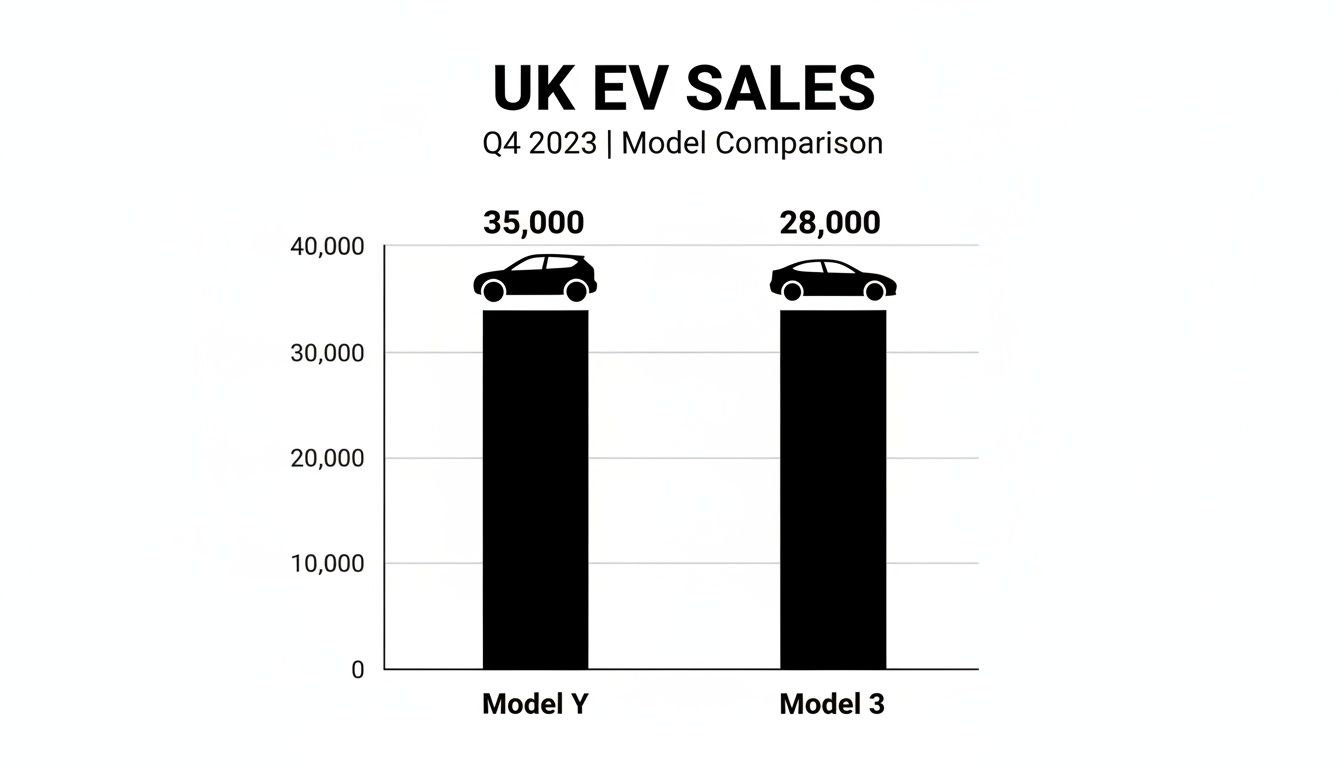
The data speaks for itself: Brits are overwhelmingly choosing the practicality and space of the Model Y.
Total Cost of Ownership: The Snapshot
To put it all into perspective, let's look at the key costs side-by-side for the standard RWD models. This should give you a clearer picture of the financial commitment beyond just the price tag. And to get a proper handle on what you'll be spending at the plug, check out our no-nonsense guide on electric car charging costs in the UK.
Model 3 vs Model Y UK Ownership Cost Snapshot
| Metric | Tesla Model 3 (Highland RWD) | Tesla Model Y (RWD) | The Verdict |
|---|---|---|---|
| New Price (OTR) | From £39,990 | From £44,990 | The Model 3 is the clear winner on upfront cost, leaving £5k in your pocket. |
| Depreciation | Moderate | Lower | The Model Y's massive popularity gives it stronger residual values, protecting your investment better over time. |
| BIK Tax (2024/25) | 2% | 2% | A dead heat. Both are exceptionally cheap company cars, with only a marginal difference in cash terms. |
| Insurance Group | 48-50 | 46-50 | Highly variable. The Y can sometimes be cheaper despite its higher price. Always get quotes. |
| Efficiency | Excellent (~4.4 mi/kWh) | Very Good (~3.9 mi/kWh) | The sleeker, more aerodynamic Model 3 will cost you slightly less per mile in electricity. |
While the Model 3 wins on purchase price and running efficiency, the Model Y strikes back with superior residual values, which could easily close that initial £5,000 gap over a few years of ownership.
Prams, Pups, and the Weekly Shop: The Practicality Test
Let's cut to the chase. Forget the spec sheets for a second. The real-world test for most buyers in the UK isn't a drag strip; it's a drizzly supermarket car park on a Saturday morning. It's about whether the pram fits, if the dog can jump in, and if you can get the weekly shop home without a fight. This is where the Model Y really starts to pull ahead.
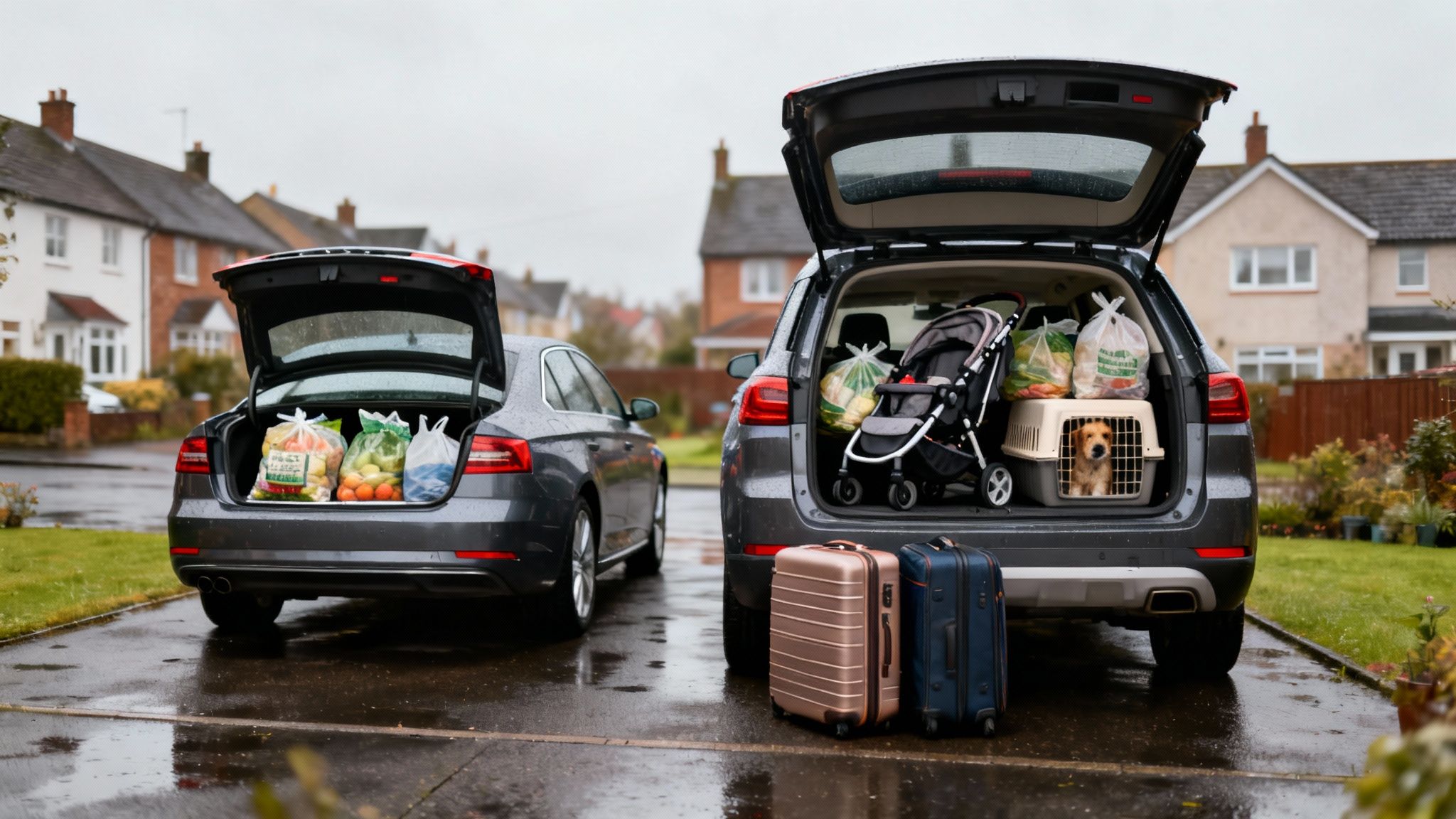
On paper, the Model 3 has a perfectly reasonable 682 litres of total storage, combining its boot and that handy front 'frunk'. But the Model Y boasts a massive 971 litres in the same configuration. That's a significant jump, but the raw numbers don't tell the full story. The real decider is the shape of the boot opening.
The Boot: Saloon Frustration vs. Hatchback Freedom
The Model 3, being a saloon, has a deep boot but a comparatively small opening. Think posting a suitcase through a letterbox. It's absolutely fine for soft bags and groceries, but the moment you try to load something bulky—a pushchair, a large dog crate, or the spoils of an IKEA trip—the frustration begins. You’ll find yourself twisting, angling, and probably swearing under your breath.
This is where the Model Y plays its trump card. Its hatchback boot lid lifts high to reveal a huge, wide-open space with a completely flat floor. Loading those awkward items is an absolute doddle. It’s this one feature that transforms the Y from a car into a proper utility vehicle, ready for family holidays, tip runs, and whatever else you can throw at it.
It's not just that the Model Y's boot is bigger; it's fundamentally more usable. For anyone regularly hauling more than just shopping bags, the hatchback design is a game-changer. It’s the undisputed champion for family life.
Honestly, if your daily routine involves children, dogs, or any hobby requiring gear, the conversation pretty much ends here. The Model 3 is for those whose luggage is a bit more... restrained. The Model Y is built for the organised chaos of modern family life in Britain.
Inside the Cabin: Space for People (and Paws)
Step inside, and the difference is just as stark. Both cars share the same minimalist dashboard dominated by that huge central screen, but the feeling of space is worlds apart. The Model Y’s higher roofline and larger glass area make the cabin feel light, airy, and significantly more spacious than the cosier, more driver-focused cockpit of the Model 3.
Rear passengers, in particular, get a much better deal in the Y. They're treated to plentiful headroom and legroom , making it a far more pleasant place to be on a long motorway slog. The Model 3 is fine for adults on shorter journeys, but taller passengers might find their hair brushing the headliner. If you regularly carry people in the back, the Y is simply the kinder choice.
Here’s how that extra space plays out in the real world:
- The Family Holiday: Packing for a week away in Cornwall? The Model Y will swallow suitcases, a cool box, and a couple of bodyboards without breaking a sweat. In the Model 3, you'll be playing a very stressful game of luggage Tetris.
- The Canine Companion: A well-behaved Labrador can sit comfortably in the boot of the Model Y with the parcel shelf removed. In the Model 3, they’d be squeezed onto the back seats, leaving a trail of muddy paw prints.
- The Weekend Tip Run: That old shelving unit or collection of garden waste has no chance of fitting through the Model 3’s boot opening. With its seats folded down, the Model Y essentially becomes a small van.
In fact, the Model Y's seats fold almost completely flat, opening up an enormous 2,158-litre load bay. This has even spawned a "car camping" subculture, where owners can comfortably sleep two adults on a mattress in the back. You can lie there and stare at the stars through the panoramic glass roof—something you simply can’t do in its saloon sibling. The practicality debate, frankly, is a knockout victory for the Model Y.
The Driving Experience: Saloon Agility vs Crossover Comfort
On paper, the Model 3 and Model Y share the same skateboard of batteries and motors, so you’d be forgiven for thinking they drive identically. You would also be spectacularly wrong. The real difference between these two isn’t just about boot space; it’s about how they feel from the driver’s seat on a damp, unpredictable British road. This is where the choice becomes less about practicality and more about personality.
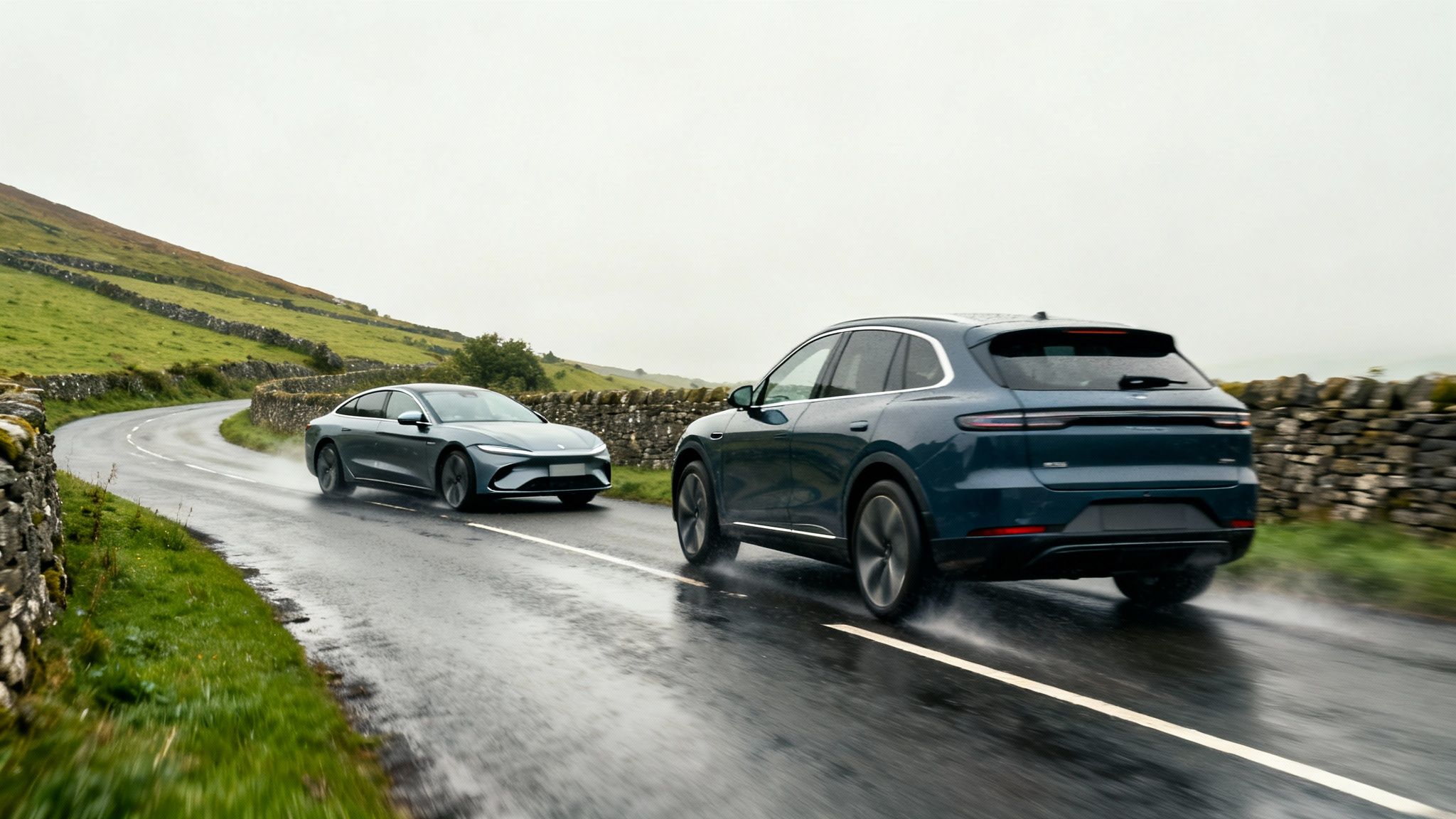
The Model 3, especially in its latest ‘Highland’ guise, is undeniably the driver’s car of the two. It sits 1.3 inches lower to the ground , and that lower centre of gravity makes it feel more planted, agile, and eager to change direction. It’s the one you’d choose for a spirited blast down a twisty B-road, where its sharper steering and reduced body roll inspire a level of confidence the taller Y just can't match.
In contrast, the Model Y offers a more commanding and relaxed driving position. You sit higher, with a much better view over traffic and hedgerows, which is a genuine advantage during the daily grind or on a congested motorway. It feels less like a sports saloon and more like a proper, grown-up family chariot.
The Great British Pothole Test
Here’s the crucial decider for UK roads: ride comfort. Historically, Teslas have been known for a firm, almost brittle ride that crashes over our nation's crumbling tarmac. The Model Y, with its slightly softer suspension setup, has always had the edge here, absorbing lumps and bumps with a bit more grace.
However, the updated Model 3 Highland has changed the game entirely. Tesla’s engineers clearly had a word with themselves and fitted significantly improved suspension, making it a far more compliant and comfortable companion. The difference is no longer night and day. The Y is still a touch softer, but the 3 is no longer the bone-jarring experience it once was.
In the real world, the Model Y's ride feels better suited to soaking up the relentless imperfections of urban streets and pockmarked A-roads. The Model 3 is vastly improved, but the Y's crossover setup still provides that extra layer of cushioning that your spine will thank you for after a long journey.
This is a critical point in the Model 3 vs Model Y comparison; the Y trades a sliver of handling dynamism for a noticeable increase in day-to-day comfort, a compromise many British drivers will happily make.
Steering Feel and Sheer Grunt
Both cars deliver that trademark, instant electric shove that can embarrass far more expensive machinery at the traffic lights. Performance, even in the base rear-wheel-drive models, is more than ample for any sane driving situation in the UK.
The key difference lies in the sensation of speed.
- Model 3: Feels lower, faster, and more dramatic. You're more connected to the road, and the acceleration feels more visceral. It’s the more engaging and exciting car to simply hustle along.
- Model Y: Still brutally quick, but its extra height and weight (around 180 kg more) dull the sensation slightly. It feels more effortless and serene, delivering its performance with less drama and more of a quiet, relentless surge.
The steering in the Model 3 is quicker and provides a better sense of connection to the front wheels. The Model Y’s steering is perfectly accurate but feels a little lighter and more distant, prioritising ease of use over outright feedback. For nipping through city traffic and executing three-point turns, the Y’s setup is arguably less effort.
Ultimately, choosing between them comes down to a simple question of what you prioritise. Do you want a car that feels like a refined, comfortable appliance for getting from A to B with minimum fuss? Or do you want a car that can still put a grin on your face on the right road? The Model Y is the former, a supremely competent and relaxing cruiser. The Model 3 is the latter, a sharper tool that rewards the keen driver.
Living With A Tesla: Range, Charging, And That Giant Screen
So, beyond the raw specs and how many suitcases you can cram in the boot, what are these cars actually like to live with? This is where the real ownership experience kicks in – from the nagging voice of range anxiety on a bleak January morning to figuring out a giant iPad that controls, well, absolutely everything. Let's get into the nitty-gritty of owning a Tesla in the UK.
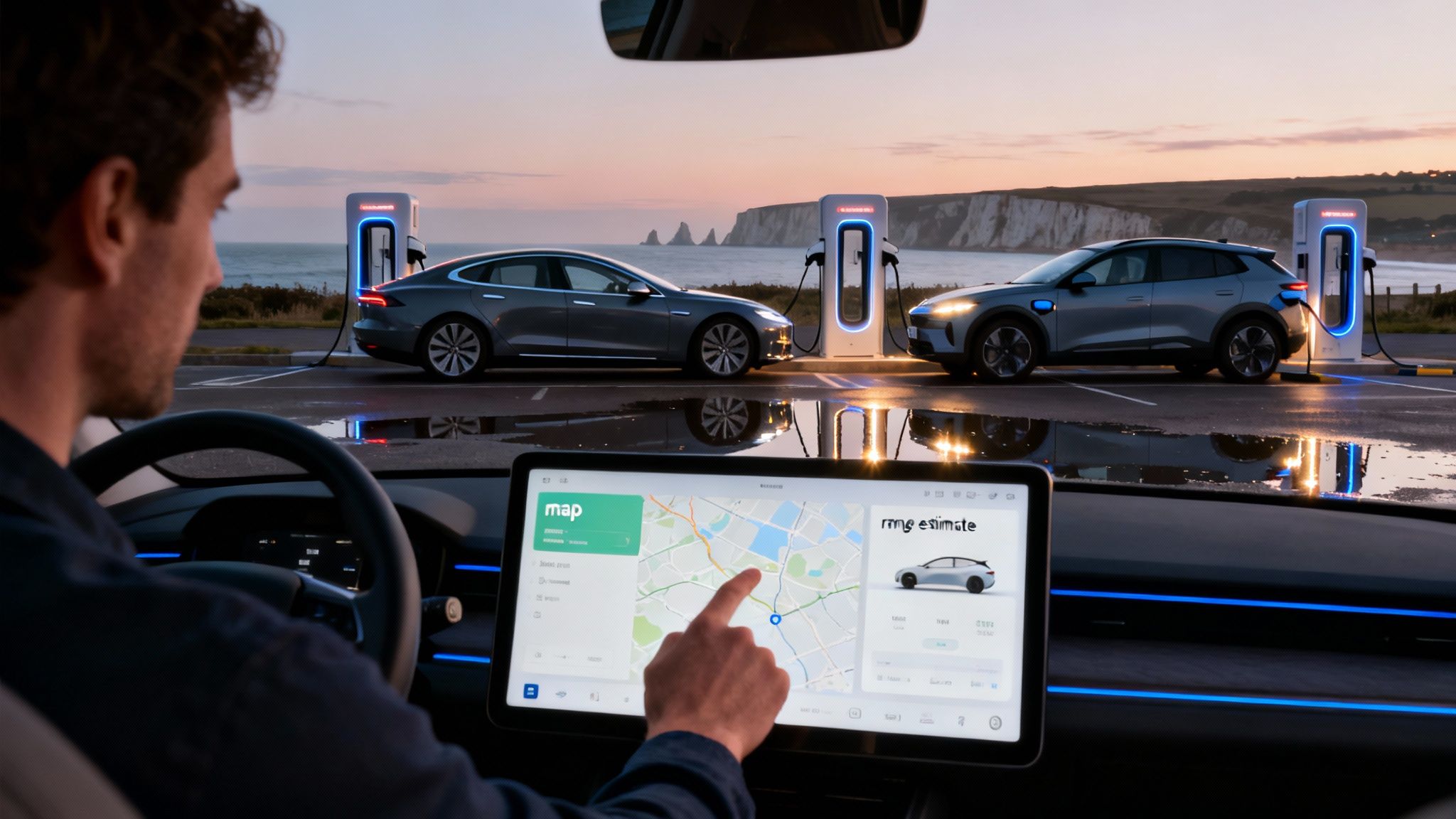
First up, the elephant in the room: range. Forget the official WLTP figures for a moment; those are best-case scenarios cooked up in a lab. Out on the UK’s damp, chilly roads, the sleeker, more aerodynamic Model 3 consistently comes out on top. It simply cuts through the air more efficiently, which means you’ll wring out more miles from every charge.
You can realistically expect the RWD Model 3 to deliver 250-270 miles in summer, but be prepared for that to drop to a more modest 200-220 miles when the temperature really plummets.
The Model Y, being a taller and bulkier car, is naturally a bit thirstier. It has to punch a bigger hole in the air, and that takes a toll on efficiency, especially at motorway speeds. A summer range of around 230-250 miles for the RWD version will likely dip below the 200-mile psychological barrier in the depths of winter. It’s still more than enough for the daily grind, but it’s a key difference if you’re constantly up and down the country.
Charging and the Supercharger Safety Net
Of course, charging is Tesla’s trump card. The Supercharger network is, to put it simply, the best in the business. It’s reliable, fast, and flawlessly integrated into the car’s sat-nav. Just pop in your destination, and the car tells you where to stop and for how long, even pre-heating the battery as you get close to ensure you get the fastest charge possible.
This network almost completely erases range anxiety for both models. That said, the Model 3's better efficiency means you might find yourself making fewer or shorter stops on a long trek from London to Edinburgh, saving you a bit of time and money along the way. For a deeper look into the realities of EV range claims, check out our electric car range comparison for the UK.
That Big Screen: Revolution or Distraction?
Now, about that massive screen dominating the dashboard. Tesla's minimalist cabin means everything is controlled here – your speed, navigation, adjusting the mirrors, even opening the glovebox. On your first drive, it can feel like a recipe for disaster. A sudden downpour? That'll be three frantic taps on a screen while you're trying to see the road.
The screen is both Tesla's greatest strength and its most infuriating weakness. You do eventually get used to it, and the voice commands are surprisingly good. But the complete lack of physical buttons for basic functions is a decision that prioritises minimalist aesthetics over common-sense ergonomics.
After a week or so, your muscle memory starts to adapt, and it becomes less of a headache. The system itself is incredibly fast and smooth, with genuinely brilliant features like Sentry Mode and built-in streaming apps. The software is identical in both cars, but you have to ask yourself: are you ready for a button-free future? It's a polarising experience you'll either love or loathe, and a proper test drive is the only way to know which side you fall on.
Our Final Verdict And The Best UK Deals This Week
Right then, after digging through all the specs and real-world numbers, where do we land? Deciding between the Model 3 and Model Y isn't really about which car is objectively "better" – it's about which one fits your life. Think of it this way: one's a sharply tailored suit, the other is a trusty pair of walking boots.
The updated Model 3 ‘Highland’ is, hands down, the superior car to drive. It feels more nimble, it’s more efficient on a long run, and you just feel more plugged into the road. It’s the obvious pick for the solo commuter, a couple, or anyone who puts a premium on driving dynamics over sheer practicality.
But when it comes to practicality, the Model Y is the undisputed king. It’s the family workhorse, the weekend getaway machine, and the car that scoffs at a fully-loaded IKEA trip. That enormous boot and spacious cabin make it the go-to choice for anyone who regularly deals with car seats, dogs, or just... lots of stuff.
So, Which One Is For You?
Let's cut to the chase. Here’s a brutally honest breakdown for different UK buyers.
-
The Company Car Driver: This one's a tough call. Both cars fall into that beautiful 2% Benefit-in-Kind (BIK) tax bracket, which is a massive win. The Model 3 is a bit cheaper to lease and more efficient, saving the business money. But for anyone facing soul-destroying treks up the M6, the Model Y's extra comfort and commanding driving position might just clinch it.
-
The Young Family: Honestly, just get the Model Y. Don't even hesitate. That hatchback boot alone will save you from a world of stress and muttered curses when trying to load a buggy. It’s simply built for the beautiful chaos of family life, and you'll be grateful for every last litre of space.
-
The City Dweller or Commuter: The Model 3 is your best bet here. It's a touch easier to squeeze into tight parking spots, sips electricity more efficiently in stop-start traffic, and is a far more engaging drive when you finally break free of the city limits. The lower purchase price and running costs are the cherry on top.
It really boils down to a classic head-versus-heart debate. Your head, running the numbers on cost and efficiency, points squarely at the Model 3. Your heart, picturing the kids, the dog, and that spontaneous trip to the garden centre, is yelling for the Model Y. You've got to be honest with yourself about what you actually need , not just what you want.
Deal Of The Week: A Cracking Used Model Y
After a good scour of the UK's used market, we've unearthed a deal that shows just how much value you can get by side-stepping the new car showroom. The sweet spot right now is definitely in the nearly-new market.
We spotted a 2022 Tesla Model Y Long Range with around 20,000 miles on the clock, on sale for just under £33,000 at a reputable independent dealer in the Midlands. This is a car that cost nearly £55,000 brand new. For less than the price of a basic VW ID.4, you're getting the big battery, all-wheel drive, and that famous Tesla performance in a car that's barely been run in.
With some great financing options out there, it’s a massively compelling package. If you are looking at finance, our guide on the best UK electric car finance deals can help you find a good rate without getting ripped off. This particular used Model Y is where the smart money is going this week.
Frequently Asked Questions
Still weighing your options? It’s a classic head-versus-heart debate, isn't it? The practical choice versus the one that puts a bigger grin on your face. Let's break down a couple of the most common questions that crop up when trying to choose between these two.
Is The Model Y Really Worth The Extra Cost?
For many people, yes, it absolutely is. If you're constantly juggling prams, the weekly shop, and gear for a weekend away, the Model Y's enormous boot and roomier cabin are worth every penny of the extra £5,000 . It simply swallows up family life in a way the Model 3 can't.
But if you’re mainly driving solo or as a couple, and your luggage is usually a weekend bag, the financial argument for the Model 3 'Highland' is compelling. You pocket the savings and end up with a car that's a touch more agile and a little cheaper on electricity. It really comes down to being honest about how much space you genuinely need day-to-day.
What About Ride Comfort On Rubbish British Roads?
This used to be a very easy question to answer. The Model Y, with its softer, long-travel suspension, was comfortably the winner for soaking up the pockmarked reality of UK tarmac. The old Model 3 could feel a bit crashy and firm.
However, the updated 'Highland' Model 3 has changed the game. Tesla has clearly put a huge amount of effort into refining the suspension, and the new car is vastly more compliant and settled than the old one. While the Model Y might still have a slight edge in pure cushioning, the comfort gap has narrowed significantly. The 3 is no longer a compromise, so a back-to-back test drive is the only way to know for sure which one suits you best.
At VoltsMonster , we cut through the hype to give you the real story on electric cars. For more no-nonsense reviews and guides, check out the rest of our articles at https://www.voltsmonster.com.
VoltsMonster Electric Vehicle Blog