Finding the Best EV Charger in the UK: A No-Nonsense Guide
Let's be blunt: the best EV charger for most people is a dependable, 7kW smart charger from a well-regarded UK brand that lets you top up overnight on a cheap electricity tariff. Forget all the marketing fluff about absurd speeds and features you'll never use. What you really need is something that simply works, filling your car's battery while you sleep without mugging your wallet.
Your Search for the Best EV Charger Ends Here
Right then, let's cut to the chase. You've got a shiny new electric car, or one's on its way, and suddenly you're wading through a swamp of acronyms, kilowatts, and promises of 'smart' this and 'eco' that. Trying to find the best EV charger can feel less like a simple purchase and more like cramming for a physics exam you never signed up for.
Consider this guide your lifeline. We're going to break down the jargon, see through the sales spin, and give you a straight-talking, practical map to choosing the right charger for your home, your car, and your sanity. Think of it as that chat down the pub you wish you could have with someone who’s already been through it all and has the scars to prove it.
Why Home Charging Is Still King
Despite what the doom-mongers might say, the public charging network is expanding at an impressive rate. In fact, the UK's EV charging network grew by a massive 23% over the past year. The Department for Transport reports a staggering 86,021 chargers are now up and running across Britain. That's a new charger being installed every 33 minutes , which is fantastic news for those long-haul trips. You can get more details on this growth over at Future Transport News.
But for the day-to-day reality of running an EV, nothing comes close to the sheer convenience and low cost of plugging in at home. It’s the difference between having your own personal fuel pump in the garage versus queuing up at the local Tesco on a rainy Tuesday, probably behind a bloke in a Nissan Leaf who looks like he’s been there since dawn.
The real magic of owning an electric car isn't the quiet ride or the neck-snapping acceleration; it's waking up every single morning with a 'full tank' that cost you less than a fancy coffee. That’s why nailing your home charging setup is so crucial.
What This Guide Will Actually Teach You
Our goal isn't to push a specific charger on you. Instead, we want to arm you with enough knowledge to make a shrewd decision for yourself, so you don't end up paying for things you don't need.
Here’s what you’ll know by the end of this:
- Decoding the Tech: We'll explain power speeds (kW), sockets, and why a 7kW unit is the perfect sweet spot for the vast majority of UK homes.
- Smart vs. Dumb Chargers: You'll learn which 'smart' features are genuinely useful for saving cash and which are just digital window dressing.
- The Real Costs: We’ll get into installation, what a 'standard install' truly covers, and the current state of government grants (spoiler: it’s not great news).
- A Buyer's Checklist: A no-nonsense list to help you compare models by looking at warranties, safety certifications, and customer support.
This isn't about finding the single best EV charger on the market. It's about finding the best EV charger for you. By the time you're done here, you’ll be able to confidently tune out the marketing noise and focus on what really counts. Let’s get cracking.
Decoding Speeds, Sockets, and Other Gubbins
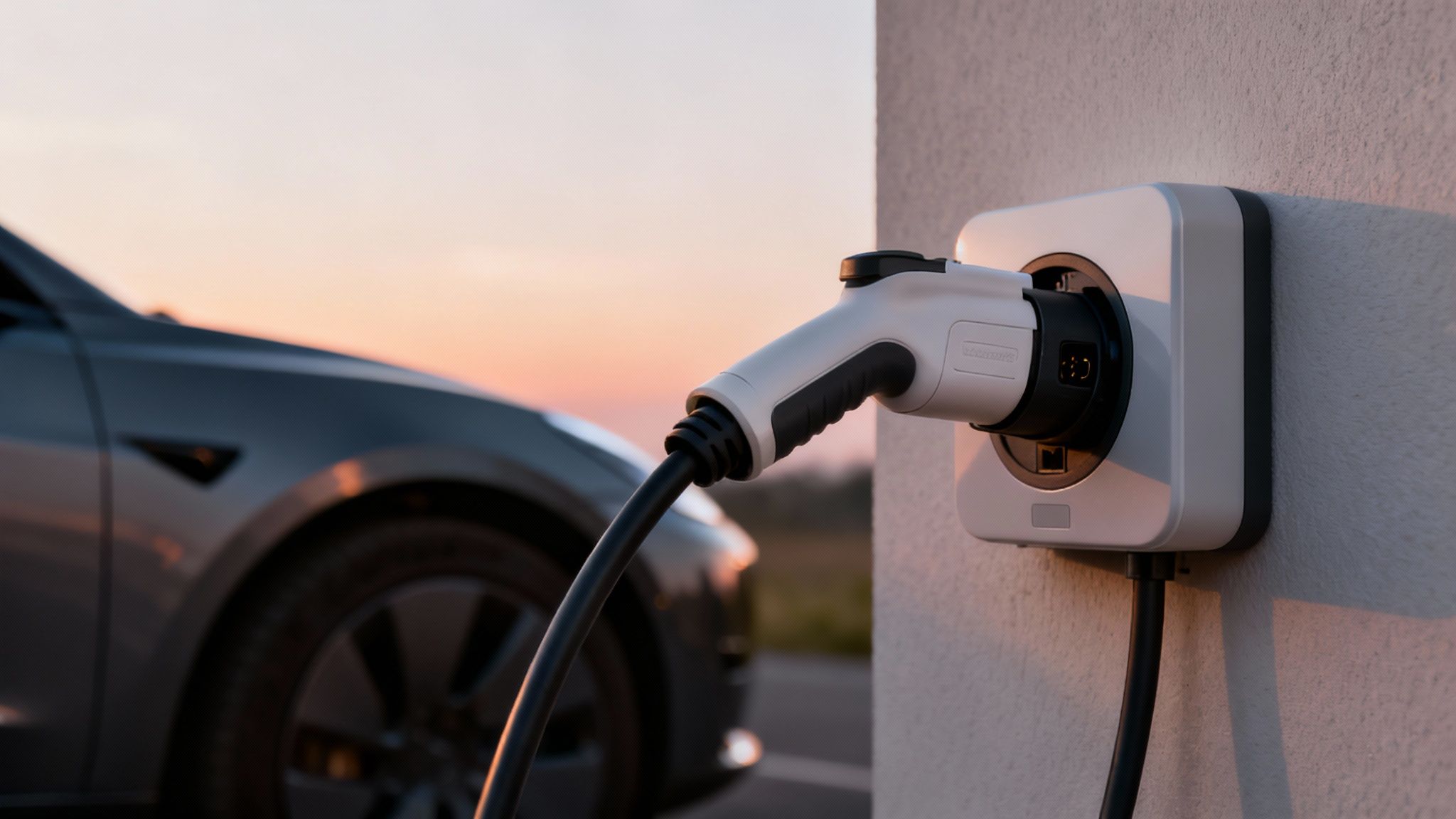
Alright, let's get into the nitty-gritty. The moment you start looking for an EV charger, you'll be bombarded with numbers and acronyms that seem designed to make you feel like you need a degree in electrical engineering. Don't panic. It’s all much simpler than it looks.
Think of charging your car like filling a bathtub. The power, measured in kilowatts ( kW ), is just how fast the tap is running. A higher kW number means a faster flow of electricity, filling your car's battery quicker. Simple as that.
For home charging here in the UK, you're realistically looking at two main speeds: the slow trickle and the sensible overnight fill. Most chargers on the market fall squarely into one of these camps.
Getting to Grips with Home Charging Speeds
When it comes to home EV chargers, you'll mainly see three figures thrown about, but only one of them truly matters for most of us. Let’s break them down, jargon-free.
-
3.6kW (Slow): This is the tortoise in the race. It’ll charge a typical EV from empty in about 12-16 hours . While it's a definite step up from a standard three-pin plug, it feels a bit pedestrian for a primary charger unless you have a car with a tiny battery or only ever do short local trips.
-
7kW (Fast): Now we're talking. This is the sweet spot for home charging. A 7kW charger will top up most EVs overnight in a much more civilised 6-8 hours . It's the Goldilocks option—fast enough for a full 'tank' by morning but doesn't require any bonkers electrical upgrades to your house.
-
22kW (Very Fast): This sounds tempting, doesn't it? The problem is, it requires a three-phase electricity supply. Most UK homes have a standard single-phase supply, making a 22kW charger about as useful as a chocolate teapot unless you're prepared for a very expensive and complex upgrade. For domestic use, it's almost always overkill.
So, when you’re hunting for the best EV charger for your driveway, a 7kW unit is your benchmark. It's the industry standard for a reason: it perfectly balances speed, cost, and practicality for the average British home.
The Great Connector Kerfuffle
Next up, the plug itself. This used to be a Wild West of competing standards, a bit like VHS versus Betamax but with more volts. Thankfully, things have settled down, and in the UK and Europe, one king rules them all for home and public AC charging.
The only connector you really need to know about is the Type 2 . Pretty much every new electric car sold here uses it for AC charging, which is what your home charger provides. You'd have to go out of your way to buy a new home charger that doesn't have a Type 2 socket or plug.
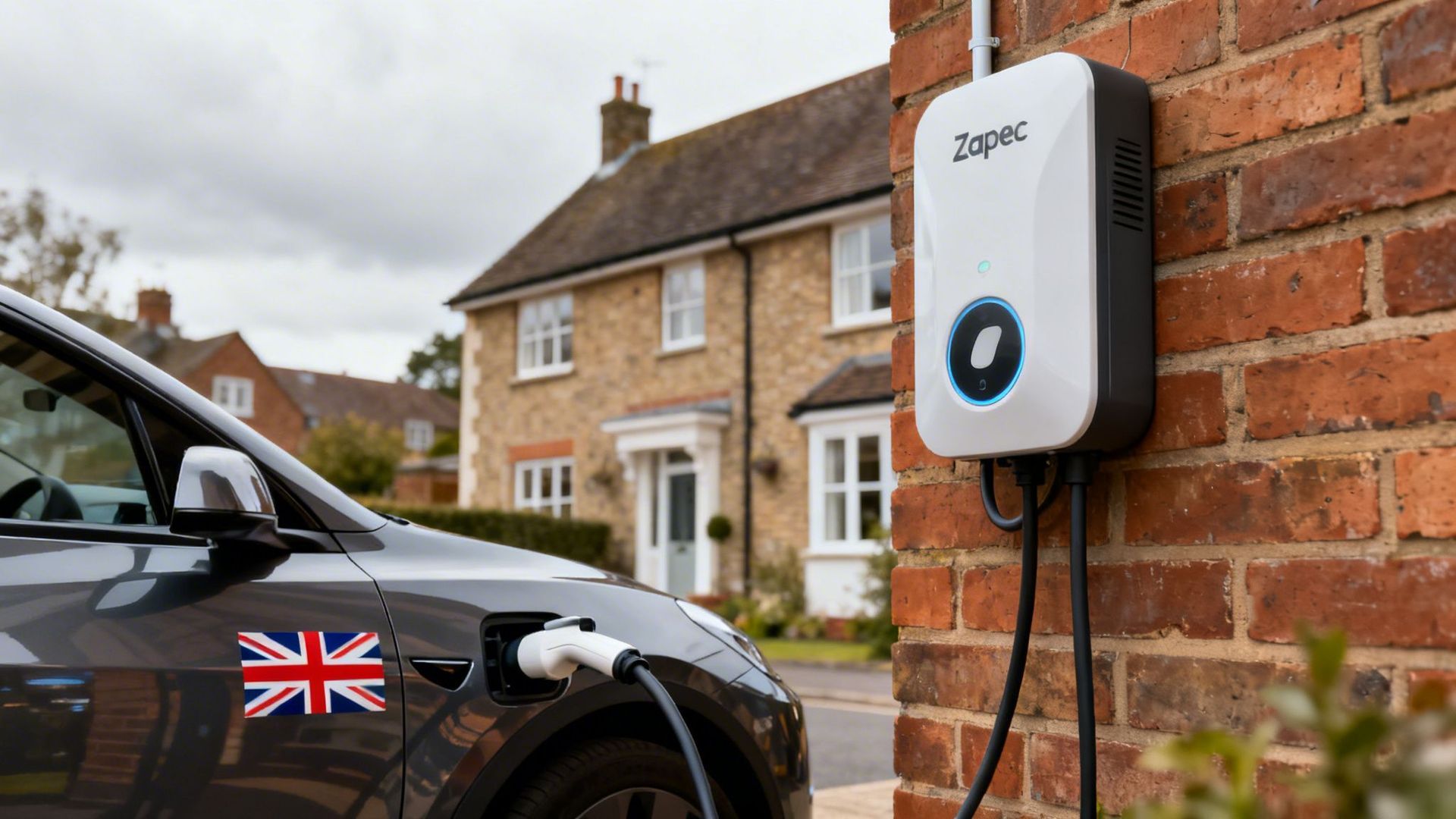
This means you can stop worrying about compatibility. Whether you buy a charger with a built-in cable (tethered) or one with just a socket (untethered), it will work with your car. The decision between the two is purely about convenience versus a slightly tidier look on your wall—a debate we’ll get into later. For now, just remember: Type 2 is the answer.
So, to recap the technical mumbo-jumbo in simple terms: aim for a 7kW charger, and it will come with the Type 2 connector you need. It really is that straightforward. Now you can nod along knowingly when the installer starts talking shop, safe in the knowledge you understand the important bits. Next, we'll look at whether "smart" chargers are actually clever or just a clever marketing ploy.
Are Smart Chargers Actually Clever or Just a Nuisance?
Every charger brand under the sun will tell you their box is 'smart', 'intelligent', or even 'AI-powered'—a term so overused it’s become almost meaningless. But what does this actually mean when it comes to the simple act of putting electricity into your car? Is it all just marketing guff, or is there genuine substance behind the buzzwords?
A genuinely smart charger is your secret weapon for cheaper motoring. Forget the blinking lights and fancy graphics; its real talent lies in its ability to charge your car when electricity is dirt cheap. This usually happens in the dead of night, while the rest of the country is dreaming of spreadsheets and dental appointments. This isn't just a gimmick; it can properly slash your 'fuel' bill.
The alternative is a 'dumb' charger, which is essentially just an on/off switch. You plug your car in, and it starts charging immediately, regardless of whether you're paying peak rate. A smart charger, by contrast, is a bit more cunning. It waits for your instructions, which brings us to the features that actually matter.
The Holy Trinity of Smart Features
When you're sifting through the options to find the best EV charger, my advice is to ignore the noise and focus on these three essential functions. If a charger can’t do these things well, it’s not as clever as it claims to be.
-
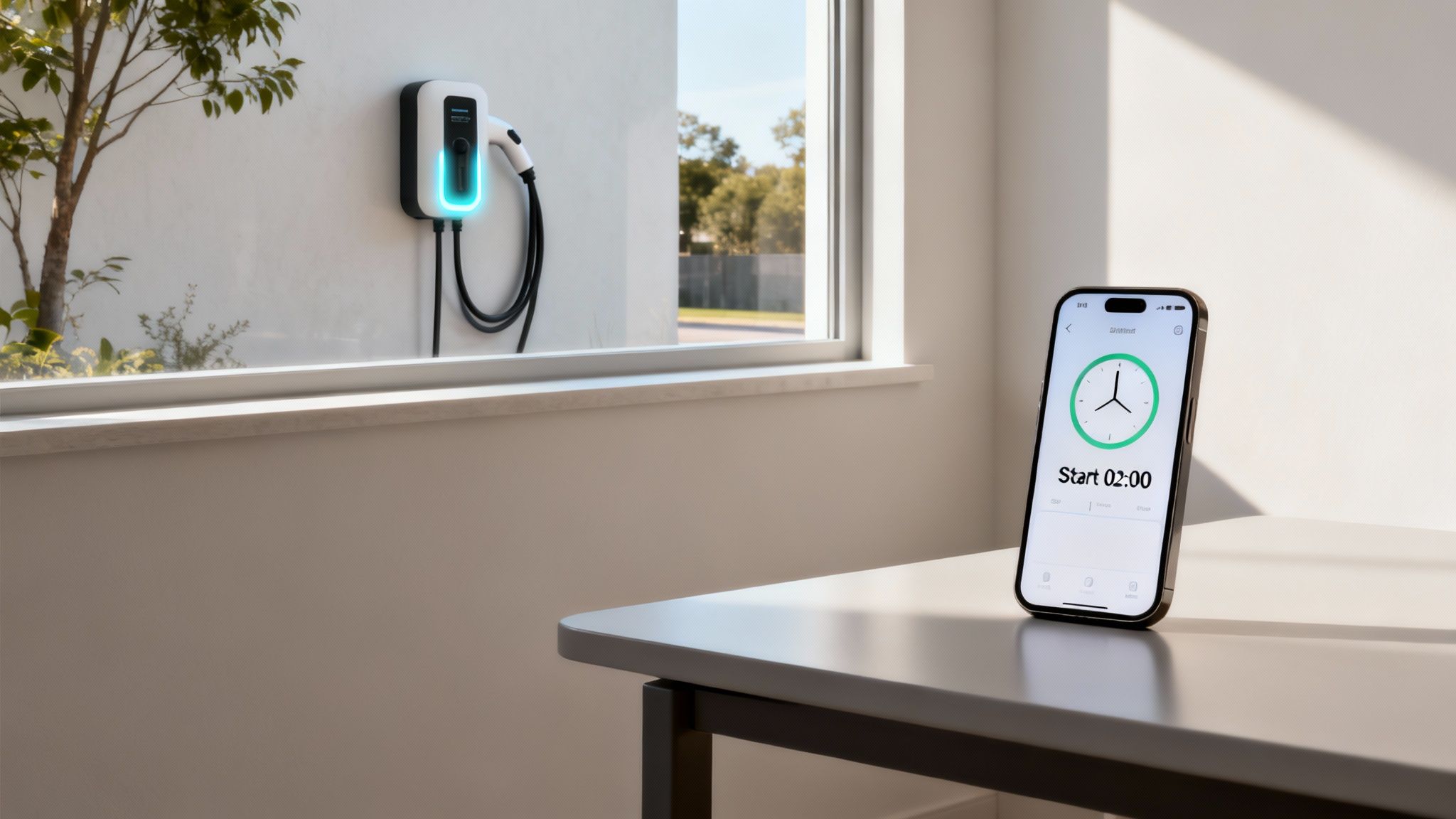
Scheduled Charging: This is the absolute bare minimum. It lets you tell the charger, via an app, when to start and stop charging. So, you might plug your car in at 7 pm, but you can schedule the power to only start flowing at 12:30 am when your cheap overnight tariff kicks in.
-
Energy Tariff Integration: This is the next level up. The truly great EV chargers can link directly with your energy provider's tariff, like the popular Octopus Agile or Go plans. Instead of you just setting a simple timer, the charger automatically finds the cheapest (and sometimes even free) windows to top up, optimising every session without you lifting a finger.
-
A Half-Decent App: The app is your remote control for all this cleverness. It needs to be reliable, easy to understand, and not look like it was designed in 1998. A clunky, bug-ridden app can turn a brilliant piece of hardware into an expensive and frustrating wall ornament.
While the focus for most EV drivers is convenient home charging—with 77% of UK BEV owners using their private setups—it’s worth noting the public network is also becoming smarter. The UK’s network is seeing jaw-dropping growth, with ultra-rapid chargers set for a fivefold increase to 8,842 devices by July 2025. This rapid expansion is making public top-ups much less of a chore. You can explore more on these charging trends to see how the UK is shaping up.
Cutting Through the Marketing Fluff
Now for the features that sound impressive but are often just digital clutter. Brands love to pad out their spec sheets with functions designed to dazzle you, but their real-world value can be pretty questionable.
A charger's "intelligence" isn't measured by how many features it has, but by how well it executes the few that actually save you money. The goal is to set it up once and then forget about it, confident it’s doing the right thing.
Things like 'eco modes' that promise to charge only with your solar panels (if you have them) are great in theory, but many chargers execute this poorly. 'Voice control' is another one—it sounds futuristic, but shouting at your wallbox from the living room is usually far less practical than just tapping a button on the app.
The key is to distinguish between a truly brainy bit of kit and one that’s just got a few extra flashing lights. The best EV charger for you will nail the fundamentals: scheduled charging, tariff integration, and a solid app. Anything else is just a bonus, not a deal-breaker.
Getting to Grips with Installation Costs (and Dodgy Grants)
Alright, let's talk about the bit they don't exactly shout about in the glossy brochures: the cost. Buying the perfect EV charger is only act one of this little play. While the price of the unit itself is the opening line, the real, unscripted drama often comes from getting the thing installed.
A 'standard install' sounds lovely and reassuring, doesn't it? It conjures up images of a cheerful electrician, a quick bit of drilling, and a perfectly neat job, all done for a nice, round number. The reality? Your home, with its quirky wiring and inconveniently placed fuse box, might be anything but 'standard'.
So, What Does a 'Standard Install' Actually Mean?
In the world of EV chargers, 'standard installation' is a term with more caveats than a budget airline ticket. It’s the best-case scenario, a perfect alignment of the electrical stars. Generally, it assumes a few key things are already in your favour.
For most installers, a standard job typically includes:
- A cable run of about 10-15 metres from your consumer unit (that's your fuse box) to where the charger will live.
- Drilling through one straightforward brick wall.
- Your consumer unit having enough spare capacity and a modern safety doohickey called an RCD (Residual Current Device).
- No need for any major groundwork, like digging trenches or tunnelling under your prize-winning petunias.
Anything that falls outside this neat little box is where the costs start to creep up. And believe me, they can creep with surprising speed. The moment the electrician sucks air through their teeth and says, "Right, well, the thing is...", you know your 'standard' price is about to become anything but.
Think of a 'standard installation' price as a starting point, not a final figure. The unique quirks of your property will always have the final say on the bill. It's less a fixed price and more of a hopeful estimate.
Unearthing the Hidden Costs
So, what are these little gremlins that can send the price soaring? Your mission, should you choose to accept it, is to ask your potential installer some very direct questions before they even think about picking up a drill. It’s like a pre-flight check to avoid any financial turbulence.
Make sure you get clarity on these potential budget-busters:
- The Cable Run: Is your ideal charger spot more than 15 metres from the fuse box? Every extra metre of that thick, armoured cable costs money in both parts and labour.
- Your Consumer Unit: Is it an ancient relic from the 1970s? If it needs upgrading to meet modern safety standards, that’s a separate, and often significant, job in itself.
- Earth Rods: Depending on your home's earthing setup (the way it protects you from electric shocks), you might need a big metal spike hammered into the ground near your charger. It’s a vital safety feature, but it adds to the final bill.
Don't be shy about asking. A good, honest installer will happily walk you through all of this during a survey. A dodgy one will be vague and hit you with a surprise on the invoice later.
That Government Grant You Probably Can't Get
Ah, the OZEV grant. Once upon a time, it was a glorious handout that took a nice £350 chunk off the cost for pretty much any homeowner. These days, it's a shadow of its former self, a bit like a faded pop star on a reunion tour.
As of the latest rules, the grant—now called the EV chargepoint grant—is no longer available for most homeowners in single-unit properties like houses and bungalows. Instead, it’s been repurposed to help those who face bigger hurdles getting a charger installed.
So, who actually qualifies now? The list is depressingly short. You might be eligible for up to £350 off the cost if you fall into one of these specific groups:
- You live in a flat (whether you own it or rent it).
- You rent any type of property (including a house).
And that’s pretty much it. The government's goal is to support people with shared parking or who need to get a landlord's permission, which makes sense. But for the average UK homeowner, that particular ship has sailed, sunk, and is now a home for barnacles.
As always, things can change, so it's worth checking the official government website for the EV chargepoint grant for the very latest criteria.
How to Avoid Being Fleeced: A Buyer's Checklist
Right, you’re armed with knowledge and ready to part with your hard-earned cash. But entering the world of EV charger shopping can feel a bit like navigating a Moroccan souk—everyone’s promising the deal of a lifetime, but some of those deals lead to a dodgy back alley. How do you spot a genuine bargain from a pile of soon-to-be-obsolete plastic?
This is your pre-flight checklist. Run through these points before you even think about clicking ‘buy’. It's all about future-proofing your purchase and making sure the best EV charger for you is one that's reliable, safe, and won't leave you stranded with a dead car and a dead-end customer service number.
The Great Cable Debate: Tethered vs Untethered
First up, the eternal question that divides the EV community: should your charger have its cable permanently attached ( tethered ) or just a socket for you to plug your own in ( untethered )?
A tethered charger is the undisputed king of convenience. You pull up, grab the handle, and plug in. Simple. There’s no faffing about with a cable you’ve had to wrestle from the boot. The downside? It can look a bit messy, with a thick black cable permanently coiled on your pristine outside wall.
An untethered unit is the tidy minimalist's choice. It’s just a neat little box. The catch is that you have to get your own cable out of the car every single time, which, on a rainy Tuesday night, can feel like a genuine hardship. Honestly, there's no right answer here—it's pure personal preference.
Warranty and Support: The Boring but Crucial Bits
This is where you find the real value. A flashy-looking charger with a one-year warranty from a company you’ve never heard of is a massive red flag. Look for a solid three-year warranty as an absolute minimum, and check that it’s backed by a proper UK-based company.
When your charger throws a wobbly at 3 am and refuses to charge your car, you'll be glad you chose a brand with a responsive UK support team you can actually speak to, rather than an anonymous email address that replies three days later in broken English.
Before you buy, do a quick bit of detective work. Look up reviews for their customer support. A cheap charger from a faceless brand can become the most expensive mistake you make if it fails and you’re left high and dry.
Safety First: Don't Scrimp on Certifications
This isn't a Bluetooth speaker; it's a high-power electrical device attached to your house and your very expensive car. Safety is completely non-negotiable.
Make sure any charger you consider has the UKCA mark . This is the UK’s replacement for the European CE mark, and it signifies that the product meets all the necessary safety regulations. If it doesn't have it, don't touch it with a barge pole. It's a clear signal the manufacturer has cut corners, and your home’s electrical system isn't the place for that kind of gamble.
The government does still offer some help with costs, though it’s not as widespread as it once was. This flowchart shows how the current UK grant eligibility works, helping you see if you can get some money back.
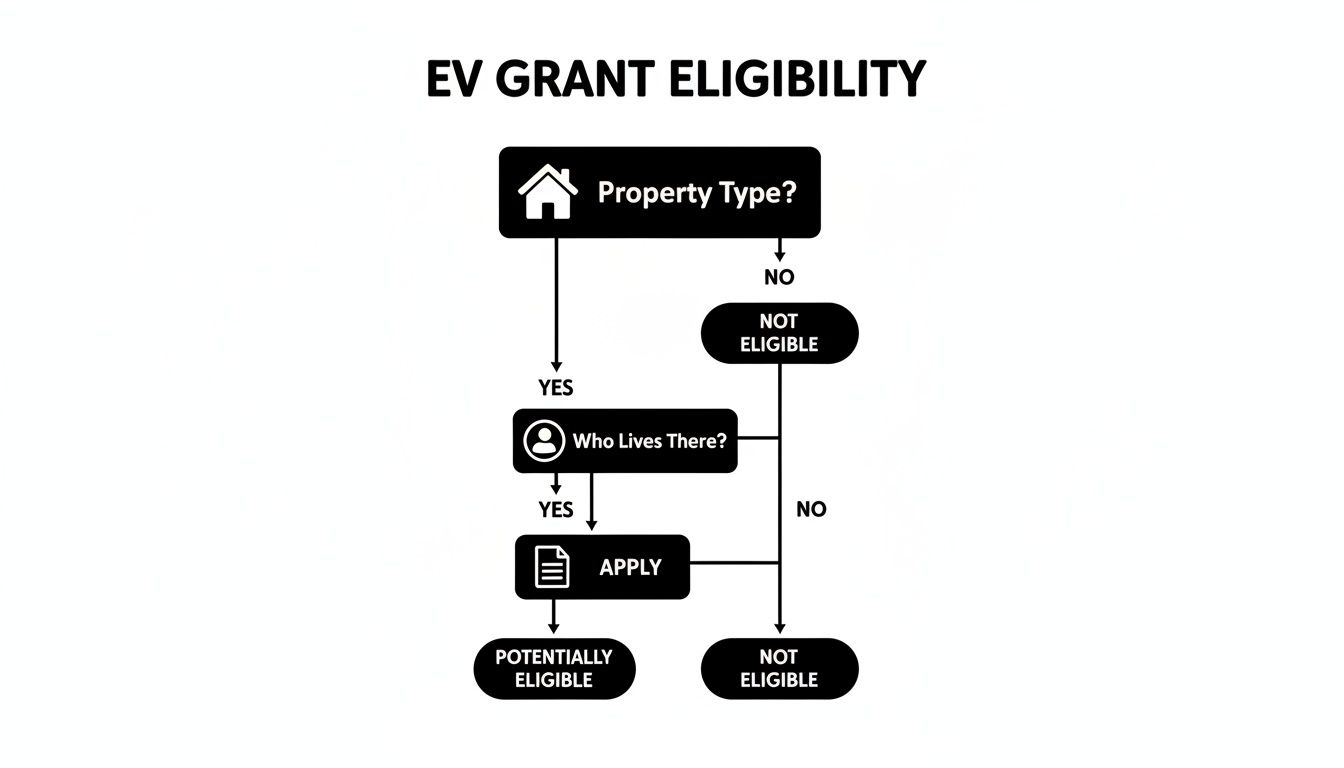
As you can see, the path to getting a grant is now much narrower, primarily focusing on renters and people living in flats.
Your Mission, Should You Choose to Accept It
So, there we have it. The hunt for the perfect EV charger isn't about finding some mythical, one-size-fits-all silver box. It’s about finding the right box for you , your car, and your daily routine. It’s about cutting through the marketing noise and focusing on what actually counts.
By now, you should have the confidence to see past the flashy sales pitches. The mission is straightforward: find a reliable, safe, 7kW smart charger from a brand with a solid reputation. Make sure it plays nicely with your energy tariff and, most importantly, get it fitted by a certified professional who genuinely knows their stuff.
Don't Fall for the Hype
Forget getting bogged down in a spec-sheet war, chasing the highest possible power rating or a list of ‘smart’ features longer than your arm. Most of them you’ll never use. Your main goal is wonderfully simple.
Your mission, should you choose to accept it, is to get a charger that reliably and cheaply puts juice in your car while you're tucked up in bed. Everything else is just noise.
This isn’t about winning a game of Top Trumps on your driveway. It’s about solid, real-world practicalities. A charger that quietly gets the job done overnight on a cheap off-peak tariff is the undisputed king of EV ownership. That's how you unlock the biggest savings and the best part of running an electric car.
Your Final Orders
So, what's next? Head back to the checklist we shared earlier. Trust the homework you've done and the knowledge you’ve picked up here. Don't let a slick salesperson dazzle you into buying a 22kW beast your home can't even power, or an app so complicated it gives you a weekly migraine.
Choose wisely. Then, get ready to enjoy that smug satisfaction of waking up to a 'full tank' every single morning, knowing it cost you less than a fancy coffee. Believe me, it's a feeling that never gets old.
Welcome to the club.
Frequently Asked Questions
Alright, you've taken in a lot of information, and a few questions are probably still rattling around. It’s completely normal. Let's tackle the most common head-scratchers with some straight-talking answers to clear up any final doubts.
Think of this as the final check before you commit. We've gathered the questions we get asked most often from VoltsMonster readers on the hunt for the perfect EV charger.
Do I Really Need a 7kW Charger or Will a 3kW One Do?
For pretty much everyone driving a fully electric car, a 7kW charger is the only sensible choice. A 3kW unit, which is basically what you get from a standard 3-pin plug, is painfully slow. We're talking well over 24 hours for a full charge on an EV with a decent-sized modern battery.
A 3kW trickle might be okay for a plug-in hybrid with a tiny battery, or if you only drive a few miles a week. But for the day-to-day reality of owning a proper EV, a 7kW charger gets the job done overnight in a much more practical 8-10 hours . Don't hamstring your EV experience from day one; it's a false economy.
What Is the Difference Between a Tethered and Untethered Charger?
This one’s refreshingly simple. A tethered charger has the charging cable permanently attached to the wall box. An untethered one just has a socket, meaning you use the separate cable that came with your car to plug in each time.
Tethered is all about convenience—no more wrestling a muddy, coiled cable from your boot on a rainy night. Untethered, on the other hand, looks much neater on your wall and offers a bit more flexibility if you need different cable lengths or types. It's simply a choice between ultimate ease-of-use and a tidier aesthetic.
Ultimately, the tethered vs untethered debate is less about technical superiority and more about your personal tolerance for minor inconveniences. There's no wrong answer, just the one that annoys you the least.
Can I Just Get a Local Sparky to Install My EV Charger?
Short answer? No. Well, you could , but it's a monumentally bad idea. Unless your local electrician is specifically qualified and certified for EV charger installations, you should steer well clear.
You need an installer who is OZEV-authorised or accredited by a body like NICEIC. These pros understand the very specific, complex regulations for EV chargers, covering crucial safety features like earthing and PEN fault detection. They also know the correct procedure for notifying your local electricity network (the DNO) about the new high-load device on their grid.
Using an unqualified electrician is a shortcut to trouble. It will likely void your charger’s warranty, could compromise your home’s electrical safety, and might land you with a very expensive bill to fix it properly later. It’s just not worth the risk.
Ready to dive deeper into the world of electric vehicles? At VoltsMonster , we offer honest reviews, practical guides, and entertaining vlogs to demystify everything from charging to maintenance. Join our community and get the real story at https://www.voltsmonster.com.
VoltsMonster Electric Vehicle Blog